Boost Mobile on building an EMS-less, vendor-agnostic network from the ground up

By Ray Le Maistre
Jul 10, 2026
To embed our video on your website copy and paste the code below:
<iframe src="https://www.youtube.com/embed/cy4fXHZSHYk?modestbranding=1&rel=0" width="970" height="546" frameborder="0" scrolling="auto" allowfullscreen></iframe>
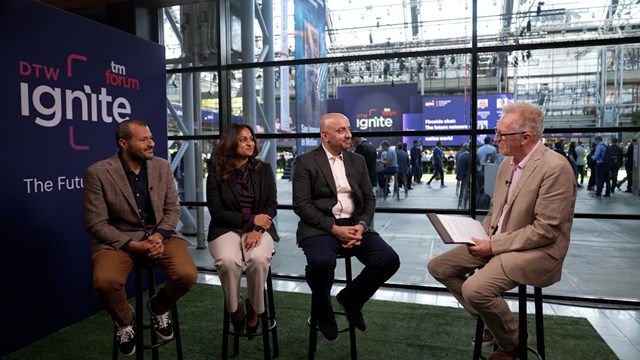
We are in Copenhagen for DTW Ignite 2026. I'm here with a great panel today to talk about the evolution of network management and OSS. I have Dawood Shahdad, Senior VP of Hybrid M&O at Boost Mobile; Sruthi Nair, Director of Voice Core Engineering and Automation at Boost Mobile; and Ahmed Abdelaziz, VP of Network Transformation at Rakuten Symphony. Welcome all. We're going to get straight into it. Dawood, from a leadership perspective, the industry is moving away from traditional EMSs — element management systems — towards unified, vendor-agnostic observability. What are the primary business drivers for Boost Mobile to move towards this EMS-less model, and how does this support your broader digital transformation goals?
Dawood Shahdad, Boost Mobile (00:57):
Yeah, absolutely. And thanks for having me here, Ray. Look, we started our network journey back in 2021, and this was one of our fundamental principles: that we would never have a vendor-provided EMS. EMSs, we believe, were a thing of the past. They used to be the most popular thing back in the early 2000s. But as we go into the modern world — right now we're kind of towards the mid-cycle of 5G, heading towards 6G — EMSs are going to become less and less relevant, which is why we ended up picking Rakuten Symphony as the single platform that essentially provides us centralised observability. All of our vendor functions, whether coming from Mavenir, Nokia, Oracle, Matrixx — everything talks to a single centralised observability framework where we do fault management, config management, alarms, KPIs. We're also doing things like deep packet inspection, a whole bunch of stuff in this centralised framework.
(01:54):
The whole idea is we don't want our internal employees — our NOC personnel, our engineering personnel — to be trained on multiple platforms, which increases complexity. If I've got to change something under the hood, now I've got to bring in a new EMS system, there's a learning curve — it's just a whole bunch of headache. Secondly, once you have disjointed multiple EMS systems, it's extremely difficult to figure out how to correlate things between one domain or one vendor and another domain, another vendor. It just becomes a nightmare. We're all talking about this theme of autonomous networks. How will you ever get there if you don't have this centralised, unified layer? We're very happy we started this way back in the day. We are well into this. We've been using this EMS-less, single centralised framework — vendor-agnostic — from Rakuten for about four years now, and it's been doing wonderfully for us.
Ray Le Maistre, TelecomTV (02:49):
Okay, fantastic. And that makes a lot of sense as networks evolve from the legacy traditional to where they need to go. You mentioned autonomous networks — building on that, AI is frequently discussed and it's all over this event, but for an operator of your scale, what are the tangible business outcomes that you expect from AI-driven operations, and what do you see as the highest return on investment in automating the human element of the NOC?
Dawood Shahdad, Boost Mobile (03:22):
Yeah. Let me touch on the first aspect of it. Look, we want to be very intentional when it comes to implementing AI within our network. We have built a network that is relatively new compared to the other operators that exist in the US. We're not really trying to compete with them on the existing business model — which is, you've got 100 million customers each, let me figure out how to get a couple of million from you, three million from you, and try to become profitable. We're more interested in being essentially considered a software company, and telecom happens to be a service that we provide. So our interest in adopting and implementing AI will be: how does it help us? How does it open new avenues for us? How does it help us scale? How does it help us differentiate? For example, when everybody globally is starting to talk about NTN and we're going to need to build networks across the world, how do we accelerate that versus the incumbents, where they may have to learn a few new things and new concepts, potentially start deploying on a public cloud — which we've been doing for the last six years.
(04:24):
So we see the role of AI, and essentially autonomous networks, and the journey we have taken so far, as a super solid foundation that allows us to get to that state.
Ray Le Maistre, TelecomTV (04:33):
Okay, excellent. Now, Sruthi, shifting to the technical side — moving away from EMS silos creates a massive data integration challenge. How is Boost Mobile leveraging Rakuten Intelligent Operations to normalise performance and fault data across a hybrid core to achieve true observability?
Sruthi Nair, Boost Mobile (04:57):
In our network as of today, we have different vendors and partners such as Nokia, Oracle, and Mavenir. As you mentioned, everybody comes with their own EMS, complexity, and overhead, which we wanted to avoid. So now we have the centralised observability platform from Rakuten, which gives us a single pane of glass. Of course, there are a lot of challenges from a technical perspective, because if I take Nokia, for example, we have around 15 to 20 products from them. Each product has its own legacy — a few of them come from their previous Alcatel-Lucent heritage, a few of them are Nokia, a few of them are Siemens. So when they all come in, the formats are different, the data tagging — everything is different. And this is just Nokia as a vendor. When we then pass that data to Rakuten, they require a standardised format, and no product in Nokia is similar to another.
(05:55):
So our first approach was to go to the vendors and partners and say, "Please, can you change it? Make it conform to this standardised format." If we had gone that route, it would never have become a reality. So what we did was ask our partner Rakuten to come up with a template — we challenged them — where all the vendors and products would send them the data, they would normalise it, get it into a standardised format, parse it, and send it across. This was one of our major challenges when we started, and this is how we overcame it. I would give a big shout-out to all our partners — with their help, support, and collaboration is where we are today.
Ray Le Maistre, TelecomTV (06:39):
I'm sure that's a situation that resonates with a lot of operators around the world. Now, regarding the technical drivers for AI — how do you ensure that AI models are trustworthy? In a live, high-traffic network, how are you balancing automated decision-making with the need for technical oversight?
Sruthi Nair, Boost Mobile (07:02):
So I'm an engineer at heart. I don't trust AI at all — till I see it, I don't believe it. I won't say our network is completely autonomous, but that is our north star. We want to get there, maybe 18 months down the line. So we have to take small, deliberate, careful steps towards it. We have built a framework around the observability platform. This framework gets all the alarms from the observability platform, gets into the nodes and network functions, and checks how the network is doing. It doesn't take any decisions. At the stage we are right now, I don't want it to take any decisions — I want it to inform us, and we take the decision. It recommends that this may be the issue and this is what you may want to do, but we don't act on it automatically. Our engineers go in, they get paged out, and then they take the decision.
(07:59):
This is production. We have voice calls — we have 911 calls. We do not want to drop any of them. So we are taking steps towards automation, but very, very careful ones. There are places where we have automated as well. If, for example, it's a packet core UPF and something has gone wrong there, we have given it a playbook: if these things happen, this is what you have to do. In such scenarios, if all the criteria are met, it takes the element out of rotation without human intervention. But these are very few cases — I would say a couple of them. For the rest, we would like to be the owners; we would like to drive the decision, as of today.
Ray Le Maistre, TelecomTV (08:43):
Okay, excellent. And that makes a lot of sense, especially as you said with critical communications — you need to be very careful with the delivery of those. And Ahmed, we're at an event where there's a lot of talk about AI, but one of the other hot topics in the industry is satellite communications. As we look towards the integration of NTNs — non-terrestrial networks — and satellite-to-mobile connectivity, the network footprint is expanding exponentially. How do you see the current observability framework evolving to accommodate the latency and scale requirements of NTNs?
Ahmed Abdelaziz, Rakuten Symphony (09:22):
It comes with a few challenges, because first of all, you're used to your network being static. Your sites did not go anywhere — unless in a few cases, such as cells on wheels — but mostly your network had a static topology. Now you're talking about a network that is always moving. There is a lot of dynamic interaction that is always changing your topology, changing your data collection method, and even things like handover and how you serve your customer change with the business model. So when you're running a static model alongside a dynamic model in a similar fashion, you need to have a data layer that can ingest both without disrupting the path. As Sruthi just mentioned, the goal with any new technology is not disruption — it is more about slow and steady wins the race. You have to go with careful steps, make sure the two business models are able to run together, and have the capability to ingest both data sets in an equal fashion and make sense of them within your network.
(10:24):
Previously, when you looked at the regular terrestrial network, losing coverage meant that you actually went out of the cell coverage area or zone. But now, with non-terrestrial networks to support that, your business model — in terms of build, deploy, and even operate — changes drastically because of the extra layer on top.
Ray Le Maistre, TelecomTV (10:46):
Okay. And again, this is something that operators all over the world are having to consider now that their service area is getting so much bigger and they have to deal with that. But just coming back to autonomous networks for a moment — what have been the low-hanging-fruit use cases where autonomous network features provide immediate value for operators? Where is the fastest time to value with network automation?
Ahmed Abdelaziz, Rakuten Symphony (11:15):
I can cite off the top of my head a use case that we worked on at Rakuten with a few of our partners. But what I would suggest for companies is that we are not network custodians. For every company, there is a business area where they see the most value and the most return. The transformation journey needs to be self-funded, which means that your first successful step enables you to reach another step where you gain business value and ROI, so that you can reinvest it into the network. Because if you pursue five or six use cases at the same time, you're going to end up with more experimentation and more overloaded costs.
(12:11):
In our case it was energy efficiency, for example, because that is where we saw: if I save 20–30% of energy on the radio network elements, or on the core, or even on the servers, you're going to be able to reinvest that money back into the network. But for other companies, it might be lifecycle management, or it might be fault and performance automation. So it depends on the company, but the key is that you focus on the use case where you have the most pain points and where you can see that, if you tackle it with autonomy, you're going to be able to achieve a bigger ROI.
Ray Le Maistre, TelecomTV (12:32):
Okay, fantastic insights. I'm sure that's something operators all over the world are thinking about — how they get their ROI from their autonomous strategies. So Ahmed, Sruthi, Dawood — thanks so much for joining us today. Great insights, and enjoy the rest of the show. Thank you.
Please note that video transcripts are provided for reference only – content may vary from the published video or contain inaccuracies.
Panel discussion
Recorded at DTW Ignite 2025 in Copenhagen, this panel brings together senior figures from Boost Mobile and Rakuten Symphony to discuss the practical realities of moving away from vendor-supplied element management systems. Boost Mobile explains why it chose a single centralised observability framework from the outset in 2021, how it tackled data normalisation across multiple vendors including Nokia, Oracle and Mavenir, and why it is taking a deliberate, step-by-step approach to automation in a live network carrying critical communications. The discussion also covers how observability frameworks will need to evolve to handle the dynamic topology of non-terrestrial networks, and where operators are most likely to find early ROI from network automation.
Featuring:
- Dawood Shahdad, SVP, Hybrid MNO, Boost Mobile
- Sruthi Nair, Director, Voice Core Engineering and Automation, Boost Mobile
- Ahmed Abdelaziz, VP, Network Transformation, Rakuten Symphony
Recorded June 2026
Email Newsletters
Sign up to receive TelecomTV's top news and videos, plus exclusive subscriber-only content direct to your inbox.