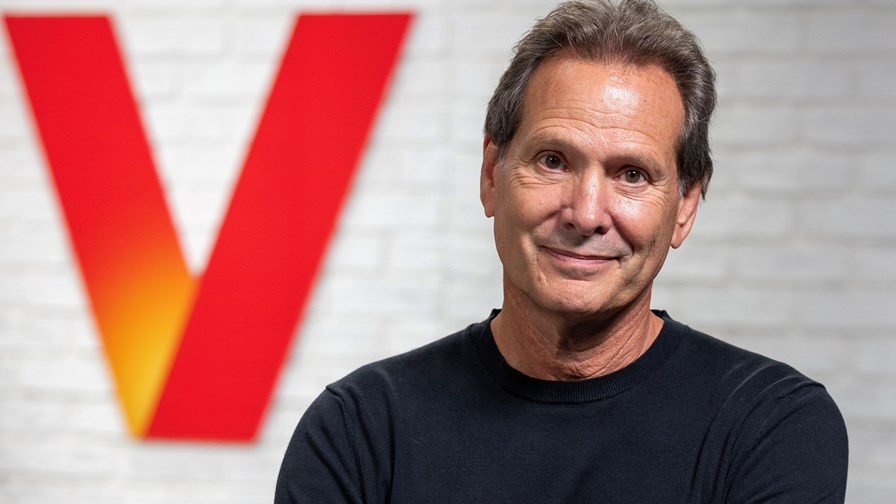
Verizon CEO Dan Schulman clains his company is "redefining loyalty".
- Verizon boasts its new offer is ‘redefining loyalty’
- 5G passes the 3 billion user mark – report
- Orange loses legal battle in Iraq
In today’s industry news roundup: Verizon unleashes a slew of offers designed to make customers ‘delighted’; there are now more than 3 billion 5G subscribers around the world, according to a new market report from Ericsson; Orange loses a long-running legal dispute in Iraq; and much more!
The battle between the US market’s three main telcos for the hearts and minds of US consumers continues, and this time it’s Verizon claiming to have unveiled the best thing since sliced bread by “redefining loyalty”. In what it describes as “the next step in its ongoing transformation, replacing complexity and friction with simplicity and true customer choice,” the operator claims it is “putting its customers first – existing and new – by redefining loyalty and eliminating activation and upgrade fees.” And as part of its “customer-centred reboot”, Verizon is also launching Verizon Simplicity, which it claims is “the industry’s most simple and cost-effective plan… there are no network tiers; everyone gets Verizon’s best 5G network.” It has also launched Verizon One, “a streamlined plan that combines Mobility and Home on one bill with taxes and fees included,” which in these days of conference offerings is the least you’d expect from a major operator. To be fair to Verizon CEO Dan Schulman, he is actually building on his previous comments with actions: In April Schulman noted that Verizon needed to focus more on customer satisfaction and “treat people like humans, not like accounts”. Now, just a few weeks later he’s saying, “We’re fundamentally reshaping Verizon inside and out to put the customer at the centre of everything we do. We’re listening, designing for them and moving faster than we ever have before. For too long, this industry has burdened people with complex plans, forced upgrades they don’t need, and so-called ‘rewards’ with tonnes of caveats. We are working to ensure everything that we do is simple, clear and delightful.” Delightful might be an adjective too far, but we get what he means…
There are now more than 3 billion 5G subscriptions in use around the globe, according to the latest Ericsson Mobility Report, with 5G networks now carrying half of all mobile data traffic globally. According to its latest study, Ericsson found that around 660 million 5G subscriptions were added in 2025, accounting for one-third of all mobile subscriptions by the end of the year. North America had the highest 5G penetration with 79%, followed by Northeast Asia (60%), western Europe (54%) and Gulf Cooperation Council countries (53%). The Swedish vendor predicts that around 1.2 billion 5G subscriptions will be added by the end of 2027, at which point it will surpass 4G as the dominant mobile access technology. Mobile network data traffic grew by 22% between Q1 2025 and the same quarter this year. Ericsson also revealed that 390 service providers have now launched 5G, with around 90 of those already offering 5G standalone (5G SA) services. Differentiated connectivity offerings (you can see what the vendor means by that term here) are also growing – from 65 (out of 118) that were commercially available during Ericsson’s last report, to 84 (out of 151) that are available now. Internet of things (IoT) is also growing, with Ericsson predicting there will be around 8 billion cellular IoT connections by the end of 2031. The full Ericsson Mobility report is available here.
Iraq’s ministry of justice has revealed it has seen off an $800m international arbitration lawsuit filed by Orange over the expropriation of its stake in a Kurdistan mobile operator – nearly six years after the case was filed. Local reports claim the arbitration panel rejected all claims brought by the telco against the Republic of Iraq and the Communications and Media Commission (CMC). Orange had filed the lawsuit with the World Bank’s ICSID, accusing Iraq of unlawfully expropriating hundreds of millions of dollars from its acquisition of a 44% stake in Korek Telecom back in 2011. In 2013, Iraqi authorities claimed the transaction violated local licensing rules and ordered the shares to be reverted back to local shareholders. According to local reports, the court also ordered Orange to pay the Republic of Iraq $10m to cover legal fees. TelecomTV contacted Orange for comment but had not received any at the time of publication.
Jersey Telecom Group CEO Daragh McDermott has decided to step down from his role at the Channel Island telco just weeks after completing the £500m merger with Manx Telecom. McDermott has spent 26 years at JT, including the last five leading the telco but, in a statement, he said “now is the right time for me to step down”. JT non-executive director Brian Fitzpatrick will assume the role of interim CEO with immediate effect while the JT board seeks a replacement.
Only days after becoming a listed company, and seeing its share price rocket (geddit?) by 20% in the first few days of trading to achieve a market valuation of $2.5tn, Starlink’s parent company, SpaceX, has announced a deal to acquire Anysphere, best known for its AI coding agent Cursor, in an all-stock deal worth $60bn (though it should also be renowned for its very minimalist website…). The deal isn’t coming out of the blue: The companies were already close partners and SpaceX had previously struck a deal that gave it the right to acquire Anysphere for $60bn or pay $10bn for the work the two companies had done together – it has chosen the former. The details of the agreement can be found in this 97-page document, or you can check out this report from CNBC (which is shorter…). SpaceX is perhaps best known for its innovative space rockets and Starlink satellite constellation, but its business empire also includes xAI, the giant social media and AI developer.
Finland and Sweden have launched a joint 6G resilience programme led by the University of Oulu and the KTH Royal Institute of Technology with support from the likes of Ericsson and Nokia, to advance Europe’s technological sovereignty and societal security. The programme, dubbed ‘6G-FISRE - Towards Resilient 6G Networks - A Swedish-Finnish Joint Undertaking’ (take a breath…), has a budget of €4.3m and brings together “leading academic, industrial and public-sector partners to develop next-generation communication systems that operate reliably under increasingly complex and uncertain conditions,” noted the University of Oulu in this announcement. Other members of the consortium include Aalto University, Chalmers University of Technology, Luleå University of Technology, VTT Technical Research Centre of Finland, Bittium, Combient and Saab. The programme “places particular emphasis on dual-use capabilities, designing 6G systems that serve civilian needs and security-related applications alike while influencing international technology development,” noted the university. Professor Hirley Alves stated: “Mobile networks have always been built for speed and efficiency, not for surviving a crisis. This programme designs resilience in 6G from the ground up, ensuring critical services remain connected even during cyberattacks and disasters. Finland and Sweden have long been wireless pioneers, innovating in parallel. By joining our research, industry and testbeds into a single programme, we turn two strong national efforts into a single Nordic force capable of shaping the global 6G standard.” The KTH Royal Institute of Technology is also in the news currently for its involvement in Telia’s sovereign AI exploits.
– The staff, TelecomTV
Email Newsletters
Sign up to receive TelecomTV's top news and videos, plus exclusive subscriber-only content direct to your inbox.