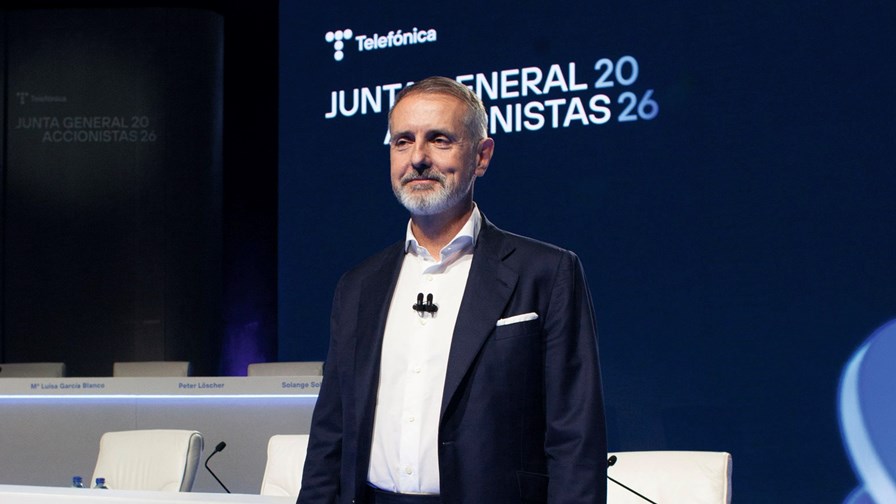
Telefónica Chairman and CEO Marc Murta addresses the telco's 2026 AGM.
- Telefónica chief hails transformation strategy
- NTIA launches 6G security initiative
- Globe strikes partnerships with e& and KDDI
In today’s industry news roundup: Telefónica CEO Marc Mutra claims his transformation strategy is working following revenue growth in its latest quarter; US NTIA launches a ‘call to action’ for 6G collaboration with international governments; Globe strikes a wholesale voice agreement with e& and a retail partnership with KDDI; and much more!
Telefónica’s chairman and CEO Marc Murtra believes his Transform & Grow strategy, introduced in November 2025, is working. The operator, which is selling off non-core operations so it can focus on its businesses in Spain, Germany, Brazil and the UK, reported revenues of almost €16.4bn for the first six months of 2026, an improvement of 1.7% compared with the same period a year ago. The telco’s adjusted earnings before interest, taxes, depreciation and amortisation (EBITDA) was 3.8% better at €5.77bn. There are many metrics that telcos can report, but Murta is very keen on adjusted operating cash flow after leases (OpCFaL): Indeed, the telco has now upgraded its full year target for adjusted OpCFaL to more than 3% growth (at constant currency rates), compared with its previous target of more than 2%. Murtra noted that the financials, in particular the improving performance during the second quarter of this year, are a sign that the strategy “is yielding results. Ambitious, rigorous and effective management along with strong momentum and improving operating leverage lead us to upgrade our adjusted OpCFaL guidance. This is perhaps the most important metric for a telecom company, as it reflects the performance of the core business,” while the rest of the telco’s operating and financial metrics “are on track to fulfil our 2026 guidance.” Let’s see how the second half of 2026 goes, but it’s fair to say that Telefónica does appear to be a more focused, robust and optimistic company than it was before Murta took over in early 2025.
The US National Telecommunications and Information Administration (NTIA) has launched a new initiative that aims to bring together trusted partner governments to develop a shared vision and roadmap for 6G deployments. The NTIA, which is part of the Department of Commerce, launched its “Call to Action for 6G Leadership and Security” as part of President Donald Trump’s pledge to “win the 6G race”. It has already been backed by 20 partner governments from across Europe, the Indo-Pacific region and Asia. Backers include Australia, Canada, France, Germany, Italy, Japan, the Republic of Korea and the UK. The aim is to ensure the next generation of mobile networks “reflect our shared security interests, strengthen our competitiveness and drive innovation,” noted to NITA administrator Arielle Roth. This includes collaborating to deliver an open, interoperable, secure, resilient, AI-native, highly innovative and resource-efficient global communications system, while complementing industry-led technical work on future standards.
Globe Telecom has struck a strategic partnership for the management of its international voice traffic with the Carrier and Wholesale Services (C&WS) division of e&. Under the agreement, e& will become the Philippines operator’s preferred international voice partner, providing other global operators with a secure and resilient gateway for voice traffic terminating on the Globe network. e& C&WS offers a number of voice security services, including a voice firewall, AI-enabled fraud prevention, real-time traffic monitoring, advanced analytics and SIM-box detection, which will all be leveraged by Globe to help reduce fraud across international voice.
The move comes shortly after Globe Telecom, which is working closely with Nokia on the development of its next-generation AI-enabled network infrastructure, announced a strategic partnership with Japanese operator KDDI to explore growth opportunities in mobile services and retail experiences in the Philippines. The collaboration will see Globe and KDDI work together to explore how the Japanese telco’s experiences in its home market can complement Globe’s scale and market reach, which spans around 67 million customers. Areas set to be explored include recurring revenue models that link telecom with financial, entertainment, lifestyle and other digital services. Initially, the partners will assess an initiative to expand Globe’s retail footprint and overhaul its customer experience in-store.
New Zealand operator Spark is to implement a new organisational structure that will split its core Connectivity business from its Digital Services division. In a filing for investors, Spark said it will carry out a strategic review with the aim of simplifying its Digital Services arm, which includes IT services and cloud, as this could be positioned for a future sale. Spark noted it has hired an advisor to conduct a strategic review of the Digital Services division to assess options for maximising shareholder returns, with the review expected to conclude in the first half of 2027. The operator has about 2.6 million mobile and 660,000 fixed broadband customers, more than 1,100 large enterprise and 110,000 small- and medium-sized business (SMB) customers. As part of its SPK-30 strategy, the telco will focus on its core connectivity business, which includes consumer mobile, broadband, and business connectivity, including managed services, internet of things (IoT) and security. This will be led by chief commercial officer Mark Beder, who becomes chief customer officer of Connectivity. Customer director Greg Clark will temporarily oversee the Digital Services division as interim chief customer officer of Digital Services, before leaving the company in December 2026.
AT&T has completed the $23bn acquisition of 5G spectrum licences from Echostar. The US telco agreed to buy spectrum licences in a deal announced last August as it looks to boost its 5G capacity and improve download speeds across the US. The FCC approved the deal in May, subject to a number of conditions placed upon the seller. The deal adds around 30MHz of nationwide 3.45GHz mid-band spectrum and approximately 20MHz of nationwide 600MHz low-band spectrum to AT&T’s portfolio.
The FTTH Council Europe has renamed itself as the Fibre Council Europe to reflect its expanded focus on the full fibre ecosystem, including infrastructure that supports mobile networks, datacentres and digital services. The industry group said it will retain its values but expand its mission to “reflect the breadth of the fibre ecosystem we represent,” according to director general Vincent Garnier. The industry body, which was founded in 2004, represents more than 160 members across the fibre networking value chain, including equipment makers and operators. It also runs the annual FTTH Conference, which is being rebranded as Fibre Horizons from 2027.
– The staff, TelecomTV
Email Newsletters
Sign up to receive TelecomTV's top news and videos, plus exclusive subscriber-only content direct to your inbox.