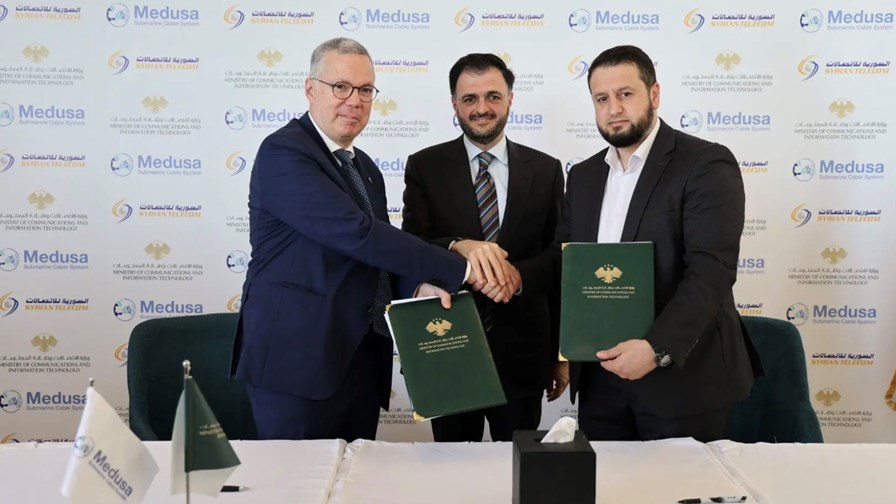
Norman Albi, CEO of Medusa, Jamal Al-Din Al-Khatib, chairman of the Steering Committee at Syria Telecom, and Adbul-Salam Haykal of the Syrian Ministry of Communications and Technology.
- Medusa submarine cable adds landing point in Syria
- Telco network cloud infra spending to hit $24.8bn by 2030
- Manx Telecom rings in a new era
In today’s industry news roundup: The Medusa Submarine Cable System marks “a major milestone” in boosting Mediterranean connectivity with a new agreement to land in Tartous, Syria; accelerating AI and cloud-native adoption will be behind an increase in global telco network infrastructure spending, finds Omdia; Manx Telecom on the Isle of Man is to merge with Channel Islands operator Jersey Telecom; and much more!
The Medusa Submarine Cable System has completed some significant steps in recent weeks. For instance, the 8,700 kilometre system that will eventually connect north Africa and southern Europe has made its first landing in Marseille in the South of France, courtesy of Orange Group’s fibre and datacentre infrastructure. Now, Medusa has signed an agreement with Syria Telecom and the Syrian Ministry of Communications and Technology to land the submarine cable in Tartous in Syria, “marking a major milestone in strengthening digital connectivity across the Mediterranean region”. According to the release, Tartous will serve as a “low-latency gateway, facilitating faster and more secure data exchange while supporting the growing global demand for capacity driven by AI infrastructure and digital transformation”. The agreement also marks an important step for Syria. As noted by Reuters, “after 14 years of civil war and decades of western sanctions, Syria’s infrastructure shortfalls include poor internet connectivity. Many users have to use costly mobile data instead of a wireless connection to get basic tasks done online”. Once it is completed, the Medusa system is set to deliver connectivity between Morocco, Portugal, Spain, France, Algeria, Tunisia, Italy, Greece, Cyprus and Egypt. The project is a joint effort between Alcatel Submarine Networks (ASN), Elettra (an Orange subsidiary), Medusa and Orange. The construction of Medusa is funded by African internet service provider (ISP) AFR-IX Telecom, Orange and the European Union through CEF (Connecting Europe Facilities) grants. The CEO of Medusa, Norman Albi, has previously said that the cable system is expected to be in service in the fourth quarter of 2025. For more information, see this press release.
Speaking of the importance of infrastructure investment to support future connectivity needs and more, a new report from research and analyst firm Omdia spells out the degree to which telco adoption of cloud and AI will fuel their spending in the coming years. According to its Telco Network Cloud Market Tracker, global spending on telco network cloud infrastructure and software is projected to grow from $17.4bn in 2025 to $24.8bn by 2030, representing a compound annual growth rate (CAGR) of 7.3%. The report highlights that the growth in cloud adoption by operators is expected to double to 12% in 2025 compared to last year, primarily owing to the “increasing maturity of cloud-native tooling, automation frameworks, and the integration of AI and GenAI into network operations”. Omdia senior analyst Inderpreet Kaur observed that telcos are “rapidly modernising their infrastructure to support cloud-native network functions and AI-driven automation. The migration to containerised network functions is encouraging telcos to focus their investments on platforms that support both virtualised and containerised network functions”. For more information, see this press release.
Bigger things lie ahead for Isle of Man operator Manx Telecom. Not only is it changing hands yet again but it is also to merge with Jersey Telecom (JT), an operator that provides services in the Channel Islands. According to press releases from all parties involved, JT has partnered with infrastructure investor CVC DIF to buy Manx Telecom from funds managed by Basalt Infrastructure Partners. The investment will be made through a fund called DIF Infrastructure VIII and is expected to close in the fourth quarter of 2025. Gary Lamb, CEO of Manx Telecom Group, hailed the partnership as “an exciting new chapter with Jersey Telecom sharing our core values and long-term vision. With their support and CVC DIF’s experience and track record in the telecoms sector, we are in a strong position to accelerate innovation and continue delivering the high-quality service our customers expect.” Daragh McDermott, CEO of JT Group, added that the move “marks a major step forward for JT Group. With the local expertise of Manx Telecom and the deep sector experience of CVC DIF, we are building a scalable and powerful platform for innovation and international expansion – one that combines local expertise with global ambition to better serve our customers across the Crown Dependencies and beyond”. Meanwhile, Tom Goossens, partner and co-head of the DIF Infrastructure fund strategy at CVC DIF, said the investment in Manx Telecom “reflects our conviction in the long-term value of resilient, locally rooted digital infrastructure”. CVC DIF was established in 2024 when CVC Capital acquired 60% of DIF Capital Partners. According to Manx Telecom, this “strategic acquisition brings together two trusted operators with strong local foundations and expanding international reach. The combined group will serve customers in the Isle of Man, Jersey, Guernsey and across the globe”. Founded in 1987, Manx Telecom is the incumbent digital-infrastructure platform on the Isle of Man, offering broadband, fixed line, mobile and secure data services to residential, business and public sector customers. Over the past couple of decades, it has seen several ownership changes. In 2001, it exited the BT stable as part of the demerger of the UK operator’s wireless business, which eventually became O2. In 2006, it became part of the Telefónica group when the Spain-based operator acquired O2 UK. A couple of other transactions then took place in subsequent years. In 2010, private equity firms HgCapital and CPS Partners acquired Manx Telecom from Telefónica, and in 2014 the operator floated its shares on London’s Alternative Investment Market (AIM). After a brief stint as an independent operator, it was acquired by Basalt Infrastructure Partners in 2019. For more information, see this press release.
Telcos are also still investing in spectrum to support their mobile network developments, including 5G-friendly millimetre mobile airwaves (mmWave). In the UK, regulator Ofcom recently released a total of 5.4GHz of spectrum across the 26GHz and 40GHz band. BT-owned EE, Virgin Media O2 (VMO2) and VodafoneThree each won 800MHz of spectrum in the 26GHz band and 1GHz of spectrum in the 40GHz band, and each committed to pay £13m. Ofcom has now announced the results of the auction’s assignment stage, with EE securing licences for the 26.7GHz-27.5GHz and 41.5GHz-42.5GHz frequencies. VMO2 has licences for 25.1GHz-25.9GHz and 40.5GHz-41.5GHz and VodafoneThree for 25.9GHz-26.7GHz and 42.5GHz-43.5GHz. Ofcom notes that the auction is now complete, and the winners are free to deploy the spectrum in accordance with the conditions of their licences.
As has been well documented, operators have nevertheless struggled to make money out of their costly 5G investments. 5G fixed wireless access (FWA) has long been seen as one of the most promising use cases in the early stages of 5G deployments, although market forecasts for subscriber take-up and revenue growth can vary. For instance, a recent Omdia report forecasts that global 5G FWA subscriptions are set to more than double from 71 million in 2024 to 150 million by 2030. Omdia also says that the 5G FWA segment is projected to expand at a 23% CAGR, driving total FWA service revenues to $46bn by 2030. ABI Research, meanwhile, predicts that the global subscriber base for FWA will reach almost 233 million by 2030, of which 5G FWA is set to account for 81% (about 189 million subscribers) of that 2030 total. According to Ericsson, meanwhile, there were about 160 million FWA connections globally at the end of 2024 and the vendor predicts the global total will reach 350 million by 2030, of which 80% are expected to be over 5G. Omdia also said that India is projected to become the largest 5G FWA market with 37 million subscriptions by 2030, with the United States remaining a key market at 20 million subscriptions. In addition, its report finds that 5G FWA is on track to surpass DSL as the world’s third-largest broadband technology. Also worth noting here is that Verizon has just launched a new low-cost FWA plan, Verizon Home Internet Lite, at $25/month for a limited time. T-Mobile US 5G Home Internet plans start at $50/month while AT&T offers Internet Air plans at $60/month before discounts.
As they continue with 5G, operators and vendors are also looking ahead to 6G as the next-generation of mobile technology beckons from around 2030 onwards. In one recent development, Ericsson and Nokia have partnered with Berlin’s Fraunhofer Heinrich Hertz Institute (HHI) on video coding standardisation in a bid to improve “immersive media and mobile video user experiences in the 6G era”, as well as strengthen Europe’s role in next-generation standardisation. According to a joint release, researchers have demonstrated a new video codec with, they claim, considerably higher compression efficiency than the current standards (these being the acronym soup that is H.264/AVC, H.265/HEVC, and H.266/VVC), “without significantly increasing complexity, while also improving energy efficiency and scalability”. As noted by Thomas Wiegand, executive director of Fraunhofer HHI, video technologies “are central to the digital experiences of tomorrow. Our joint research with Ericsson and Nokia demonstrates Europe’s strong competence in advanced media technologies and its active role in global standardisation efforts”. For more information, see this press release.
– The staff, TelecomTV
Email Newsletters
Sign up to receive TelecomTV's top news and videos, plus exclusive subscriber-only content direct to your inbox.