- France’s four main telcos have agreed a deal that will reduce the number of major infrastructure-based telcos from four to three
- Altice France (SFR) will be broken up, with various assets acquired by Bouygues Telecom, Iliad and Orange
- The move still has to clear a number of key regulatory hurdles
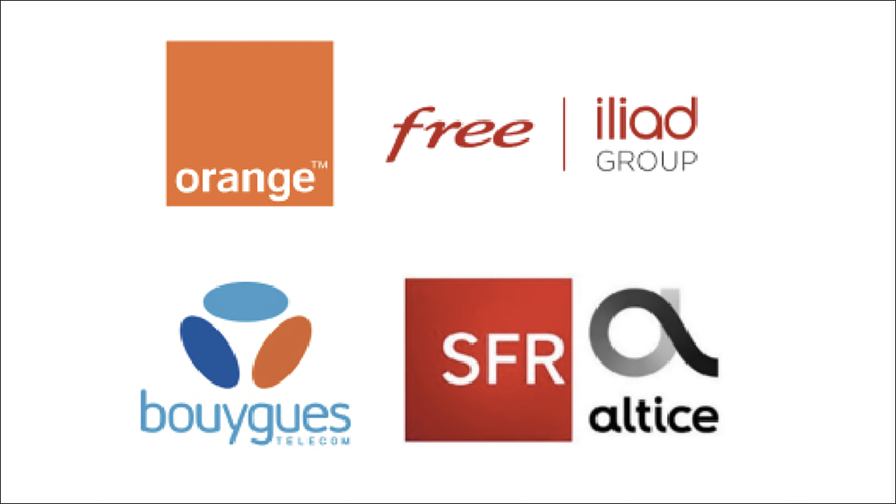
After more than five months of intense negotiations, the €20.35bn M&A deal that will result in the joint acquisition of France’s second-largest operator, SFR (Altice France), by a consortium comprising the country’s other three main infrastructure-based telcos, Bouygues Telecom, Iliad Group and Orange, has been agreed but now faces major regulatory hurdles.
Having had an initial bid rejected last year, the consortium, all of which compete directly with SFR, renewed takeover talks with Altice France at the start of this year and announced an improved offer worth €20.35bn in April. Now a final agreement has been reached that will boost the revenues and customer bases of the consortium members and reduce the number of major infrastructure-based telcos from four to three, which is a major move in a market that has more than 83 million active cellular and 33 million fixed broadband connections.
Kester Mann, director of consumer and connectivity at research and analyst firm CCS Insight, noted that the agreement “paves the way for the greatest shake-up in the French telecom sector since the arrival of disruptive fourth mobile operator Iliad in 2012.”
The deal will also give Altice France owner, billionaire telecom tycoon Patrick Drahi, capital with which to reduce his Altice empire’s heavy debt load: Altice France’s net debt at the end of 2025 was €15.6bn, but that represents only part of Drahi’s Altice group debts that total about €52bn.
Those funds from the SFR sale won’t be in the Altice bank account any time soon, though, as the deal has to be rubber stamped by French and European regulators and is not expected to be completed, at best, for at least a year, after which a complex asset/employee transfer and integration process will begin. The consortium members believe it will be worth it, though (more on that later).
So what is being split up and shared? SFR ended 2025 with 19.4 million mobile and just over 6 million fixed broadband customers, and the consortium is buying the majority of assets operated by Altice France/SFR (you can see which assets are not included in this previous article).
The SFR assets that are being acquired generated revenues of €8bn and EBITDAal (earnings before interest, taxes, depreciation and amortisation after leases) of €2.6bn in 2025. Based on the agreement and the 2025 performance of SFR, Bouygues Telecom will gain 52% of the revenues and 42% of the earnings, Iliad will get 27% of the revenues and 33% of the EBITDA, and Orange will get 21% of revenues and 24% of the EBITDA.
In terms of customers and assets, SFR’s business will be split up as follows:
- Bouygues Telecom will pay €8.55bn for the SFR Business operations (which generated revenues of €1.2bn in 2025), part of the consumer (B2C) operations that has 5.9 million customers (3.3 million mobile, 2.6 million fixed line), the Prixtel MVNO (500,000 customers), SFR’s mobile network in less dense areas (Crozon), the dedicated B2B fixed infrastructure and SFR’s share of the horizontal fibre-to-the-home (FTTH) network in part of the very dense area known as ‘Faber’.
- Iliad is paying €6.2bn for the low-cost ‘RED by SFR’ operation (6 million customers) and part of the regular SFR B2C activities (1.6 million consumer customers and 400,000 small business customers under the SFR brand).
- Orange is paying €5.6bn for part of SFR’s B2C activities as well as SFR’s Régio, Syma and Coriolis MVNOs, which altogether will add about 4 million mobile and about 1 million fixed broadband customers to its books.
- The licensed spectrum currently used by SFR will be shared between the consortium members (Orange is getting 47 MHz of capacity, Iliad is getting 50 MHz, Bouygues has not specified its share).
- Assets not being allocated to any one consortium member as part of the deal (IT systems, most of the mobile and fixed infrastructure, retail stores, wholesale operations) will be equally owned by the consortium members but managed by SFR for at least 30 months after the completion of the deal to ensure continuity of operations during the integration phase.
The operators have agreed various transaction details related to shifting asset values, break-up fees and the ongoing employment of SFR employees at their respective new operators – those details are available in this announcement.
Now, some of the more tricky post-agreement, pre-close processes begin. The companies will open up a consultation period with the relevant employee representative bodies “in order to engage a responsible and constructive dialogue and to ensure a successful outcome for all parties,” noted Orange in its announcement, though the consortium members have stated they will “ensure employment for all the staff of the acquired scope until the beginning of 2029, either by allowing them to continue in their present position or providing them with a job opportunity.”
The deal also “remains subject to the approval of the competent regulatory authorities. Each party will promptly initiate the necessary processes with the relevant authorities.”
And there will be plenty of opposition to the deal from campaigners and politicians who will see the move as anti-competitive, though CCS Insight’s Mann believes it stands a good chance of being approved, especially considering the ongoing competition in the UK communications sector despite last year’s merger of Vodafone and Three that left the British market with three main infrastructure-based telcos.
“The biggest challenge now is to convince competition authorities that the deal will bring positive outcomes to the French market,” noted Mann. “Several years ago, this would have felt like a herculean task. But the regulatory tide has steadily been turning [in] favour of consolidation in Europe, following recent deals approved in the UK and Spain. Although a lengthy probe is likely, it is surely odds-on to get the green light,” he added.
If the deal is agreed, it will be a boost not only for the French consortium but for the Tier 1 operators such as Deutsche Telekom, Telefónica and Vodafone that have long been calling for a relaxation of European M&A regulation in the telecom sector.
“The agreement appears to be a successful outcome for all parties. Bouygues, Orange and Iliad each gain important new assets in their pursuit of greater scale, while eliminating a major rival will reduce the competitive intensity of the market. For Altice, it ends months of speculation surrounding its heavy debt burden,” noted Mann.
And the consortium members are indeed bullish about the resulting outcome, not only for themselves but for the French market.
“This transaction is intended to boost the capacity for investment in French digital infrastructure over the long term. It should help to improve the resilience of fixed and mobile superfast broadband networks, support technological innovation and strengthen control over infrastructure that is strategic for France,” noted Bouygues Telecom in this announcement.
Benoît Torloting, Bouygues Telecom’s CEO stated: “As we celebrate our 30th anniversary, this transaction will enable us to scale up by becoming the number-two telecommunications operator in France, with the ambition of always better serving our customers.”
Bouygues is particularly pumped about its opportunities in the enterprise services market. It noted that the deal will enable it to “scale up its B2B services and significantly boost its presence amongst SMEs, intermediate-size businesses, major corporate clients, local authorities and public sector bodies. The combination of Bouygues Telecom’s B2B activities with those of SFR Business would enable Bouygues Telecom, by becoming a strong challenger, to fully seize the opportunities offered by the growth of the ICT services market; to offer expanded fixed and mobile connectivity solutions; and to strengthen its expertise in ICT services, cloud computing, cybersecurity, one-stop-shop communications, smart networks, and digital services for businesses. Bouygues Telecom would thus have a comprehensive and enhanced offering to support businesses in their digital transformation, infrastructure security, network upgrades and the development of new collaborative services.”
Iliad Group, meanwhile, claimed in this investor slideshow that the deal, if concluded, would add 8 million users to its customer base, making it the third-largest telco in the European Union by subscriber numbers with a total of 70 million (once it adds in the customers from its holdings in Ireland’s eir and Sweden’s Tele2, where it holds controlling stakes), behind only Deutsche Telekom (144 million) and Orange (99 million) but ahead of Vodafone Group (68 million) and Telefónica (57 million).
Meanwhile, Orange CEO Christel Heydemann stated in this announcement: “Today’s strategic announcement marks a decisive step in our most important market. This agreement is set to reinforce Orange’s leadership position in France and in Europe and will support the ambitions of our Trust the future plan. In an accelerating digital world, France needs operators capable of investing massively and sustainably in infrastructure and digital services…. This is an ambitious industrial project that we will carry out together with all our teams in France.”
- Ray Le Maistre, Editorial Director, TelecomTV
Email Newsletters
Sign up to receive TelecomTV's top news and videos, plus exclusive subscriber-only content direct to your inbox.