Postpaid plans may have more data, but low-end offers are vanishing – Tarifica

By Anne Morris
Aug 19, 2026
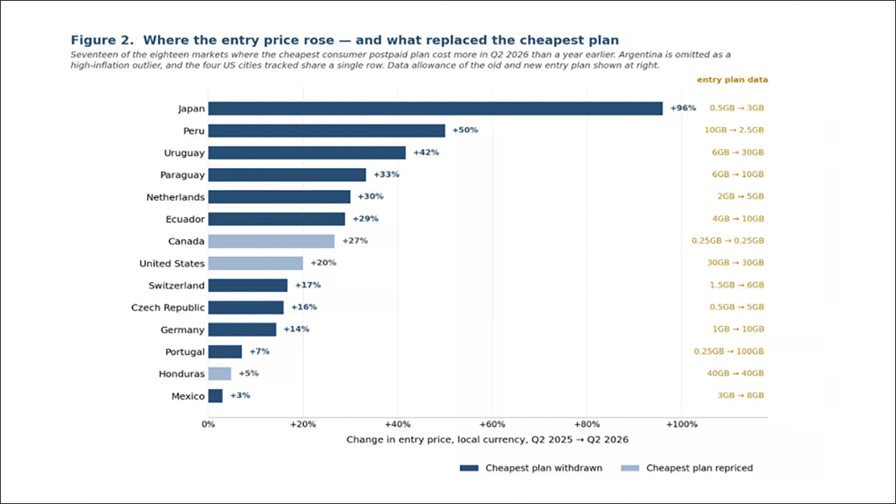
Better value, less choice. Source: Tarifica.
- Tarifica has published new research on the availability of post-paid entry plans
- It found an alarming narrowing of choice at the lower end of the market
- It advises tracking postpaid entry prices separately to ensure all needs are met
News that the UK has gained yet another mobile virtual network operator in the form of Vodafone-hosted AO Mobile comes hot on the heels of recent research that says the UK MVNO market is set for significant growth over the next few years. Indeed, cost-conscious customers now have another low-cost SIM-only plan to choose from: AO Mobile is offering 500GB for £12 per month to members of electrical retailer AO in a 30-day rolling plan.
The UK is of course not the only market where cost often trumps speeds, potentially providing a ready market for newer MVNOs from the likes of AO, Revolut and Monzo. However, a new study from telecom data provider Tarifica has identified a trend in postpaid mobile markets that may alarm more price-sensitive consumers, and possibly market regulators too: Low-cost postpaid mobile plans are disappearing in a number of markets, reducing the choice of options available for those who really want cheaper plans.
Using data from Tarifica’s Telecom Pricing Intelligence Platform (TPIP), the study compared the cheapest standard consumer postpaid plans across 44 markets between the second quarters (Q2) of 2025 and 2026. It found that the entry price increased in 18 of these markets.
In 11 of the 18 markets where entry prices rose, the previous cheapest plan was simply withdrawn from the market altogether, as illustrated in Japan and Switzerland. In the other six markets, an operator raised the price of a tariff it continued to sell.
Tarifica found that Swisscom’s 1.5GB Mobile XS plan at 29.90 Swiss francs (CHF) (£27.20) is no longer available, leaving Sunrise’s 6GB Swiss Connect Lite plan at CHF 34.90 as the cheapest postpaid option in the market. Consumers at the entry point now receive more data, but the minimum monthly cost of postpaid service has increased by about 17%.
Meanwhile, it noted that Japan saw an even more pronounced change following the withdrawal of Docomo’s low-cost Irumo range. The cheapest postpaid plan available in the market thus moved from 550 yen (£2.54) to 1,078 yen (£4.99), an increase of 96%.
Better value, but less choice in non-premium postpaid
As observed by Soichi Nakajima, vice president of data and analysis at Tarifica, this illustrates a subtle but important shift in the postpaid market.
“Consumers are often getting more data for only a modest increase in price, but the small plan that allowed them to keep their monthly spending to a minimum is disappearing,” Nakajima said.
The Tarifica study added that although consumers are receiving at least as much data for their money, customers primarily interested in minimising their monthly spending can end up paying more for data they may never use.
“Price per gigabyte doesn’t tell the whole story about affordability,” Nakajima said. “For some consumers, the most important question is simply how little they can spend and still have postpaid service. Our findings show that in a meaningful number of markets, that minimum commitment is moving higher as smaller plans disappear.”
Tarifica provides more examples to back up its research. For instance, last year a consumer in Germany could buy one gigabyte from Freenet for €6.99 (£5.98) a month. That plan is no longer sold. The cheapest postpaid tariff that Freenet offers today is 10GB for €7.99 (£6.83) – 10 times the data for one euro more.
By any conventional measure this is an improvement, according to Tarifica. Yet for the consumer who only ever wants one gigabyte, it is also a 14% increase in the minimum they can spend on a postpaid mobile service.
The data firm pointed out that this is specifically a postpaid story. In most of these markets, it said, prepaid packages remain available below the postpaid entry price, and prepaid prices have not moved in the same direction.
What has narrowed is the choice of plans available at the lower end of the postpaid market. In Tarifica’s view, this development makes the low end of the postpaid range worth tracking as a category in its own right, rather than being bundled in with the averages that describe the market as a whole.
“For a regulator assessing whether postpaid markets continue to serve low-usage consumers, the question is not only what the typical plan costs but whether a genuinely small postpaid plan remains available,” the firm concluded.
- Anne Morris, Contributing Editor, TelecomTV
Email Newsletters
Sign up to receive TelecomTV's top news and videos, plus exclusive subscriber-only content direct to your inbox.