To embed our video on your website copy and paste the code below:
<iframe src="https://www.youtube.com/embed/Tzi7Cr5fUTE?modestbranding=1&rel=0" width="970" height="546" frameborder="0" scrolling="auto" allowfullscreen></iframe>
James Pearce, TelecomTV (00:08):
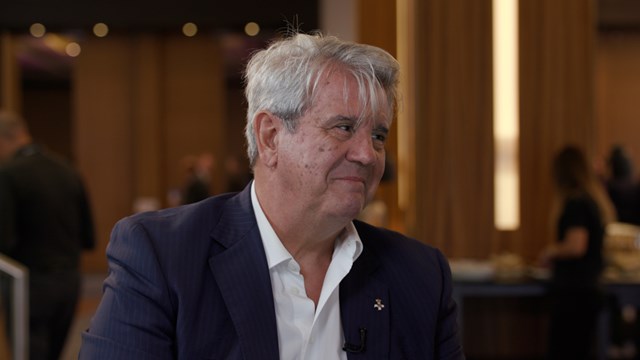
Welcome to TelecomTV. I'm James Pearce. I'm in Düsseldorf at the AI-Native Telco Forum, and I'm delighted to be joined by Enrique Blanco, who recently joined Rakuten Symphony as a strategic advisor. Welcome back to the industry, Enrique. You recently returned with Rakuten. What persuaded you to join them and what excites you about the company?
Enrique Blanco, Rakuten Symphony (00:28):
This is a very good question because I have a vision, and the vision from the mobile network is fully applicable to the rest. And only if we can be opening the interfaces and the network, so this evolution will be sustainable. This is something that has been in my mindset for more than 10 years. And Rakuten Symphony today is a company that is getting almost all of the pieces of the puzzle that you need, trying to make this a reality. So why not? It is a possibility, and I think that I have still something to offer to the industry - and this is why I chose Rakuten Symphony.
James Pearce, TelecomTV (01:07):
Brilliant. You talked about operators needing a holistic framework during your session earlier, rather than isolated products. Why is that so important for the industry in its journey to become AI-native?
Enrique Blanco, Rakuten Symphony (01:21):
This is essential. So all the big operators, we have a huge legacy, and all of them need to be re-engineered and all of them need to be fully evolved with the AI-native capabilities. If we forget any piece, maybe it's a brutal mistake that we cannot solve, and finally we will be just unsustainable. All the people today are using the AI capabilities for the autonomous network - managing the performance - but it needs to be covering everything. The OSS needs to be covered, the legacy needs to be covered, the radio needs to be covered. We cannot forget any piece of the network. If we don't do it, maybe we will just be building some silos that will be just impossible to evolve, or the CapEx will be just impossible to support. This is why it's so relevant - the AI needs to be attacking all the pieces of the network.
James Pearce, TelecomTV (02:16):
You talked before about AI on the network rather than just in the network. When we're looking at that distinction, why is that important?
Enrique Blanco, Rakuten Symphony (02:25):
It's important because if we are building within the radio itself, following the 6G rules or whatever, and we are just including all the AI capabilities, all the algorithms, and we are encapsulating - so we just maintain a blocking. We cannot reach all the efficiencies, all the services, all the capabilities. This is why I say we need to be opening the interfaces of the radio, as we did with Wi-Fi for instance. And the AI needs to be capable to manage, to offer new services, to make revenues, to make performance, to make efficiency - including the radio. If we don't do it, we will maintain the blocking, and it's going to be much more negotiation with the procurement team and the providers than really opening the network to give this possibility and to make a modular evolution - which is the only solution trying to make sustainable the evolution to 6G in the next three, four years.
James Pearce, TelecomTV (03:22):
You talked just now about coming back to the industry with a vision in mind. How important is that to you as somebody who's been in the industry so long, had such an impact during your time with Telefónica, to come back with that vision and to be able to express that and share that with your peers?
Enrique Blanco, Rakuten Symphony (03:37):
Because evolution cannot be a risk. So we are just thinking about the evolution - I see in this presentation that AI-native is quite different to the evolution. Hey, legacy exists. You enjoy the services today because legacy exists. The point is that I'm not breaking everything and going through a new paradigm. How can I reach offering to the societies and to the customer what they are asking for, fully supported by the new standards? How can you make this not a risk? How can you be accommodating the new revenues, the new services to the cost of the evolution of the network? So we need an opportunity to try to do this. And you were asking initially, why Rakuten Symphony? Because you need extremely strong cloud capabilities. You need open RAN capabilities. You need a strong OS with strong AI capabilities. And this is not only Rakuten Symphony - it's one of them.
(04:41):
This is what the industry is thinking to do. And this is what I say - 6G cannot be a trend, it needs to be an opportunity. If we can do it, changing how we are evolving, it's going to be a smooth evolution. It's not going to be a risk. And we can help reduce the OpEx with the AI-native capabilities in the RAN network evolution - autonomous - and with the modular evolution using the AI over the radio. That this is not going to be a commodity, I know it, but we need to push, trying to be much more close to that immediately.
James Pearce, TelecomTV (05:21):
Maybe you could outline for us some of the biggest challenges that you see that could hamper operator ambitions to reach level four or even level five autonomous networks. How does the industry overcome those kinds of roadblocks?
Enrique Blanco, Rakuten Symphony (05:35):
This is yes or yes. When you are in a telecom operator and you are building your three-year strategic plan, efficiency is a must - that's all. So the OpEx over revenues, you need to be containing, maintaining, reducing - and you need to be saving. And you need to be saving while growing and maintaining the quality and the performance for your customer, because to decrease OpEx by reducing customer quality is not a good idea. You will pay in revenues immediately. When we were working in TM Forum with the autonomous network journey, the AI-native capabilities were helping us trying to build algorithms, helping us to be much more efficient, making networks that are extremely automated. So it is a must. And this has been happening in the past three years or so. Most of the big operators are very close to the four - 3.8, 3.5, 3.7.
(06:40):
And TM Forum have been designing which are the KPIs, trying to be sure that we can compare. And this is amazing. This is great. The point is, we need to maintain this pressure. All the operators will be reducing and automating and so on. But this is not enough. This is not enough, because you are making 50% of your homework preparing your network for the evolution to 6G - which is going to happen in 2030. It is a must and we cannot be waiting, because if we wait, nothing happens. And this is why I say - which is the vision that we need to implement? And I know that it is not easy, but we need to do it.
James Pearce, TelecomTV (07:19):
What should our viewers look out for from you and from Rakuten in the coming months?
Enrique Blanco, Rakuten Symphony (07:25):
Convincing the industry that we need to give ourselves an opportunity. An opportunity that needs to be identified in a significant market share, trying to be tested in the next months. So how this evolution is feasible and we can be solving all the technical issues - there are still some issues in terms of performance and quality and so on. What we are asking the industry is: give us an opportunity to demonstrate that this is the right way we need to follow. If nothing happens, all of us - all the industry, all the CTOs of the telecom operators - we know how the evolution to 6G is going to be: exactly the same as in 5G. The point is, are we looking for that or not? My opinion is not. We need to find another way. In the next months, we are trying to open minds, trying to consider that all the issues - and there are some issues - can be solved, and we can find an opportunity to do things in a different way and make it sustainable.
(08:31):
If this happens, most of the telecom operators will be talking again about 6G - not like today, where people are extremely prudent because the transition is additional CapEx without warranty of revenues. This is not sustainable.
James Pearce, TelecomTV (08:45):
Enrique, thank you so much for joining.
Enrique Blanco, Rakuten Symphony (08:47):
My pleasure. Thank you very much.
Welcome to TelecomTV. I'm James Pearce. I'm in Düsseldorf at the AI-Native Telco Forum, and I'm delighted to be joined by Enrique Blanco, who recently joined Rakuten Symphony as a strategic advisor. Welcome back to the industry, Enrique. You recently returned with Rakuten. What persuaded you to join them and what excites you about the company?
Enrique Blanco, Rakuten Symphony (00:28):
This is a very good question because I have a vision, and the vision from the mobile network is fully applicable to the rest. And only if we can be opening the interfaces and the network, so this evolution will be sustainable. This is something that has been in my mindset for more than 10 years. And Rakuten Symphony today is a company that is getting almost all of the pieces of the puzzle that you need, trying to make this a reality. So why not? It is a possibility, and I think that I have still something to offer to the industry - and this is why I chose Rakuten Symphony.
James Pearce, TelecomTV (01:07):
Brilliant. You talked about operators needing a holistic framework during your session earlier, rather than isolated products. Why is that so important for the industry in its journey to become AI-native?
Enrique Blanco, Rakuten Symphony (01:21):
This is essential. So all the big operators, we have a huge legacy, and all of them need to be re-engineered and all of them need to be fully evolved with the AI-native capabilities. If we forget any piece, maybe it's a brutal mistake that we cannot solve, and finally we will be just unsustainable. All the people today are using the AI capabilities for the autonomous network - managing the performance - but it needs to be covering everything. The OSS needs to be covered, the legacy needs to be covered, the radio needs to be covered. We cannot forget any piece of the network. If we don't do it, maybe we will just be building some silos that will be just impossible to evolve, or the CapEx will be just impossible to support. This is why it's so relevant - the AI needs to be attacking all the pieces of the network.
James Pearce, TelecomTV (02:16):
You talked before about AI on the network rather than just in the network. When we're looking at that distinction, why is that important?
Enrique Blanco, Rakuten Symphony (02:25):
It's important because if we are building within the radio itself, following the 6G rules or whatever, and we are just including all the AI capabilities, all the algorithms, and we are encapsulating - so we just maintain a blocking. We cannot reach all the efficiencies, all the services, all the capabilities. This is why I say we need to be opening the interfaces of the radio, as we did with Wi-Fi for instance. And the AI needs to be capable to manage, to offer new services, to make revenues, to make performance, to make efficiency - including the radio. If we don't do it, we will maintain the blocking, and it's going to be much more negotiation with the procurement team and the providers than really opening the network to give this possibility and to make a modular evolution - which is the only solution trying to make sustainable the evolution to 6G in the next three, four years.
James Pearce, TelecomTV (03:22):
You talked just now about coming back to the industry with a vision in mind. How important is that to you as somebody who's been in the industry so long, had such an impact during your time with Telefónica, to come back with that vision and to be able to express that and share that with your peers?
Enrique Blanco, Rakuten Symphony (03:37):
Because evolution cannot be a risk. So we are just thinking about the evolution - I see in this presentation that AI-native is quite different to the evolution. Hey, legacy exists. You enjoy the services today because legacy exists. The point is that I'm not breaking everything and going through a new paradigm. How can I reach offering to the societies and to the customer what they are asking for, fully supported by the new standards? How can you make this not a risk? How can you be accommodating the new revenues, the new services to the cost of the evolution of the network? So we need an opportunity to try to do this. And you were asking initially, why Rakuten Symphony? Because you need extremely strong cloud capabilities. You need open RAN capabilities. You need a strong OS with strong AI capabilities. And this is not only Rakuten Symphony - it's one of them.
(04:41):
This is what the industry is thinking to do. And this is what I say - 6G cannot be a trend, it needs to be an opportunity. If we can do it, changing how we are evolving, it's going to be a smooth evolution. It's not going to be a risk. And we can help reduce the OpEx with the AI-native capabilities in the RAN network evolution - autonomous - and with the modular evolution using the AI over the radio. That this is not going to be a commodity, I know it, but we need to push, trying to be much more close to that immediately.
James Pearce, TelecomTV (05:21):
Maybe you could outline for us some of the biggest challenges that you see that could hamper operator ambitions to reach level four or even level five autonomous networks. How does the industry overcome those kinds of roadblocks?
Enrique Blanco, Rakuten Symphony (05:35):
This is yes or yes. When you are in a telecom operator and you are building your three-year strategic plan, efficiency is a must - that's all. So the OpEx over revenues, you need to be containing, maintaining, reducing - and you need to be saving. And you need to be saving while growing and maintaining the quality and the performance for your customer, because to decrease OpEx by reducing customer quality is not a good idea. You will pay in revenues immediately. When we were working in TM Forum with the autonomous network journey, the AI-native capabilities were helping us trying to build algorithms, helping us to be much more efficient, making networks that are extremely automated. So it is a must. And this has been happening in the past three years or so. Most of the big operators are very close to the four - 3.8, 3.5, 3.7.
(06:40):
And TM Forum have been designing which are the KPIs, trying to be sure that we can compare. And this is amazing. This is great. The point is, we need to maintain this pressure. All the operators will be reducing and automating and so on. But this is not enough. This is not enough, because you are making 50% of your homework preparing your network for the evolution to 6G - which is going to happen in 2030. It is a must and we cannot be waiting, because if we wait, nothing happens. And this is why I say - which is the vision that we need to implement? And I know that it is not easy, but we need to do it.
James Pearce, TelecomTV (07:19):
What should our viewers look out for from you and from Rakuten in the coming months?
Enrique Blanco, Rakuten Symphony (07:25):
Convincing the industry that we need to give ourselves an opportunity. An opportunity that needs to be identified in a significant market share, trying to be tested in the next months. So how this evolution is feasible and we can be solving all the technical issues - there are still some issues in terms of performance and quality and so on. What we are asking the industry is: give us an opportunity to demonstrate that this is the right way we need to follow. If nothing happens, all of us - all the industry, all the CTOs of the telecom operators - we know how the evolution to 6G is going to be: exactly the same as in 5G. The point is, are we looking for that or not? My opinion is not. We need to find another way. In the next months, we are trying to open minds, trying to consider that all the issues - and there are some issues - can be solved, and we can find an opportunity to do things in a different way and make it sustainable.
(08:31):
If this happens, most of the telecom operators will be talking again about 6G - not like today, where people are extremely prudent because the transition is additional CapEx without warranty of revenues. This is not sustainable.
James Pearce, TelecomTV (08:45):
Enrique, thank you so much for joining.
Enrique Blanco, Rakuten Symphony (08:47):
My pleasure. Thank you very much.
Please note that video transcripts are provided for reference only – content may vary from the published video or contain inaccuracies.
Enrique Blanco, Strategic Advisor, Rakuten Symphony
Enrique Blanco, strategic advisor at Rakuten Symphony, discusses why operators need a holistic AI-native framework rather than isolated products, the distinction between AI on the network and AI in the network, the enduring importance of open radio interfaces, the challenges associated with achieving Level 4/Level 5 autonomous networks and why, after a short break away, he returned to the telecom sector.
Recorded September 2026
Email Newsletters
Sign up to receive TelecomTV's top news and videos, plus exclusive subscriber-only content direct to your inbox.