To embed our video on your website copy and paste the code below:
<iframe src="https://www.youtube.com/embed/GGZFxk8LLMM?modestbranding=1&rel=0" width="970" height="546" frameborder="0" scrolling="auto" allowfullscreen></iframe>
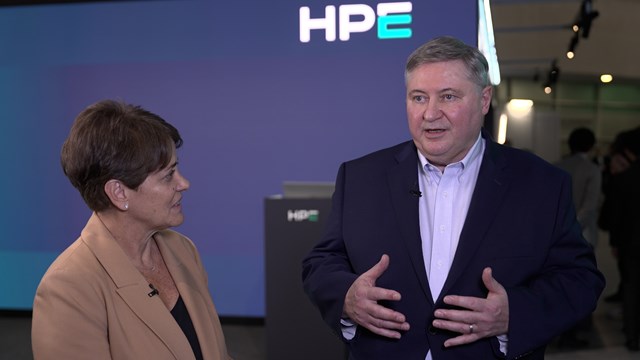
The AI-Native Telco Forum is a new in-person TelecomTV event dedicated to showcasing best practices and real world deployments of AI across telecom networks. It's being held in Dusseldorf on the 23rd and 24th of October. The forum is being supported by Deutsche Telecom. We thought we would take this opportunity to chat with one of the keynote speakers, Ahmed Hafez, the Senior Vice President Network strategy data and AI in networks at Deutsche Telecom. Welcome, Ahmed.
Ahmed Hafez, Deutsche Telekom (00:44):
Thanks a lot. Hi Tony. Thanks a lot for inviting me.
Tony Poulos, TelecomTV (00:47):
Look, from your perspective, what does AI native really mean for the telco today?
Ahmed Hafez, Deutsche Telekom (00:53):
Excellent question. So hard to have a standardized, definitive answer, but I will give you the key ingredients, at least from our perspective, what we see as AI native telco. So basically ai nativeness can have two legs, one in data and the other one in ai. So if I look into data, we need very clear, clean, and high quality data generated by our networks. This data that is generated with high quality needs to have enough metadata around it, and metadata here means that data has to have meanings. Usually we used to have a lot of data generated by the networks, but this data was not precise enough, was not clear enough, was not also well explained. And every supplier would have different types of data, different explanations of the data, even different schema of the data. We need that all to go away. And then we have some standardized approach to data that allows us to plug in AI without having to parcel through a lot of hurdles to clean the data and prepare them for ai.
(01:53):
So in essence, the current state of the networks is not natively prepared for AI to be plugged in. The other elements related to AI are related to interfaces to ai. So I need native interfaces in the network that I can plug in AI that doesn't exist today. The other dimension also is the closed loop by design networks were not really designed for closed loop by design. They were designed to be robust in a certain areas to have some fallbacks, so to have some redundancy, but not as a closed loop well by design. So at least these few elements are very essential for an AI native network or AI native telco, if you like.
Tony Poulos, TelecomTV (02:38):
So which parts of the network are seeing the most impact from AI so far?
Ahmed Hafez, Deutsche Telekom (02:42):
Excellent question. Again, actually, all the network will be impacted ai, but if I were to single out a couple of them, I would say operations will be massively impacted. And the reason for that is the sheer volume of operation and effect operations on the networks. So we deploy the networks, but we stay in operations all the time. We're running the network 24 by seven nonstop. So there is a lot of value to be gained in operational side upon the operational side from the observability point of view, including maintenance, and then how you manage incidents and faults to whether how you optimize the network. So the entire chain of operations will be heavily impacted. The other area is also individual customer experience, because with the AI, you can actually have very robust and very specific and special way to see what is the impact of the customer of my networks, how my network is performing in the eye of customers. And this is pretty important going forward that we actually move towards very, very detailed view in individual customer experience. So we'll be able to tailor this customer experience towards customers and bring them what they need.
Tony Poulos, TelecomTV (03:56):
And how far along are operators in moving from isolated AI pilots to wider adoption?
Ahmed Hafez, Deutsche Telekom (04:03):
This is a very important question. I have seen in the industry quite a big variety. So you see operators that are quite advanced and then continuously bringing the big topics together and then trying to address them in a contiguous manner, like in an umbrella manner. But there are also others that are still stuck into individual very special minute and small individual use cases. The use cases, individual use cases can be good, but they are not enough to scale. So I see more towards the latter than the first one. So few are ahead, few are trying to bring things together properly and then cover the autonomous networks in its wider view. And then many are trying to do use cases but did not reach that point yet.
Tony Poulos, TelecomTV (04:49):
And what do you think are the biggest risks that operators should be aware of when embedding AI at scale?
Ahmed Hafez, Deutsche Telekom (04:55):
Of course there are many risks, but I would name three of them. The first one is data quality. So data quality is an ongoing process. You would spend maybe in the beginning a lot of effort to get it to a certain level, but you have to keep monitoring it because data is the bloodline for ai. So if data gets corrupted, gets bad, the results would be bad. So this is a high risk. You have to keep monitoring your data quality. The second part is the black box effect. If you rely so much on supplies bringing you a solution, you don't understand the solution, but you get the outcome, this may lead to you deviating or drifting away from the outcome if you're not well monitoring what's going on and understanding how it is actually working. So transparency and understandability of how AI is actually functioning in your network is very important for the sustainability of its quality. The last but not least at all is security. The more we go into agenda ai, the more we recognize the risks that could be entailed from a security standpoint. And this requires to do many measures and different layers in order to protect the AI from protect the network from any wrong passages or injections or someone implanting an agent that is undecided or unauthorized and can do things in the network. So I would name out the three. So the data quality, the black box effect, and finally the security.
Tony Poulos, TelecomTV (06:29):
So what new services or monetization opportunities could AI unlock for telcos in the next few years?
Ahmed Hafez, Deutsche Telekom (06:37):
Right. There are two dimensions for that. One dimension is how do I personalize existing services? So hyper-personalization, nothing here. We kept thinking about that, but not knowing which is the right tool to use to that, and AI stepping in to enable us for that. There is another dimension is that how do you create new services and then the sky's the limit. So you can think, yeah, we use communication, but you can build a lot of stuff on communication, whether it's through XR glasses, AI glasses, or you start to do enhancements on existing services or you implement something just enabling AI to its customers. There are lots of possibilities to do, and it is not something that we should limit ourselves as operators to do, but we should expose capabilities via APIs that could be also utilized by others. You can develop services, you can develop applications that utilize network intelligence, network information that might be needed. So I would say that we can flip this around and create the enablers that will make others create services on top of the networks much wider and much deeper.
Tony Poulos, TelecomTV (07:48):
Well, that makes a lot of sense. And finally, for those planning to attend the AI native Telco forum, why is now the right time for this discussion?
Ahmed Hafez, Deutsche Telekom (07:58):
I mean, let's say it's better late than ever. So we will have to continue discussing seriously. Ai, the discussions on AI will not stop the development AI super fast. So we need to exchange, we need to discuss, we need to understand what's going on. We need to share best practice. It's very important that the entire industry moves together because it is not in some s, of course, everybody wants to compete, but there are lots of elements that has nothing to do with competition, but rather to do with standardization, right Approaches, right perspectives on things. Something that would also help regulators to put things in the right dimension so that it is not an impediment, but rather an enablement. So all these things are important that we get together regularly to see what's going on. How do we actually utilize AI for the telcos? So it's the era of ai. How do we transform the telco towards this era and to make the most out of it.
Tony Poulos, TelecomTV (08:56):
Thanks Ahmed for joining us today.
Ahmed Hafez, Deutsche Telekom (08:58):
Thanks for inviting. Thank you.
Tony Poulos, TelecomTV (09:00):
And for more details on the AI Native Telco Forum, you'll find all the links you'll need below this video. Thanks for being with us.
Please note that video transcripts are provided for reference only – content may vary from the published video or contain inaccuracies.
Ahmed Hafez, SVP Network Strategy and Data & AI in Networks, Deutsche Telekom
In this exclusive preview ahead of the AI-Native Telco Forum in Düsseldorf on 23-24 October, Tony Poulos speaks to Deutsche Telekom’s Ahmed Hafez about what it really means to become an AI-native telco. They explore where AI is making the biggest impacts, the business opportunities and challenges, and how operators can turn early trials into scaled deployments. The discussion also outlines what attendees can expect to learn from the inaugural event and why the timing is so critical.
Find out more about the upcoming AI-Native Telco Forum, which takes place on 23-34 October in Düsseldorf, including the full agenda and registration details, here.
Recorded September 2025