Mavenir on turning the distributed network into an AI monetisation opportunity
To embed our video on your website copy and paste the code below:
<iframe src="https://www.youtube.com/embed/uhI_9c-FQFA?modestbranding=1&rel=0" width="970" height="546" frameborder="0" scrolling="auto" allowfullscreen></iframe>
Bejoy Pankajakshan, Mavenir (00:09):
What I'm going to cover is from our customer perspective operators, what do we see in terms of the AI use cases that they are implementing today, versus what they're considering for the future? So jump straight into the four strategic plays that we see today. A lot of the morning session was spent on OpEx reduction and the whole operational transformation use case, which is the first one there. But the second one, which is AI services, which some operators in the US have now launched—for example, T-Mobile. Live translation is one of the key use cases that's gotten a lot of interest globally now. Additional AI-based communication protection, you're seeing a lot more of security use cases in AI, especially anything involving communication. So deepfake side of use cases that exist today, where voice is cloned and you can't figure out if it's AI-generated audio or not. So we see some of those use cases also coming in.
(01:04):
And then there are these other two areas that I've highlighted. One is the Sovereign AI Cloud, which is a big deal in the European market. You see a lot more of the European operators play in that space. And then the last one is AI Grid, which goes towards the whole distributed compute and distributed inferencing. So looking at one of the charts which Intel shared earlier, which shows the amount of inferencing traffic that's supposed to happen by 2035, 37% if I remember the chart. This is the opportunity that the operator has to monetise on the distributed inferencing, given the footprint that they have. So that's the fourth opportunity that we see.
(01:42):
So today, if you look at where the operators are, primarily you have end devices with ChatGPT application or any frontier model access application on the device, connecting over the top of the operator and going to the frontier model. So the value chain is essentially being bypassed, where even in 5G or the new version of AI services, the operator is being bypassed and just becoming a data pipe. Now, in 6G, there's a lot of discussion happening on the AI for network and the network for AI concepts. There's many considerations there as to whether you create a whole different 6G core just for AI, meaning a separate domain on which AI services run. That is going the other extreme, where the operator could be completely bypassed. There's also a discussion on how we would enhance some of the existing nodes to support AI services.
(02:37):
So keeping aside 6G opportunity, what is doable today? So that's what's shown on the right side, where operator could be the intermediary, which actually channels the services for AI through their network and becomes part of the value chain. And we've seen this, especially in the Chinese operator market, this actually happened, come to fruition. A lot of discussion now on Model-as-a-Service, Token-as-a-Service capability. In China, it was more easy to do because a lot more access to open source models, versus in North American markets and Europe, it's more the frontier access. There's a lot more considerations on what's called model routing, selecting the right model for the right use case.
(03:16):
So what value does the operator bring? First, the distributed network, which of course is a lot more than what even hyperscalers, the other networks that have been built out there for AI services can provide. Secondly, embed communications natively in the operator network. So doing AI voice, which earlier was not very sexy, but now you're seeing a lot more focus of operators on communication and how AI is applied, and that becoming a monetisation angle for them. The third is the trusted relationship in terms of billing that they have with the end customers, be it consumers or enterprises. And then finally, the sovereignty, which goes back to the third and the fourth bucket of pillars that I mentioned earlier, Sovereign AI Cloud and AI Grid.
(04:00):
So what does it take for them to actually offer these services? Which is where the AI-integrated platform comes in. So pretty much all of you who have gone through a cloud-native transformation are familiar with the Kubernetes-based distribution and how workloads today run on top of Kubernetes. When it comes to AI workloads, there's a similar need to run the lifecycle management of these AI workloads within the operator network. So pretty much all the main players that are in the Kubernetes cloud-native space have now evolved to also offer AI platforms. Now, this is different for the neo-cloud providers like CoreWeave and Nebius and others who build their own stack and are using open source distribution of Kubernetes, versus in the operator network you have an SLA-driven Kubernetes network. So on top of it, you need to build an AI platform to support the AI workloads that the operators could serve. When it comes to simple operational use cases like AI service assurance, even to support something like that, you need an AI platform that's running within the operator network. So that becomes a key new capability that needs to be built within the operator network itself.
(05:09):
Yeah, so one of the key capabilities here is what's called model routing, which is essentially picking the right model for the right use case. And that is a capability within the AI platform with something called an AI gateway. So most of you may be familiar with API gateways. This is different from an API gateway. There's some functional overlap with API gateway, but it does a lot more in terms of how you count the amount of tokens that are used as the different models are used, and then giving a way for it to be charged eventually.
(05:37):
The next piece to it is the whole AI orchestration piece. So earlier in the panels and discussions, there's a lot of focus on intent management, and the intent piece of this can come from enterprises that are buying a service from an operator. It can come from the operations team, which is trying to run the network, or it can come from the billing side, which is checking on the subscriber experience. In all these cases, when it comes to AI-based services, there's a need for an intent orchestrator as well, which can bundle along from a practical purpose being integrated with the intent orchestrator, the end-to-end orchestrator that the operator launches. But what that essentially does is captures the intent and orchestrates it downstream to the right node. So for model routing functions, it can route it to the AI gateway. If it's an operational use case, route it to the AI service assurance use case. So these are the kind of capabilities that are required within the AI platform that operators have to launch.
(06:37):
And this is a concept that I mentioned earlier, which is not a concept anymore because pretty much all the operators in China have launched this. Just like you have data buckets that are sold by operators or voice buckets that are sold by operators, the concept here is now selling AI plans. So it's AI token buckets, which means that there are a few key capabilities that need to be within the operator network. The first part, as I mentioned, is a model routing capability, selecting the right model for the right use case. The second is the token metering. How exactly do you count these tokens as they pass through the network? Be it models that are hosted locally within the operator network, or when it goes to the external frontier model, because not every use case is going to be driven by an on-prem model. Take translation as an example, because this is a use case that a few operators have launched, and pretty much all the operators that we talk to globally are interested in it. You could have the majority of languages, which are the high hitters, be using the local models versus the language which is used in a few countries, not widely deployed or widely used by consumers, enterprises. That could go towards a frontier model, like use OpenAI or some other frontier model. So that is an example of a model routing use case. And even in those use cases, you need to be able to count the tokens that are used. So essentially, you could charge for it.
(08:03):
Which takes us to how Token-as-a-Service or tokenomics and Model-as-a-Service will come together so the operator could start monetising this. So Model-as-a-Service, essentially the same concept as model routing, which is based on the use case, you route to the right model. But Token-as-a-Service, this is one of the key new capabilities that operators need to build into their network to be able to monetise on these AI services. And that cannot come at the expense of billing systems that take years to upgrade. So essentially, and this is not work that's happening in 3GPP, it's not work that's happening directly in TMF either, but across different organisations. Even NVIDIA themselves are driving a lot of this in the AI-as-a-Service space. And pretty much all the neo-cloud providers have to have some offering that's similar to this. And the way Mavenir, we have architected the solution is a modification of what 3GPP has defined with a Charging Enforcement Function. So essentially based on what the AI gateway counts, we are able to convert these tokens into a metric which can be integrated into the operator charging system. So essentially allow the capability to integrate existing AI services that are being launched by the operator, be it translation or operational transformation use cases or future ones like AI Grid or Sovereign Cloud. And for all of these use cases, being able to count the token usage and charge for it.
(09:33):
So in summary, if we look at these four buckets of operator use cases under AI transformation, the primary one is a whole journey to Level 5, and what does it take to enable those AI services there? This is pretty well understood. Pretty much all vendors in this space have solutions in this domain. The second one is more of making bets based on the business case, and this is one that we see different operators take different approaches. Some may put more emphasis on something like translation. Some of the more advanced ones are looking at Token-as-a-Service, Model-as-a-Service use cases. Of course, the third bucket is purely driven by operators who want to launch sovereign clouds for government interest. It's being pushed by the government or for their own monetisation angle. In Europe, for example, you've got Deutsche Telekom that's launched it, Telefónica Spain has launched it. And the last one is the emerging one, which is how do you leverage the AI inferencing distributed network, the operator network, which is more widely distributed, to cater to new use cases around monetisation?
(10:46):
And in the Mavenir booth here, we got all these services actually running live. If you stop by during any of the breaks, you could see how different AI services, translation, consumer protection can be charged to an operator bill using Token-as-a-Service. It kind of put together all these services and being able to charge for it. Thank you.
What I'm going to cover is from our customer perspective operators, what do we see in terms of the AI use cases that they are implementing today, versus what they're considering for the future? So jump straight into the four strategic plays that we see today. A lot of the morning session was spent on OpEx reduction and the whole operational transformation use case, which is the first one there. But the second one, which is AI services, which some operators in the US have now launched—for example, T-Mobile. Live translation is one of the key use cases that's gotten a lot of interest globally now. Additional AI-based communication protection, you're seeing a lot more of security use cases in AI, especially anything involving communication. So deepfake side of use cases that exist today, where voice is cloned and you can't figure out if it's AI-generated audio or not. So we see some of those use cases also coming in.
(01:04):
And then there are these other two areas that I've highlighted. One is the Sovereign AI Cloud, which is a big deal in the European market. You see a lot more of the European operators play in that space. And then the last one is AI Grid, which goes towards the whole distributed compute and distributed inferencing. So looking at one of the charts which Intel shared earlier, which shows the amount of inferencing traffic that's supposed to happen by 2035, 37% if I remember the chart. This is the opportunity that the operator has to monetise on the distributed inferencing, given the footprint that they have. So that's the fourth opportunity that we see.
(01:42):
So today, if you look at where the operators are, primarily you have end devices with ChatGPT application or any frontier model access application on the device, connecting over the top of the operator and going to the frontier model. So the value chain is essentially being bypassed, where even in 5G or the new version of AI services, the operator is being bypassed and just becoming a data pipe. Now, in 6G, there's a lot of discussion happening on the AI for network and the network for AI concepts. There's many considerations there as to whether you create a whole different 6G core just for AI, meaning a separate domain on which AI services run. That is going the other extreme, where the operator could be completely bypassed. There's also a discussion on how we would enhance some of the existing nodes to support AI services.
(02:37):
So keeping aside 6G opportunity, what is doable today? So that's what's shown on the right side, where operator could be the intermediary, which actually channels the services for AI through their network and becomes part of the value chain. And we've seen this, especially in the Chinese operator market, this actually happened, come to fruition. A lot of discussion now on Model-as-a-Service, Token-as-a-Service capability. In China, it was more easy to do because a lot more access to open source models, versus in North American markets and Europe, it's more the frontier access. There's a lot more considerations on what's called model routing, selecting the right model for the right use case.
(03:16):
So what value does the operator bring? First, the distributed network, which of course is a lot more than what even hyperscalers, the other networks that have been built out there for AI services can provide. Secondly, embed communications natively in the operator network. So doing AI voice, which earlier was not very sexy, but now you're seeing a lot more focus of operators on communication and how AI is applied, and that becoming a monetisation angle for them. The third is the trusted relationship in terms of billing that they have with the end customers, be it consumers or enterprises. And then finally, the sovereignty, which goes back to the third and the fourth bucket of pillars that I mentioned earlier, Sovereign AI Cloud and AI Grid.
(04:00):
So what does it take for them to actually offer these services? Which is where the AI-integrated platform comes in. So pretty much all of you who have gone through a cloud-native transformation are familiar with the Kubernetes-based distribution and how workloads today run on top of Kubernetes. When it comes to AI workloads, there's a similar need to run the lifecycle management of these AI workloads within the operator network. So pretty much all the main players that are in the Kubernetes cloud-native space have now evolved to also offer AI platforms. Now, this is different for the neo-cloud providers like CoreWeave and Nebius and others who build their own stack and are using open source distribution of Kubernetes, versus in the operator network you have an SLA-driven Kubernetes network. So on top of it, you need to build an AI platform to support the AI workloads that the operators could serve. When it comes to simple operational use cases like AI service assurance, even to support something like that, you need an AI platform that's running within the operator network. So that becomes a key new capability that needs to be built within the operator network itself.
(05:09):
Yeah, so one of the key capabilities here is what's called model routing, which is essentially picking the right model for the right use case. And that is a capability within the AI platform with something called an AI gateway. So most of you may be familiar with API gateways. This is different from an API gateway. There's some functional overlap with API gateway, but it does a lot more in terms of how you count the amount of tokens that are used as the different models are used, and then giving a way for it to be charged eventually.
(05:37):
The next piece to it is the whole AI orchestration piece. So earlier in the panels and discussions, there's a lot of focus on intent management, and the intent piece of this can come from enterprises that are buying a service from an operator. It can come from the operations team, which is trying to run the network, or it can come from the billing side, which is checking on the subscriber experience. In all these cases, when it comes to AI-based services, there's a need for an intent orchestrator as well, which can bundle along from a practical purpose being integrated with the intent orchestrator, the end-to-end orchestrator that the operator launches. But what that essentially does is captures the intent and orchestrates it downstream to the right node. So for model routing functions, it can route it to the AI gateway. If it's an operational use case, route it to the AI service assurance use case. So these are the kind of capabilities that are required within the AI platform that operators have to launch.
(06:37):
And this is a concept that I mentioned earlier, which is not a concept anymore because pretty much all the operators in China have launched this. Just like you have data buckets that are sold by operators or voice buckets that are sold by operators, the concept here is now selling AI plans. So it's AI token buckets, which means that there are a few key capabilities that need to be within the operator network. The first part, as I mentioned, is a model routing capability, selecting the right model for the right use case. The second is the token metering. How exactly do you count these tokens as they pass through the network? Be it models that are hosted locally within the operator network, or when it goes to the external frontier model, because not every use case is going to be driven by an on-prem model. Take translation as an example, because this is a use case that a few operators have launched, and pretty much all the operators that we talk to globally are interested in it. You could have the majority of languages, which are the high hitters, be using the local models versus the language which is used in a few countries, not widely deployed or widely used by consumers, enterprises. That could go towards a frontier model, like use OpenAI or some other frontier model. So that is an example of a model routing use case. And even in those use cases, you need to be able to count the tokens that are used. So essentially, you could charge for it.
(08:03):
Which takes us to how Token-as-a-Service or tokenomics and Model-as-a-Service will come together so the operator could start monetising this. So Model-as-a-Service, essentially the same concept as model routing, which is based on the use case, you route to the right model. But Token-as-a-Service, this is one of the key new capabilities that operators need to build into their network to be able to monetise on these AI services. And that cannot come at the expense of billing systems that take years to upgrade. So essentially, and this is not work that's happening in 3GPP, it's not work that's happening directly in TMF either, but across different organisations. Even NVIDIA themselves are driving a lot of this in the AI-as-a-Service space. And pretty much all the neo-cloud providers have to have some offering that's similar to this. And the way Mavenir, we have architected the solution is a modification of what 3GPP has defined with a Charging Enforcement Function. So essentially based on what the AI gateway counts, we are able to convert these tokens into a metric which can be integrated into the operator charging system. So essentially allow the capability to integrate existing AI services that are being launched by the operator, be it translation or operational transformation use cases or future ones like AI Grid or Sovereign Cloud. And for all of these use cases, being able to count the token usage and charge for it.
(09:33):
So in summary, if we look at these four buckets of operator use cases under AI transformation, the primary one is a whole journey to Level 5, and what does it take to enable those AI services there? This is pretty well understood. Pretty much all vendors in this space have solutions in this domain. The second one is more of making bets based on the business case, and this is one that we see different operators take different approaches. Some may put more emphasis on something like translation. Some of the more advanced ones are looking at Token-as-a-Service, Model-as-a-Service use cases. Of course, the third bucket is purely driven by operators who want to launch sovereign clouds for government interest. It's being pushed by the government or for their own monetisation angle. In Europe, for example, you've got Deutsche Telekom that's launched it, Telefónica Spain has launched it. And the last one is the emerging one, which is how do you leverage the AI inferencing distributed network, the operator network, which is more widely distributed, to cater to new use cases around monetisation?
(10:46):
And in the Mavenir booth here, we got all these services actually running live. If you stop by during any of the breaks, you could see how different AI services, translation, consumer protection can be charged to an operator bill using Token-as-a-Service. It kind of put together all these services and being able to charge for it. Thank you.
Please note that video transcripts are provided for reference only – content may vary from the published video or contain inaccuracies.
Bejoy Pankajakshan, EVP, Chief Technology & Strategy Officer, Mavenir
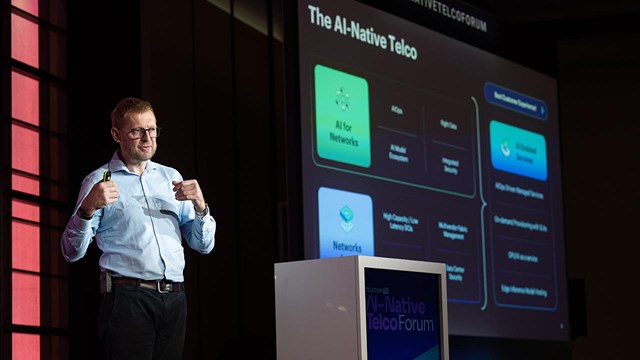
At the AI-Native Telco Forum 2026, Bejoy Pankajakshan, EVP and chief technology & strategy officer at Mavenir, discusses the four strategic AI plays being pursued by operators, why operators risk being bypassed in the AI value chain, how an AI-integrated platform with model routing and an AI gateway works, and how token-as-a-service and model-as-a-service enable operators to meter and charge for AI services.
Broadcast live Sept 2026