To embed our video on your website copy and paste the code below:
<iframe src="https://www.youtube.com/embed/CIb_Vl7HNjE?modestbranding=1&rel=0" width="970" height="546" frameborder="0" scrolling="auto" allowfullscreen></iframe>
Ohad Barnoy, Amdocs (00:09):
Morning, everybody. Agentic-Ready Data Foundation. I'm going to try to talk a little bit today about how we see data as the basis for success in transforming into an agentic operator. And I'm going to start just with a very quick number. So Ahmed mentioned this morning, "Don't offer me POCs. If you're a vendor, don't offer me POCs." And I couldn't agree more. And my first takeaway is, don't ask for POCs, and if somebody's asking you as a vendor for POCs, chances are they're not the decision-maker. So you need to find the decision-maker. Why are POCs failing and not transforming actually to production? So I'll tell this through an anecdotal example that I recently had. I met with an amazing start-up that offered me an AI solution to manage my pipeline better, accelerate deals, manage my pipeline better. And they wanted to do a POC. They wanted to show me how I can use their AI in order to close deals faster, bigger deals for our sales team. And I told them, "I don't want to do a POC. I want to do a pilot to production." And they said, "Okay, what does that mean?" I said, "Well, I use Teams for all my communication with my customers. We also use their facilitator, Copilot.
(01:35):
I'm not advertising Microsoft, but this is the tool we use. Obviously, we use Outlook, we use a CRM to manage all the deals. And my salespeople, when they're communicating with the customers, if they're in Europe, they're using WhatsApp. If they're in the US, they're using the Apple..." don't remember the name. "And if they're in Eastern Europe or APAC, they're using Rakuten Viber. Now all I need is for you guys to integrate with all of these to see that you can actually have your AI use case work." And they basically said, "Oh, we've never done this before. We don't know how to do everything you're asking for." And that is when I told them, "Guys, just go, sit down, try to do integration with Microsoft, try to do integration with one of them, and come back to me when you can actually do this." So in my view, this is why POCs are failing. POCs are failing not because they're not proving a value of a technology, it's because they can't work in our complex ecosystem. And that's why you need to demand and suggest, demand as a telco, suggest as a vendor, to do pilots to production, and you'll see a significant increase both in the success and the adoption rates.
(02:41):
Next slide might get me kicked out of ANTA, so I apologise in advance. What are we all doing today? Today, and I didn't think about Germany when I had the BMW there, but regardless. Today, what we're doing is we're taking all our systems, we're taking all our processes, and we're infusing AI into them. We're adding AI capabilities, sometimes strategically, sometimes tactically. Sometimes we're looking use case by use case by use case, and sometimes we're looking across our entire gamut of operations. But what we're doing is we're doing AI add-ons. That's good. We don't have any choice. We have to do that. Where we should aspire to is to become a truly AI-native telco. And I know that it was supposed to be a Tesla, but I thought it might be too controversial because today some people love to hate Elon Musk and so on. The bottom line is when Elon Musk was interviewed about what's the difference between his EV and a German EV, which are amazing—I had a BMW i4 when I lived in Seattle, and I loved it—he said, "They took a BMW 4, and they changed the engine. I built it from the ground up." Now, we all understand we can't build our systems, all our systems, from the ground up. But to Danielle's point from the previous session, if you're looking at 6G, for example, this is where you should be thinking, "I don't want to take the processes that I manage my RAN in 5G and infuse AI into them. I actually want to build an AI-native radio access network."
(04:24):
Let's just move quickly into what I mentioned before, and again, Ahmed mentioned it in the morning. 2025 and the beginning of 2026, we're all hysterical about using AI, infusing AI, cost reduction, revenue generation, better customer experience. And most of us looked into very tactical, focused pilots, projects that would drive business outcome. There's nothing wrong with that. It drives business outcome. You can absolutely use AI tools. I'll give the classic example for your conversational IVR for your customer engagement in order to improve customer experience and reduce calls that are coming into the contact centre.
(05:16):
Tactically, that's the right approach that we need to take. But the more we look into where we need to think, we need to look at the process of why did the customer even call the 1-800 number. What caused them to call the 1-800 number? And can I predict that ahead of time? My entire customer journey, the entire process that I did before I even acquired this customer, when I acquired this customer, when I activated their SIM, when they connected to the first tower, when they had the experience, when they got their first bill, maybe they even walked into the store or did my digital, that entire experience, for some reason, caused them to call the 1-800 number. How do I take that entire process, look at it end to end, and don't automate it, but actually AI-native it, if you want to think about that. So when we're looking at what we need to provide to telcos moving forward from an Amdocs standpoint, we're looking at how do you take these complex business and network workflows and actually look at them end to end and turn them into an AI-native process.
(06:31):
And I'll give an example of a live production use case that we have, which is actually looking at what I just said. So we have a concept that's called personality engineering. The practical term is customer digital twin, where most of you are from the network, you know the network digital twin. Now think exactly the same, but about Ohad's digital twin. So imagine right here next to me is standing my digital twin, and he knows all my behaviours. He knows how I think. He knows how I act. He knows how I'm going to react to somebody saying to me the word apple. Yuck. He knows everything about me. And we can use this customer digital twin because you guys have all the data, the telcos. As Sachin mentioned from Rakuten, the data is yours. Our system may be the ones creating it. We may need to have to expose it to you as MCPs in order for your AI to be able to consume it, but the data is yours. So you have all the data about your customer experience. Yes, it's in different fragmented systems. Some of it is in the retail application, some of it is on the digital, some of it is in the network, some of it is in your BSS. It's all over the place. But you have all the data, and you can actually map. And this is what we did for—I'll show an example in a second, the example from the Canadian Tier 1 operator. We created what we call archetypes. Archetypes are personality aggregators of a person.
(08:07):
So for example, I am a cost saver. When you offer me something or when you talk to me about something, it has to be in the sense of why would I want to spend this money on this? What's the value for me out of this? In some use cases. My boss, on the other hand, the one that convinced me to get the BMW i4, he's all about innovative capabilities, or in other words, wants to look good and so on. So when you're thinking about those traits, how does AI know to talk to me differently than to my boss? If I give the AI, the sales agents, the care agents, the virtual agents, that information, they can actually help me make better decisions. So these numbers don't look huge, but the actual outcome here is amazing. 9%, almost 10%, and by the way, I looked at the numbers this morning, this has been running in production for the last three months, it's actually up to above 15% reduction in human handover in the group of sales agents and care agents, virtual care sales and sales agents that are getting the archetype of the customer. So when they know who they're talking to, not just the name of the person, but the personality, they change the entire conversation. And this goes back to Danielle's point about context, about understanding who the customer is.
(09:41):
The engagement has also increased by almost 10%. Now, what's the engagement? The engagement is this is a sales agent that's reaching out to customers and with a conversational IVR and talking to them. In this case, almost, I think it was about 40% of the customers were hanging up before even the greeting took place, before, "Hi, Ohad. This is the sales agent from Telco X, and I have this amazing promotion," 40% of the customers were hanging up. So we were able to reduce that number by 10%. So again, this is just by knowing and adjusting the greeting to the different personality of the person. These numbers are going to continue to grow. I wanted to use this example to show you how leveraging all your data and building the right data foundation across all your towers, leveraging context and leveraging ontology can actually drive significant business outcome in areas that are impacting both your customers and are not just focused on cost reduction, which we're all implementing. Thank you very much.
Guy Daniels, TelecomTV (10:48):
Thanks so much, Ohad. Great.
Morning, everybody. Agentic-Ready Data Foundation. I'm going to try to talk a little bit today about how we see data as the basis for success in transforming into an agentic operator. And I'm going to start just with a very quick number. So Ahmed mentioned this morning, "Don't offer me POCs. If you're a vendor, don't offer me POCs." And I couldn't agree more. And my first takeaway is, don't ask for POCs, and if somebody's asking you as a vendor for POCs, chances are they're not the decision-maker. So you need to find the decision-maker. Why are POCs failing and not transforming actually to production? So I'll tell this through an anecdotal example that I recently had. I met with an amazing start-up that offered me an AI solution to manage my pipeline better, accelerate deals, manage my pipeline better. And they wanted to do a POC. They wanted to show me how I can use their AI in order to close deals faster, bigger deals for our sales team. And I told them, "I don't want to do a POC. I want to do a pilot to production." And they said, "Okay, what does that mean?" I said, "Well, I use Teams for all my communication with my customers. We also use their facilitator, Copilot.
(01:35):
I'm not advertising Microsoft, but this is the tool we use. Obviously, we use Outlook, we use a CRM to manage all the deals. And my salespeople, when they're communicating with the customers, if they're in Europe, they're using WhatsApp. If they're in the US, they're using the Apple..." don't remember the name. "And if they're in Eastern Europe or APAC, they're using Rakuten Viber. Now all I need is for you guys to integrate with all of these to see that you can actually have your AI use case work." And they basically said, "Oh, we've never done this before. We don't know how to do everything you're asking for." And that is when I told them, "Guys, just go, sit down, try to do integration with Microsoft, try to do integration with one of them, and come back to me when you can actually do this." So in my view, this is why POCs are failing. POCs are failing not because they're not proving a value of a technology, it's because they can't work in our complex ecosystem. And that's why you need to demand and suggest, demand as a telco, suggest as a vendor, to do pilots to production, and you'll see a significant increase both in the success and the adoption rates.
(02:41):
Next slide might get me kicked out of ANTA, so I apologise in advance. What are we all doing today? Today, and I didn't think about Germany when I had the BMW there, but regardless. Today, what we're doing is we're taking all our systems, we're taking all our processes, and we're infusing AI into them. We're adding AI capabilities, sometimes strategically, sometimes tactically. Sometimes we're looking use case by use case by use case, and sometimes we're looking across our entire gamut of operations. But what we're doing is we're doing AI add-ons. That's good. We don't have any choice. We have to do that. Where we should aspire to is to become a truly AI-native telco. And I know that it was supposed to be a Tesla, but I thought it might be too controversial because today some people love to hate Elon Musk and so on. The bottom line is when Elon Musk was interviewed about what's the difference between his EV and a German EV, which are amazing—I had a BMW i4 when I lived in Seattle, and I loved it—he said, "They took a BMW 4, and they changed the engine. I built it from the ground up." Now, we all understand we can't build our systems, all our systems, from the ground up. But to Danielle's point from the previous session, if you're looking at 6G, for example, this is where you should be thinking, "I don't want to take the processes that I manage my RAN in 5G and infuse AI into them. I actually want to build an AI-native radio access network."
(04:24):
Let's just move quickly into what I mentioned before, and again, Ahmed mentioned it in the morning. 2025 and the beginning of 2026, we're all hysterical about using AI, infusing AI, cost reduction, revenue generation, better customer experience. And most of us looked into very tactical, focused pilots, projects that would drive business outcome. There's nothing wrong with that. It drives business outcome. You can absolutely use AI tools. I'll give the classic example for your conversational IVR for your customer engagement in order to improve customer experience and reduce calls that are coming into the contact centre.
(05:16):
Tactically, that's the right approach that we need to take. But the more we look into where we need to think, we need to look at the process of why did the customer even call the 1-800 number. What caused them to call the 1-800 number? And can I predict that ahead of time? My entire customer journey, the entire process that I did before I even acquired this customer, when I acquired this customer, when I activated their SIM, when they connected to the first tower, when they had the experience, when they got their first bill, maybe they even walked into the store or did my digital, that entire experience, for some reason, caused them to call the 1-800 number. How do I take that entire process, look at it end to end, and don't automate it, but actually AI-native it, if you want to think about that. So when we're looking at what we need to provide to telcos moving forward from an Amdocs standpoint, we're looking at how do you take these complex business and network workflows and actually look at them end to end and turn them into an AI-native process.
(06:31):
And I'll give an example of a live production use case that we have, which is actually looking at what I just said. So we have a concept that's called personality engineering. The practical term is customer digital twin, where most of you are from the network, you know the network digital twin. Now think exactly the same, but about Ohad's digital twin. So imagine right here next to me is standing my digital twin, and he knows all my behaviours. He knows how I think. He knows how I act. He knows how I'm going to react to somebody saying to me the word apple. Yuck. He knows everything about me. And we can use this customer digital twin because you guys have all the data, the telcos. As Sachin mentioned from Rakuten, the data is yours. Our system may be the ones creating it. We may need to have to expose it to you as MCPs in order for your AI to be able to consume it, but the data is yours. So you have all the data about your customer experience. Yes, it's in different fragmented systems. Some of it is in the retail application, some of it is on the digital, some of it is in the network, some of it is in your BSS. It's all over the place. But you have all the data, and you can actually map. And this is what we did for—I'll show an example in a second, the example from the Canadian Tier 1 operator. We created what we call archetypes. Archetypes are personality aggregators of a person.
(08:07):
So for example, I am a cost saver. When you offer me something or when you talk to me about something, it has to be in the sense of why would I want to spend this money on this? What's the value for me out of this? In some use cases. My boss, on the other hand, the one that convinced me to get the BMW i4, he's all about innovative capabilities, or in other words, wants to look good and so on. So when you're thinking about those traits, how does AI know to talk to me differently than to my boss? If I give the AI, the sales agents, the care agents, the virtual agents, that information, they can actually help me make better decisions. So these numbers don't look huge, but the actual outcome here is amazing. 9%, almost 10%, and by the way, I looked at the numbers this morning, this has been running in production for the last three months, it's actually up to above 15% reduction in human handover in the group of sales agents and care agents, virtual care sales and sales agents that are getting the archetype of the customer. So when they know who they're talking to, not just the name of the person, but the personality, they change the entire conversation. And this goes back to Danielle's point about context, about understanding who the customer is.
(09:41):
The engagement has also increased by almost 10%. Now, what's the engagement? The engagement is this is a sales agent that's reaching out to customers and with a conversational IVR and talking to them. In this case, almost, I think it was about 40% of the customers were hanging up before even the greeting took place, before, "Hi, Ohad. This is the sales agent from Telco X, and I have this amazing promotion," 40% of the customers were hanging up. So we were able to reduce that number by 10%. So again, this is just by knowing and adjusting the greeting to the different personality of the person. These numbers are going to continue to grow. I wanted to use this example to show you how leveraging all your data and building the right data foundation across all your towers, leveraging context and leveraging ontology can actually drive significant business outcome in areas that are impacting both your customers and are not just focused on cost reduction, which we're all implementing. Thank you very much.
Guy Daniels, TelecomTV (10:48):
Thanks so much, Ohad. Great.
Please note that video transcripts are provided for reference only – content may vary from the published video or contain inaccuracies.
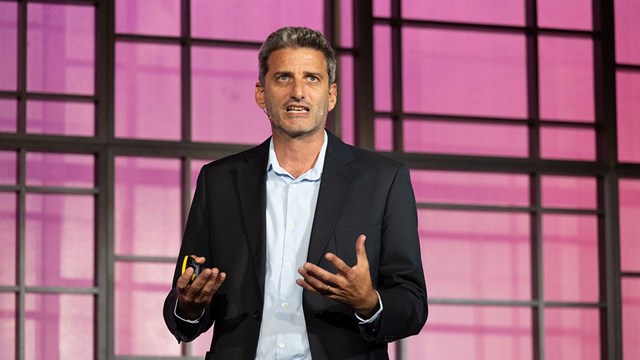
Ohad Barnoy, Vice President, Head of GenAI and Data Services, Amdocs
At the AI-Native Telco Forum 2026, Ohad Barnoy, VP and head of GenAI and data services at Amdocs, discussed why proofs of concept fail to reach production and the case for pilot-to-production, the difference between infusing AI into existing systems and building AI-native operations, the importance of a data foundation, context and ontology, and a live customer digital twin use case using personality archetypes to improve customer engagement.
Broadcast live Sept 2026