Telcos shift AI goals towards revenue generation – report

By Martyn Warwick
Oct 28, 2025
- Strategic focus of telco AI strategies is shifting to the delivery of operational and commercial benefits
- Proposed telco AI plans now changing to include revenue objectives
- Developing sovereign AI services is also becoming popular with telcos
Where the deployment of AI is concerned, telcos and services providers around the world are beginning to shift their focus to the fulfilment of revenue-generation goals rather than using the technology solely for cost-saving purposes. That’s according to a new report from GSMA Intelligence, the research arm of the global trade body that represents the interests of mobile network operators.
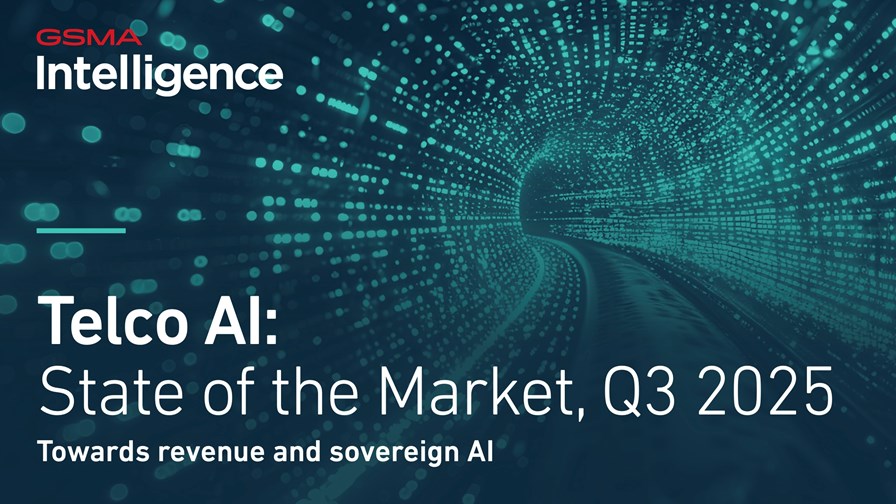
The research unit has just published Telco AI: State of the Market, Q3 2025. Towards revenue and sovereign AI. Based on an analysis of AI deployments from 250 telcos across the globe, it is a snapshot of where operators are now and where they hope and intend to be heading. It indicates that telcos are moving on from total focus on the efficiency drives they introduced with the help of AI when it became apparent that the technology had a major role to play in the networks of the future and now intend to apply their AI assets (established or yet to be deployed) to generate earnings and profits.
The report also flags sovereign AI as a long-term strategic necessity of telcos. Of which, more later…
The GSMA report makes clear that, hitherto, telco AI deployments have been about saving money via “easy-win or low-risk solutions for customer care, network automation and pre-emptive maintenance”, with 80% of AI deployments squarely targeted at ameliorating “internal inefficiencies” in areas including customer care, network fault detection and OSS/BSS.
Now though, the pendulum is starting to swing towards revenue generation.
Leading the emerging trend is the US, which already accounts for 20% of all telco AI deployments. Elsewhere, China (and other Asian countries) are looking to GPU-as-a-service (GPUaaS) as well as agentic AI and edge AI inferencing, where AI models are loaded directly to devices to process data locally for inferencing tasks. Edge AI enables intelligent and autonomous operations with lower latency than inferencing from the cloud or datacentres.
Meanwhile, in Europe, 25% of the AI services announced in Q3 this year included a “revenue objective”, a “forward indicator” of new product launches and/or revenue models being put into practice, such as GPUaaS and edge inferencing as mentioned above. The first commercial offerings are likely to become operational during 2026.
Size matters
So, change is in the air, but low-risk/easy-win scenarios where AI is used to automate routine processes, such as in customer care, still account for 50% of deployments, with network process management taking second place at just under 20%.
Furthermore, there is an evident correlation between the size and reach of a telco and the extent of its AI deployments. For example, big Tier 1 operators, perpetually locked in a struggle for “first-mover” advantage over their rivals, have some 20% more AI deployments per group than the smaller (and less financially secure) Tier 2 and Tier 3 operators. That said, the report shows that the strategic objective for one in five current AI deployments is to generate revenue.
Unsurprisingly, there are also regional differences in the deployment of telco AI, and operators are introducing the technologies into their networks and operations at different rates. Thus, as the report shows, between 75% and 85% of Latin American and European telcos claim their AI services portfolios are now live as opposed to 50% to 60% at telcos in other parts of the world. The GSMA posits that these figures show that telcos that are experiencing the greatest pressures on cash flows have used AI primarily to save costs rather than to position themselves as leading-edge innovators.
And, as the world well knows, among manufacturers, Nvidia continues to dominate the provision of GPUs used in telco AI scenarios, with Google and Microsoft competing for cloud partnerships. The GSMA Intelligence report has it that the next growth phase will be in the realms of AI orchestration and hybrid models that blend core, edge and sovereign workloads.
Sovereign AI: Nations are doing it for themselves
The new report is subtitled, “Towards revenue and sovereign AI”, and while revenues and profitability remain central to telco AI rationales, “sovereign AI” is becoming a hot button to be pushed when considering the likely strategic advantages of the technologies.
In essence, sovereign AI refers to the ability of a national government, organisation, company or even an individual to control AI technologies, including underlying data, infrastructure and models, according to the laws, values and “strategic interests” of a sovereign nation.
Among the key aspects of sovereign AI are data control, whereby sensitive data is stored and processed within an individual country’s jurisdiction and is managed in full compliance with national legislation and industry regulations.
Meanwhile, infrastructure autonomy relates to the building and operating of AI models on local hardware, such as in-country datacentres and cloud services. Another key is model ownership and governance whereby a country can develop its own AI models or have full control and transparency over third-party models to ensure they align with local values and regulations.
One of the great attractions of the concept of sovereign AI is the greatly reduced reliance it confers on input from and involvement of foreign technology providers or external infrastructure to help ensure critical AI services are not vulnerable to external interference or geopolitical influences. Sovereign AI means interested parties develop and run AI on their terms, thus staying in complete control of sensitive data, and operating within a country’s legal framework.
Want to know more? TelecomTV will be holding its own sovereign event in the City of London on 3 December, the day before The Great Telco Debate. The Digital Sovereignty Forum will comprise six in-depth panel sessions covering the full spectrum of sovereignty concerns that are shaping the telecom sector today. Don’t miss it!
– Martyn Warwick, Editor in Chief, TelecomTV
Email Newsletters
Sign up to receive TelecomTV's top news and videos, plus exclusive subscriber-only content direct to your inbox.