Orange Business and Blue Planet on invisible OSS and AI-driven network operations

By James Pearce
May 11, 2026
To embed our video on your website copy and paste the code below:
<iframe src="https://www.youtube.com/embed/5tNqZm-qGRY?modestbranding=1&rel=0" width="970" height="546" frameborder="0" scrolling="auto" allowfullscreen></iframe>
Ray Le Maistre, TelecomTV (00:05):
We're here at Future Net World 2024 in London and following their keynote here at the event, I'm with Gabriele Di Piazza. He is VP of Product Management at Blue Planet and Mohamed Talaye, CTO at Orange Business. Gentlemen, welcome to TelecomTV.
Mohamed Talaye, Orange Business (00:24):
Thank you for having us.
Ray Le Maistre, TelecomTV (00:24):
Now, we're here today to talk about the evolution of operations in an increasingly AI-enabled services era. So Mohamed, let's come to you first. As customer needs evolve and change, and as physical and digital worlds come together, what do service providers such as Orange Business need to deliver that will be of true value to their customers? And what operational changes are critical to enable this new era of services?
Mohamed Talaye, Orange Business (01:00):
So I think we should start with our customer expectations. So customers yesterday were operating on a physical environment, sites, data centres, private data centres, and today they are moving to more cloud. So cloud came, hyperscalers came and said they want to connect these two worlds together. Connecting them together, it requires us to deliver more resilience, operation as one delivery. So we cannot really operate the physical and the digital as two different worlds. So we have to merge them. That's where we in Orange Business start to think a little bit differently. So we start to introduce platformisation. So we are building a platform architecture where we are changing our infrastructure to be more programmable. We are changing our front end to be more self-service towards our customers so they can do more themselves. But also that requires us to change the middle layer because the middle layer, that's where all the magic happens.
(01:57):
And that's what requires what we call invisible OSS. Invisible OSS doesn't mean it will disappear. It's important and it will continue. But it needs to be moved from ticket-based OSS to more real-time based OSS, we need to start to simplify it. We need to start to think about how we can use OSS to deliver better and faster time to market. And that's where we are really looking to a totally different operation with OSS and that's how we will be able to deliver end-to-end value to our customers.
Ray Le Maistre, TelecomTV (02:27):
Okay. And Gabriele, how does OSS need to evolve in order to enable the kind of value creation that Mohamed's been talking about here?
Gabriele Di Piazza, Blue Planet (02:38):
Yeah. I mean, if you just consider what Mohamed discussed, this will introduce more complexities. Now we need to take into consideration a couple of things in my opinion. One is a deep understanding and factoring in of service and business intent. It's something that typically gets separated a little bit from OSS. The other aspect is that data becomes the foundation. Everybody's talking about AI, but AI is only as intelligent as the data underneath that. And what I mean by that is it's not just about clean data collection and consolidation, but it's understanding the ontology and the knowledge around this data. So it's important to me that OSS is based on this data foundation. And then all the functions that are composing OSS, they can now share and they can basically have a common set of capabilities. But this, in my opinion, is what brings that intelligence that then will also result in simplification through a set of agents and communication across agents.
(03:51):
And this will also enable and unlock new customer experiences for operators such as Orange Business.
Ray Le Maistre, TelecomTV (03:58):
So Mohamed, as networks become more dynamic and software driven, how do you ensure that configuration changes don't become a source of risk? And what role does governance play in maintaining trust at scale?
Mohamed Talaye, Orange Business (04:13):
That's interesting because we don't have a lot of greenfield, so we don't have a lot of day zero and day one. Mostly it's kind of day two and day two, that's where operations come to the picture. With the speed, speed is very important. And when we start to talk about invisible OSS and agents taking better data, that will give us speed, but speed without trust, it becomes risky and it becomes risky very fast. That's where we are introducing governance, more control, and we are trying to build the governance not to be after, it's to be before. So if we think about it, what we are doing here, we are building NetDevOps. So NetDevOps where we are, first of all, allowing the customers to co-manage parts of the network with us, and we are adding a CI/CD pipeline.
(04:57):
Before anything is deployed to the network, we are actually applying some checks upfront, and that's control, and that gives us speed, but gives us speed with trust, speed with control. And by doing that, it helps us to avoid the risk of deploying either a bad configuration to the network or opening a little bit too much or tightening it a little bit too much, which is actually you need to find always the right balance.
Ray Le Maistre, TelecomTV (05:23):
Now, it's much talked about that agents are supposed to simplify operations, but what would that look like when it comes to enabling operations at the kind of scale that Mohamed is talking about? Because this is a lot of customers on big networks and a lot of critical software and services as well.
Gabriele Di Piazza, Blue Planet (05:46):
In fact, I think the evolution towards this agentic world, I think will also include the fact that you need to rebuild this trust at the beginning, as Mohamed said. As a matter of fact, I think that a real North Star is the evolution towards this digital twin capability. So the ability of starting to emulate, first map in real time, then emulate and simulate conditions and eventually optimise. And this is why I think even the topic of drift configuration, change management, NetDevOps becomes central. And this is actually a functionality and a capability that is not isolated or siloed, but it needs to lay at the bottom of all the different functions across OSS and therefore used by agents. So if you look from planning a service, introduction of a service and implementation across the board, so the governance needs to basically bring all of these functions together.
(06:54):
And another aspect is compliance and policy, right? You mentioned making sure and ensuring that you have the right configuration. And this is one of the main sources today of outages and manual and the inability to roll back. So making sure that everything is compliant and the devices are compliant as well is one of the key aspects that I think is going to become foundational.
Ray Le Maistre, TelecomTV (07:18):
Now, ultimately, of course, the kind of evolution that we're talking about here, Mohamed, it's only going to work if it's backed up by a business model that really supports everything. So what new opportunities do you envisage will arise from an automated system of intelligence like the one we're talking about here?
Mohamed Talaye, Orange Business (07:39):
I actually see the opportunity in two layers, right? One layer, which is the typical one, a better business case, better operations, faster time to market, even beyond the digital twin, I call it even dynamic twin, because it's not only understanding the topology and building it just to see it, but actually to start to work with it. So I want to allow the customers to change on it and to try different things to introduce sandbox and that's more to move to the dynamic twin. But that's a layer which we deal with every day and that's what we expect. But there's another layer where we believe by having invisible OSS, by having the platformisation, by allowing more real time, that will create totally new business cases for us, totally new revenue streams for us. So I think about it more when I get end to end real time, I can actually scale up and scale down connectivity to a customer's business own workload, right?
(08:39):
And think about AI and now AI is changing the way we see traffic, but let's think a little in the future. If I create an agent, this agent, I can deploy it as close as possible to the customer, even inside the customer premises and this agent able to understand the customer workload, able to understand the contract between us and the customer, able to understand the regulation which is applied to the customer and then start to take decisions on behalf of the customer. So the agent understands, for example, we'll move from hyperscaler A to hyperscaler B, then it can order our cloud connectivity product and then it can scale up the bandwidth during the migration, scale it down and it only acts for the best interest of the customer. And this type of opportunities can be created when you have invisible OSS. Another opportunity, what if we start to create a customer twin?
(09:33):
So it's not just a digital twin. Now we have an agent deployed as a customer, able to understand the workload. So actually it can act fully on behalf of the customer as a customer twin. And then you can talk about, okay, we'll have a fully automated customer twin or a customer twin, which requires one click at the end. So these opportunities cannot exist without a platform, without invisible OSS.
Ray Le Maistre, TelecomTV (09:58):
Okay. Well, I mean, these sound like the kind of scenarios that the industry has been talking about for years, but it sounds like we're actually getting there in the real world with real customers, and that's got to be exciting for the enterprise sector.
Mohamed Talaye, Orange Business (10:12):
We actually are on our way there. So we introduced today observability, different ways of doing monitoring. We are working with Blue Planet to kind of build this new OSS experience, and these are steps to go there. We are also, we are investing in our network. We are moving from the traditional network functions to more programmable to VNFs and down the line CNFs. So I start to take steps to move towards this.
Gabriele Di Piazza, Blue Planet (10:39):
And for us, I have to say, there's no better way to do this first in a partnership spirit, as we are working with Orange Business, we've been working for quite some time already, but also looking at how Orange is really thinking about their customer experience. So there are like three players here, right? It's not just being a supplier for Orange and a partner for Orange, but starting to understand and anticipate the needs of how they are thinking of their end customer experience. And I think that's the best angle in thinking how OSS will evolve. Ideally, we would like even OSS to start to understand and anticipate some of these decisions for customers. And again, there's no better way to do it than in the context of a customer relation as opposed to sitting back in a lab and building it and hoping that it works.
(11:32):
So that's, I think the success aspect of this.
Ray Le Maistre, TelecomTV (11:36):
Well, it sounds like you're making great progress together. Great that you've come along to tell us about it here at TelecomTV. Good luck with the rest of 2024 and hope to catch up again soon and find out what happens next. So Gabriele, Mohamed, thanks very much.
Gabriele Di Piazza, Blue Planet (11:52):
Thank you.
Mohamed Talaye, Orange Business (11:53):
Thank you. Thank you for having us. Thank you.
We're here at Future Net World 2024 in London and following their keynote here at the event, I'm with Gabriele Di Piazza. He is VP of Product Management at Blue Planet and Mohamed Talaye, CTO at Orange Business. Gentlemen, welcome to TelecomTV.
Mohamed Talaye, Orange Business (00:24):
Thank you for having us.
Ray Le Maistre, TelecomTV (00:24):
Now, we're here today to talk about the evolution of operations in an increasingly AI-enabled services era. So Mohamed, let's come to you first. As customer needs evolve and change, and as physical and digital worlds come together, what do service providers such as Orange Business need to deliver that will be of true value to their customers? And what operational changes are critical to enable this new era of services?
Mohamed Talaye, Orange Business (01:00):
So I think we should start with our customer expectations. So customers yesterday were operating on a physical environment, sites, data centres, private data centres, and today they are moving to more cloud. So cloud came, hyperscalers came and said they want to connect these two worlds together. Connecting them together, it requires us to deliver more resilience, operation as one delivery. So we cannot really operate the physical and the digital as two different worlds. So we have to merge them. That's where we in Orange Business start to think a little bit differently. So we start to introduce platformisation. So we are building a platform architecture where we are changing our infrastructure to be more programmable. We are changing our front end to be more self-service towards our customers so they can do more themselves. But also that requires us to change the middle layer because the middle layer, that's where all the magic happens.
(01:57):
And that's what requires what we call invisible OSS. Invisible OSS doesn't mean it will disappear. It's important and it will continue. But it needs to be moved from ticket-based OSS to more real-time based OSS, we need to start to simplify it. We need to start to think about how we can use OSS to deliver better and faster time to market. And that's where we are really looking to a totally different operation with OSS and that's how we will be able to deliver end-to-end value to our customers.
Ray Le Maistre, TelecomTV (02:27):
Okay. And Gabriele, how does OSS need to evolve in order to enable the kind of value creation that Mohamed's been talking about here?
Gabriele Di Piazza, Blue Planet (02:38):
Yeah. I mean, if you just consider what Mohamed discussed, this will introduce more complexities. Now we need to take into consideration a couple of things in my opinion. One is a deep understanding and factoring in of service and business intent. It's something that typically gets separated a little bit from OSS. The other aspect is that data becomes the foundation. Everybody's talking about AI, but AI is only as intelligent as the data underneath that. And what I mean by that is it's not just about clean data collection and consolidation, but it's understanding the ontology and the knowledge around this data. So it's important to me that OSS is based on this data foundation. And then all the functions that are composing OSS, they can now share and they can basically have a common set of capabilities. But this, in my opinion, is what brings that intelligence that then will also result in simplification through a set of agents and communication across agents.
(03:51):
And this will also enable and unlock new customer experiences for operators such as Orange Business.
Ray Le Maistre, TelecomTV (03:58):
So Mohamed, as networks become more dynamic and software driven, how do you ensure that configuration changes don't become a source of risk? And what role does governance play in maintaining trust at scale?
Mohamed Talaye, Orange Business (04:13):
That's interesting because we don't have a lot of greenfield, so we don't have a lot of day zero and day one. Mostly it's kind of day two and day two, that's where operations come to the picture. With the speed, speed is very important. And when we start to talk about invisible OSS and agents taking better data, that will give us speed, but speed without trust, it becomes risky and it becomes risky very fast. That's where we are introducing governance, more control, and we are trying to build the governance not to be after, it's to be before. So if we think about it, what we are doing here, we are building NetDevOps. So NetDevOps where we are, first of all, allowing the customers to co-manage parts of the network with us, and we are adding a CI/CD pipeline.
(04:57):
Before anything is deployed to the network, we are actually applying some checks upfront, and that's control, and that gives us speed, but gives us speed with trust, speed with control. And by doing that, it helps us to avoid the risk of deploying either a bad configuration to the network or opening a little bit too much or tightening it a little bit too much, which is actually you need to find always the right balance.
Ray Le Maistre, TelecomTV (05:23):
Now, it's much talked about that agents are supposed to simplify operations, but what would that look like when it comes to enabling operations at the kind of scale that Mohamed is talking about? Because this is a lot of customers on big networks and a lot of critical software and services as well.
Gabriele Di Piazza, Blue Planet (05:46):
In fact, I think the evolution towards this agentic world, I think will also include the fact that you need to rebuild this trust at the beginning, as Mohamed said. As a matter of fact, I think that a real North Star is the evolution towards this digital twin capability. So the ability of starting to emulate, first map in real time, then emulate and simulate conditions and eventually optimise. And this is why I think even the topic of drift configuration, change management, NetDevOps becomes central. And this is actually a functionality and a capability that is not isolated or siloed, but it needs to lay at the bottom of all the different functions across OSS and therefore used by agents. So if you look from planning a service, introduction of a service and implementation across the board, so the governance needs to basically bring all of these functions together.
(06:54):
And another aspect is compliance and policy, right? You mentioned making sure and ensuring that you have the right configuration. And this is one of the main sources today of outages and manual and the inability to roll back. So making sure that everything is compliant and the devices are compliant as well is one of the key aspects that I think is going to become foundational.
Ray Le Maistre, TelecomTV (07:18):
Now, ultimately, of course, the kind of evolution that we're talking about here, Mohamed, it's only going to work if it's backed up by a business model that really supports everything. So what new opportunities do you envisage will arise from an automated system of intelligence like the one we're talking about here?
Mohamed Talaye, Orange Business (07:39):
I actually see the opportunity in two layers, right? One layer, which is the typical one, a better business case, better operations, faster time to market, even beyond the digital twin, I call it even dynamic twin, because it's not only understanding the topology and building it just to see it, but actually to start to work with it. So I want to allow the customers to change on it and to try different things to introduce sandbox and that's more to move to the dynamic twin. But that's a layer which we deal with every day and that's what we expect. But there's another layer where we believe by having invisible OSS, by having the platformisation, by allowing more real time, that will create totally new business cases for us, totally new revenue streams for us. So I think about it more when I get end to end real time, I can actually scale up and scale down connectivity to a customer's business own workload, right?
(08:39):
And think about AI and now AI is changing the way we see traffic, but let's think a little in the future. If I create an agent, this agent, I can deploy it as close as possible to the customer, even inside the customer premises and this agent able to understand the customer workload, able to understand the contract between us and the customer, able to understand the regulation which is applied to the customer and then start to take decisions on behalf of the customer. So the agent understands, for example, we'll move from hyperscaler A to hyperscaler B, then it can order our cloud connectivity product and then it can scale up the bandwidth during the migration, scale it down and it only acts for the best interest of the customer. And this type of opportunities can be created when you have invisible OSS. Another opportunity, what if we start to create a customer twin?
(09:33):
So it's not just a digital twin. Now we have an agent deployed as a customer, able to understand the workload. So actually it can act fully on behalf of the customer as a customer twin. And then you can talk about, okay, we'll have a fully automated customer twin or a customer twin, which requires one click at the end. So these opportunities cannot exist without a platform, without invisible OSS.
Ray Le Maistre, TelecomTV (09:58):
Okay. Well, I mean, these sound like the kind of scenarios that the industry has been talking about for years, but it sounds like we're actually getting there in the real world with real customers, and that's got to be exciting for the enterprise sector.
Mohamed Talaye, Orange Business (10:12):
We actually are on our way there. So we introduced today observability, different ways of doing monitoring. We are working with Blue Planet to kind of build this new OSS experience, and these are steps to go there. We are also, we are investing in our network. We are moving from the traditional network functions to more programmable to VNFs and down the line CNFs. So I start to take steps to move towards this.
Gabriele Di Piazza, Blue Planet (10:39):
And for us, I have to say, there's no better way to do this first in a partnership spirit, as we are working with Orange Business, we've been working for quite some time already, but also looking at how Orange is really thinking about their customer experience. So there are like three players here, right? It's not just being a supplier for Orange and a partner for Orange, but starting to understand and anticipate the needs of how they are thinking of their end customer experience. And I think that's the best angle in thinking how OSS will evolve. Ideally, we would like even OSS to start to understand and anticipate some of these decisions for customers. And again, there's no better way to do it than in the context of a customer relation as opposed to sitting back in a lab and building it and hoping that it works.
(11:32):
So that's, I think the success aspect of this.
Ray Le Maistre, TelecomTV (11:36):
Well, it sounds like you're making great progress together. Great that you've come along to tell us about it here at TelecomTV. Good luck with the rest of 2024 and hope to catch up again soon and find out what happens next. So Gabriele, Mohamed, thanks very much.
Gabriele Di Piazza, Blue Planet (11:52):
Thank you.
Mohamed Talaye, Orange Business (11:53):
Thank you. Thank you for having us. Thank you.
Please note that video transcripts are provided for reference only – content may vary from the published video or contain inaccuracies.
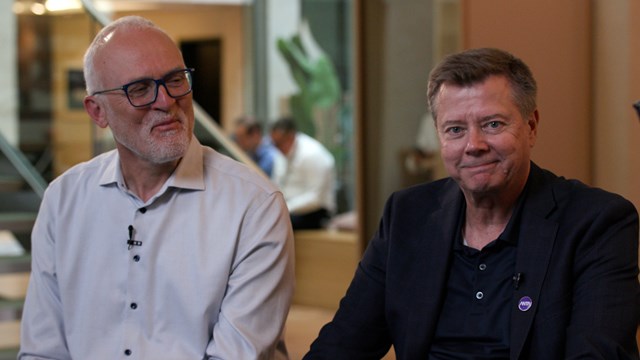
Gabriele Di Piazza, Blue Planet & Mohamed Talaye, Orange Business
Orange Business CTO Mohamed Talaye and Blue Planet’s VP of product management, Gabriele Di Piazza, discuss the shift from ticket-based to real-time OSS, platformisation strategies, and how AI agents will enable new business models in enterprise services.
Featuring:
- Gabriele Di Piazza, Vice President, Product Management, Blue Planet
- Mohamed Talaye, CTO, Orange Business
Recorded April 2026
Email Newsletters
Sign up to receive TelecomTV's top news and videos, plus exclusive subscriber-only content direct to your inbox.