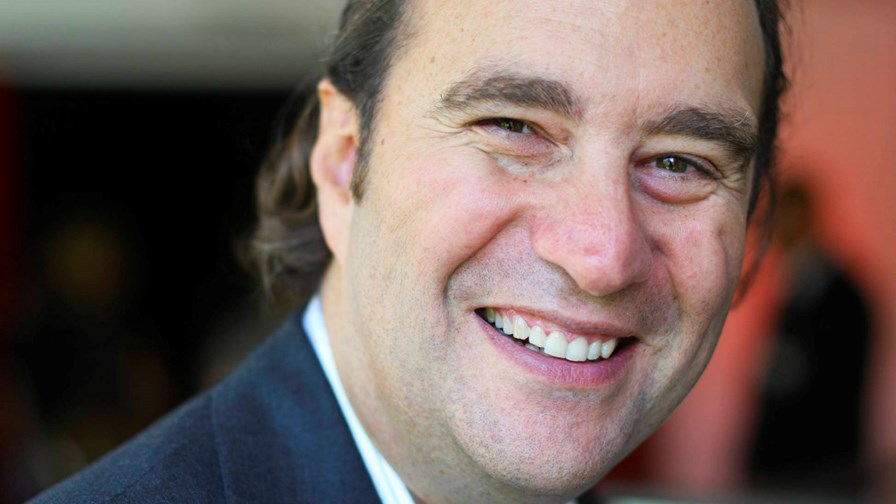
Iliad's Xavier Niel via Flickr © rsepulveda (CC BY-SA 2.0)
- Xavier Niel cuts his stake in Belgium’s Proximus to less than 1%
- AT&T teams up with Cisco to tackle quantum for businesses with SD-WAN service
- Vodafone sees revenue bump but stocks still tumble
In today’s industry news roundup: Telecoms entrepreneur Xavier Niel signals his exit from Belgian operator Proximus following government resistance to increasing his stake; AT&T partners with Cisco to launch an SD-WAN service aimed at boosting quantum resilience; despite filing positive financial results and with group revenues up 8%, Vodafone’s share price fell; and much more!
Telecom sector entrepreneur Xavier Niel, the founder and head of pan-European operator Iliad Group and who holds a number of stakes in other telcos (including Tele2 and Eir) via his investment vehicles, has reduced his stake in Belgium’s national operator Proximus to less than 1%, according to a filing by the operator. Niel had built a stake of more than 6% in state-owned Proximus and had proposed to the Belgian government that he should increase that stake further to have a greater say over the telco’s strategy, as we reported last October. But the Belgian government has continued to resist his overtures and now Niel, via his Saxo Holding investment vehicle, has signalled his exit.
AT&T’s business unit has partnered with Cisco to launch a quantum-resilient SD-WAN service that offers post-quantum cryptography (PQC), helping organisations protect their encrypted data. With the expectation that, in the wrong hands, quantum computing will pose a serious threat to traditional encryption models used by organisations that handle sensitive or regulated information, AT&T Business has launched a PQC network solution that brings NIST (National Institute of Standards and Technology) security standards into its SD-WAN offering. The PQC solution uses Cisco 8000 Series Secure Routers to deliver quantum-resilient solutions, including encryption, authentication and secure boot capabilities. The service, which AT&T Business says will be made available for its customers later this year, comes just weeks after Cisco revealed a new prototype switch that it claims can successfully connect multiple quantum computers of different types.
Vodafone has published its full fiscal year results to the end of March and, on the face of it, the operator is making decent progress with its plans and has even steadied the ship in its largest market, Germany, where it has been struggling with subscriber losses in recent years. Total group revenues increased by 8% to €40.5bn, helped by the consolidation of Three UK, while group service revenues increased on a like-for-like basis by 5.4% to €33.5bn, with all parts of the telco’s international operations reporting full year growth except for Germany, which improved over the course of the year and finally achieved year-on-year sales gains in the fiscal fourth quarter. But investors are clearly still not convinced that Vodafone is hitting the right mark, as the company’s share price tumbled by 7.6% to 111 pence during Tuesday trading on the London Stock Exchange.
If the US president is to be believed, the green agenda is “dead”. But in a week when Liberty Media-owned Formula One has rowed back on some of its ESG (environmental, social and governance) commitments by announcing planned tweaks to its engines in 2027, an operation part-owned by Liberty Global (a sister company to Liberty Media) has actually doubled down on sustainability with a new ESG strategy. The UK’s Virgin Media O2 (VMO2), jointly owned by Liberty Global and Telefónica, has set out its ‘Responsible Business Plan’ – which includes a commitment to achieve net-zero across its operations by the end of 2040, plans to double the number of people buying refurbished devices through its O2 Recycle scheme by 2030, and a promise to position itself as a champion of device reuse culture in 30 cities by 2030 – to reduce e-waste. The plan isn’t purely environmental, as VMO2’s strategy also includes a pledge to help 500,000 low-income households stay connected. The plan – which you can read in full here – focuses on four key areas: Climate, connection, control and circularity. These will embed ESG into every aspect of VMO2’s business, the operator said.
Telekom Srbija has been raising money to invest in its 5G rollout and refinance debt after its second international bond issuance raised €1.95bn, more than double the telco’s 2024 debut on the Euronext Dublin exchange. The transaction was the largest corporate bond issuance ever executed in the south-east/central and eastern European region, the company said in its announcement, with the participation of several large pension funds, insurance companies, sovereign-affiliated investors and global asset managers. Investor demand hit $13.87bn from around 300 global institutional investors. The transaction will enable Telekom Srbija to refinance existing debt under more favourable terms and will support the telco’s network expansion and 5G deployment in Serbia. It comes just days after the operator, which launched 5G at the end of 2025, secured a $50m loan from the Export-Import Bank of the United States.
SoftBank Group, the parent company of Japanese telco SoftBank Corp. (which just unveiled its new AI-centric strategy), is preparing to announce a major AI datacentre infrastructure investment in France with potential investment levels of up to $100bn, according to Bloomberg (subscription required). The details are expected to be revealed by the Japanese giant’s founder and CEO, Masayoshi Son, and French President Emmanuel Macron during the upcoming Choose France Summit. France is a hotbed of datacentre activity currently as multiple datacentre players vie to build the facilities that could play a key role in Europe’s emerging digital sovereign services sector.
UK home broadband provider Onestream has acquired the Cuckoo customer base from AllPoints Fibre Network (APFN), a move that doubles Onestream’s total subscriber numbers to about 150,000. No financial details were disclosed. The deal will see Cuckoo’s customer contract, brand and domain transfer from APFN to Onestream, while the connections will remain on APFN’s Aquila wholesale platform. Onestream, which was founded in 2016 in Hampshire, has been selling its broadband services using wholesale connections from BT’s Openreach and Vodafone but, as part of the Cuckoo customer base deal, Onestream now also gains access to APFN’s wholesale network and associated partnerships with the likes of CityFibre.
– The staff, TelecomTV
Email Newsletters
Sign up to receive TelecomTV's top news and videos, plus exclusive subscriber-only content direct to your inbox.