Telenor’s sovereign AI Factory puts Norway in control the country’s critical data

By Charlotte Kan
Mar 13, 2026
To embed our video on your website copy and paste the code below:
<iframe src="https://www.youtube.com/embed/vwJSRnwfLXA?modestbranding=1&rel=0" width="970" height="546" frameborder="0" scrolling="auto" allowfullscreen></iframe>
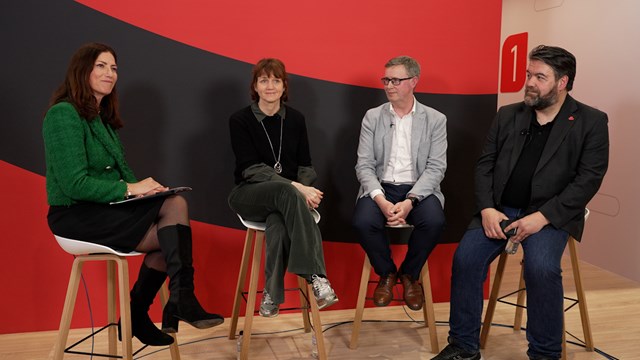
Thank you for joining us here in Barcelona for MWC 2026, where we are going to discuss Telenor's new sovereign AI Factory. This AI Factory is Norway's fast, sustainable and sovereign AI cloud platform built to handle sensitive data. To discuss it and more, I am delighted to be joined by Kaaren Hilsen, Kaaren as the CEO of Telenor AI Factory. Jørgen Brecke, who's Senior Vice President of Technology Strategy and Partnerships at Telenor, and Rich Stephens, who is Vice President of Europe, Middle East, and Africa for Telco at Red Hat. Thank you for joining us today. So Kaaren, tell us why this AI Factory and why now?
Kaaren Hilsen, Telenor (00:56):
Yeah. When it all started, it was here actually two years ago where we announced a partnership with Nvidia because we saw it was a perfect partnership. We had a problem to solve in Norway with Telenor. Telenor is sitting with processes, data systems all governed by the Security Act. And we wanted to use AI then to transform and really make our network even more resilient, but we couldn't just put that data that's super sensitive out anywhere in the cloud. So this is where our vision then together with Nvidia started to build an AI Factory. So basically what we did is we took Nvidia's sort of blueprint for the AI stack and put a Telenor-graded or telco-graded security on it. And then we thought, okay, if we can do this for Telenor, we can do this for other customers. We saw that there was a need for other customers in the Norwegian market that were sitting on sensitive data.
(01:51):
And if you think intelligence is becoming a national resource, just the same as power, electricity, food, digital infrastructure, that you can't just rely on foreign companies. You need to really take ownership and make sure that it's really the critical data is made resilient and actually controlled in the country. So this is how we started the AI Factory journey just two years ago.
Charlotte Kan, TelecomTV (02:17):
That's a very interesting and valid point actually, how data is becoming critical infrastructure, so therefore you need to protect it indeed. Jørgen now, Telenor Group truly has a proven history of innovation with initiatives like the EU project 5G-VINNI, your large 5G experimental platform, Ikora, network on wheels, advanced 5G AI agents for maritime and 6G projects, etc. So tell us more about the results from Telenor AI Factory and maybe some of the use cases that you and your customers are bringing to market based on this AI platform.
Jørgen Brecke, Telenor (02:56):
Yeah, sure. So it's an exciting journey. It's one of the innovations where we actually go early to the market. Some of the innovations you talked about on the 5G, we were quite early on, but it took a long time before we saw the market impact. But then the AI Factory saw immediate response from the market. Immediately after launching two years ago, we started to get requests from potential customers that they wanted to do innovation together with us. And we are seeing this in several areas. So one is in the kind of autonomous industry where one of our customers are using the MediaHundred to do kind of AI visioning for their autonomous driving in industry facilities. And they need low latency and they need also to make sure that the proprietary data is staying within the country and within Norway. So they are using AI Factory for that purpose.
(03:54):
Then the second area that we see a lot of innovation is in the public sector and they are also seeking on very personal sensitive data. So they have high privacy and also high archiving regulations that they need to protect and comply to. So there we see also services in providing public services using generative AI in those services to make them more efficient and also provide better customer experience for the public sector. Third area is more on our own operations where we are using AI and AI Factory now to kind of put AI into our operations. And we're using it for fault management, detecting the faults, correcting the faults using AI so that we can provide faster resolution to the problems. Hopefully before the customer notices the problem itself. So that's one area. And then we're also using AI strongly in our code generation now. And our code generation is tightly linked to the secure data.
(05:00):
So actually the code generation and the data management we need to use on a secure sovereign platform like AI Factory.
Charlotte Kan, TelecomTV (05:07):
So many applications here. Now, Rich, let's hear your perspective at Red Hat since Telenor selected Red Hat as their core environment for building, training, and deploying AI-based agents and applications, including retrieval augmented generation, also known as RAG and agentic workflows with Llama Stack. So tell us, how are you supporting Telenor?
Rich Stephens, Red Hat (05:32):
It's great. Thanks, Charlotte. I think for us, first of all, I'd say we're really grateful and proud of the partnership with Telenor. I think we genuinely are leading the industry in what we're doing together, which I think is fantastic. And for us, I think there's probably three areas. When we look at the cloud-native platform that Red Hat provides with OpenShift AI, it's really looking at how we can ... The first point would be how we look at creating a lifecycle for agentic AI, how we can help move everything from keeping complexity, we keep simplicity in that environment. We help the data scientists really develop from complex models, RAG workflows all the way through to how you do the training models on maybe an Nvidia GPU all the way through to which VLLM you want to choose. And then really leading through into our Ansible platform, which really helps take the data and look at providing insights on that data to see how you can automate and really deliver automation to reduce the workload and the workflows.
(06:28):
So I think that's the first point. The second point is something we call technological sovereignty, which is really looking at with the Red Hat platform. If you look at what we would call the factory floor as a product, how do we then take that and how can we separate the hardware layer from the operational layer and really giving the ability to run any model on any platform. And that's a really important thing because as use cases build and get complex, we want to be able to drive the innovation and be able to deliver. And then the third thing would be, I guess, human sovereignty looking at something that Red Hat's really proud of. We just launched a sovereign support, which means only EU nationals, EU residents will work on any product or programme. And I think that really helps them protect the data and the metadata that's being used by Telenor and our joint customers, right?
Charlotte Kan, TelecomTV (07:16):
So it's about removing all those barriers
Rich Stephens, Red Hat (07:18):
So
Charlotte Kan, TelecomTV (07:18):
Innovation can
Rich Stephens, Red Hat (07:19):
Fly. It's keeping a platform that allows everyone to innovate, trying to remove the blockers of innovation.
Kaaren Hilsen, Telenor (07:25):
And if I just add, because I was just listening to it, because you say the blockers and barriers, and then ... And AI is all about experimentation, but it's a bit scary to do it when you've got sensitive data that's under a Security Act. And we've seen that that has been one of the biggest barriers. I mean, there was even this report out, I think last year from MIT saying that 95% of GenAI cases fail to give value return, because the 5% that succeed, they're the ones that are really going deep down into those processes, systems, and everything. And then what we're trying to do here together with Red Hat is to actually give the customers and the examples you gave Jørgen a platform to help them experiment in a safe and secure environment. And sovereignty has also become a bit of an emotion as well.
(08:12):
So you sort of give this and we try to give, I think that the beauty of what we've designed together here, it gives the customer the flexibility and scalability so they can start to experiment in a secure environment and then scale as their cases go. And we see that with Telenor's own use cases you said. They started off, as you know, with a few GPUs and just within six months, they've tripled the usage. So I think we're onto something good.
Rich Stephens, Red Hat (08:39):
I think so. I would agree with that. 100%.
Charlotte Kan, TelecomTV (08:41):
And Kaaren, here at MWC, the conversations are still very much focused on AI, of course. And there's a topic there that's taken the back burner somehow and it's sustainability, and yet it remains a very important conversation still. So tell us about sustainability as part of your AI Factory solution. What are you doing around that field and what is it enabling?
Kaaren Hilsen, Telenor (09:02):
As you said, unfortunately, it's getting forgotten about in a lot of dialogues. And that sort of upsets me a bit because they actually say the emissions from data centres now exceed airline industries and all this. So I even heard a comment and we said, "Yeah, but don't worry. AI is going to solve climate change." But we can't let that happen. We have to continue to do that. And that's why we say our AI Factory is sovereign, secure, and sustainable. We only use renewable energy, and so it's 100% sort of hydropower generated. And in addition, all the excess heat from these sort of high power GPUs producing heat is going back into district heating. So we've really sort of tried to make sure that we put that sustainability stamp on it and make sure it's in every dialogue that we have as well.
Charlotte Kan, TelecomTV (09:52):
That's important. It almost sounds like sustainability by design really in this solution. Rich, you've mentioned that your job, of course, at Red Hat is to facilitate innovation and help your clients thrive. So what are the practical challenges that organisations that work with you face when implementing sovereign AI? And how does Telenor AI Factory built on Red Hat's solution address potential issues?
Rich Stephens, Red Hat (10:19):
Yeah, no, I think that's a good question. Kaaren touched on it a little bit there. I think I looked at probably the most important question we get constantly is about compliance and security and obviously the CSA that's been out now for a couple of weeks and everyone reviewing that and digesting that. But it's about, again, how do we ... The Red Hat platform is secure by native. It's cloud-native. So we want to make sure that we take sovereignty is embedded in everything we do and security. And I think that's a key thing we get from our customers. I think the second is about making sure we have as much inflexibility in our architectures as possible. So in the Telenor case, it would be using the amazing data centre of the SkyGuard data centre, using 5G edge, wherever that's going to be inside that sovereign environment is super important to be able to make sure you've got architectures that can actually stretch to whatever use case you might want to use.
(11:11):
And as we figure it out together and customers figure it out on what they want to use AI for or where we think AI is headed in terms of the first wave of real use cases that drive value. And I think there, I said it before, but I think sovereignty about the humans, about how do we make sure that when it's not good enough just to have a platform that's sovereign, the people that are working on that need to be sovereign. They need to be in the country, in the region, inside the EU, go back to talking about some of the acts and some of the geopolitical sensitivities that are coming out, we need to make sure that that sits within the EU.
Charlotte Kan, TelecomTV (11:45):
Well, thank you for that. A final question for you, Jørgen, because you mentioned that Telenor AI Factory is described as more than a platform. It's a community, really. A community of builders, of experts, of partners working to accelerate responsible AI adoption. So tell us about the role of the ecosystem and your partners here in this solution.
Jørgen Brecke, Telenor (12:07):
Yeah, no, and what a better place to talk about it here than MWC where the whole event is filled with partners. So the ecosystem has been important from day one. And when we also started, we were sure that we could not build an AI Factory alone. So we have worked with partners and we worked with ecosystem from the beginning, starting with Nvidia, then also with the foundation of our data centre, building a data centre in Norway that is secure, is sovereign, and is also kind of sustainable has been important. And building that with partners, providing green energy, and also being able to recycle the heat provided by the GPUs back into the city and warming up 15,000 homes. So that's a partner around building the foundation. And then we have partners in the technology space with Red Hat and being the core of the services that we provide, then we provide GPU as a service.
(13:07):
Having a strong Kubernetes platform that is portable is something that customers actually appreciate. They need to also feel that they are resilient. They're not stuck with Telenor or we want them to work with us, but they shouldn't feel that they're stuck so that it's portable is very, very important. And that's also something that we feel will be beneficial when we talk about the edge cloud, that we are able to do inferencing closer to the edge to keep kind of providing ultra low latency to the future AI services. And then lastly, is around all the developers. That's where really the innovation is happening. So attracting different types of companies and kind of a safe playground, as Kaaren said, so that they can actually test and kind of innovate new services has been important for us to build that ecosystem around the AI Factory. Well,
Charlotte Kan, TelecomTV (14:03):
Thank you very much for sharing a very powerful example of how collaboration can lead to very impressive results around energy use in particular. That's a great example of the power of the pack really here. Many thanks to all of you for a great conversation around sovereignty and protection of data, many thanks to Kaaren, Jørgen and Rich.
Please note that video transcripts are provided for reference only – content may vary from the published video or contain inaccuracies.
Jørgen Brecke, Kaaren Hilsen, Telenor & Rich Stephens, Red Hat
At MWC26, Kaaren Hilsen and Jørgen Brecke from Telenor and Rich Stephens from Red Hat discuss Telenor’s AI Factory, a sovereign AI cloud platform designed to securely handle sensitive data in Norway. They share the origins of the project, its green credentials, its focus on national data sovereignty, and its applications in sectors such as industry, public services, and Telenor’s own operations.
Featuring:
- Jørgen Brecke, SVP Technology Strategy & Partnerships, Telenor
- Kaaren Hilsen, CEO, Telenor AI Factory
- Rich Stephens, Vice President, EMEA Telco, Red Hat
Recorded March 2026
Email Newsletters
Sign up to receive TelecomTV's top news and videos, plus exclusive subscriber-only content direct to your inbox.