Sovereign AI factories: The challenges and opportunities for telcos

By Tony Poulos
Mar 5, 2026
To embed our video on your website copy and paste the code below:
<iframe src="https://www.youtube.com/embed/fug4M9GPDQ0?modestbranding=1&rel=0" width="970" height="546" frameborder="0" scrolling="auto" allowfullscreen></iframe>
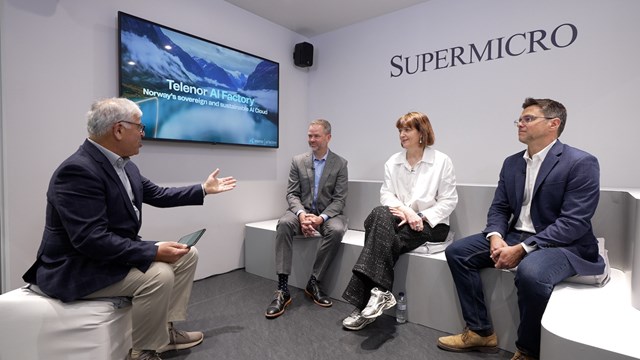
Tony Poulos here with TelecomTV, and today I'm going to find out all about sovereign AI factories. And to help me, I have with me Clay Simmons, who is the Vice President, CGO, Chief of Staff at Supermicro. Welcome, Clay. We have Kaaren Hilsen, who is the CEO of Telenor AI Factory. Perfect person to have on this panel. And also Joao Kluck Gomes, who is Senior Director, Business Development, AI Factories and Applications at NVIDIA. Welcome to you all. I'm going to start with you, Kaaren, but here's a really long question. We're hearing about sovereign AI more than ever, particularly in Europe and the Nordics. At the same time, we're seeing telecom operators stepping into the new role by building AI factories. What's driving this shift and why are telcos uniquely positioned to deliver sovereign AI?
Kaaren Hilsen, Telenor (01:01):
Wow. You said it was a long question. It is. Okay. But I think, I mean, if we sort of look back historically, telcos have been building sovereign networks for years. We've been taking sort of global technologies and building a network that's very secure for the countries. Yep. So what we thought would better fit for a telco than to take a world-class sort of the NVIDIA AI stack and actually then put the telco graded security levels on it. So this is why then the AI factory was born then in Telenor. So we're building this, we call it the sovereign, secure and sustainable AI factory. Bit of a mouthful, all the S's there. So super, super important. And the journey started because Telenor itself had a need. We're sitting with super sensitive data that you can't just put anywhere into the cloud to produce your intelligence.
(01:54):
So back to, I love the quote your CEO has, every country has to own the production of its own intelligence and intelligence is becoming a critical resource just as infrastructure is. So we actually built this for Telenor to be able to develop its own AI use cases on our AI factory. Well,
Tony Poulos, TelecomTV (02:13):
You threw a hospital pass to Joao, so it might be good for him to respond to that, IP.
Joao Kluck Gomes, NVIDIA (02:17):
Yeah. I think sovereign AI is about the importance of AI at the end of the day. I think in the past several years, we have seen AI become part of our life, everything we do and how we do it. And more and more, that is an essential technology and essential technology needs essential infrastructure. And every country wants to be part of the AI creation of the AI economy. And as they build those capabilities, who better than the telcos to go do that? Because if you think about telcos, they are a provider of sovereign capabilities today, right? Connectivity, fibre, everything that our culture needs to communicate. So it's just natural for them to extend that decision infrastructure from communications to AI, create a national ecosystem, create wealth in big part of the AI economy, I think is natural and it makes a lot of sense.
Tony Poulos, TelecomTV (03:11):
Well, Clay, you're working with telcos, I know. Why do you think they're in a position to provide these AI factories?
Clay Simmons, Supermicro (03:17):
Yeah, I think just piggybacking off of some of their comments, especially in the EU regions, the GDPR and the requirements for privacy, telcos have this already innate within them. So for a new entrant into the market to develop an AI factory, they don't have this. They don't understand the SLAs and the security requirements that the telco already has within their ideological processes and their overall business operations. And so I think also too, with the interdependencies of other foreign countries, and of course there's so many countries here, even within the EU, that the sovereign AI is having telco drive the sovereign AI is a really good approach. Additionally, I think just the telco having these distributed systems already of connectivity, they have a lot of flexibility to deliver compute, both centrally and also disparate.
Tony Poulos, TelecomTV (04:30):
Well, of course, it's one thing to define a strategy. It's another to build it. Telenor launched the state-of-the-art AI factory in Norway. What did it take to turn this vision into reality and what were the biggest business and technical challenges along the way? Kaaren, you'll be the best to answer that first.
Kaaren Hilsen, Telenor (04:47):
And there has been challenges. I always say to my team, if we have a day without challenges or problems, then we have a problem. But it started off ... I mean, Joao, I always remember you said you have to just believe, just believe. And it was like, yeah, but how do we believe? What do we do? But it is, it's starting with a belief. We started small. We actually started building a very small AI factory first where we tested, we took Telenor as a use case, but also external because as you said, many other customers came to us. They actually have critical functions in Norway and saying, "Okay, you've got the learnings from your security, you've been doing this for years. How can we put our data in?" So we started off with a handful of customers on a small AI factory. We're now running pilots.
(05:32):
We're running pilots also with the public sector in Norway, testing out. And then our ambition then is to take those and scale up with our customers. But AI is a bit sort of scary as well. It's about experimenting, but how do you experiment with sensitive data? So again, it's sort of putting that telco sort of almost trusted stamp and the security and letting customers be courageous and dare to experiment in the factory. And then as I said, the ambition is to then scale with the customers.
Tony Poulos, TelecomTV (06:06):
And how are you helping out with all of this, Clay?
Clay Simmons, Supermicro (06:08):
Yeah, I think it's really about the partnership and the alignment that we've had for now a couple of years, several years, right? So first, the great partnership that we've had with NVIDIA and then the new relationship that we've forged with Telenor. I think to be completely transparent, we have not really been a Supermicro, an incumbent in telco. So it was interesting to bring these two companies together because Telenor wanted to get into AI and we do that really well. So it was kind of departing maybe from the more traditional telco ideologies and focus. I think I got to give a lot of credit to Telenor and to Kaaren for thinking beyond and seeing the bigger picture of what could be the future for telco and allowing us to come in and partner with them to deliver a whole new set of services beyond voice and data.
Kaaren Hilsen, Telenor (07:18):
But can I just, because I think we shouldn't underestimate. I mean, the power of partnerships and is, I always say building the AI Factory is about co-creation and collaboration. And this is something we purpose here. We can't do everything ourselves. I mean, we're sitting with sort of great expertise here and is sort of taking these and putting the pieces together. And I think you're going to see this more and more now, sort of these ecosystems of partnerships evolving because we can't sit back and wait to sort of, now we need to be there. And I think that's the beauty of the partnerships.
Tony Poulos, TelecomTV (07:49):
Well, it's a whole new world for telcos and that's why these guys are with NVIDIA. Everyone wants to be with NVIDIA with, you mention AI, they mention NVIDIA. So what's your role helping out?
Joao Kluck Gomes, NVIDIA (07:59):
AI is still a new technology. I think we're all impressed with how quick it's happening. But if you think about it, this is still a nascent technology. So we're still pretty much into the creation process of AI. So we're all learning and exploring all the possibilities. And I think that is a challenge, but it's actually an opportunity because especially on the sovereignty space, right? The role is how do we enable this local ecosystem? How do we help the country become part of the AI creation process? So we are seeing telcos not only investing in infrastructure, and that is a basic foundational capability, but going beyond that, creating national models for the country that really represent their language, their culture, that incorporate the events and the things that are important for the people. We are seeing telcos even building upon that model to create a national or local or localised ecosystem that can create applications that are highly relevant for the people that addresses their needs, their cost points.
(08:58):
And I think this is really like the important part of sovereign AI, to create that local ecosystem, to enable that AI creation process. And nobody better than telcos to do that because they have that national entity and the people and the universities and the schools and everything else that it takes. So this is a lifetime opportunity for all of us and telcos in particular.
Tony Poulos, TelecomTV (09:20):
And quite a challenge with 27 or 28 different countries and nationalities in Europe alone, which have different ideals and different refinements. So it's amazing that we're getting this far with it. But looking ahead, this feels bigger than a single data centre. If we fast forward three to five years, what does success look like and how does this evolve into the broader AI ecosystem? I think I'll start with you on this one. Sure.
Clay Simmons, Supermicro (09:47):
Well, I think what Telenor's done with the AI factory, it'll be the cornerstone, I think, for Telenor's future. And telcos alike, right, that engage in AI data centres. It'll be the heart and surrounding the heart will be a very complex and powerful network of connectivity. And that's something very unique for telcos so that they will be able to have a distributed compute. So where they're doing training in a centralised function, now they'll be able to deploy inferencing and other services and deliver beyond traditional voice and data, a whole new set of offerings that we haven't even thought of yet. And very exciting. So I'm looking forward to what Telenor does with this.
Tony Poulos, TelecomTV (10:39):
Well, what are you planning for the future?
Kaaren Hilsen, Telenor (10:42):
It's a bit when you say what does success look like? And I want to measure it that is actually helped society move forward. I mean, that to me is, I mean, that's why I get up every morning thinking we're really contributing to make a better society. And it sounds a bit idealistic, but it is true. I mean, it really is taking these sort of tough cases. It's transforming societies, helping, whether it's in the health sector, the public sector within energy, I mean, telcos, I think there's so many opportunities here. So really, our ambition is to really help move societies forward. And we're starting in Norway. We have a Nordic footprint. I mean, there's so many, as you say, the learnings we take, the sharings to ... Can we say make the world a better place? I don't know, but it's sort of thing. But as I said, we can't forget sustainability either.
(11:33):
That element is so important here. Well,
Joao Kluck Gomes, NVIDIA (11:35):
I'm pretty sure Joao has a pretty good idea of what's going to happen for five years. Just getting excited. I always get when I hear Kaaren talking. But yeah, I think about use case and I think everything that AI can do for the citizens, for the people of the country, like you think about healthcare and imagine AI systems helping people get the healthcare that they need, calling them and advising them and helping them go through the systems or education, right? The role of AI in education is just scratching the surface. And all of these areas that are natural hot telcos, right? Like building the infrastructure, building the models, building the application, and they bring the people to use it through mobile phones, right? In many countries is mobile phone centric countries and people who access that AI to their cell phones or even like we are seeing the development of voice driven AI assistants that in many countries is what makes more sense, right?
(12:28):
People want to talk with systems in natural language, the way they talk to all of us. And I think the future is bright and they're seeing all these opportunities and telcos are at the forefront of it to make it happen.
Tony Poulos, TelecomTV (12:43):
Well, knowing that the regulators in Europe and particularly in Europe are probably watching closely on sovereign AI as well and probably driving a lot of it. And are your customers asking for sovereign AI? Do they know what it is? I'm wondering, I suppose the future is going to be very critical for getting everyone involved in this. Thank you so much for being with me today. It's been great understanding more about sovereign AI factories. Thank you all.
Clay Simmons, Supermicro (13:05):
Thank you.
Tony Poulos, TelecomTV (13:06):
Thank you.
Joao Kluck Gomes, NVIDIA (13:07):
Thank you.
Kaaren Hilsen, Telenor (13:07):
Thank you.
Please note that video transcripts are provided for reference only – content may vary from the published video or contain inaccuracies.
Panel Discussion
Kaaren Hilsen of Telenor, Clay Simmons of Supermicro and Joao Kluck Gomes of NVIDIA explore the emergence of sovereign AI factories, particularly in Europe and the Nordics. They discuss why telecom operators are well positioned to deliver sovereign AI, the technical and business challenges faced in building these factories, and the importance of partnerships and collaboration. The conversation also covers the future impact of AI factories on society, the need for secure and sustainable solutions, and the evolving role of telcos in enabling national AI ecosystems.
Featuring:
- Clay Simmons, Vice President, CGO Chief of Staff, Supermicro
- Joao Kluck Gomes, Senior Director, Business Development – AI Factories & Applications, NVIDIA
- Kaaren Hilsen, CEO, Telenor AI Factory
Recorded March 2026
Email Newsletters
Sign up to receive TelecomTV's top news and videos, plus exclusive subscriber-only content direct to your inbox.