To embed our video on your website copy and paste the code below:
<iframe src="https://www.youtube.com/embed/alq6uMdfd_Q?modestbranding=1&rel=0" width="970" height="546" frameborder="0" scrolling="auto" allowfullscreen></iframe>
Speaker 1 (00:07):
We're in Barcelona for MWC26. I'm here with Rob Joyce. He is Director of Mobile Ancest Engineering at Virgin Media O2, the UK operator. Rob, great to see you. Thanks so much for joining us today.
Speaker 2 (00:21):
Great to be here. Looking forward to it.
Speaker 1 (00:22):
This show is almost turning into an AI show, but it's important to come back and look at the mobile, the pure mobile aspects of things as well. So what are the key customer trends that you're seeing currently that are impacting the way you plan and manage VMO2 cellular network?
Speaker 2 (00:41):
Well, we talked to our customers and we really want to understand what they want from a mobile network. And it's quite simple really. They want reliable coverage everywhere. So that's our strategy is getting the largest and the most reliable coverage out across the UK. I mean, we're spending 700 million pounds this year on our mobile transformation program, and that's all about adding coverage primarily through O2 satellite. And I know we'll talk about that in a minute, but it's also about adding an additional two terabits of capacity to the network so that when our customers have connectivity, they've got reliable capacity as well. So that's the crux. People want to do TikTok, people want to do YouTube on a train. It's not just a question of here, there, and it's everywhere. We want solid coverage everywhere, trains, airports, stadiums, et cetera. So it's what we call our moments that matter.
(01:35)
There's nothing worse than you've probably done it yourself, get into a ticket booth where you need to download that QR code and it just doesn't work. We need reliable coverage everywhere. So that's our strategy.
Speaker 1 (01:45):
Yeah. Well, I mean, this show is a perfect example of how you can make the experience good. Or if you go back a few years not so good and they've managed to figure that out over time. Now, there's been a lot of talk, particularly in the past year or so about the anticipated growth in uplink data traffic from end user devices. Are you expecting this to be a trend and a pressure on the networks? And how can you plan for this?
Speaker 2 (02:15):
Yeah, a great question. And we've been monitoring this. We can see that there could be a shift towards Uplink, depends on wearables, et cetera. And I'm looking forward to going around the stands this week and actually seeing what's coming down the line. But key facts then, we've seen 30% growth in uplink traffic over the last two years. Uplink has grown faster than downlink in our network over the last two years. So there is an underlying trend there that we're monitoring. And what we're doing now is we're beginning to forecast scenarios where we've got small, medium, large growth on the uplink so that we're ready to be able to cater for that growth. And we're quite lucky in that we've got a lot, as O2, we've got a lot of TDD spectrum. So we've got the 3.5, we've got the 2.6, we've got the 2.3. And actually shifting the frame structure in TDD is quite simple.
(03:10)
It's parameterization rather than physical changes. So if we needed to, we could start dedicating more of the TDD spectrum towards Uplink. So we're quite comfortable that we could cope with a growth in Uplink. We're just now watching how this grows over the next couple of years. And as I say, I'm hoping to get to the likes of Qualcomm and the other chip manufacturers to see what they've got coming down the line because the chips that they'll be showing today is what will be in handsets in 18 months, two years time. So that gives a good idea what's coming, especially chips for wearables. I think that's the key thing here, because if we start seeing streaming to a cloud for AI inference of videos, then that's really going to start putting load on the uplink of the cellular networks.
Speaker 1 (03:53):
Yeah. The chip companies and the test and measurement companies usually have- Precisely. Have things out there before. That's right. Ahead of the game usually. It's really hard to have any conversations here without talking about AI. So we're going to get to that now. But in what ways is AI helping you with network management and monitoring of what's going on? And is it making your life easier? Can you see that already?
Speaker 2 (04:17):
It is. I mean, AI is coming in. I mean, it helps me write my weekly report, to be honest, but more seriously, design drawings. We get design drawings from our multiple partners and we used to spend hours reviewing them all the dates wrong, all the scales wrong. We're now using AI to do a lot of that legwork for us. So we're reviewing detailed design drawings using AI. It's saving us about 8,000 man hours a year in terms of effort.
Speaker 1 (04:41):
Wow.
Speaker 2 (04:41):
And it means that when we do get a design drawing from our partners, when we open it, we're fairly sure it should be what we want. The other thing we're using AI for is in our Sun platforms. So we've got a Sun platform across the O2 network. It makes 20,000 changes per day on the network automatically, so closed loop. We're beginning to put AI more and more into that platform. So we can start to do clever things like tilts during the day, et cetera. We can look for sell outages and then react to those. And then we can also start thinking about AI in terms of how we perceive the user's experience on the network. So we can start seeing, oh, Ray had a bad day, I'm going to say a bad day, but Ray had a bad experience at this train station today and then he had another one yesterday.
(05:32)
We need to do something. We need to maybe talk to Ray, make sure that we tell him we fixed that station or it will get fixed next week. So we're using AI to try and, I guess, give individual users a great experience on the network and actually monitor for, I guess churn prevention is really what I'm trying to say here, that we're using AI to monitor each and every user's experience of the network.
Speaker 1 (05:56):
Yeah. No, I mean, that's an important part of it. There's a lot of focus and talk these days about revenue generation, but churn management is as big an economic factor as anything else for the mobile operators in saturated markets.
Speaker 2 (06:10):
Yeah. It goes back to my point about the strategy being the largest and the most reliable network. Clearly catching these pain points where our customers are key, if we're going to live up to that sort of mission of ours.
Speaker 1 (06:23):
Now, one of the still incredibly important topics for operators that's maybe being pushed aside a little bit here at WC in the past couple of years by AI is energy efficiency. Are there any emerging capabilities or processes that are helping VMO2 to manage its RAN power consumption better year on year?
Speaker 2 (06:47):
Yeah. Well, I'll start maybe first of all with the simple stuff, and that's network refresh. So clearly we're now rolling out a new generation of towers across the network, our gigasites, and they're much more energy efficient in terms of bits per what bits per what or what's per bit, whichever way you want to look at it, but it's certainly more efficient. So that's helping us become more efficient. The other thing that we're doing is we're using our SON platforms to actually do power management now as well. So 70% of our electricity bill is on the RAN. So certainly it's an area that we're targeting now to make sure that if we can save 10%, that's millions of pounds of savings. So we're using SOM to do what we call power downs. So low traffic power downs. And we don't just use SOM to do it, for example, midnight to 5:00 AM every morning.
(07:39)
We're flexible. So we'll monitor a site, we'll see how the traffic changes, we'll predict when the traffic's going to change, and then the sun engine will then power down that site. It'll turn off carriers, it'll turn off parts of the beam corming to reduce power on the massive mime radios because ultimately they're there for capacity. So you don't need capacity in the middle of the night, so you can start stepping down to some of the base layers. And because we've put 5G on multiple frequency layers in our network now, we can do that. So we've got 5G in 700 megs now. We've just finally finished turning 3G off. So we've got 900, we're putting 5G on the 900 band. So we've got 5G standalone on the low bands now. So on a gigasite that's got 3.5, 2.6 as well, we can power down a lot of the high band capacity on a night and just stick to the low band 5G bands.
(08:29)
So that's what we're doing to save efficiency. And as I say, if we could save 10% of that, 70% of our power bill, it's a lot of money.
Speaker 1 (08:38):
Yeah. You mentioned satellite earlier on, of course. Out of nowhere in the past couple of years, satellite communications, but particularly for the mobile operators, director device or satellite to smartphone, this is now a really big part of a lot of operator strategies. And of course it is with VMO2 as well. VMO2 just announced its relationship or just started the service with Starlink. How is this impacting your strategy and the way that you're thinking about the network, I guess the extended network now?
Speaker 2 (09:12):
Well, O2 Satellite, you're right, launched this week. So it's our tie up with Starlink. We're the first European operator to bring device to device data services to Europe. And we're really excited. We've gone from 89% land mass coverage of the UK to 95%. Put that in basic terms. That's about two thirds the size of whales added to the network overnight. So our customers now have much more reliable coverage. And as I said, go back to my strategy. It's all about being the biggest, being the most reliable, and this is a key underpinning factor of that.
(09:51)
It's interesting. You're right, D2D has sort of come from drawing books to being here quite quickly, and we're quite excited to be partnering with Starling. They've got the biggest D2D constellation currently, 650 satellites in that constellation. Each satellite has about 40 spot beams on it, and then we're dedicating five megs of our 1,800 to the satellite. So it can do text, it can do WhatsApp, it can do WhatsApp calls. It's probably about up to about four megabits per second for Swapbeam. So it's a decent 4G data service. Clearly it's aimed for areas outside of the terrestrial area. It doesn't serve indoors clearly. It won't go through the metal roof of a car, but certainly goes through my glass roof for the Tesla. So it does work in cars with glass roofs, but it's for the hikers, it's for the sailors, it's for the bikers. It's making sure that you've got a service that you know when you go up to the highlands of Scotland, you've got dedicated or you've got reliable text messages.
(11:00)
You know that you can text 999 if you needed to. And that's what it's all about. If you remember I said that the underpinning strategy is coverage first, then capacity and then capability. And this is our base coverage layer now. And it's a compliment to the terrestrial network. You only select it when you are in a real not spot. So it's not like we're going to cover London or you can choose to use it in London, you can't, because in London we've got our gigasite capacity there and that's where you best serve. It's for those not spots that we may never cover it in the future. So certainly what surprised me when I came back was to see SRN. So again, the shared rural network, we've been building out sites. We're now coming to the end of that and probably that's a good point to say, okay, in rural areas, we've built what we need to in terms of physical infrastructure.
(11:57)
The last mile is going to be the satellite and it makes more sense to cover the far rural areas using satellite than building new powered infrastructure on the ground.
Speaker 1 (12:09):
And so just to clarify on a point you mentioned there, clearly this service is for when you're out of reach of the terrestrial network, but just in a theoretical situation where the network wasn't available for some reason or another, or you were at the top of very, very high building and the internal network and small cells went down in a city, is that connectivity, is it there in theory or is it ... If you're in the center of London, for example?
Speaker 2 (12:43):
Well, it's there. So the satellite network covers pretty much the whole of the UK. We stop at the 58th parallel, so that's Inverness upwards. We're just waiting for more launches to take us beyond there. So it does cover the whole of the UK. Yes, if you were in a city and you'd subscribe to the service, it's a three pound a month bolt-on monthly, so it's affordable. Yeah. If you lost cellular connectivity, you would reselect to the satellite. Can it cope with the capacity of London? No, it can't, but certainly it's there. So it's there as a reliable backup as well.
Speaker 1 (13:20):
Sure.
Speaker 2 (13:22):
Yeah. So like I say, I've been testing it. I'm quite excited to see it launch. We're seeing some good feedback now on the web from early adopters and yeah, we're looking forward to really seeing what people do with it. And as I say, it's mainly aimed as, as I mentioned, more for the hikers, the bikers, the salers, et cetera.
Speaker 1 (13:42):
Yeah, absolutely. And then finally, another much more actually of a theme here this year. 6G has been brewing up for a few years already and then the standards process got going last year, but there seems to be an acceleration of developments this year. Is this something that you're planning for, you're thinking about and how you develop your existing 5G infrastructure and how that's going to evolve into the 6G era?
Speaker 2 (14:14):
It is. We recently ran RFP. We yet to announce the results of that, but clearly we've got an eye on the future there. So we want to make sure that the kit that we're deploying today is ready for the future. Clearly with traffic growing still at roundabout 20% year on year, so whether that's the uplink or the downlinks, if we multiply that out a few years, it means traffic still doubles every five years on the network. So we're not in this no growth era, it still doubles. So we're going to need more capacity on our macro cells in the next five years. Now, whether that's 5G or 6G, certainly we need something. And we see that the six gigahertz band is the prime candidate for the new spectrum. I think most likely if we're going to develop new technology for a new spectrum, it will probably be 6G.
(15:09)
We've been recently been up to the vendors and looking at their 6G research labs. I've already seen a 6G prototype handset this sort of size doing two gigabits per second indoors on six gig from an outdoor macro. So the interesting thing is the massive MIMO panel at six gig can be a similar size to the current massive mime panel at 3.5 gigs, but because it's got more elements, it gets pretty much a similar downlink range to 3.5. So we do think that six gig is the answer. The challenge that we have as UK, PLC, is that OFCOM are still sort of dancing around the, should we give it to cellular or should we give it to WiFi? We think we should align with the European position on this.
(15:58)
We think it would be nice. There's now three operators effectively in the UK. It'd be nice if there were three, 200 meg channels and at the minute the way Ofcom trying to share the wifi and the cellular, you can't quite do that. So I think Ofcom hopefully we'll see the light and we'll be assigning that. But I do think that 6G is coming. Of course, there's lots of speculation about what's it going to be used for. For me, it's all about capacity. We know capacity is growing. We know we're going to need new system to cope with that capacity and six gigahertz is key to that. And I expect that 6G will be provisioned in six gig, but also across all the other bands, just as we've seen with 5G now, we're refarming our old 3G spectrum this week to 5G. Certainly we expect that we'll see 6G being placed in the legacy bands and 600 megahertz is now being talked about so that we could expect a new low band as well in that sort of timeframe.
(17:00)
So it'd be interesting to see what comes out with WRC in terms of the six gig and the 600 meg band as well. It is. Exactly.
Speaker 1 (17:08):
Yeah. All eyes on that. Rob, great. We covered a lot of ground there, but great to hear what VMO2 is doing and how you're thinking about all the different aspects and look forward to catching up with you again soon. And good luck at the show here and getting some more ideas about what's going to give you- Sleepless nights. Sleepless nights, but also the opportunity for new innovation and thinking about things a bit differently.
Speaker 2 (17:38):
Great. Thank you. Thank you
Speaker 1 (17:39):
Very much for your time. Thanks
Speaker 2 (17:40):
For having us.
Speaker 1 (17:41):
Cheers.
We're in Barcelona for MWC26. I'm here with Rob Joyce. He is Director of Mobile Ancest Engineering at Virgin Media O2, the UK operator. Rob, great to see you. Thanks so much for joining us today.
Speaker 2 (00:21):
Great to be here. Looking forward to it.
Speaker 1 (00:22):
This show is almost turning into an AI show, but it's important to come back and look at the mobile, the pure mobile aspects of things as well. So what are the key customer trends that you're seeing currently that are impacting the way you plan and manage VMO2 cellular network?
Speaker 2 (00:41):
Well, we talked to our customers and we really want to understand what they want from a mobile network. And it's quite simple really. They want reliable coverage everywhere. So that's our strategy is getting the largest and the most reliable coverage out across the UK. I mean, we're spending 700 million pounds this year on our mobile transformation program, and that's all about adding coverage primarily through O2 satellite. And I know we'll talk about that in a minute, but it's also about adding an additional two terabits of capacity to the network so that when our customers have connectivity, they've got reliable capacity as well. So that's the crux. People want to do TikTok, people want to do YouTube on a train. It's not just a question of here, there, and it's everywhere. We want solid coverage everywhere, trains, airports, stadiums, et cetera. So it's what we call our moments that matter.
(01:35)
There's nothing worse than you've probably done it yourself, get into a ticket booth where you need to download that QR code and it just doesn't work. We need reliable coverage everywhere. So that's our strategy.
Speaker 1 (01:45):
Yeah. Well, I mean, this show is a perfect example of how you can make the experience good. Or if you go back a few years not so good and they've managed to figure that out over time. Now, there's been a lot of talk, particularly in the past year or so about the anticipated growth in uplink data traffic from end user devices. Are you expecting this to be a trend and a pressure on the networks? And how can you plan for this?
Speaker 2 (02:15):
Yeah, a great question. And we've been monitoring this. We can see that there could be a shift towards Uplink, depends on wearables, et cetera. And I'm looking forward to going around the stands this week and actually seeing what's coming down the line. But key facts then, we've seen 30% growth in uplink traffic over the last two years. Uplink has grown faster than downlink in our network over the last two years. So there is an underlying trend there that we're monitoring. And what we're doing now is we're beginning to forecast scenarios where we've got small, medium, large growth on the uplink so that we're ready to be able to cater for that growth. And we're quite lucky in that we've got a lot, as O2, we've got a lot of TDD spectrum. So we've got the 3.5, we've got the 2.6, we've got the 2.3. And actually shifting the frame structure in TDD is quite simple.
(03:10)
It's parameterization rather than physical changes. So if we needed to, we could start dedicating more of the TDD spectrum towards Uplink. So we're quite comfortable that we could cope with a growth in Uplink. We're just now watching how this grows over the next couple of years. And as I say, I'm hoping to get to the likes of Qualcomm and the other chip manufacturers to see what they've got coming down the line because the chips that they'll be showing today is what will be in handsets in 18 months, two years time. So that gives a good idea what's coming, especially chips for wearables. I think that's the key thing here, because if we start seeing streaming to a cloud for AI inference of videos, then that's really going to start putting load on the uplink of the cellular networks.
Speaker 1 (03:53):
Yeah. The chip companies and the test and measurement companies usually have- Precisely. Have things out there before. That's right. Ahead of the game usually. It's really hard to have any conversations here without talking about AI. So we're going to get to that now. But in what ways is AI helping you with network management and monitoring of what's going on? And is it making your life easier? Can you see that already?
Speaker 2 (04:17):
It is. I mean, AI is coming in. I mean, it helps me write my weekly report, to be honest, but more seriously, design drawings. We get design drawings from our multiple partners and we used to spend hours reviewing them all the dates wrong, all the scales wrong. We're now using AI to do a lot of that legwork for us. So we're reviewing detailed design drawings using AI. It's saving us about 8,000 man hours a year in terms of effort.
Speaker 1 (04:41):
Wow.
Speaker 2 (04:41):
And it means that when we do get a design drawing from our partners, when we open it, we're fairly sure it should be what we want. The other thing we're using AI for is in our Sun platforms. So we've got a Sun platform across the O2 network. It makes 20,000 changes per day on the network automatically, so closed loop. We're beginning to put AI more and more into that platform. So we can start to do clever things like tilts during the day, et cetera. We can look for sell outages and then react to those. And then we can also start thinking about AI in terms of how we perceive the user's experience on the network. So we can start seeing, oh, Ray had a bad day, I'm going to say a bad day, but Ray had a bad experience at this train station today and then he had another one yesterday.
(05:32)
We need to do something. We need to maybe talk to Ray, make sure that we tell him we fixed that station or it will get fixed next week. So we're using AI to try and, I guess, give individual users a great experience on the network and actually monitor for, I guess churn prevention is really what I'm trying to say here, that we're using AI to monitor each and every user's experience of the network.
Speaker 1 (05:56):
Yeah. No, I mean, that's an important part of it. There's a lot of focus and talk these days about revenue generation, but churn management is as big an economic factor as anything else for the mobile operators in saturated markets.
Speaker 2 (06:10):
Yeah. It goes back to my point about the strategy being the largest and the most reliable network. Clearly catching these pain points where our customers are key, if we're going to live up to that sort of mission of ours.
Speaker 1 (06:23):
Now, one of the still incredibly important topics for operators that's maybe being pushed aside a little bit here at WC in the past couple of years by AI is energy efficiency. Are there any emerging capabilities or processes that are helping VMO2 to manage its RAN power consumption better year on year?
Speaker 2 (06:47):
Yeah. Well, I'll start maybe first of all with the simple stuff, and that's network refresh. So clearly we're now rolling out a new generation of towers across the network, our gigasites, and they're much more energy efficient in terms of bits per what bits per what or what's per bit, whichever way you want to look at it, but it's certainly more efficient. So that's helping us become more efficient. The other thing that we're doing is we're using our SON platforms to actually do power management now as well. So 70% of our electricity bill is on the RAN. So certainly it's an area that we're targeting now to make sure that if we can save 10%, that's millions of pounds of savings. So we're using SOM to do what we call power downs. So low traffic power downs. And we don't just use SOM to do it, for example, midnight to 5:00 AM every morning.
(07:39)
We're flexible. So we'll monitor a site, we'll see how the traffic changes, we'll predict when the traffic's going to change, and then the sun engine will then power down that site. It'll turn off carriers, it'll turn off parts of the beam corming to reduce power on the massive mime radios because ultimately they're there for capacity. So you don't need capacity in the middle of the night, so you can start stepping down to some of the base layers. And because we've put 5G on multiple frequency layers in our network now, we can do that. So we've got 5G in 700 megs now. We've just finally finished turning 3G off. So we've got 900, we're putting 5G on the 900 band. So we've got 5G standalone on the low bands now. So on a gigasite that's got 3.5, 2.6 as well, we can power down a lot of the high band capacity on a night and just stick to the low band 5G bands.
(08:29)
So that's what we're doing to save efficiency. And as I say, if we could save 10% of that, 70% of our power bill, it's a lot of money.
Speaker 1 (08:38):
Yeah. You mentioned satellite earlier on, of course. Out of nowhere in the past couple of years, satellite communications, but particularly for the mobile operators, director device or satellite to smartphone, this is now a really big part of a lot of operator strategies. And of course it is with VMO2 as well. VMO2 just announced its relationship or just started the service with Starlink. How is this impacting your strategy and the way that you're thinking about the network, I guess the extended network now?
Speaker 2 (09:12):
Well, O2 Satellite, you're right, launched this week. So it's our tie up with Starlink. We're the first European operator to bring device to device data services to Europe. And we're really excited. We've gone from 89% land mass coverage of the UK to 95%. Put that in basic terms. That's about two thirds the size of whales added to the network overnight. So our customers now have much more reliable coverage. And as I said, go back to my strategy. It's all about being the biggest, being the most reliable, and this is a key underpinning factor of that.
(09:51)
It's interesting. You're right, D2D has sort of come from drawing books to being here quite quickly, and we're quite excited to be partnering with Starling. They've got the biggest D2D constellation currently, 650 satellites in that constellation. Each satellite has about 40 spot beams on it, and then we're dedicating five megs of our 1,800 to the satellite. So it can do text, it can do WhatsApp, it can do WhatsApp calls. It's probably about up to about four megabits per second for Swapbeam. So it's a decent 4G data service. Clearly it's aimed for areas outside of the terrestrial area. It doesn't serve indoors clearly. It won't go through the metal roof of a car, but certainly goes through my glass roof for the Tesla. So it does work in cars with glass roofs, but it's for the hikers, it's for the sailors, it's for the bikers. It's making sure that you've got a service that you know when you go up to the highlands of Scotland, you've got dedicated or you've got reliable text messages.
(11:00)
You know that you can text 999 if you needed to. And that's what it's all about. If you remember I said that the underpinning strategy is coverage first, then capacity and then capability. And this is our base coverage layer now. And it's a compliment to the terrestrial network. You only select it when you are in a real not spot. So it's not like we're going to cover London or you can choose to use it in London, you can't, because in London we've got our gigasite capacity there and that's where you best serve. It's for those not spots that we may never cover it in the future. So certainly what surprised me when I came back was to see SRN. So again, the shared rural network, we've been building out sites. We're now coming to the end of that and probably that's a good point to say, okay, in rural areas, we've built what we need to in terms of physical infrastructure.
(11:57)
The last mile is going to be the satellite and it makes more sense to cover the far rural areas using satellite than building new powered infrastructure on the ground.
Speaker 1 (12:09):
And so just to clarify on a point you mentioned there, clearly this service is for when you're out of reach of the terrestrial network, but just in a theoretical situation where the network wasn't available for some reason or another, or you were at the top of very, very high building and the internal network and small cells went down in a city, is that connectivity, is it there in theory or is it ... If you're in the center of London, for example?
Speaker 2 (12:43):
Well, it's there. So the satellite network covers pretty much the whole of the UK. We stop at the 58th parallel, so that's Inverness upwards. We're just waiting for more launches to take us beyond there. So it does cover the whole of the UK. Yes, if you were in a city and you'd subscribe to the service, it's a three pound a month bolt-on monthly, so it's affordable. Yeah. If you lost cellular connectivity, you would reselect to the satellite. Can it cope with the capacity of London? No, it can't, but certainly it's there. So it's there as a reliable backup as well.
Speaker 1 (13:20):
Sure.
Speaker 2 (13:22):
Yeah. So like I say, I've been testing it. I'm quite excited to see it launch. We're seeing some good feedback now on the web from early adopters and yeah, we're looking forward to really seeing what people do with it. And as I say, it's mainly aimed as, as I mentioned, more for the hikers, the bikers, the salers, et cetera.
Speaker 1 (13:42):
Yeah, absolutely. And then finally, another much more actually of a theme here this year. 6G has been brewing up for a few years already and then the standards process got going last year, but there seems to be an acceleration of developments this year. Is this something that you're planning for, you're thinking about and how you develop your existing 5G infrastructure and how that's going to evolve into the 6G era?
Speaker 2 (14:14):
It is. We recently ran RFP. We yet to announce the results of that, but clearly we've got an eye on the future there. So we want to make sure that the kit that we're deploying today is ready for the future. Clearly with traffic growing still at roundabout 20% year on year, so whether that's the uplink or the downlinks, if we multiply that out a few years, it means traffic still doubles every five years on the network. So we're not in this no growth era, it still doubles. So we're going to need more capacity on our macro cells in the next five years. Now, whether that's 5G or 6G, certainly we need something. And we see that the six gigahertz band is the prime candidate for the new spectrum. I think most likely if we're going to develop new technology for a new spectrum, it will probably be 6G.
(15:09)
We've been recently been up to the vendors and looking at their 6G research labs. I've already seen a 6G prototype handset this sort of size doing two gigabits per second indoors on six gig from an outdoor macro. So the interesting thing is the massive MIMO panel at six gig can be a similar size to the current massive mime panel at 3.5 gigs, but because it's got more elements, it gets pretty much a similar downlink range to 3.5. So we do think that six gig is the answer. The challenge that we have as UK, PLC, is that OFCOM are still sort of dancing around the, should we give it to cellular or should we give it to WiFi? We think we should align with the European position on this.
(15:58)
We think it would be nice. There's now three operators effectively in the UK. It'd be nice if there were three, 200 meg channels and at the minute the way Ofcom trying to share the wifi and the cellular, you can't quite do that. So I think Ofcom hopefully we'll see the light and we'll be assigning that. But I do think that 6G is coming. Of course, there's lots of speculation about what's it going to be used for. For me, it's all about capacity. We know capacity is growing. We know we're going to need new system to cope with that capacity and six gigahertz is key to that. And I expect that 6G will be provisioned in six gig, but also across all the other bands, just as we've seen with 5G now, we're refarming our old 3G spectrum this week to 5G. Certainly we expect that we'll see 6G being placed in the legacy bands and 600 megahertz is now being talked about so that we could expect a new low band as well in that sort of timeframe.
(17:00)
So it'd be interesting to see what comes out with WRC in terms of the six gig and the 600 meg band as well. It is. Exactly.
Speaker 1 (17:08):
Yeah. All eyes on that. Rob, great. We covered a lot of ground there, but great to hear what VMO2 is doing and how you're thinking about all the different aspects and look forward to catching up with you again soon. And good luck at the show here and getting some more ideas about what's going to give you- Sleepless nights. Sleepless nights, but also the opportunity for new innovation and thinking about things a bit differently.
Speaker 2 (17:38):
Great. Thank you. Thank you
Speaker 1 (17:39):
Very much for your time. Thanks
Speaker 2 (17:40):
For having us.
Speaker 1 (17:41):
Cheers.
Please note that video transcripts are provided for reference only – content may vary from the published video or contain inaccuracies.
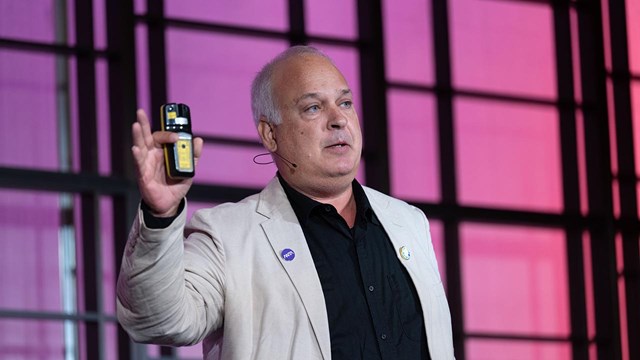
Rob Joyce, Director of Mobile Access Engineering, Virgin Media O2
Rob Joyce, director of mobile access engineering at Virgin Media O2 (VMO2), discusses the UK operator’s direct-to-device (D2D) launch with Starlink, how it’s using AI, its expectations for uplink data traffic trends, and much more.
Recorded March 2026
Email Newsletters
Sign up to receive TelecomTV's top news and videos, plus exclusive subscriber-only content direct to your inbox.