Navigating market megatrends with HPE Acceleration Playbooks

By Clarence Reynolds
Mar 12, 2026
To embed our video on your website copy and paste the code below:
<iframe src="https://www.youtube.com/embed/8wBjwvZNhKQ?modestbranding=1&rel=0" width="970" height="546" frameborder="0" scrolling="auto" allowfullscreen></iframe>
Clarence Reynolds, TelecomTV (00:01):
I'm Clarence Reynolds at MWC26. A series of marketing mega trends is disrupting enterprise strategy and telecoms. Norm Follett, Senior Director of Global Technical Marketing, is here to give us the roadmap he takes customers on to show them what's possible. Norm, thank you for joining us. What are you hearing from customers when it comes to navigating all of the new technology that's out there and they don't know where to start?
Norm Follett, HPE (00:27):
I think the world of IT and telecommunications is always disruptive, but there are definitely patterns that are taking place across the industry. And so when we speak to our customers and we interact with them on a constant basis, talking about their challenges and the things that they're trying to deal with and they're trying to address in their infrastructure, we start to really notice that there's this consistent pattern across different customers in different verticals really, different enterprises, whatever they're trying to do, there seems to be this repetitive motion that's going on across the industry. And we kind of see that boiling down into a couple of different things. So there's really a series of mega trends. And you could argue how many, but we kind of think there's really three predominant things happening in the industry right now that are forcing our customers to take action. They either need to address it or they're going to be left behind or they're going to incur some really significant costs and performance issues unless they take action.
(01:24):
So it's not optional. They need to go forward.
Clarence Reynolds, TelecomTV (01:27):
So what are those three pillars?
Norm Follett, HPE (01:29):
Well, funny that you asked that. So the great VM reset, the AI gold rush and security and resiliency imperative around data. And of course, all of this is being exacerbated by what's transforming our industry. And that's the actual use of AI as AI has now moved past this notion of concept and experimentation to where now there's an expectation that you're going to be able to drive value and be able to integrate AI technologies and solutions into your day-to-day business for the benefit of your company. Now in the great VM reset, what's really taking place there is that because of the changes to the virtualisation cost models and just really the high rising costs of also cloud technologies as well is that it's forcing you to really rethink what you're doing there. Do you have the right strategy? Are you in with a single vendor? Do you want to approach what you're doing completely differently?
(02:30):
And it's really exacerbating the notion of a hybrid cloud type of deployment because there are certain configurations and things that you need on-premises, and there are certain things that you can benefit from being in the cloud. So you reach that conclusion no matter where you're starting. If you say, "Hey, I'm all on-premises or I'm all up in the cloud and that's the way we do it." All organisations are reaching the conclusion that the optimum setup is really to have a hybrid cloud and then optimise what you're doing in that regard.
Clarence Reynolds, TelecomTV (02:58):
And how is AI playing a role in that?
Norm Follett, HPE (03:01):
Well, as I mentioned earlier, the expectation now is that you're getting value out of AI. So it's the AI gold rush, right? I need to implement AI. I need to do it in a sensible way. I need to do it in a pragmatic and practical way in my environment to where I can get some very tangible ROI from these implementations. But Clarence, that's also got great impact on your infrastructure as well. I mean, the power and the energy that's really required to drive AI workloads, you really have to partner with a vendor or a supplier that really has optimised those challenges for you, that they're really dealing with the energy consumption, that they're dealing with the sustainability angle. So you don't have to rethink it and you're benefiting from an optimal design. And that's something that we're very proud of from what we've been doing at Hewlett Packard Enterprise and our capabilities in our AI-based technologies and solutions.
Clarence Reynolds, TelecomTV (03:57):
And along with AI comes security concerns.
Norm Follett, HPE (04:01):
Right, exactly.
Clarence Reynolds, TelecomTV (04:02):
What are your customers saying about that?
Norm Follett, HPE (04:04):
Well, one of the motions, and we'll talk about this, it's having your data ready for AI and that AI experience, and that's having it optimised to where you can actually harvest that data and you can apply it to your AI data models and your infrastructure, but then also doing it in a secure way to where you're not letting information or technologies or solutions out there that are things that you don't want people to see or it's not necessarily optimal for you.
Clarence Reynolds, TelecomTV (04:34):
So what you're describing is like a buffet of options. What's on the buffet?
Norm Follett, HPE (04:38):
Well, let's go to the buffet table.
(04:41):
Okay. So again, VM reset, AI gold rush, security and resiliency imperative. And when you first asked me, what are your customers seeing? What we're seeing is that this is kind of your to-do list, right? This is your project list across your infrastructure. And I know we have many people listening today, but I would challenge you if you just think about what's on your project list, you're probably seeing a lot of very familiar connotations here. Going through it and really unifying your data foundation, making sure that within your IT infrastructure, all your data is in the right place, the right spot, you're using the right technologies. It's not fragmented across the silos within your organisation. Get the VM cost down. It's too much. We're spending too much money. Do we really need to renew that? And then transform with private cloud, right? Again, we have to have that hybrid cloud notion and the private cloud notion, and then simplify the operations on top of that.
(05:35):
So you have to do all these things, but you want to have a holistic, dare I say, single pane of glass
(05:41):
View of your hybrid IT operations, and then modernise your multi-generation compute. The infrastructure that you had in place a decade ago, or maybe even three years ago, is not necessarily optimised to be able to run the AI workloads and the AI models. And then getting back to ... Otherwise, you're going to incur so much cost associated with it. Any fiscal benefit that you get from AI is just consumed by implementing it. So you need to make sure you're modernising this in a sensible way. And then preparing your data for AI and speed time to AI value. You can't have projects taking a year. You need to rock and roll. You need to get out there and you need to be able to take care of that. And then upgrade the inference edge, right? I mean, a lot of things are visualisation and working with inference technologies.
(06:33):
That has tremendous challenges on its own because think about all the data you're now collecting. And I know you know this problem. Think about all the data that you're collecting at the edge of your infrastructure and your locations around the world or even your locations around your building and how much data is being generated there. So you need to upgrade that infrastructure to be able to handle that input and handle that processing and feed all these data models. And then accelerating network for AI workloads and modernising network for AI ops. Now, we're benefiting tremendously from our Juniper acquisition and combining it with our Aruba network technologies, which was really geared towards the inference edge or part of the portfolio as well. And then with some of our now AI-native routing and using networking for AI and AI for networking, right? To really optimise that.
(07:24):
We're showing a couple of different technologies here on the showcase floor that is a combination of a software stack, working with our optimised switching and routing technologies, some of the new announcements here at the show from our Juniper colleagues, and really showing how you can stitch this all together and really handle those AI workloads in the network. For example, from a configuration perspective, you don't want your GPU sitting there idle, right? Waiting for the network to feed into you or waiting for your memory stack to actually be able to consume that. So we have intentionally designed infrastructure that optimises that throughput so those GPUs are constantly moving things in and out, in and out, in and out, versus being in an idle state. Idle hands is a waste of money. Idle GPUs is a waste of money. And then of course, all of these things, you have to make sure that you're ensuring digital sovereignty and you're protecting those critical workloads.
(08:19):
And that has a whole different type of approach. And it's really about converging your networks and your security, security embedded, embedded in your networks, not just that, "Oh, we'll throw something on top, we'll throw a scan." No, all of the operations has a security concern and a security aspect as you're moving these large data sets across your IT infrastructure. Clarence, these are the things everybody sees and everybody ... Again, check your desk. I bet anything, you probably have seven or eight projects that really recognise that. And our overall encompassing solution is what we're doing with HPE GreenLake and HPE GreenLake, that hybrid cloud and really driving a hybrid IT model and also on a consumption type of basis as well, paying for what you use rather than just having, again, sit around idle and not being able to actually benefit from that infrastructure. So this is just kind of a glimpse of all the different types of solutions.
(09:13):
Now notice we have a little bit compute, hybrid cloud, networking and HPE Financial Services because there's always a business aspect. How do I fund this transformation? How can I afford to do these types of things? And we have a very good set of offerings where we're here to help and partner with respect to you being able to actually fund this transformation. And often it's with a circular economy, you may have the source of that funding of transformation in your building right now today and you're not aware of it. And we have multiple different programmes on that. So I throw that out there because decision makers, it's all good, but you have to find a way to execute it. But the point being here is you can see that all of these different disciplines, compute, cloud, networking, and business continuity with financial services all come into the mix to address each one of these pillars and the VM reset, the gold rush and the security issue.
(10:03):
And then here we're going through and we're really showing people the different options and the different solutions that HPE is bringing to bear. And that's Clarence, that's really what we're demonstrating across the show floor today at Mobile World Congress, that we're really giving people crisp examples of what they can do and the technologies and solutions that we've designed to address those mega trends and those imperatives that are taking place.
Clarence Reynolds, TelecomTV (10:29):
Norm, thank you for those insights.
Norm Follett, HPE (10:31):
Hey, it's really been a pleasure. It's great to see you here back at Mobile World Congress, Clarence.
I'm Clarence Reynolds at MWC26. A series of marketing mega trends is disrupting enterprise strategy and telecoms. Norm Follett, Senior Director of Global Technical Marketing, is here to give us the roadmap he takes customers on to show them what's possible. Norm, thank you for joining us. What are you hearing from customers when it comes to navigating all of the new technology that's out there and they don't know where to start?
Norm Follett, HPE (00:27):
I think the world of IT and telecommunications is always disruptive, but there are definitely patterns that are taking place across the industry. And so when we speak to our customers and we interact with them on a constant basis, talking about their challenges and the things that they're trying to deal with and they're trying to address in their infrastructure, we start to really notice that there's this consistent pattern across different customers in different verticals really, different enterprises, whatever they're trying to do, there seems to be this repetitive motion that's going on across the industry. And we kind of see that boiling down into a couple of different things. So there's really a series of mega trends. And you could argue how many, but we kind of think there's really three predominant things happening in the industry right now that are forcing our customers to take action. They either need to address it or they're going to be left behind or they're going to incur some really significant costs and performance issues unless they take action.
(01:24):
So it's not optional. They need to go forward.
Clarence Reynolds, TelecomTV (01:27):
So what are those three pillars?
Norm Follett, HPE (01:29):
Well, funny that you asked that. So the great VM reset, the AI gold rush and security and resiliency imperative around data. And of course, all of this is being exacerbated by what's transforming our industry. And that's the actual use of AI as AI has now moved past this notion of concept and experimentation to where now there's an expectation that you're going to be able to drive value and be able to integrate AI technologies and solutions into your day-to-day business for the benefit of your company. Now in the great VM reset, what's really taking place there is that because of the changes to the virtualisation cost models and just really the high rising costs of also cloud technologies as well is that it's forcing you to really rethink what you're doing there. Do you have the right strategy? Are you in with a single vendor? Do you want to approach what you're doing completely differently?
(02:30):
And it's really exacerbating the notion of a hybrid cloud type of deployment because there are certain configurations and things that you need on-premises, and there are certain things that you can benefit from being in the cloud. So you reach that conclusion no matter where you're starting. If you say, "Hey, I'm all on-premises or I'm all up in the cloud and that's the way we do it." All organisations are reaching the conclusion that the optimum setup is really to have a hybrid cloud and then optimise what you're doing in that regard.
Clarence Reynolds, TelecomTV (02:58):
And how is AI playing a role in that?
Norm Follett, HPE (03:01):
Well, as I mentioned earlier, the expectation now is that you're getting value out of AI. So it's the AI gold rush, right? I need to implement AI. I need to do it in a sensible way. I need to do it in a pragmatic and practical way in my environment to where I can get some very tangible ROI from these implementations. But Clarence, that's also got great impact on your infrastructure as well. I mean, the power and the energy that's really required to drive AI workloads, you really have to partner with a vendor or a supplier that really has optimised those challenges for you, that they're really dealing with the energy consumption, that they're dealing with the sustainability angle. So you don't have to rethink it and you're benefiting from an optimal design. And that's something that we're very proud of from what we've been doing at Hewlett Packard Enterprise and our capabilities in our AI-based technologies and solutions.
Clarence Reynolds, TelecomTV (03:57):
And along with AI comes security concerns.
Norm Follett, HPE (04:01):
Right, exactly.
Clarence Reynolds, TelecomTV (04:02):
What are your customers saying about that?
Norm Follett, HPE (04:04):
Well, one of the motions, and we'll talk about this, it's having your data ready for AI and that AI experience, and that's having it optimised to where you can actually harvest that data and you can apply it to your AI data models and your infrastructure, but then also doing it in a secure way to where you're not letting information or technologies or solutions out there that are things that you don't want people to see or it's not necessarily optimal for you.
Clarence Reynolds, TelecomTV (04:34):
So what you're describing is like a buffet of options. What's on the buffet?
Norm Follett, HPE (04:38):
Well, let's go to the buffet table.
(04:41):
Okay. So again, VM reset, AI gold rush, security and resiliency imperative. And when you first asked me, what are your customers seeing? What we're seeing is that this is kind of your to-do list, right? This is your project list across your infrastructure. And I know we have many people listening today, but I would challenge you if you just think about what's on your project list, you're probably seeing a lot of very familiar connotations here. Going through it and really unifying your data foundation, making sure that within your IT infrastructure, all your data is in the right place, the right spot, you're using the right technologies. It's not fragmented across the silos within your organisation. Get the VM cost down. It's too much. We're spending too much money. Do we really need to renew that? And then transform with private cloud, right? Again, we have to have that hybrid cloud notion and the private cloud notion, and then simplify the operations on top of that.
(05:35):
So you have to do all these things, but you want to have a holistic, dare I say, single pane of glass
(05:41):
View of your hybrid IT operations, and then modernise your multi-generation compute. The infrastructure that you had in place a decade ago, or maybe even three years ago, is not necessarily optimised to be able to run the AI workloads and the AI models. And then getting back to ... Otherwise, you're going to incur so much cost associated with it. Any fiscal benefit that you get from AI is just consumed by implementing it. So you need to make sure you're modernising this in a sensible way. And then preparing your data for AI and speed time to AI value. You can't have projects taking a year. You need to rock and roll. You need to get out there and you need to be able to take care of that. And then upgrade the inference edge, right? I mean, a lot of things are visualisation and working with inference technologies.
(06:33):
That has tremendous challenges on its own because think about all the data you're now collecting. And I know you know this problem. Think about all the data that you're collecting at the edge of your infrastructure and your locations around the world or even your locations around your building and how much data is being generated there. So you need to upgrade that infrastructure to be able to handle that input and handle that processing and feed all these data models. And then accelerating network for AI workloads and modernising network for AI ops. Now, we're benefiting tremendously from our Juniper acquisition and combining it with our Aruba network technologies, which was really geared towards the inference edge or part of the portfolio as well. And then with some of our now AI-native routing and using networking for AI and AI for networking, right? To really optimise that.
(07:24):
We're showing a couple of different technologies here on the showcase floor that is a combination of a software stack, working with our optimised switching and routing technologies, some of the new announcements here at the show from our Juniper colleagues, and really showing how you can stitch this all together and really handle those AI workloads in the network. For example, from a configuration perspective, you don't want your GPU sitting there idle, right? Waiting for the network to feed into you or waiting for your memory stack to actually be able to consume that. So we have intentionally designed infrastructure that optimises that throughput so those GPUs are constantly moving things in and out, in and out, in and out, versus being in an idle state. Idle hands is a waste of money. Idle GPUs is a waste of money. And then of course, all of these things, you have to make sure that you're ensuring digital sovereignty and you're protecting those critical workloads.
(08:19):
And that has a whole different type of approach. And it's really about converging your networks and your security, security embedded, embedded in your networks, not just that, "Oh, we'll throw something on top, we'll throw a scan." No, all of the operations has a security concern and a security aspect as you're moving these large data sets across your IT infrastructure. Clarence, these are the things everybody sees and everybody ... Again, check your desk. I bet anything, you probably have seven or eight projects that really recognise that. And our overall encompassing solution is what we're doing with HPE GreenLake and HPE GreenLake, that hybrid cloud and really driving a hybrid IT model and also on a consumption type of basis as well, paying for what you use rather than just having, again, sit around idle and not being able to actually benefit from that infrastructure. So this is just kind of a glimpse of all the different types of solutions.
(09:13):
Now notice we have a little bit compute, hybrid cloud, networking and HPE Financial Services because there's always a business aspect. How do I fund this transformation? How can I afford to do these types of things? And we have a very good set of offerings where we're here to help and partner with respect to you being able to actually fund this transformation. And often it's with a circular economy, you may have the source of that funding of transformation in your building right now today and you're not aware of it. And we have multiple different programmes on that. So I throw that out there because decision makers, it's all good, but you have to find a way to execute it. But the point being here is you can see that all of these different disciplines, compute, cloud, networking, and business continuity with financial services all come into the mix to address each one of these pillars and the VM reset, the gold rush and the security issue.
(10:03):
And then here we're going through and we're really showing people the different options and the different solutions that HPE is bringing to bear. And that's Clarence, that's really what we're demonstrating across the show floor today at Mobile World Congress, that we're really giving people crisp examples of what they can do and the technologies and solutions that we've designed to address those mega trends and those imperatives that are taking place.
Clarence Reynolds, TelecomTV (10:29):
Norm, thank you for those insights.
Norm Follett, HPE (10:31):
Hey, it's really been a pleasure. It's great to see you here back at Mobile World Congress, Clarence.
Please note that video transcripts are provided for reference only – content may vary from the published video or contain inaccuracies.
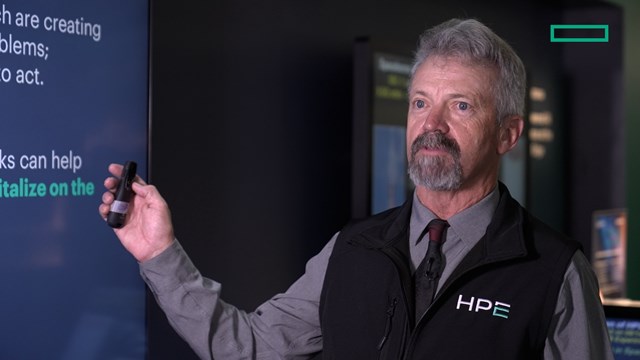
Norm Follett, Senior Director, HPC Global Technical Marketing, Space Technologies & Solutions, HPE
HPE’s Norm Follett explains how a series of market megatrends is creating disruptive shifts in enterprise IT strategy, reframing customer problems, challenging established assumptions and generating the need to act. He reveals how HPE’s Acceleration Playbooks help customers address the challenges these megatrends present while capitalising on the opportunities they create.
Recorded March 2026
Email Newsletters
Sign up to receive TelecomTV's top news and videos, plus exclusive subscriber-only content direct to your inbox.