To embed our video on your website copy and paste the code below:
<iframe src="https://www.youtube.com/embed/LpcldSpjB2U?modestbranding=1&rel=0" width="970" height="546" frameborder="0" scrolling="auto" allowfullscreen></iframe>
James Pearce, TelecomTV (00:07):
Welcome to Mobile World Congress. I'm James Pearce with TelecomTV. AI has been a huge topic at this year's show, and who better to speak to me about it than Steve Jarrett, who is the Chief AI Officer at Orange? Thank you for joining me today, Steve.
Steve Jarrett, Orange (00:20):
Great to see you, James.
James Pearce, TelecomTV (00:21):
So let's dive straight in. Let's talk about the role that artificial intelligence is currently playing within Orange's strategic priorities within the EMEA region.
Steve Jarrett, Orange (00:31):
We just announced a new strategy for the company two weeks ago at our Capital Market Day called Trust the Future. And that has three pillars and each of them has a lot of AI in each of them. The first is about customer intimacy. And so that's about how do we provide better marketing that's more appealing and more relevant to our customers, as well as when the customers interact with us, how do we better serve them with AI either in assisting our employees that are talking to customers or directly helping the customers. And so there's lots of opportunity in that pillar. The second is called innovative growth. And there we have a number of really exciting new products in Africa. We have a product called Maxit, which is our super app that includes money payment. Over 23 million users are actively using that application. And in the booth, we're showing that we're now enabling regional African languages to be managed and handled in that app.
(01:26):
So we found that about 80 million people in our target countries cannot use the app because the app does not understand these regional languages that they speak. So our AI research team has done a lot of work to fine-tune models to begin to understand Wolof, Bambara, Lingala, and many other languages that are not understood by any other AI model. And then lastly, excellence at scale is the third pillar. That's about how do we give great products and technologies internally to our employees. And there, the live intelligence service that we built, over 100,000 employees have used it and that's over 80% of the employee base. And it's been a huge success. And that gives AI tools to the entire company, models like from OpenAI, from Google, from Anthropic, and from Mistral and others. And that really gives them these powerful tools in their daily work lives.
(02:24):
There are many other specific use cases that we have that leverage AI to improve the excellence of Orange, but that tool has been really powerful in letting everybody have access to a really strong set of tools and models. And it's been so successful that we're selling externally. And we call that live intelligence, and that's a really successful B2B product for us today.
James Pearce, TelecomTV (02:45):
It sounds really, really important. So maybe you can talk about how it's delivering value for Orange and contributing towards operational efficiencies across the organisation.
Steve Jarrett, Orange (02:54):
Sure. So in each of those three pillars, so I mentioned briefly about customer intimacy. So we're seeing a lot of value being generated by having better targeted marketing to people. So last year we generated over 300 million euros in value from data night programmes at Orange. And a significant proportion of that was this notion that by using AI, we can target a much better relevant offer. And we're actually testing the uplift of those offers with holdout groups. So we know the actual incremental value there. That's been a huge win. In contact centres, very similarly, using AI to improve the way in which we can answer customers' questions more quickly, more accurately, and more cost effectively has been very effective. The second big domain is in networks. And so we've been saving a lot of money in our CapEx. So we use AI to help identify which cell sites to upgrade, which ones to leave alone, for example.
(03:54):
And that's been extremely successful all across all the Orange countries. And then in terms of excellence at scale internally, we're not saying publicly what we think the value is of all the employees using the tools. You can. But it's really significant. So we survey all of the employees as they use the tool and we ask them how much time they're saving and it's significant. And having the power of these tools available to all of them is great because then we do not have shadow AI usage where people are using the app on their phone personally and Orange information is not leaving the company. And so being able to resell that product externally to customers in a trusted way is becoming a really great value revenue stream for us.
James Pearce, TelecomTV (04:44):
You mentioned that the three-year strategy is around trust and obviously AI sovereignty is a really big topic at the moment. So how does Orange assess the importance of that and what opportunities does the organisation see emerging in that area?
Steve Jarrett, Orange (04:58):
Yes, it's a great question. So Trust the Future is the new strategy. It fits so well with our core skill because for decades and decades, we've been providing really secure services and telecoms infrastructure to customers ranging from other large French enterprises and other enterprises across Europe and Africa to governments who have really, really stringent needs for sovereignty and security. And so because we have this great skill and expertise, we now have a product offering that ranges across all of those needs, from things that are based on public cloud, to things that are based on trusted cloud, as well as sovereign cloud. And so Orange, I think maybe uniquely has this really strong set of portfolio like Blue, which is our joint investment with Microsoft and Capgemini on a sovereign cloud that runs Azure. And then we have our own offerings from Orange Business that run in our data centres in France.
(05:59):
And there will be things coming out about those offerings in the next few weeks from Orange Business. And so we have a really rich range of solutions, but it's challenging because running sophisticated AI models in each of those environments takes a lot of skill. Thankfully, we have a really deep AI research team. I have over 100 PhDs just in research in AI in my team, plus many, many other hundreds of software engineers in my team and in other teams in the company that enable us to do this at scale, which I think is also fairly rare in the telco industry.
James Pearce, TelecomTV (06:36):
That sounds like a lot of very smart people that you've got.
Steve Jarrett, Orange (06:39):
I am very gifted with a brilliant team.
James Pearce, TelecomTV (06:43):
Obviously AI, as you know, is moving very fast. So given the rapid evolution of the technology and automation as well, since Orange first discussed automation around 2020, you were talking about automating the network, what specific actions is the company taking now in its infrastructure?
Steve Jarrett, Orange (07:01):
Yes. Well, actually it starts before we think about the AI infrastructure, we think about data. So data democracy is a programme we've talked about before, I think, where we know that having high quality data that's accessible, that's documented, and that the people that are generating the data know that they're responsible for producing that high quality data. That is a multi-year journey, and that's super foundational for us to have AI at scale, because without great data, there's no way you have great AI. So that's really the first thing. Secondly, as I mentioned, we've been making these investments in different infrastructures. So with Blue, for its sovereign Azure, with Orange Business, with our live intelligence and other offerings, and then we also have a really rich public cloud offering. And on each of those infrastructures, some of which we've announced, some which we have not, we have really good AI partnerships, not just the models, but also all the tooling that goes with the models because as agents become more and more popular, just having a good model is just part of the challenge that you need to solve.
(08:10):
So we will have more announcements coming soon about the great work we've been doing there, but we think it gives us a really rich, flexible set of options that cover the spectrum of needs from customers, from people that are happy with public cloud, all the way to the really, really sovereign requirements that are necessary in certain countries.
James Pearce, TelecomTV (08:31):
Now you talked about trust and again, the importance of customers and customer intimacy. So I just wanted to touch on that a little bit more. Yes. How is AI helping you be more intimate or maybe engage more with your customers directly?
Steve Jarrett, Orange (08:48):
Yes. So this notion that we use AI in all of our customer interactions has been really transformative. So the first step there is to use AI to really augment our employees that are interacting with customers. So enabling them to much more quickly answer questions, to find answers to problems that they're trying to solve for customers internally with all the internal data we have, that's been a huge advantage. And that speaks to the more than 100,000 users internally that we have of this tool. And a lot of that is in helping to answer questions in their daily work life, which relate to customers. So that's been transformative. The second thing is in the contact centre as well. So we're providing AI that enables us to have AI solutions for customers to directly interact with AI. If they find that that's faster and more appealing, and in fact, it's not launched yet, but we have a great solution coming in France for our Sosh sub-brand that's really state of the art.
(09:51):
And that's a great example of how we see this really good balance between providing AI support for customers that want it, as well as having the augmentation of the people when you want to talk to a human. And we think responsibility across the company with AI, a big part of that is not just ethical responsibility and CO2 being managing, mitigating CO2, but it's this notion of human in the loop. It's the notion of using the right tool at the right time, so we're not using AI when we do not have to, but when we do, making sure that humans are in the loop so that our customers really can feel trust with us and the kinds of services that we're delivering to them.
James Pearce, TelecomTV (10:37):
Steve, that's brilliant. Thank you so much for joining me today on TelecomTV.
Steve Jarrett, Orange (10:41):
Great. Thanks a lot. It was nice to talk to you. Thank you.
Welcome to Mobile World Congress. I'm James Pearce with TelecomTV. AI has been a huge topic at this year's show, and who better to speak to me about it than Steve Jarrett, who is the Chief AI Officer at Orange? Thank you for joining me today, Steve.
Steve Jarrett, Orange (00:20):
Great to see you, James.
James Pearce, TelecomTV (00:21):
So let's dive straight in. Let's talk about the role that artificial intelligence is currently playing within Orange's strategic priorities within the EMEA region.
Steve Jarrett, Orange (00:31):
We just announced a new strategy for the company two weeks ago at our Capital Market Day called Trust the Future. And that has three pillars and each of them has a lot of AI in each of them. The first is about customer intimacy. And so that's about how do we provide better marketing that's more appealing and more relevant to our customers, as well as when the customers interact with us, how do we better serve them with AI either in assisting our employees that are talking to customers or directly helping the customers. And so there's lots of opportunity in that pillar. The second is called innovative growth. And there we have a number of really exciting new products in Africa. We have a product called Maxit, which is our super app that includes money payment. Over 23 million users are actively using that application. And in the booth, we're showing that we're now enabling regional African languages to be managed and handled in that app.
(01:26):
So we found that about 80 million people in our target countries cannot use the app because the app does not understand these regional languages that they speak. So our AI research team has done a lot of work to fine-tune models to begin to understand Wolof, Bambara, Lingala, and many other languages that are not understood by any other AI model. And then lastly, excellence at scale is the third pillar. That's about how do we give great products and technologies internally to our employees. And there, the live intelligence service that we built, over 100,000 employees have used it and that's over 80% of the employee base. And it's been a huge success. And that gives AI tools to the entire company, models like from OpenAI, from Google, from Anthropic, and from Mistral and others. And that really gives them these powerful tools in their daily work lives.
(02:24):
There are many other specific use cases that we have that leverage AI to improve the excellence of Orange, but that tool has been really powerful in letting everybody have access to a really strong set of tools and models. And it's been so successful that we're selling externally. And we call that live intelligence, and that's a really successful B2B product for us today.
James Pearce, TelecomTV (02:45):
It sounds really, really important. So maybe you can talk about how it's delivering value for Orange and contributing towards operational efficiencies across the organisation.
Steve Jarrett, Orange (02:54):
Sure. So in each of those three pillars, so I mentioned briefly about customer intimacy. So we're seeing a lot of value being generated by having better targeted marketing to people. So last year we generated over 300 million euros in value from data night programmes at Orange. And a significant proportion of that was this notion that by using AI, we can target a much better relevant offer. And we're actually testing the uplift of those offers with holdout groups. So we know the actual incremental value there. That's been a huge win. In contact centres, very similarly, using AI to improve the way in which we can answer customers' questions more quickly, more accurately, and more cost effectively has been very effective. The second big domain is in networks. And so we've been saving a lot of money in our CapEx. So we use AI to help identify which cell sites to upgrade, which ones to leave alone, for example.
(03:54):
And that's been extremely successful all across all the Orange countries. And then in terms of excellence at scale internally, we're not saying publicly what we think the value is of all the employees using the tools. You can. But it's really significant. So we survey all of the employees as they use the tool and we ask them how much time they're saving and it's significant. And having the power of these tools available to all of them is great because then we do not have shadow AI usage where people are using the app on their phone personally and Orange information is not leaving the company. And so being able to resell that product externally to customers in a trusted way is becoming a really great value revenue stream for us.
James Pearce, TelecomTV (04:44):
You mentioned that the three-year strategy is around trust and obviously AI sovereignty is a really big topic at the moment. So how does Orange assess the importance of that and what opportunities does the organisation see emerging in that area?
Steve Jarrett, Orange (04:58):
Yes, it's a great question. So Trust the Future is the new strategy. It fits so well with our core skill because for decades and decades, we've been providing really secure services and telecoms infrastructure to customers ranging from other large French enterprises and other enterprises across Europe and Africa to governments who have really, really stringent needs for sovereignty and security. And so because we have this great skill and expertise, we now have a product offering that ranges across all of those needs, from things that are based on public cloud, to things that are based on trusted cloud, as well as sovereign cloud. And so Orange, I think maybe uniquely has this really strong set of portfolio like Blue, which is our joint investment with Microsoft and Capgemini on a sovereign cloud that runs Azure. And then we have our own offerings from Orange Business that run in our data centres in France.
(05:59):
And there will be things coming out about those offerings in the next few weeks from Orange Business. And so we have a really rich range of solutions, but it's challenging because running sophisticated AI models in each of those environments takes a lot of skill. Thankfully, we have a really deep AI research team. I have over 100 PhDs just in research in AI in my team, plus many, many other hundreds of software engineers in my team and in other teams in the company that enable us to do this at scale, which I think is also fairly rare in the telco industry.
James Pearce, TelecomTV (06:36):
That sounds like a lot of very smart people that you've got.
Steve Jarrett, Orange (06:39):
I am very gifted with a brilliant team.
James Pearce, TelecomTV (06:43):
Obviously AI, as you know, is moving very fast. So given the rapid evolution of the technology and automation as well, since Orange first discussed automation around 2020, you were talking about automating the network, what specific actions is the company taking now in its infrastructure?
Steve Jarrett, Orange (07:01):
Yes. Well, actually it starts before we think about the AI infrastructure, we think about data. So data democracy is a programme we've talked about before, I think, where we know that having high quality data that's accessible, that's documented, and that the people that are generating the data know that they're responsible for producing that high quality data. That is a multi-year journey, and that's super foundational for us to have AI at scale, because without great data, there's no way you have great AI. So that's really the first thing. Secondly, as I mentioned, we've been making these investments in different infrastructures. So with Blue, for its sovereign Azure, with Orange Business, with our live intelligence and other offerings, and then we also have a really rich public cloud offering. And on each of those infrastructures, some of which we've announced, some which we have not, we have really good AI partnerships, not just the models, but also all the tooling that goes with the models because as agents become more and more popular, just having a good model is just part of the challenge that you need to solve.
(08:10):
So we will have more announcements coming soon about the great work we've been doing there, but we think it gives us a really rich, flexible set of options that cover the spectrum of needs from customers, from people that are happy with public cloud, all the way to the really, really sovereign requirements that are necessary in certain countries.
James Pearce, TelecomTV (08:31):
Now you talked about trust and again, the importance of customers and customer intimacy. So I just wanted to touch on that a little bit more. Yes. How is AI helping you be more intimate or maybe engage more with your customers directly?
Steve Jarrett, Orange (08:48):
Yes. So this notion that we use AI in all of our customer interactions has been really transformative. So the first step there is to use AI to really augment our employees that are interacting with customers. So enabling them to much more quickly answer questions, to find answers to problems that they're trying to solve for customers internally with all the internal data we have, that's been a huge advantage. And that speaks to the more than 100,000 users internally that we have of this tool. And a lot of that is in helping to answer questions in their daily work life, which relate to customers. So that's been transformative. The second thing is in the contact centre as well. So we're providing AI that enables us to have AI solutions for customers to directly interact with AI. If they find that that's faster and more appealing, and in fact, it's not launched yet, but we have a great solution coming in France for our Sosh sub-brand that's really state of the art.
(09:51):
And that's a great example of how we see this really good balance between providing AI support for customers that want it, as well as having the augmentation of the people when you want to talk to a human. And we think responsibility across the company with AI, a big part of that is not just ethical responsibility and CO2 being managing, mitigating CO2, but it's this notion of human in the loop. It's the notion of using the right tool at the right time, so we're not using AI when we do not have to, but when we do, making sure that humans are in the loop so that our customers really can feel trust with us and the kinds of services that we're delivering to them.
James Pearce, TelecomTV (10:37):
Steve, that's brilliant. Thank you so much for joining me today on TelecomTV.
Steve Jarrett, Orange (10:41):
Great. Thanks a lot. It was nice to talk to you. Thank you.
Please note that video transcripts are provided for reference only – content may vary from the published video or contain inaccuracies.
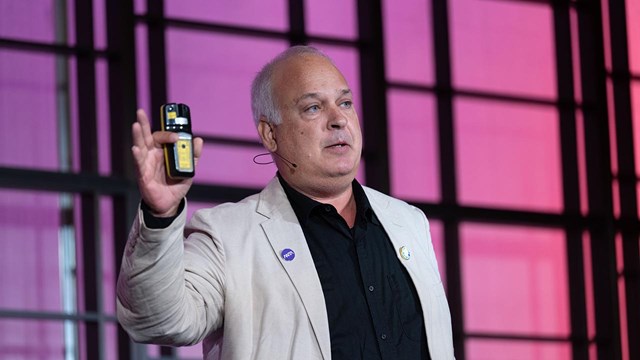
Steve Jarrett, Chief AI Officer, Orange
Steve Jarrett, chief AI officer at Orange, discusses how AI is delivering value to the international operator, the importance of AI sovereignty, the road to autonomous networks and more.
Recorded March 2026
Email Newsletters
Sign up to receive TelecomTV's top news and videos, plus exclusive subscriber-only content direct to your inbox.