MWC26: BT’s Howard Watson on 6G, virtualisation and retirement

By Ray Le Maistre
Mar 6, 2026
To embed our video on your website copy and paste the code below:
<iframe src="https://www.youtube.com/embed/VSZto1tUc9g?modestbranding=1&rel=0" width="970" height="546" frameborder="0" scrolling="auto" allowfullscreen></iframe>
Ray Le Maistre, TelecomTV (00:08):
So we're in Barcelona. It's MWC26. I'm here with Howard Watson, still supporting the job title of Chief Security and Network Officer at BT, that's right. Yeah. It's like which one? Which one? But you're coming to the end of your time at BT and heading into retirement. So congratulations on that and a great career. But what are you going to miss the most once you have cleared up your desk?
Howard Watson, BT (00:34):
I mean, I think it's ... I guess everybody says it, but I will miss lots of great people. I've had the real privilege. And if you think about it, I've been 10 years in my current role, 14 years at BT, 42 years in the UK telecoms industry. And it's a bit sad that I've never done anything else really. But the amount of people that I've met that have worked on, I guess, moving telco from a little bit of a luxury to real critical national infrastructure, which has happened across that time. So there's been some amazing people and we've done some amazing things. And I actually, lots of it at BT, but if I go back a bit further, I remember being in the cable industry actually, pushing 50 megabits per second broadband in 2006. And actually sitting opposite BT, sort of cajoling them into rolling out their superfast broadband, which they did at the time.
(01:31):
But if I look, my proudest moments at BT would be launching BT Sport in 2013 across multiple platforms, going through the whole process of bringing EE into the BT family, integrating the technical teams in 2016, being the first to launch 5G in 2019, a month ahead of Vodafone.
(01:53):
And it goes on and on and on. And actually what's been really great throughout that period is to have Greg McCall alongside me and to be able to develop as a successor. So I'm so proud that he's actually taking over from me and we'll have the continuity because all of those things I described on most of them, he was involved in as well. But I will also miss the innovation in the industry. I mean, you see it at this show, really. And actually you have to look beyond the sort of flash to find what's really happening. And things move quickly and slowly in our industry, and I will miss some of that for
Ray Le Maistre, TelecomTV (02:35):
Sure. Yeah. So have you had more of a ... Or will you get more of a chance to kind of wander around at the show this year and maybe spend some time in some of the halls? It can be hard to get to, even over a couple of days.
Howard Watson, BT (02:50):
I mean, last year, I remember counting after I'd been here that I'd had like 29 meetings over the two and a half days. Greg's doing most of them this time. So I'm spending some time, as you say, I did halls one to four yesterday. And it's that bit of getting into five, six, seven. That's really important because that's where there's a lot of small companies doing that great innovation.
Ray Le Maistre, TelecomTV (03:12):
Yeah. Yeah. No, absolutely. So I mean, over the years, obviously at MWC, there's been a lot of trends. And as we all know, AI is kind of sort of swamping everything this year, but a lot of industry trends have come and gone. What's your view on how virtualisation in particular, which started to talk of network functions virtualisation or NFV, how has that impacted the way that telecom networks and systems have evolved in the past 12 years? Because 2014, I think was when NFV suddenly became a buzz term. Yeah.
Howard Watson, BT (03:52):
So when I joined BT in 2011, and again, had the privilege of going to Adastral Park and talking to the research teams, and having spent time running that has been a real privilege. I met a couple of people who co-wrote the seminal paper on NFV, and BT were co-authors of that first paper. And it's changed its name over the years, but effectively what we've done is we have shifted the sort of core capability of a telco from a whole load of appliances inside an exchange room or a data centre to be a true platform capability, running on virtualised, in most cases, x86 infrastructure. So very much sort of through that, helping the softwareisation, to use that word, of network capability. We called it network cloud. Took quite a while to be able to work out how to do it well, but having done that, having put our mobile core onto that capability, it really sort of stands us in good stead for the future in terms of most features, most functions being software developed now.
(05:06):
So as we now talk about network as a service or intent-based networking, we wouldn't be able to do any of that if it hadn't been that shift from all those appliances from lots of different vendors to, in many cases, just software running on virtualised infrastructure.
Ray Le Maistre, TelecomTV (05:23):
Yeah. And I guess the creation and launch of BT Sport and having to get down a cloud platform, did that really accelerate sort of BT's adoption and learning process around virtualisation and telco cloud?
Howard Watson, BT (05:37):
Yeah, it did. I would say that started it, but really what really accelerated it for us was having to change out our mobile core for geopolitical reasons.
Ray Le Maistre, TelecomTV (05:50):
Remember
Howard Watson, BT (05:50):
Those.
Ray Le Maistre, TelecomTV (05:50):
Yeah, absolutely. They don't end.
Howard Watson, BT (05:56):
And we thought to ourselves, because we're changing out our 4G core and our 5G core, we don't want to have two separate ones because most of the industry were looking at putting in a new 5G only core. And so we wanted 4G, 5G and 5G standalone, and we wanted it to be cloud native. And so that is fundamentally what then accelerated that telco cloud capability for us.
Ray Le Maistre, TelecomTV (06:20):
So I mean, you mentioned the geopolitical situation there, and obviously that has had a much greater impact on lots of companies in the telecom sector in the past 10 years. Has that trend, have those impacts made your job harder? And do you think such pressures are going to intensify as we enter this AI era? Because you kind of see things starting to split now, whereas the world was coming together, now it seems to be dividing.
Howard Watson, BT (06:49):
Yeah. What was the book called? The World is Flat. It doesn't feel like it is anymore, does it? No. So I think it is tough. I think on both mobile and fixed, I mean, the choice of partners and vendors to work with there is quite limited and governments quite rightly worry about that. And of course, they then pass that worry over to us and to me in my role, quite rightly. And so I think the UK has done quite a good job of spending time thinking about where are the single points of supply chain challenge and how can we work around those. It was a task force set up to look at diversification of supply that evolved into a working group, but it's still a problem. And Open RAN is not the solution. Keep saying that, but I know the whole industry don't agree on that, but I do think that that is tough.
(07:57):
And if I compare it to the other half of my role, security, opposite problem is too many vendors. I've got like 40 to choose from, and that needs a bit of consolidation to simplify the landscape, but we don't want to go down to two.
Ray Le Maistre, TelecomTV (08:11):
Right. Yeah.
Howard Watson, BT (08:12):
What I will always say though is whilst you want a breadth of choice, you probably only really want two vendors in your network. You don't want this vision of people going around maintaining the network with vans full of different manufacturers' kits. I think two is sufficient, but you'd like to have three or four to choose from to pick those two.
Ray Le Maistre, TelecomTV (08:37):
Right, right. Yeah. Perm two out of four.
Howard Watson, BT (08:40):
Rather than two out of two.
Ray Le Maistre, TelecomTV (08:41):
Right. Yeah. Or two out of 20. Yeah. Yeah. Yeah, exactly. And the choices and the options now for telecom operators in terms of who they turn to work with on the AI is now proliferating because everybody has some kind of AI offer these days. And a lot of hope is being pinned on AI for the telecom sector a bit too much perhaps is the ... People talk about the hype cycle, but AI is not new. This has been said many, many times before. There's new iterations of it, but it's not exactly come out of the blue, is it?
Howard Watson, BT (09:24):
No, I mean, we've been doing sort of algorithmic AI for a long time. I mean, generative AI is a revolutionary step forward and that will evolve into agentic AI. The way we look at it is what's AI for networks? And I do think there's a lot of discussion here actually this week about autonomous networks and AI will certainly be really important in that self-healing and making them more intent-based. My view generally on AI is about augmenting the human that's still in the loop as opposed to automating the human away. And I think that is really important in networks as well.
(10:07):
The test case I've always used for self-healing is when you've got two routers that are a resilient pair, and this one's flapping away because they seem to do that as a failure mode, and this one can't quite decide whether that one's working or not. I think I need a human to make that decision to switch it off so that that one can take over. And I'm not sure I'd rely on AI to do that. And those routers carry a third of the country's traffic at the moment. So there's some real critical pieces there. The other piece, of course, is we're building networks for delivering AI to customers and that's ever evolving and will inference go into a telco. Will inference be the thing that means that the network edge truly has a role? We've been looking for that role for some time.
Ray Le Maistre, TelecomTV (11:00):
Starting to see suggestions that it might-
Howard Watson, BT (11:03):
Yeah,
Ray Le Maistre, TelecomTV (11:04):
A little bit. Yeah.
Howard Watson, BT (11:05):
Then the devices are getting ever more powerful as well. And so having models on devices as well. So it's still not 100% clear, but we're certainly looking at how do we deploy GPUs into some of our edge exchanges and what that means for the future.
Ray Le Maistre, TelecomTV (11:23):
Another big topic. So AI is really big here, but there's an awful lot more 6G talk at this show. It's really ramped up this year. And obviously the standards process has begun. There's talk now trying to accelerate the introduction of 6G to 2029 or earlier, and of course there's lots of companies who would love to see that to get the spending going earlier. But is this industry ready for a next generation of mobile technology or even anywhere near it? Is 2030 too early? I
Howard Watson, BT (12:01):
Think 2030 is ... I've always said, can we pick Brisbane as the Olympics in 2032 rather than Los Angeles in 2028? Because we seem to like to launch for Olympics. But I think our friend over in the US has written to the operators saying have something by 2028. But I really hope we don't do what happened last time and that four or five operators go completely pre-standards. And I don't think they will. I think it's right that now we really do put the effort into getting the standards right, ensuring it's an evolution with backwards compatibility from 5G to 6G and not a complete change. And we're strong supporters of NGMN and working with the operators there to put our input in on that. And interestingly, I also look around, if you look at, I always try and get a look at China Mobile and China Unicom because they finished 5G, they finished fibre to the home.
(13:04):
So you're right, Chinese vendors need something to sell to them for the next five years. What they're focusing on, which is good to see, is launching upper six gigahertz with 5G and using that to enhance both upstream and downstream capacity. And I think that's an opportunity there. I think that's something, if we can agree in the UK that upper 6GHz should be used for mobile and not shared with Wi-Fi, which I still think is too difficult,
(13:36):
Then I'd love to be doing something, I would love to see BT do something with upper six gigahertz towards the back end of this decade, but let's not confuse that with 6G.
Ray Le Maistre, TelecomTV (13:46):
Yes. Yeah, yeah, yeah.
Howard Watson, BT (13:47):
And 6G still needs to work out what are the real use cases. So yeah, I'd still say 2032, but it'll probably be 2029.
Ray Le Maistre, TelecomTV (13:59):
So Howard, finally, what would be your parting thoughts for the telecom sector? I mean, who knows you might come back again next year, just to see the people again. I'm starting
Howard Watson, BT (14:12):
To call it a transition to a plural
Ray Le Maistre, TelecomTV (14:15):
Career rather than complete retirement. Oh, very good. But what does that mean? But any parting thoughts? What advice would you give to the industry to help it along and to help it ... Because the thing this industry really needs is growth, which is really hard to come by. So any thoughts that you can give to the sector that could help there?
Howard Watson, BT (14:37):
I mean, I think the most important thing is we in this sector need to always remember that we are now critical national infrastructure that's at the core of the, in many cases, digital ambitions of the countries that we operate in. And that is an immense responsibility that we have to take really seriously. So as we talked earlier, as nations are becoming ever more sovereign, resilience becomes really important and resilience across data, yes, but operations and ideally supply chain as well. And I think that's a real challenge for people in my role. Across the broader telecoms landscape, I mean, one anecdote that I always used to use is I still worry that as we become ever more a utility delivering packets, unlike all the other utilities, we forgot to put the packet meter on to count them. So this unlimited model that we have created, I'm not blaming anybody else that we have created, does mean that there is this risk of a race at the bottom in terms of revenue.
(15:49):
And I think we need to find the levers which really allow the cost of telecoms to consumers and businesses to reflect the value. And we need to slowly but surely nudge that up, as you say, to get growth because connectivity is everything now. And if it wasn't there, people would suddenly realise it's a big problem.
Ray Le Maistre, TelecomTV (16:13):
Absolutely. Absolutely. And we saw that particularly in the COVID lockdown times, which seems now so long ago, but it wasn't really. And that really brought the importance of the communication networks to the fore. But I mean, goodness, if somebody could figure out that model to ramp up the revenue from these vital services that are provided, everybody would be grateful in this industry. Indeed. I think will the customers fall in line though? No, we've made them too used to it being the price it is. That's the problem. That would be a tough gig, but great thought to end on how ... I'm sure we will talk again, but thank you for your time and input for the industry and for TelecomTV over the years. It's always been a pleasure.
Howard Watson, BT (17:04):
Thank you, Ray, thank you very much. Thank you.
Ray Le Maistre, TelecomTV (17:06):
Thank you.
So we're in Barcelona. It's MWC26. I'm here with Howard Watson, still supporting the job title of Chief Security and Network Officer at BT, that's right. Yeah. It's like which one? Which one? But you're coming to the end of your time at BT and heading into retirement. So congratulations on that and a great career. But what are you going to miss the most once you have cleared up your desk?
Howard Watson, BT (00:34):
I mean, I think it's ... I guess everybody says it, but I will miss lots of great people. I've had the real privilege. And if you think about it, I've been 10 years in my current role, 14 years at BT, 42 years in the UK telecoms industry. And it's a bit sad that I've never done anything else really. But the amount of people that I've met that have worked on, I guess, moving telco from a little bit of a luxury to real critical national infrastructure, which has happened across that time. So there's been some amazing people and we've done some amazing things. And I actually, lots of it at BT, but if I go back a bit further, I remember being in the cable industry actually, pushing 50 megabits per second broadband in 2006. And actually sitting opposite BT, sort of cajoling them into rolling out their superfast broadband, which they did at the time.
(01:31):
But if I look, my proudest moments at BT would be launching BT Sport in 2013 across multiple platforms, going through the whole process of bringing EE into the BT family, integrating the technical teams in 2016, being the first to launch 5G in 2019, a month ahead of Vodafone.
(01:53):
And it goes on and on and on. And actually what's been really great throughout that period is to have Greg McCall alongside me and to be able to develop as a successor. So I'm so proud that he's actually taking over from me and we'll have the continuity because all of those things I described on most of them, he was involved in as well. But I will also miss the innovation in the industry. I mean, you see it at this show, really. And actually you have to look beyond the sort of flash to find what's really happening. And things move quickly and slowly in our industry, and I will miss some of that for
Ray Le Maistre, TelecomTV (02:35):
Sure. Yeah. So have you had more of a ... Or will you get more of a chance to kind of wander around at the show this year and maybe spend some time in some of the halls? It can be hard to get to, even over a couple of days.
Howard Watson, BT (02:50):
I mean, last year, I remember counting after I'd been here that I'd had like 29 meetings over the two and a half days. Greg's doing most of them this time. So I'm spending some time, as you say, I did halls one to four yesterday. And it's that bit of getting into five, six, seven. That's really important because that's where there's a lot of small companies doing that great innovation.
Ray Le Maistre, TelecomTV (03:12):
Yeah. Yeah. No, absolutely. So I mean, over the years, obviously at MWC, there's been a lot of trends. And as we all know, AI is kind of sort of swamping everything this year, but a lot of industry trends have come and gone. What's your view on how virtualisation in particular, which started to talk of network functions virtualisation or NFV, how has that impacted the way that telecom networks and systems have evolved in the past 12 years? Because 2014, I think was when NFV suddenly became a buzz term. Yeah.
Howard Watson, BT (03:52):
So when I joined BT in 2011, and again, had the privilege of going to Adastral Park and talking to the research teams, and having spent time running that has been a real privilege. I met a couple of people who co-wrote the seminal paper on NFV, and BT were co-authors of that first paper. And it's changed its name over the years, but effectively what we've done is we have shifted the sort of core capability of a telco from a whole load of appliances inside an exchange room or a data centre to be a true platform capability, running on virtualised, in most cases, x86 infrastructure. So very much sort of through that, helping the softwareisation, to use that word, of network capability. We called it network cloud. Took quite a while to be able to work out how to do it well, but having done that, having put our mobile core onto that capability, it really sort of stands us in good stead for the future in terms of most features, most functions being software developed now.
(05:06):
So as we now talk about network as a service or intent-based networking, we wouldn't be able to do any of that if it hadn't been that shift from all those appliances from lots of different vendors to, in many cases, just software running on virtualised infrastructure.
Ray Le Maistre, TelecomTV (05:23):
Yeah. And I guess the creation and launch of BT Sport and having to get down a cloud platform, did that really accelerate sort of BT's adoption and learning process around virtualisation and telco cloud?
Howard Watson, BT (05:37):
Yeah, it did. I would say that started it, but really what really accelerated it for us was having to change out our mobile core for geopolitical reasons.
Ray Le Maistre, TelecomTV (05:50):
Remember
Howard Watson, BT (05:50):
Those.
Ray Le Maistre, TelecomTV (05:50):
Yeah, absolutely. They don't end.
Howard Watson, BT (05:56):
And we thought to ourselves, because we're changing out our 4G core and our 5G core, we don't want to have two separate ones because most of the industry were looking at putting in a new 5G only core. And so we wanted 4G, 5G and 5G standalone, and we wanted it to be cloud native. And so that is fundamentally what then accelerated that telco cloud capability for us.
Ray Le Maistre, TelecomTV (06:20):
So I mean, you mentioned the geopolitical situation there, and obviously that has had a much greater impact on lots of companies in the telecom sector in the past 10 years. Has that trend, have those impacts made your job harder? And do you think such pressures are going to intensify as we enter this AI era? Because you kind of see things starting to split now, whereas the world was coming together, now it seems to be dividing.
Howard Watson, BT (06:49):
Yeah. What was the book called? The World is Flat. It doesn't feel like it is anymore, does it? No. So I think it is tough. I think on both mobile and fixed, I mean, the choice of partners and vendors to work with there is quite limited and governments quite rightly worry about that. And of course, they then pass that worry over to us and to me in my role, quite rightly. And so I think the UK has done quite a good job of spending time thinking about where are the single points of supply chain challenge and how can we work around those. It was a task force set up to look at diversification of supply that evolved into a working group, but it's still a problem. And Open RAN is not the solution. Keep saying that, but I know the whole industry don't agree on that, but I do think that that is tough.
(07:57):
And if I compare it to the other half of my role, security, opposite problem is too many vendors. I've got like 40 to choose from, and that needs a bit of consolidation to simplify the landscape, but we don't want to go down to two.
Ray Le Maistre, TelecomTV (08:11):
Right. Yeah.
Howard Watson, BT (08:12):
What I will always say though is whilst you want a breadth of choice, you probably only really want two vendors in your network. You don't want this vision of people going around maintaining the network with vans full of different manufacturers' kits. I think two is sufficient, but you'd like to have three or four to choose from to pick those two.
Ray Le Maistre, TelecomTV (08:37):
Right, right. Yeah. Perm two out of four.
Howard Watson, BT (08:40):
Rather than two out of two.
Ray Le Maistre, TelecomTV (08:41):
Right. Yeah. Or two out of 20. Yeah. Yeah. Yeah, exactly. And the choices and the options now for telecom operators in terms of who they turn to work with on the AI is now proliferating because everybody has some kind of AI offer these days. And a lot of hope is being pinned on AI for the telecom sector a bit too much perhaps is the ... People talk about the hype cycle, but AI is not new. This has been said many, many times before. There's new iterations of it, but it's not exactly come out of the blue, is it?
Howard Watson, BT (09:24):
No, I mean, we've been doing sort of algorithmic AI for a long time. I mean, generative AI is a revolutionary step forward and that will evolve into agentic AI. The way we look at it is what's AI for networks? And I do think there's a lot of discussion here actually this week about autonomous networks and AI will certainly be really important in that self-healing and making them more intent-based. My view generally on AI is about augmenting the human that's still in the loop as opposed to automating the human away. And I think that is really important in networks as well.
(10:07):
The test case I've always used for self-healing is when you've got two routers that are a resilient pair, and this one's flapping away because they seem to do that as a failure mode, and this one can't quite decide whether that one's working or not. I think I need a human to make that decision to switch it off so that that one can take over. And I'm not sure I'd rely on AI to do that. And those routers carry a third of the country's traffic at the moment. So there's some real critical pieces there. The other piece, of course, is we're building networks for delivering AI to customers and that's ever evolving and will inference go into a telco. Will inference be the thing that means that the network edge truly has a role? We've been looking for that role for some time.
Ray Le Maistre, TelecomTV (11:00):
Starting to see suggestions that it might-
Howard Watson, BT (11:03):
Yeah,
Ray Le Maistre, TelecomTV (11:04):
A little bit. Yeah.
Howard Watson, BT (11:05):
Then the devices are getting ever more powerful as well. And so having models on devices as well. So it's still not 100% clear, but we're certainly looking at how do we deploy GPUs into some of our edge exchanges and what that means for the future.
Ray Le Maistre, TelecomTV (11:23):
Another big topic. So AI is really big here, but there's an awful lot more 6G talk at this show. It's really ramped up this year. And obviously the standards process has begun. There's talk now trying to accelerate the introduction of 6G to 2029 or earlier, and of course there's lots of companies who would love to see that to get the spending going earlier. But is this industry ready for a next generation of mobile technology or even anywhere near it? Is 2030 too early? I
Howard Watson, BT (12:01):
Think 2030 is ... I've always said, can we pick Brisbane as the Olympics in 2032 rather than Los Angeles in 2028? Because we seem to like to launch for Olympics. But I think our friend over in the US has written to the operators saying have something by 2028. But I really hope we don't do what happened last time and that four or five operators go completely pre-standards. And I don't think they will. I think it's right that now we really do put the effort into getting the standards right, ensuring it's an evolution with backwards compatibility from 5G to 6G and not a complete change. And we're strong supporters of NGMN and working with the operators there to put our input in on that. And interestingly, I also look around, if you look at, I always try and get a look at China Mobile and China Unicom because they finished 5G, they finished fibre to the home.
(13:04):
So you're right, Chinese vendors need something to sell to them for the next five years. What they're focusing on, which is good to see, is launching upper six gigahertz with 5G and using that to enhance both upstream and downstream capacity. And I think that's an opportunity there. I think that's something, if we can agree in the UK that upper 6GHz should be used for mobile and not shared with Wi-Fi, which I still think is too difficult,
(13:36):
Then I'd love to be doing something, I would love to see BT do something with upper six gigahertz towards the back end of this decade, but let's not confuse that with 6G.
Ray Le Maistre, TelecomTV (13:46):
Yes. Yeah, yeah, yeah.
Howard Watson, BT (13:47):
And 6G still needs to work out what are the real use cases. So yeah, I'd still say 2032, but it'll probably be 2029.
Ray Le Maistre, TelecomTV (13:59):
So Howard, finally, what would be your parting thoughts for the telecom sector? I mean, who knows you might come back again next year, just to see the people again. I'm starting
Howard Watson, BT (14:12):
To call it a transition to a plural
Ray Le Maistre, TelecomTV (14:15):
Career rather than complete retirement. Oh, very good. But what does that mean? But any parting thoughts? What advice would you give to the industry to help it along and to help it ... Because the thing this industry really needs is growth, which is really hard to come by. So any thoughts that you can give to the sector that could help there?
Howard Watson, BT (14:37):
I mean, I think the most important thing is we in this sector need to always remember that we are now critical national infrastructure that's at the core of the, in many cases, digital ambitions of the countries that we operate in. And that is an immense responsibility that we have to take really seriously. So as we talked earlier, as nations are becoming ever more sovereign, resilience becomes really important and resilience across data, yes, but operations and ideally supply chain as well. And I think that's a real challenge for people in my role. Across the broader telecoms landscape, I mean, one anecdote that I always used to use is I still worry that as we become ever more a utility delivering packets, unlike all the other utilities, we forgot to put the packet meter on to count them. So this unlimited model that we have created, I'm not blaming anybody else that we have created, does mean that there is this risk of a race at the bottom in terms of revenue.
(15:49):
And I think we need to find the levers which really allow the cost of telecoms to consumers and businesses to reflect the value. And we need to slowly but surely nudge that up, as you say, to get growth because connectivity is everything now. And if it wasn't there, people would suddenly realise it's a big problem.
Ray Le Maistre, TelecomTV (16:13):
Absolutely. Absolutely. And we saw that particularly in the COVID lockdown times, which seems now so long ago, but it wasn't really. And that really brought the importance of the communication networks to the fore. But I mean, goodness, if somebody could figure out that model to ramp up the revenue from these vital services that are provided, everybody would be grateful in this industry. Indeed. I think will the customers fall in line though? No, we've made them too used to it being the price it is. That's the problem. That would be a tough gig, but great thought to end on how ... I'm sure we will talk again, but thank you for your time and input for the industry and for TelecomTV over the years. It's always been a pleasure.
Howard Watson, BT (17:04):
Thank you, Ray, thank you very much. Thank you.
Ray Le Maistre, TelecomTV (17:06):
Thank you.
Please note that video transcripts are provided for reference only – content may vary from the published video or contain inaccuracies.
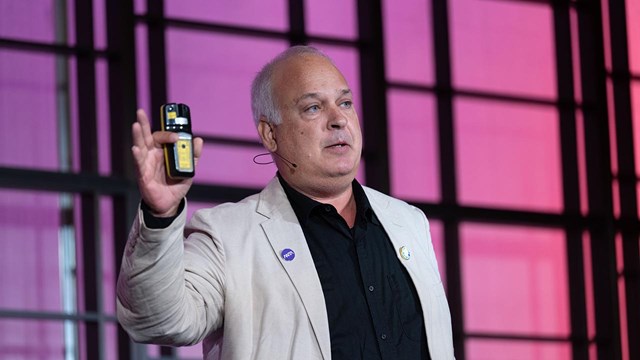
Howard Watson, Chief Security and Networks Officer, BT
In his final weeks as chief security and networks officer at UK national operator BT, Howard Watson reflects on his career in the communications technology and services sector, discusses the key trends he has seen develop over the past couple of decades, and shares his views on AI and 6G.
Recorded March 2026
Email Newsletters
Sign up to receive TelecomTV's top news and videos, plus exclusive subscriber-only content direct to your inbox.