Everything you've always wanted to know about quantum computing

By Tony Poulos
Mar 2, 2026
To embed our video on your website copy and paste the code below:
<iframe src="https://www.youtube.com/embed/p0UbjQdpooQ?modestbranding=1&rel=0" width="970" height="546" frameborder="0" scrolling="auto" allowfullscreen></iframe>
Tony Poulos, TelecomTV (00:07):
Hi, I'm Tony Poulas and I am at Mobile World Congress 2026 in Barcelona. I have a fascination with quantum computing and in order to find out more about it, I've come to the Fujitsu stand where I've met with Ellen Devereaux and Alex Foster, who are the experts in this area. And I'm going to ask them some really basic questions. Firstly, Ellen, what is quantum computing?
Alexandra Foster, Fujitsu (00:32):
So quantum computing is the idea that you can harness quantum mechanics for computational advantage. It's the hopes that we can use quantum mechanics to do some things better than we can do with normal classical computers.
Tony Poulos, TelecomTV (00:46):
And here we have, I believe, a quantum computer. Alex, would you like to explain what this is?
Ellen Devereux, Fujitsu Services Limited (00:52):
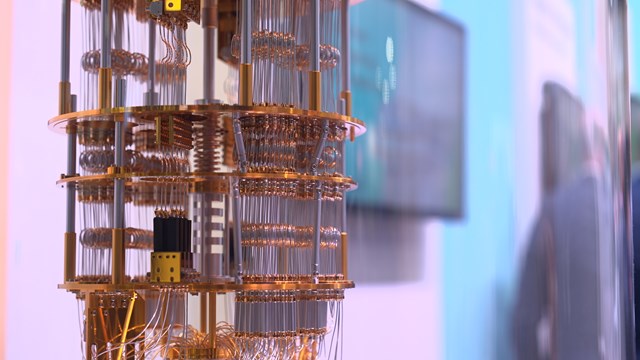
Well, this beauty here is our scaled model of our quantum mutter that we have in Tokyo with Reikin. It's about a half size model that we've got. The thing for everybody to start remembering when they look at these models of the three Cs of quantum computing. This is all about cooling. It needs to be cool. You need to have communication, that second C that you've got in that, and you also need to be able to have control. So when we're looking at this, we're looking at those three Cs around control communications, but most importantly, cooling. But then when we look down, we can look up because actually at the very, very bottom of it is actually the chip. The qubit shipbot. Our chip here is 64 qubits, which Ellen's going to tell us more about shortly. And our roadmap to 256 that we've got currently, and then our roadmap to a thousand.
(01:55)
So look down to look up so you can see the reflection. And so here it is in all its glory.
Tony Poulos, TelecomTV (02:02):
So Ellen, where is quantum computer being used? I think you've got some great use cases to share with us. Is that correct?
Alexandra Foster, Fujitsu (02:07):
Yeah. So we've got a demo on the screen here of how we've brought together our quantum computing and our quantum inspired optimization and our machine learning technology. So a catalyst is a material that promotes chemical reactions. And if we can improve our catalysts, we can get cleaner air. And there are three stages to this demonstration or this process. We've got quantum computation. We've got quantum inspired optimization. We've got AI machine learning, and all of this is 300 times faster than the classical alternative. So we can replace costly experiments with fast computational simulation. So the structure here is cerum oxide. We developed this process with Sakine Lab at Waseda University in Japan. Serum oxide is used in catalytic converters for cars. And so if we can get better catalytic converters, we have cleaner air. When we look at this, we want to understand which structure, which surface is the best structure to be a catalyst.
(03:09)
And so we start with a surface structure search. Using that, we program a quantum computer using this quantum circuit, which is the quantum foria transform, which is quadratically faster than the classical alternative. And that tells us about the different structures and theoricity we can find within the crystal. This tells us all of the potential structures and what options we have on each axis to act as a catalyst, but that doesn't tell us which one is the best catalyst. So the next step is to study how the surface reacts to reactants and how they absorb to the surface using quantum inspired optimization, which is 300 times faster than classical compute. And so here we can see for each of the surfaces that we saw previously, how a variety of reactant molecules, one, two, three, up to many reactant molecules affects the energy of the surface. And that tells us whether or not it would make a good catalyst.
(04:11)
We can then take all of this data and use it to train an AI, which means we can then ask the AI, well, what happens if I want to change the surface by adding, for example, a lanternmion? How does that affect the surface structures and how does that affect the reactant molecules and the energies? And the machine learning can tell us that process without us having to repeat all of the previous computational steps. So that's one of our use cases. We obviously have use cases across sectors, quantum computing.
Tony Poulos, TelecomTV (04:40):
Quantum computing is just part of the computing story, but what part is it playing and where is it hitting and what do we do about AI as well?
Ellen Devereux, Fujitsu Services Limited (04:48):
Well, you're right. It is absolutely just part of the story. I think people think, oh, that's it, that's the end. But actually it'll just clay. You will have that Cuper U stack, then you'll have your GPU stack, your CPU stack. So it will have its part to play in the hybrid computing stack. There will be things that, as Ellen has already talked about, that you can do with quantum computers that you cannot do with classical computers today, but that does not mean that classical computers are obsolete, absolutely not. And as Ellen said, actually that coalescence of technologies coming together, data, AI, and quantum computing alongside high performance computing, classical computing is then when we'll get those discoveries and new ways to be able to search things out, whether it's from financial services in fraud, portfolio optimization, having a look at options pricing right the way through to drug discovery in life sciences and some of the things that we've been doing on carbon in EVs.
Tony Poulos, TelecomTV (05:52):
Now we talked about this particular unit here. What's the capacity of this unit and what's the forward evolution of the capacity of quantum computers?
Ellen Devereux, Fujitsu Services Limited (06:01):
Well, what we're looking at here is 64 qubits. In Japan, we've got 256 and we have a roadmap to a thousand, and I'm going to let Ellen talk to you about the roadmap because that is what she works on on a day-to-day basis.
Alexandra Foster, Fujitsu (06:16):
So our roadmap, like Alex said, is what we're showing here is our 64 qubit machine that we've had for a while. We have a 256 qubit machine in Japan. We will have a thousand qubits in Japan in December of this year. And then in 2030, we will have 10,000 physical qubits, which is equivalent to 250 logical. So we mentioned earlier that you need all of this control and this cooling, but that's still quite error prone. So to move to useful quantum computing, we have to do error correction, which gives us logical qubits. And by 2035, we'll have a thousand logical qubits, and that's when we'll really unlock true computational advantage with quantum computing.
Tony Poulos, TelecomTV (07:01):
Wow. I hope I live that long to see all of that.
Ellen Devereux, Fujitsu Services Limited (07:04):
Well, I think we all hope we live that long. I certainly ... And also to go from where we are in innovation today, we've heard from Ellen talking about how you can use quantum inspired to be able to play, to co-create, to try it out. And then actually as we look forward, this is real, which means that actually when we have conversations about Q day, when we have conversations about post-quantum encryption, well, actually we are looking at it. So there is a security element to this. There is both the quantum advantage for innovation, but also there's the defense point of view as well. So that brings the security aspects to it. So we work with customers on that as well. And who would have thought that the super position, those naughts and ones we normally have in classical computing and superposition that we have in quantum, for those people that don't know that, flip a coin.
(08:02)
Is a coin heads, is it tails, or is it both? Well, that's probably the easiest way that we can describe that.
Tony Poulos, TelecomTV (08:09):
Well, I have to thank both of you and Fujitsu for giving me a heads up on what quantum computing is all about and where it's heading. Thank you very much. Thank you.
Hi, I'm Tony Poulas and I am at Mobile World Congress 2026 in Barcelona. I have a fascination with quantum computing and in order to find out more about it, I've come to the Fujitsu stand where I've met with Ellen Devereaux and Alex Foster, who are the experts in this area. And I'm going to ask them some really basic questions. Firstly, Ellen, what is quantum computing?
Alexandra Foster, Fujitsu (00:32):
So quantum computing is the idea that you can harness quantum mechanics for computational advantage. It's the hopes that we can use quantum mechanics to do some things better than we can do with normal classical computers.
Tony Poulos, TelecomTV (00:46):
And here we have, I believe, a quantum computer. Alex, would you like to explain what this is?
Ellen Devereux, Fujitsu Services Limited (00:52):
Well, this beauty here is our scaled model of our quantum mutter that we have in Tokyo with Reikin. It's about a half size model that we've got. The thing for everybody to start remembering when they look at these models of the three Cs of quantum computing. This is all about cooling. It needs to be cool. You need to have communication, that second C that you've got in that, and you also need to be able to have control. So when we're looking at this, we're looking at those three Cs around control communications, but most importantly, cooling. But then when we look down, we can look up because actually at the very, very bottom of it is actually the chip. The qubit shipbot. Our chip here is 64 qubits, which Ellen's going to tell us more about shortly. And our roadmap to 256 that we've got currently, and then our roadmap to a thousand.
(01:55)
So look down to look up so you can see the reflection. And so here it is in all its glory.
Tony Poulos, TelecomTV (02:02):
So Ellen, where is quantum computer being used? I think you've got some great use cases to share with us. Is that correct?
Alexandra Foster, Fujitsu (02:07):
Yeah. So we've got a demo on the screen here of how we've brought together our quantum computing and our quantum inspired optimization and our machine learning technology. So a catalyst is a material that promotes chemical reactions. And if we can improve our catalysts, we can get cleaner air. And there are three stages to this demonstration or this process. We've got quantum computation. We've got quantum inspired optimization. We've got AI machine learning, and all of this is 300 times faster than the classical alternative. So we can replace costly experiments with fast computational simulation. So the structure here is cerum oxide. We developed this process with Sakine Lab at Waseda University in Japan. Serum oxide is used in catalytic converters for cars. And so if we can get better catalytic converters, we have cleaner air. When we look at this, we want to understand which structure, which surface is the best structure to be a catalyst.
(03:09)
And so we start with a surface structure search. Using that, we program a quantum computer using this quantum circuit, which is the quantum foria transform, which is quadratically faster than the classical alternative. And that tells us about the different structures and theoricity we can find within the crystal. This tells us all of the potential structures and what options we have on each axis to act as a catalyst, but that doesn't tell us which one is the best catalyst. So the next step is to study how the surface reacts to reactants and how they absorb to the surface using quantum inspired optimization, which is 300 times faster than classical compute. And so here we can see for each of the surfaces that we saw previously, how a variety of reactant molecules, one, two, three, up to many reactant molecules affects the energy of the surface. And that tells us whether or not it would make a good catalyst.
(04:11)
We can then take all of this data and use it to train an AI, which means we can then ask the AI, well, what happens if I want to change the surface by adding, for example, a lanternmion? How does that affect the surface structures and how does that affect the reactant molecules and the energies? And the machine learning can tell us that process without us having to repeat all of the previous computational steps. So that's one of our use cases. We obviously have use cases across sectors, quantum computing.
Tony Poulos, TelecomTV (04:40):
Quantum computing is just part of the computing story, but what part is it playing and where is it hitting and what do we do about AI as well?
Ellen Devereux, Fujitsu Services Limited (04:48):
Well, you're right. It is absolutely just part of the story. I think people think, oh, that's it, that's the end. But actually it'll just clay. You will have that Cuper U stack, then you'll have your GPU stack, your CPU stack. So it will have its part to play in the hybrid computing stack. There will be things that, as Ellen has already talked about, that you can do with quantum computers that you cannot do with classical computers today, but that does not mean that classical computers are obsolete, absolutely not. And as Ellen said, actually that coalescence of technologies coming together, data, AI, and quantum computing alongside high performance computing, classical computing is then when we'll get those discoveries and new ways to be able to search things out, whether it's from financial services in fraud, portfolio optimization, having a look at options pricing right the way through to drug discovery in life sciences and some of the things that we've been doing on carbon in EVs.
Tony Poulos, TelecomTV (05:52):
Now we talked about this particular unit here. What's the capacity of this unit and what's the forward evolution of the capacity of quantum computers?
Ellen Devereux, Fujitsu Services Limited (06:01):
Well, what we're looking at here is 64 qubits. In Japan, we've got 256 and we have a roadmap to a thousand, and I'm going to let Ellen talk to you about the roadmap because that is what she works on on a day-to-day basis.
Alexandra Foster, Fujitsu (06:16):
So our roadmap, like Alex said, is what we're showing here is our 64 qubit machine that we've had for a while. We have a 256 qubit machine in Japan. We will have a thousand qubits in Japan in December of this year. And then in 2030, we will have 10,000 physical qubits, which is equivalent to 250 logical. So we mentioned earlier that you need all of this control and this cooling, but that's still quite error prone. So to move to useful quantum computing, we have to do error correction, which gives us logical qubits. And by 2035, we'll have a thousand logical qubits, and that's when we'll really unlock true computational advantage with quantum computing.
Tony Poulos, TelecomTV (07:01):
Wow. I hope I live that long to see all of that.
Ellen Devereux, Fujitsu Services Limited (07:04):
Well, I think we all hope we live that long. I certainly ... And also to go from where we are in innovation today, we've heard from Ellen talking about how you can use quantum inspired to be able to play, to co-create, to try it out. And then actually as we look forward, this is real, which means that actually when we have conversations about Q day, when we have conversations about post-quantum encryption, well, actually we are looking at it. So there is a security element to this. There is both the quantum advantage for innovation, but also there's the defense point of view as well. So that brings the security aspects to it. So we work with customers on that as well. And who would have thought that the super position, those naughts and ones we normally have in classical computing and superposition that we have in quantum, for those people that don't know that, flip a coin.
(08:02)
Is a coin heads, is it tails, or is it both? Well, that's probably the easiest way that we can describe that.
Tony Poulos, TelecomTV (08:09):
Well, I have to thank both of you and Fujitsu for giving me a heads up on what quantum computing is all about and where it's heading. Thank you very much. Thank you.
Please note that video transcripts are provided for reference only – content may vary from the published video or contain inaccuracies.
Alexandra Foster, Fujitsu and Ellen Devereux, Fujitsu Services Limited
Fujitsu is displaying a scale version of its quantum computer at MWC 2026, and Tony Poulos quizzes experts Ellen Devereux, PhD, and Alexandra Foster on what quantum computing is all about and how Fujitsu's quantum computer is being used now and in the future.
Featuring:
- Alexandra Foster, Director, Global Banking, Financial Services & Insurance (BFSI) & Professional Business Services, Fujitsu
- Ellen Devereux, PhD, Quantum Computing Consultant, Fujitsu Services Limited
Recorded March 2026
Email Newsletters
Sign up to receive TelecomTV's top news and videos, plus exclusive subscriber-only content direct to your inbox.