To embed our video on your website copy and paste the code below:
<iframe src="https://www.youtube.com/embed/7WEPuVe_lYw?modestbranding=1&rel=0" width="970" height="546" frameborder="0" scrolling="auto" allowfullscreen></iframe>
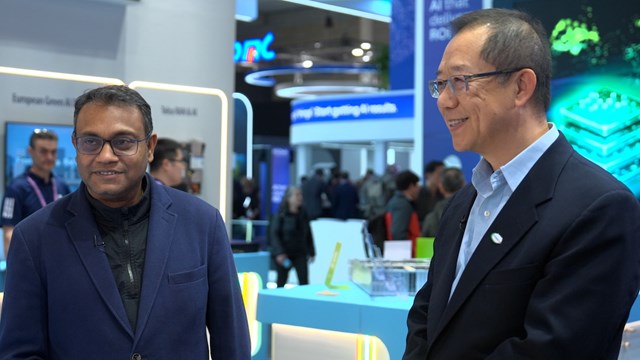
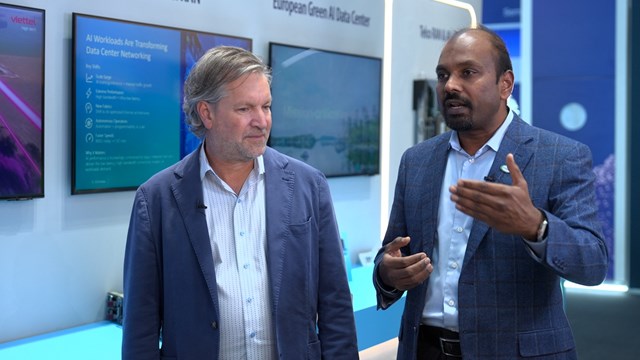
Hi, I'm Tony Poulos from TelecomTV here at MWC 2026. And I'm keen to find out a bit more about how telcos are adopting AI because it's the talk of this event. And to help me out, I have Vik Malyala, who happens to be the President and Managing Director, AMEA, SVP Technology and AI for Supermicro. Welcome, Vik. And next to you, Chris Penrose, Global VP of Business Development for Telco at NVIDIA. Welcome to both of you.
Chris Penrose, NVIDIA (00:35):
Thanks so much.
Tony Poulos, TelecomTV (00:36):
Vik, let me start off with probably with Vik on this one, but across industries, enterprises are showing a strong ambition to adopt AI. But moving from pilots to production is appearing to be a lot harder than people have expected. But what needs to change to truly accelerate enterprise AI adoption?
Vik Malyala, Supermicro (00:54):
So one of the things I see is that everyone wants to figure out a way to optimise their workflow and be able to run the business effectively. So enterprises adopting AI is no surprise at all, right? That's given. The problem is many of them are used to traditional workflows and it's not possible for them to just go and start hiring a bunch of people and the data scientists go take care of all these workflow to be modified to optimise it. The idea again here is how do we make it easy? One of the things that I have at least seen from NVIDIA doing is like bringing that Nemotron and bringing with all the NIM services to make it easy for customers to adopt. But at the same time, still people are seeing the gap in terms of how they should adopt. This is where a lot of global SIs will come into picture because they have already been working with them on different implementation of different software pieces in the data centres as well as in their enterprise compute.
(01:50):
So it's easier for them to go that way. Again, every year I see the amount of applications that NVIDIA is delivering, you just go to NVIDIA site and then it's amazing how many tools are available. So it's becoming easier and easier. And I think actually this is the year where a lot of these things are going to be adopted and it's going to be running in mainstream. Chris.
Chris Penrose, NVIDIA (02:12):
I think you said it really well. I think it starts off, you have to have a foundation, you have to have the infrastructure to do any AI work. And I think we're at this point where we're starting to see enterprises really lean in and begin to invest in that. In fact, we just did a recent survey of the telcos. We do an annual survey and we ask about the state of AI. And the good news is this year, 89% of the telcos said they're going to increase their spend year over year on AI. And they would only be doing that if they were starting to see the positive returns on it. So then I saw that they've got the infrastructure. Then it's, okay, where are these use cases and how are they going to go actually go put those things into production? And so I think we're at that point where we've done lots of POCs, but now they're at a point where they really want to take it to scale.
(02:58):
And they're looking for how do they have the right tools and the right capabilities to actually take this to go to true scale solution that's going to give them the ultimate return. And so NVIDIA is providing a lot of the basic frameworks and tools to them and training up the ecosystem partners to help them so we can either help them as a developer or we bring other developers that can help the telco be able to achieve what they want to do.
Tony Poulos, TelecomTV (03:22):
Well, of course, rolling in with this is the concept of AI factories. And we've been hearing a lot about that at this event. In tandem with a call for sovereign AI. Oh my goodness, we're getting into a dark area here. But why has sovereign AI become such an important and urgent priority and how do you see its evolution over the next few years? Who'd like to kick off with that one?
Chris Penrose, NVIDIA (03:42):
I'll take it. Yeah. I mean, we've been just amazed at what's happening. Really every nation is looking to see how do they participate as their economy participate as part of this AI wave, right? And basically, just like you have roads and you've had railways, you need the right infrastructure to be as a foundation to be able to build on top of that, the AI applications and solutions. And so we see sovereign AI really taking off because every nation is looking at how do they help create the right economic conditions for their own country, build startups, build new jobs, how do they help use that AI to help their citizens have a better life. And so a lot of focus on creating great solutions for the citizens. And then finally, how do they also tap into the research and development world to be able to innovate as they go forward?
(04:38):
And so I think our CEO says it best that no country should leave the manufacturing of intelligence to others. And I think that we really do see that every country should lean in, put in the right infrastructure and to be able to participate in what's happening with the massive AI wave.
Tony Poulos, TelecomTV (04:58):
Vik's are munching to tell us something. Right? Yes.
Vik Malyala, Supermicro (05:01):
No, what I see that every country has its unique values and they're either speaking different languages or they have different history that is quite a bit, let's say, unique to them, and they only understand what is needed for them. That's number one. Second thing here is every country wants to keep the data within the country. So they don't want someone else to kind of snoop into that because it's all about protecting your identity and making sure that you are able to build on that. That is the fundamental thing that's actually driving the sovereignty aspect of it. Initially it started with the data. Now, what do you do with the data? All the data is there, but that's where NVIDIA is coming into picture. Hopefully Supermicro is a part of it in bringing the solutions there to these countries where they can deploy them. And number one, take all the data and process it and make it useful for the country, and two, be able to create jobs, and three, able to give opportunity for all these younger generation to learn and adopt AI and make so many new things and better things so that the human experience can be better.
(06:09):
So absolutely, it is the thing that every country is wanting to do. And you can see that all of us, like NVIDIA, Supermicro and a whole bunch of these data centres and whatnot, we are trying to see how to minimise the barrier so people can actually take it and adopt it and run with it.
Chris Penrose, NVIDIA (06:28):
Yeah. And I would add on one other thing. I think that what we're also seeing is that the telcos are now beginning to play a really important role in being that provider of that sovereign infrastructure for their nation. And this is a really unique opportunity. They are the trusted brand in their nation.
Tony Poulos, TelecomTV (06:46):
And they've had experience doing
Chris Penrose, NVIDIA (06:47):
Exactly
Tony Poulos, TelecomTV (06:48):
That already.
Chris Penrose, NVIDIA (06:48):
Right. And they know how to deliver infrastructure for their nation. They know how to do it with the right compliance and the right security. And so they bring the right history of being proving as the critical infrastructure provider in their countries. And so it's really exciting to kind of see that's where many of the nations are turning to say, "You guys need to help make this happen." And then we're seeing that happen a bit.
Vik Malyala, Supermicro (07:12):
And that, just like I was talking to Nokia, right? One of the things that they were talking about is the resiliency of the infrastructure, because if something goes down, how quickly you swap out that part and make it run, because the last thing you want is you want to pick up a phone and call or you want to download something or you want to have anything to do accessing the data. If it's not there, you're not going to be happy.
Tony Poulos, TelecomTV (07:31):
Connectivity's critical,
Vik Malyala, Supermicro (07:32):
Right? Exactly. They're doing it. Now the question is, having that infrastructure in place, be able to adopt and be able to have all this AI infrastructure close to them and be able to provide services, especially at the edge, nothing beats it.
Tony Poulos, TelecomTV (07:45):
AI infrastructure forces companies now to move beyond individual servers to this new rack scale approach, especially for the next generation platforms like NVIDIA's GB300, of course, which you know so well and RTX. How is this shaping data centre design and manufacturing? Because it hasn't been changed for a long time, has it?
Chris Penrose, NVIDIA (08:07):
Yeah, it's definitely a different world. These latest computers in compute systems, because it is a system at this point, they take an entirely different level of power, they're liquid cooled, and so it really requires a complete rethink of how you're going to actually build out these new AI factories that are going to exist. But there's also an opportunity to be able to potentially go back into existing data centres and potentially retrofit, wherein you might then need some different types of solutions that might be air cooled. And that's where it's really exciting. The Supermicro is really bringing this full portfolio from the smallest edge compute up to the rack scale systems to be able to serve the needs. And we kind of see this, you've had large factories kind of being the big place where training and inferencing was happening, but we actually see over the course of time that you're going to see a more distributed inferencing architecture begin to emerge where you're going to have many more smaller data centres out there really driving inferencing and having this continuum of solutions from edge to the largest data centres out there that's a cloud, that is really an important reason why we love working with Supermicro.
(09:24):
Yeah.
Vik Malyala, Supermicro (09:24):
I mean, absolutely. The edge to the core, right? What is happening is the training clusters, those are the ones that are getting bigger and bigger. So you take a look at the latest, what is like a Groc model, right? They're talking about six trillion parameters. So to do that kind of work, I mean, those many parameters be able to train a model, you need like hundreds of thousands of GPUs, but how do you basically connect all these GPUs? In a traditional way, if you start putting like one GPU per server, then having these many systems and a massive network with so much of overhead, that's not going to fly. So what NVIDIA has done is like incredible. The GB300 and VL72, as we talk about it, these 72 GPUs are operating as a single system and you cannot obviously fit 72 GPUs in a one U type of form factor.
(10:12):
That's where the rack scale is coming into picture and be able to connect all that using the NVLink and making it look like a huge machine. And that's where the industry is training. But when you think about it, what is the purpose of having this? At the end of the day, you put all these things together, connect the network and bring the whole thing up and be able to deliver tokens. That's where the AI factories are, right? So all of a sudden you stop and look at it like, why am I having this server? What is the purpose of having these systems? The whole idea is to be able to generate these tokens in a most cost effective manner, be able to do as much of compute as possible. That's the direction. And obviously, if you're going towards the edge, you can't have that kind of infrastructure right there.
(10:55):
That's where the likes of RTX will come into picture, the likes of HGX platforms with eight of these B300s in a system. Depending on the scale, one can start with one or in a rack, many systems being plugged in. Bottom line here is rack scale is a de facto standard right now when people are looking at it and be able to look at power delivery and everything and be able to provide that at whatever the scale. I know, I can talk forever, but- I worried about that.
Tony Poulos, TelecomTV (11:20):
But let me ask the last question. It's a very important one. We often talk about AI infrastructure as separate pieces. I think we were alluding to that a moment ago, data centres, networks, edge devices, but increasingly it's described as an end-to-end ecosystem, which you were talking about just now. But what does a truly end-to-end AI architecture look like in practice and how close are we to that reality?
Chris Penrose, NVIDIA (11:45):
Yeah. So I think we're trying to help make this an easy way for people to go and create the right architecture to be able to deliver this end to end. So in NVIDIA, we build what we call reference architecture for people that want to stand up a rack scale environment in a large AI factory. And what we've done is, you're right, it takes not only GPUs, CPUs, DPUs, also networking and the software to be able to orchestrate and then the AI application software as well, it takes all that to be able to deliver ultimately the tokens and the- And the power to run it all. And you need power, you need space and power to make it all run. And so bottom line is what we do is we build out a very detailed reference architecture that we've actually tested on ourselves first. And then once we know that it's working optimally, we then bring that out to the industry and say, "Here you go.
(12:39):
Now you can go design and have that and have a speed to market because you're now doing it in a common way where all the pieces we know work the best way together." And so we're really trying to make ... We've basically kind of say, now you can take all the pieces, you know what they are, now go put it into action.
Tony Poulos, TelecomTV (12:56):
Chris,
Chris Penrose, NVIDIA (12:56):
That
Tony Poulos, TelecomTV (12:56):
Makes sense.
Vik Malyala, Supermicro (12:57):
That's what we are taking. Once NVIDIA does it, what happens with that? We take it and we need to deploy it in the data centres and how do we do that? So this is where I think the problem is kind of mitigated by Supermicro informed capacity. Many of the traditional data centres, they don't have enough cooling, they don't have enough power, they don't have the right type of power delivery. And how do we basically make them adopt the latest technology into their data centres? That's number one. Second is people are building this massive compute facilities that is to handle these large language models, but the data centres are not coming at the same speed either. And we take a look at a simple data centre, you have like chillers on the outside to water coming into the data centre. There's a power that is coming into the data centre with data and power, right?
(13:42):
Obviously you want it to be running all the time. Then you need to have racks, you need to have cooling distribution units, you need to have power delivery within the thing. All these things, UPS systems, for example. And when you connect all these things in and start looking at a data centre level, you need to have a way to manage this. If something goes wrong, how do you kind of have a telemetry into it? We work with NVIDIA to kind of look at what is the thing called the advanced element to that is going into the GB300s to see what is going wrong when, because you're talking about a massive investment and we want to make sure the systems are up and running. So what we are doing, Supermicro point of view, we look at it so- called data centre building block solutions that are DCBS, where we are looking holistically.
(14:25):
Even though we are a server company, we know as we take these complex platforms and start deploying it, people are not going to be able to use it unless the whole thing is ready. So we are looking at end to end and be able to work with the ecosystem partners to stitch our solutions together and give a turnkey solution to the customers to take it and run with it.
Tony Poulos, TelecomTV (14:45):
He loves this stuff, doesn't it?
Vik Malyala, Supermicro (14:47):
Oh my God, incredible times that we are in.
Tony Poulos, TelecomTV (14:50):
What it highlights to me is that none of this is happening without really good partnerships. This whole environment is all about partnerships. Everyone I've talked to here is talking about partnerships and you two exemplify that. I'd like to thank you so much for spending time with me today. Vik and Chris, thank you so much. Thank you for your time.
Vik Malyala, Supermicro (15:06):
It's our pleasure. Yeah.
Please note that video transcripts are provided for reference only – content may vary from the published video or contain inaccuracies.
Chris Penrose, NVIDIA & Vik Malyala, Supermicro
At MWC26, experts from Supermicro and NVIDIA explore how telcos and enterprises are moving from AI pilots into production, highlighting the need for robust infrastructure and ecosystem partnerships. They discuss the growing importance of sovereign AI, as countries seek to retain control over data and AI capabilities, and address the shift towards rack scale datacentre designs, driven by new AI workloads and platforms such as NVIDIA’s GB300.
Featuring:
- Chris Penrose, Global VP of Business Development – Telco, NVIDIA
- Vik Malyala, President & Managing Director, EMEA; SVP Technology & AI, Supermicro
Recorded March 2026
Email Newsletters
Sign up to receive TelecomTV's top news and videos, plus exclusive subscriber-only content direct to your inbox.