Broadcom on how private cloud supports sovereign AI in telecoms

By Guy Daniels
Mar 3, 2026
To embed our video on your website copy and paste the code below:
<iframe src="https://www.youtube.com/embed/Lk8F21jPhpc?modestbranding=1&rel=0" width="970" height="546" frameborder="0" scrolling="auto" allowfullscreen></iframe>
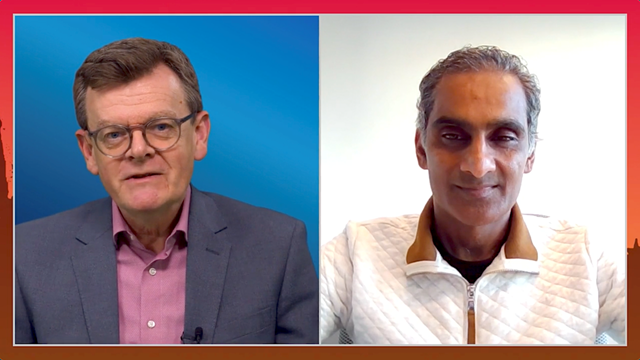
Hello, you're watching TelecomTV. I'm Guy Daniels. Now, what's behind the rise of sovereign AI? Why is the private cloud model the infrastructure of choice for this new era? And how can telcos overcome the deployment challenges in power, rackspace, and silicon supply? Well, joining me now to explain more is Ram Velaga, who is President of the Infrastructure Software Group at Broadcom. Hello, Ram. Good to see you. Thanks very much for joining us. Now, we know Broadcom is often associated with silicon, but we have seen this massive shift in how the company engages with the telecoms industry. So how would you describe this end-to-end story that Broadcom is telling now from the physical edge all the way to the data centre software?
Ram Velaga, Broadcom (00:56):
Hi, good morning. Broadcom has two large parts of the portfolio. One is on the silicon side where our products are present all the way from base stations to the data centre and the networks that connect them in between. And also, Broadcom is very much a software infrastructure player, primarily with our VMware software that allows for private cloud deployments, whether that is in an enterprise environment or in a telco environment. And the way we think about it is the customers have started their journey for clouds, whether it is public clouds or private clouds for many years now. And the primary motivation for it is to increase the utilisation of their assets. And as they go about it, and when you think about the asset utilisation, you're going to be sharing the CPUs, you're going to be sharing the memory and so on and so forth and the networks on a given infrastructure.
(02:10):
And then by being able to share, you're able to increase the utilisation, lower your costs. But also what comes into play is the ability to keep things secure. And with requirements such as sovereignty coming into play, being able to have the control that one would like to have within a given country while meeting the regulatory requirements with availability and security being top of mind. So this is where Broadcom plays from our software standpoint, specifically our private cloud solutions and our cloud solutions, both for the enterprise as well as for the telcos.
Guy Daniels, TelecomTV (02:46):
Well, it's always good to see Broadcom at MWC, and we are at that time of year where MWC is everywhere. There's so much focus on the news coming out of Barcelona. So what can we expect to see from you at the show this year? Can you walk us through some of the major announcements you've been making?
Ram Velaga, Broadcom (03:04):
Yeah, so our major announcement at the MWC this year is our TCP, which is the Telco Cloud Platform 9 that is going to be announced. Now, TCP brings significant benefits to our customers, the telco customers. One, it is a singular platform on which you can host both virtual machines as well as container workloads. Essentially, what we are saying is whether your application is being written to VMs with the security and the availability that's associated with VMs and the delineation that's associated with them, or if it is cloud-native running on a container workloads, all of them can be running on a singular platform versus having multiple different platforms, one for VMs and one for containers. Number two, it provides the availability and the security and the sovereignty that is needed for these telcos, especially telcos in different regulated environments. Telcos offering up workloads in different countries, all of which are very worried about sovereignty and the ability to continue to perform with the SLAs that are required without external dependencies.
(04:23):
Three, the TCP platform is providing a lot of efficiencies from a hardware standpoint. When you think about the world that we are currently living in where power is constrained, space is constrained, and the availability of silicon is very much constrained with all the investments which are going in the AI space and memory prices skyrocketing, the TCP 9 platform allows our customers, our telcos, to significantly increase the utilisation of their compute nodes, their storage nodes, while at the same time running them with the security and the availability requirements and the sovereignty requirements, which is they are in full control of the platform. They have the keys to be able to continue to operate the platform and not have to worry about an external third party that they might not be able to access the services and the technology and the platforms and keep the data local. So being able to provide all of these for the telcos in a way that is extremely efficient is what our Telco Cloud Platform 9 provides.
Guy Daniels, TelecomTV (05:37):
Thanks very much, Ram. Well, let's look a little deeper now at those areas of sovereignty and AI because with the convergence of regulations like the EU AI Act and growing geopolitical concerns, sovereign AI has certainly moved from being a buzzword to a real business necessity now. Why is the private cloud model now regarded as the infrastructure of choice for this AI era compared to hyperscale public cloud models?
Ram Velaga, Broadcom (06:06):
Yeah, good question. Think about it. Just even in the last couple of weeks, the amount of disruptions in the marketplace when the world is envisioning a future where the large language models have agentic capabilities and the amount of industries that are being disrupted all the way from banks to legal institutions and other intermediaries, whether it was Ubers or so and so forth, you've seen all of their market caps being disrupted by concerns about what these large language models can do. Now, when you think about those, if the large language models are available through a couple of companies from a couple of countries or continents, you'll end up finding yourself in a situation where marketplaces could be significantly disrupted and countries, there may be some countries who just feel like they're being left out and without having complete control over their destiny. In an environment like that, what we see is couple of things become extremely important.
(07:16):
One, you want to be able to have a multitude of large language models you have access to, some of which may be coming from the hyperscalers, some of these may be open source and so on and so forth. Two, once you have access to what we call a pre-trained model, you want to be able to post-train that model for the specific context that you're interested in. And that context may be very specific to a particular region, their beliefs, their cultural beliefs, their text, the knowledge information that they have and so on and so forth. So in a world where everybody wants to be self-sufficient and in a world that otherwise could be easily disrupted at many levels, not just at a technology level, but banking, retail, healthcare, everything could be disrupted, everybody wants to be able to control their destiny, and that's where the private cloud comes in.
(08:06):
Number one is you have an environment that you own and you are able to run. And number two, the data that you own is extremely important. And the data that you own is what actually adds the intelligence to the large language model. Once you've taken a generically trained large language model, the post-training in the context of the information that you have is extremely valuable. So you don't want that kind of going out into a hyper-cloud deciding someplace else that you don't necessarily have control to, and you may be giving up some of the crown jewels that you have. So in that context, being able to actually control your destiny, control your destiny, keep your data to yourself, being able to post-train the large language models, being able to have access to multiple different large language models and not feel like there is a particular hyperscaler that has a preference to a large language model.
(09:00):
And remember, another thing is these costs per token are not cheap. So the more you want to actually use AI, the more you are going to use this infrastructure, you have a margin stacking that happens with these hyperscalers. If you think about hyperscaler spending collectively across them well over $700 billion expected in 2026, at some point they have to start paying for these large language models and who's going to end up paying for this? It's going to be the end consumers that are going to use them. So having access to multiple different large language models, whether it comes from one country or comes from an open source, closed source, all of that becomes extremely important looking ahead, and that's where the private cloud plays a very, very important role.
Guy Daniels, TelecomTV (09:51):
Yeah, makes a lot of sense. Now, I spoke earlier about challenges that telcos face, and as they accelerate their AI deployments, they do face limitations in power, rackspace, and silicon supply. So how does Broadcom provide solutions to navigate these infrastructure challenges?
Ram Velaga, Broadcom (10:10):
Yeah, I would actually say the telcos have in a really good sweet spot in the journey through these clouds, as you think about it. Over the last few years before AI became a dominant theme, the hyperscalers were continuing to build a lot of data centres, and in many ways they were competing against these telco cloud partners. Now, when you think about the AI and the implications of AI on the hyperscaler, they are struggling to find space and power themselves. And whatever space and power they have available, they are prioritising investments in AI because that's a race towards leadership, market leadership. What the telco clouds have is they have existing data centres and they have power and they have network connectivity into these data centres. And as space becomes very much a premium, power becomes a premium. They're sitting on a very valuable commodity. With that as the baseline, the private cloud offered offerings by telco can take advantage of the space that they have, the power that they have, and then be able to actually provide an environment that is very much like a hyperscale public cloud solution, which is complete virtualisation of compute, network, and storage with very high utilisation rates.
(11:40):
And combined that with some of the capabilities we have in our TCP 9 platform. So for example, we have the idea of memory tiering. When you look at the compute servers today, majority of that cost that you're paying for a server is dominated by memory. And just even stories that we are hearing, when you go to buy a server today, if you have don't place your order within two weeks, the prices are going up significantly double the digit percentages every couple of weeks at a time, and you don't even have memory available to get the servers that you need. What the memory tiering allows us to do is to augment any limited memory that you have available on the CPU with NVMe attaches that you can make to it, memory attaches that you can make to it, to get significant more mileage out of the compute that you have at a fraction of the cost versus paying it for the compute that is sitting on the memory that is sitting on the server.
(12:41):
So effectively, what you are going to see is lower costs for your compute through memory tiering capabilities, and two, with some of the capabilities like vSAN, where we are able to pool the memory that is attached to the compute nodes that the customers already have, you are able to avoid buying external large storage platforms. So all of this is significant savings in terms of compute utilisation going up, the memory tiering, as well as being able to use the memory that's already available in the servers instead of using external storage and being able to share even the network resources all contributes to a lower CapEx and a lower total cost of ownership, operational costs contributing to it, versus having to buy more and more hardware on platforms that cannot support such a high, efficient, dense deployments.
Guy Daniels, TelecomTV (13:44):
Well, final question then, Ram, and let's just build on what you were talking about there, because telecoms is quite a low margin business where every percentage gain of efficiency counts. So what are you seeing in the field in terms of actual deployments that is truly delivering on the promise of shrinking physical infrastructure while at the same time increasing capacity?
Ram Velaga, Broadcom (14:07):
Yes. Let me give you an example of one of the deployments we have been working through. It was about 120,000 virtual machine cores environment, and that particular deployment, they were using 5,000 hosts. And what we were able to do working with that particular customer on the deployment was reduce the number of their physical servers from 5,000 physical servers to less than 2,000 physical servers by increasing the density of the VMs that were supported on these or deployed on the physical host. In addition, we were able to decommission external storage platforms and run the vSAN platform on the compute nodes using our TCP/VCF platforms and significantly reduce their memory costs and storage costs. And when you look at the cost savings coming from these changes, obviously this also has a ripple effect and reduction in the network because you go from 5,000 physical hosts to 1,700 or so physical hosts, and there is savings from power as well as space in addition to all the operational savings in terms of fewer footprint with software loaded on them, it calculated to about over $500 million in savings over a five-year period.
(15:47):
That is very, very tangible savings that you could see the telcos being able to realise and just going right through their bottom lines. So this is where we are extremely confident that working with the telco customers, we are able to provide a very solid alternative to hyper-cloud solutions that telcos can support on their own platforms, as well for their own network function virtualisations, being able to host it on our TCP 9 platform, whether it is in a virtual machine environment or in a cloud-native container environment, all in a singular platform.
Guy Daniels, TelecomTV (16:29):
That's quite an achievement you highlighted there. But for now, Ram, we must leave it there. Really good talking with you, and thanks so much for sharing your views with us today. Thank you.
Ram Velaga, Broadcom:
Thank you for this opportunity.
Please note that video transcripts are provided for reference only – content may vary from the published video or contain inaccuracies.
Ram Velaga, President Infrastructure Software Group, Broadcom
Ram Velaga, president of the Infrastructure Software Group at Broadcom, tells Guy Daniels about the growing importance of sovereign AI and why private cloud is becoming the preferred infrastructure model for telcos. He introduces Broadcom’s new Telco Cloud Platform 9, which runs virtual machines and containers on a single platform, and addresses deployment challenges such as power, rackspace, and silicon supply. Velaga also shares how Broadcom’s solutions helped a telco to reduce physical infrastructure and costs while increasing capacity and efficiency.
Recorded February 2026
Email Newsletters
Sign up to receive TelecomTV's top news and videos, plus exclusive subscriber-only content direct to your inbox.