To embed our video on your website copy and paste the code below:
<iframe src="https://www.youtube.com/embed/4NZ4ARCbkkI?modestbranding=1&rel=0" width="970" height="546" frameborder="0" scrolling="auto" allowfullscreen></iframe>
Tony Poulos, TelecomTV (00:07):
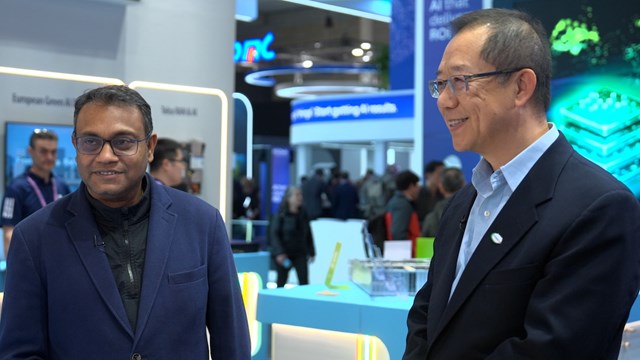
Tony Poulos from TelecomTV here at MWC 2026. Today I'm seeking information about AI RAN and future networks. And who better to help me than these two gentlemen: Soma Velayutham, who is the Vice President, AI and Telecoms at NVIDIA. Welcome, Soma, great to have you here. Yes. And with you, Yaming Wang, who is the Head of 5G and Edge Solutions at Supermicro. Well, let me kick off with this really ... This is a thoughtful question to start with. Telco networks were designed for connectivity, but now we're talking about making them AI-native from the ground up. What does it really mean for a network to be AI-native and how different is it than simply adding AI on top? Soma, what do you think about that?
Soma Velayutham, NVIDIA (00:52):
Yeah, thank you for the great question. I think the networks previously were built where predominantly the traffic was, you would seek for information and you get it downloaded. But today AI is actually prompt and generate. So you're actually interacting with the data continuously. So it's a very iterative process and therefore fundamentally it has to be software-defined and programmable because you have to ask for data and you get a response back. You're actually talking to the network.
Yaming Wang, Supermicro (01:22):
Because the AI on top of a network, which is very different from AI-native, means you bought it afterwards. Like Soma said, the previous network is already there. It's dedicated for communication. And the AI is just adding certain functionalities, but doesn't really natively build into the network, which will be ... For a natively built network, you'll start to use a deep learning algorithm, maybe doing self-healing, and also to cover both communication and also the AI part of the functionalities as well, which is very different from you just add an AI server out of the back and you call that the AI-based network.
Tony Poulos, TelecomTV (02:07):
Operators are under pressure, of course, to monetise their 5G networks, and they have been for a long time. It's a big investment for them. And now AI is seen as the next growth lever. Where are the real monetisation opportunities for AI, particularly in AI-native networks? Can you help me with that one?
Yaming Wang, Supermicro (02:25):
Yeah. So I think we're still at the early stage, but we have seen some promising use cases. Like one of the leading use cases for 6G is this ISAC, the integrated sensing and communication capability. So you start to use the radio access network to sense the objects, the moving objects, start to provide location information. And that's a very unique value with the cellular network because they have cell towers everywhere. So it's a very broad coverage. You can offer that to enterprises, to public government, and many other things. And also for robotics coverage as well. So that's just one use case. There could be many others, but the essential thing is the operators, they own the last mile. So with last mile, they can offer differentiated low latency services to many different customers. Let
Soma Velayutham, NVIDIA (03:24):
Me add to that. If you think about it fundamentally, networks today ... Let me maybe give you a slightly different view. This morning I was checking the iPhone App Store. It has 2.2 million apps, and this is in the 20-year journey. And the reason for that is it's programmable. You can create apps. Instead of searching for a killer app, what we need to do is let the networks, the base station become programmable and open up. I believe that with 6G and AI, this is fundamentally the base station will become the next ... The iPhone moment has come for the base station. And today with Supermicro and NVIDIA, the systems we are building are hardware-accelerated, but completely open and programmable. So that's kind of the iPhone of base stations.
Tony Poulos, TelecomTV (04:19):
And presumably, we're going to find out that using AI or having an AI-native network is going to add savings with energy perhaps, and the way the network operates more efficiently. Is that a critical factor as well?
Soma Velayutham, NVIDIA (04:31):
Yeah, 100%. Two things need to happen. One, networks, the traffic, AI traffic is going to also continuously go up because you're not just downloading a YouTube movie or watching a YouTube movie, you are constantly interacting with the data. So the traffic goes up, the pattern is shifting, and networks have to be much, much more efficient in doing that. So therefore, we can also use AI for RAN in order to get the spectral efficiency higher so you can deliver more traffic with less spectrum.
Tony Poulos, TelecomTV (05:02):
That's an ever-ending cycle we're going through.
Yaming Wang, Supermicro (05:05):
Yeah. If I may add, yes. So the current network, you are running on a predefined logic to go through the protocols meeting this 3GPP standard. But in the future, if we can use an AI model to run those things, you can dynamically adjust based on the traffic because you cannot predict all the traffic patterns, but you can adjust that in real time. Then you can really save energy as well.
Tony Poulos, TelecomTV (05:35):
Looking ahead, networks are expected to support not just smartphones, but autonomous systems, robotics, and what we call physical AI. How should telecom networks evolve to support this next wave of connected systems?
Soma Velayutham, NVIDIA (05:50):
That's a great question. One more. AI, there's fundamentally two kinds of AI, an agentic AI, which is more of a digital interaction. And then there's a physical AI where that AI is actually interacting with the physical world. And when you interact with the physical world, you need time-space coherency. As I move forward, the robot needs to move back and then it needs to interact. And that physical time-space coherency, telco networks are the best to provide it because they understand this concept of time-space coherency. And with physical AI, telco networks become almost critical to make sure that it's completely time synchronised and telcos will have a great value to become the nervous system of this physical AI.
Tony Poulos, TelecomTV (06:35):
How close are they getting to that though?
Yaming Wang, Supermicro (06:38):
So yeah, I want to just add on top of that. So for example, a robot today, when they turn to running around, they are based on the technology, a protocol of SLAM, really is using their own camera to look around, but it's very limited. So with the cellular network, being able to help them navigate in a much broader view, that will help them, in the physical way, to achieve that much faster. So I think we will be able to see some early trials happening in the next couple of years, and we see in five years, some of the physical AI may become a reality.
Tony Poulos, TelecomTV (07:22):
Well, something to look forward to.
Soma Velayutham, NVIDIA (07:23):
Yeah, indeed.
Tony Poulos, TelecomTV (07:24):
Soma, thank you very much for being here today and Yaming, I really appreciated that outlook. Thank you.
Yaming Wang, Supermicro (07:29):
Thank you.
Tony Poulos, TelecomTV (07:29):
Thank you.
Soma Velayutham, NVIDIA (07:30):
Thank you for having us.
Tony Poulos from TelecomTV here at MWC 2026. Today I'm seeking information about AI RAN and future networks. And who better to help me than these two gentlemen: Soma Velayutham, who is the Vice President, AI and Telecoms at NVIDIA. Welcome, Soma, great to have you here. Yes. And with you, Yaming Wang, who is the Head of 5G and Edge Solutions at Supermicro. Well, let me kick off with this really ... This is a thoughtful question to start with. Telco networks were designed for connectivity, but now we're talking about making them AI-native from the ground up. What does it really mean for a network to be AI-native and how different is it than simply adding AI on top? Soma, what do you think about that?
Soma Velayutham, NVIDIA (00:52):
Yeah, thank you for the great question. I think the networks previously were built where predominantly the traffic was, you would seek for information and you get it downloaded. But today AI is actually prompt and generate. So you're actually interacting with the data continuously. So it's a very iterative process and therefore fundamentally it has to be software-defined and programmable because you have to ask for data and you get a response back. You're actually talking to the network.
Yaming Wang, Supermicro (01:22):
Because the AI on top of a network, which is very different from AI-native, means you bought it afterwards. Like Soma said, the previous network is already there. It's dedicated for communication. And the AI is just adding certain functionalities, but doesn't really natively build into the network, which will be ... For a natively built network, you'll start to use a deep learning algorithm, maybe doing self-healing, and also to cover both communication and also the AI part of the functionalities as well, which is very different from you just add an AI server out of the back and you call that the AI-based network.
Tony Poulos, TelecomTV (02:07):
Operators are under pressure, of course, to monetise their 5G networks, and they have been for a long time. It's a big investment for them. And now AI is seen as the next growth lever. Where are the real monetisation opportunities for AI, particularly in AI-native networks? Can you help me with that one?
Yaming Wang, Supermicro (02:25):
Yeah. So I think we're still at the early stage, but we have seen some promising use cases. Like one of the leading use cases for 6G is this ISAC, the integrated sensing and communication capability. So you start to use the radio access network to sense the objects, the moving objects, start to provide location information. And that's a very unique value with the cellular network because they have cell towers everywhere. So it's a very broad coverage. You can offer that to enterprises, to public government, and many other things. And also for robotics coverage as well. So that's just one use case. There could be many others, but the essential thing is the operators, they own the last mile. So with last mile, they can offer differentiated low latency services to many different customers. Let
Soma Velayutham, NVIDIA (03:24):
Me add to that. If you think about it fundamentally, networks today ... Let me maybe give you a slightly different view. This morning I was checking the iPhone App Store. It has 2.2 million apps, and this is in the 20-year journey. And the reason for that is it's programmable. You can create apps. Instead of searching for a killer app, what we need to do is let the networks, the base station become programmable and open up. I believe that with 6G and AI, this is fundamentally the base station will become the next ... The iPhone moment has come for the base station. And today with Supermicro and NVIDIA, the systems we are building are hardware-accelerated, but completely open and programmable. So that's kind of the iPhone of base stations.
Tony Poulos, TelecomTV (04:19):
And presumably, we're going to find out that using AI or having an AI-native network is going to add savings with energy perhaps, and the way the network operates more efficiently. Is that a critical factor as well?
Soma Velayutham, NVIDIA (04:31):
Yeah, 100%. Two things need to happen. One, networks, the traffic, AI traffic is going to also continuously go up because you're not just downloading a YouTube movie or watching a YouTube movie, you are constantly interacting with the data. So the traffic goes up, the pattern is shifting, and networks have to be much, much more efficient in doing that. So therefore, we can also use AI for RAN in order to get the spectral efficiency higher so you can deliver more traffic with less spectrum.
Tony Poulos, TelecomTV (05:02):
That's an ever-ending cycle we're going through.
Yaming Wang, Supermicro (05:05):
Yeah. If I may add, yes. So the current network, you are running on a predefined logic to go through the protocols meeting this 3GPP standard. But in the future, if we can use an AI model to run those things, you can dynamically adjust based on the traffic because you cannot predict all the traffic patterns, but you can adjust that in real time. Then you can really save energy as well.
Tony Poulos, TelecomTV (05:35):
Looking ahead, networks are expected to support not just smartphones, but autonomous systems, robotics, and what we call physical AI. How should telecom networks evolve to support this next wave of connected systems?
Soma Velayutham, NVIDIA (05:50):
That's a great question. One more. AI, there's fundamentally two kinds of AI, an agentic AI, which is more of a digital interaction. And then there's a physical AI where that AI is actually interacting with the physical world. And when you interact with the physical world, you need time-space coherency. As I move forward, the robot needs to move back and then it needs to interact. And that physical time-space coherency, telco networks are the best to provide it because they understand this concept of time-space coherency. And with physical AI, telco networks become almost critical to make sure that it's completely time synchronised and telcos will have a great value to become the nervous system of this physical AI.
Tony Poulos, TelecomTV (06:35):
How close are they getting to that though?
Yaming Wang, Supermicro (06:38):
So yeah, I want to just add on top of that. So for example, a robot today, when they turn to running around, they are based on the technology, a protocol of SLAM, really is using their own camera to look around, but it's very limited. So with the cellular network, being able to help them navigate in a much broader view, that will help them, in the physical way, to achieve that much faster. So I think we will be able to see some early trials happening in the next couple of years, and we see in five years, some of the physical AI may become a reality.
Tony Poulos, TelecomTV (07:22):
Well, something to look forward to.
Soma Velayutham, NVIDIA (07:23):
Yeah, indeed.
Tony Poulos, TelecomTV (07:24):
Soma, thank you very much for being here today and Yaming, I really appreciated that outlook. Thank you.
Yaming Wang, Supermicro (07:29):
Thank you.
Tony Poulos, TelecomTV (07:29):
Thank you.
Soma Velayutham, NVIDIA (07:30):
Thank you for having us.
Please note that video transcripts are provided for reference only – content may vary from the published video or contain inaccuracies.
Soma Velayutham, NVIDIA & Yaming Wang, Supermicro
At MWC26, industry experts from NVIDIA and Supermicro discuss the importance of integrating AI from the ground up in network design, as opposed to simply adding AI functionalities, and explore the potential for monetising AI in 5G and in future 6G networks.
Featuring:
- Soma Velayutham, Vice President, AI & Telecoms, NVIDIA
- Yaming Wang, Head of 5G and Edge Solutions, Supermicro
Recorded March 2026
Email Newsletters
Sign up to receive TelecomTV's top news and videos, plus exclusive subscriber-only content direct to your inbox.