Ericsson demonstrates 5G Advanced location services for enterprise and consumer applications

By James Pearce
Jun 23, 2026
To embed our video on your website copy and paste the code below:
<iframe src="https://www.youtube.com/embed/BhagXlIXO3k?modestbranding=1&rel=0" width="970" height="546" frameborder="0" scrolling="auto" allowfullscreen></iframe>
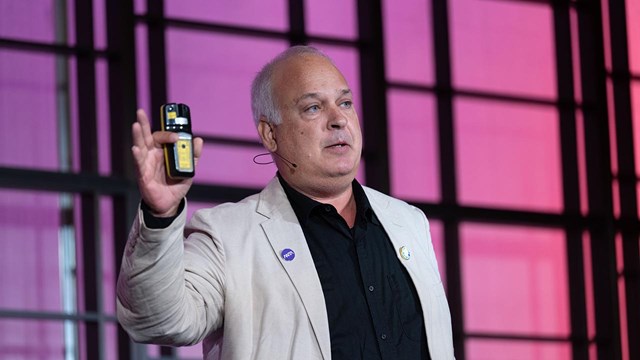
I'm delighted to be joined today by Tibor Böszörményi, who is going to walk us through Ericsson's 5G advanced location services. Tibor, over to you.
Tibor Böszörményi, Ericsson Network Location:
Hi, welcome. So if you think from a consumer perspective, we see that location-based services are already part of our daily life. We are using applications that rely on location, like food ordering, travel applications, and micromobility services. This is already a billion-dollar business, but much of the revenue is today harvested by the over-the-top players. But with 5G, the focus is shifting also towards the networks and the capabilities that we can expose from them, including location. The new connected enterprises are also demanding trusted location information, and this enables a lot of new use cases. So now is the time for CSPs to think beyond regulatory-type services and to use the location platform to enable new revenue streams in the consumer and enterprise segments.
The demo has two parts, starting first with a brief technology introduction, and then I will focus on use cases. From the technology perspective, Ericsson has developed a location platform that attempts to address as many different use cases as possible by using different positioning techniques, because every use case demands a specific approach from both an environment and a technology perspective. The three main pillars are macro network positioning, indoor positioning, and precise outdoor positioning using satellite techniques for on-demand active location.
In the case of macro network positioning, we rely on measurements from the radio network. One measurement is the so-called ranging measurement, where we calculate the distance from the antenna with an accuracy of around five metres. Another measurement allows us to utilise the advantage of active antenna systems and massive MIMO radios to calculate the angle of arrival, and combining these two results in an accurate location of around 15 to 40 metres in outdoor areas, which is almost on a par with GPS positioning. It is also worth highlighting that based on the angle-of-arrival measurement, we can also obtain a 3D location.
Moving to indoor positioning, Ericsson has developed a radio system where capacity, coverage, and positioning are all delivered in one. The main advantage here is that we are using the same communication infrastructure also for positioning purposes, and with this we can achieve sub-metre accuracy for indoor areas. Very importantly, this technology is device-independent, so any 5G device connected to this indoor radio network can be located with this accuracy.
The third important pillar of our location system focuses on satellite technology, specifically the 3GPP-standardised real-time kinematic GNSS positioning. The main advantage of this compared to traditional GNSS positioning is that we are not only measuring the time for a signal to travel between the satellite and the device, but we are also measuring the phase delay, and we are using Ericsson Network Location and the operator's mobile network to send correction information to the device. Using this, the device can calculate accuracies down to 10 centimetres or below. The operator has different ways to forward this information to devices: it can be done via unicast over the user plane to target its subscribers, or they can use their 5G radio network to broadcast this information, which enables massive scaling of the technology.
These were the active positioning methods. There is also a possibility to collect location passively from the network, by gathering measurements from the core and radio in real time from all subscribers and sending this northbound to different applications that can use it.
Moving on to use cases, to illustrate which verticals can benefit from location services, we have selected 10 different verticals where we see potential. It is important to highlight healthcare operations, where we rely on the radio dot system built into hospitals, enabling tracking of assets, patients, and staff across the hospital. In agriculture, for example, we can use precise satellite-based positioning to enable precision farming, support autonomously driven tractors for precise ploughing, or assist drones flying beyond line of sight with crop fertilisation. One further example to highlight is the public safety sector, where we can utilise our passive location feature. We can create geofences around targeted areas affected by a bushfire or any other type of emergency, and we can send messages to people in the danger areas using location-based SMS. These are just a few examples, but there are many more. Thank you very much.
James Pearce, TelecomTV:
Thank you, Tibor.
Please note that video transcripts are provided for reference only – content may vary from the published video or contain inaccuracies.
Tibor Böszörményi, Sales lead - Ericsson Network Location
Ericsson’s 5G Advanced Location Services platform addresses diverse positioning requirements through three main technologies: Macro-network, indoor, and precise outdoor location. Precision levels could reach sub-metre indoor and sub 10 cm outdoors. The platform enables new revenue streams for operators across 10 industry verticals, including healthcare asset tracking, precision agriculture and public safety emergency response, moving beyond traditional regulatory location services to create commercial opportunities in both consumer and enterprise segments.
Recorded May 2026
Related Resources
Email Newsletters
Sign up to receive TelecomTV's top news and videos, plus exclusive subscriber-only content direct to your inbox.