To embed our video on your website copy and paste the code below:
<iframe src="https://www.youtube.com/embed/xsIHs5v1EJU?modestbranding=1&rel=0" width="970" height="546" frameborder="0" scrolling="auto" allowfullscreen></iframe>
Well, this is our first session of day two. As I said, the AI native route to 6G. Welcome to our guests. We know that 6G is emerging as the first mobile generation designated as AI native from inception. No surprise there. And this creates both opportunity and disruption. Telcos and vendors face architectural decisions today or tomorrow that will lock them in strategies for decades to come. Yeah, AI capabilities are constantly evolving. So how do telcos and other stakeholders, how do they navigate 6G planning when AI native fundamentally changes network, economics, operational requirements, and competitive dynamics? That's the preamble that's going to set up our discussion. So let's first of all meet our panelists. I'm going to ask them to introduce themselves briefly, starting on my far left.
Philippe Sartori, InterDigital (01:28):
All right. Good morning. My name is Philippe Sartori. I'm from Interdigital and it's a pleasure to be here and discuss our views on AI native. So my activity is twofold. Half of it is on 6G standardization in 3GPP. We are involved from physical layer up to the more core network aspects. And the second part of my activity is more on longer term pre-standard activity. All of it with a healthy dose of AI, I would say. And just to say a couple of words about Interdigital, which may not be as well known as others, we are a pure research entity company that provides solution for audio for wireless for AI and for video. So a lot of AI there and a lot of involvement in the standards and this is probably what I will talk most about it today.
Guy Daniels, TelecomTV (02:24):
Thank you. Thank you, Philippe. Next week, Andy.
Andy Dunkin, Vodafone (02:26):
Good morning. Andy Duncan from Vodafone Group. Responsible for the Open RAN hardware development. We're already deploying general purpose compute and cloud at the edge. So we're building experience here to support deployment, not just of our current networks, but those future networks as well. And the responsibility for us is driving the strategy, ensuring vendors have the right products and then ensuring they're deployed across all of the Vodafone markets.
Guy Daniels, TelecomTV (02:56):
Thanks, Andy. Yeah.
Yue Wang, China Telecom (02:58):
Good morning. I'm Yue Wang from China Telecom. I'm the chief technologist on previous core network and AI now, next generation ICT. So basically it's about the integration of the communication and compute platform to support the new services and AI applications. Thank
Prashant Agarwal, Intel Corporation (03:16):
You. Hello. Good morning. My name is Prashant Agarwal from Intel Corporation. I'm responsible for telco business development in Europe and Middle East. I spent my last five to 10 years working with the European telcos to virtualize their end and that's one of the key things which we are doing. And I'm really looking forward toward the 6G and AI now. Thanks
Yue Wang, China Telecom (03:37):
For share.
Ahmed Hafez, Deutsche Telekom (03:38):
Good morning everyone. Ahamad Harvest from Deutsche Telekom. I'm in the group technology of Deutsche Telekom. I'm responsible for technology strategy and AI networks and 26 years in the telecom industry.
Guy Daniels, TelecomTV (03:51):
Great. Well, welcome everyone. Ahmed has kindly agreed to be a DSP co-host for this session. So I'm going to ask him to take to the podium and deliver our first DSP leaders address of today.
Ahmed Hafez, Deutsche Telekom (04:06):
So the AI native networks has no real standardized definition, but we can start from the problem statement. What problem are we trying to solve by talking about AI native? Why did we come to that term? I mean, the nativeness that we are looking forward is something that we bring that we don't need to spend a lot of effort in order to plug in AI as very simple as that. And if you see the problems we are facing, if you take data, everybody would complain from the data accuracy, data cleanness, problems, inconsistencies of data, inconsistencies between suppliers, lack of metadata and understanding of the data. There are lots of problems that we face with data in order just to start saying before any AI, just to have our data, it's not an easy thing to do. It's a very big struggle. Then even if we have the data, then we build AI.
(05:04):
So we're retrofitting things. As you see, we're retrofitting things now. Then let's say we brought AI, but we need to do closed loop automation. We need to go back and influence the network functions. We don't have everything as APIs. Inside the network, APIs are becoming more crucial than ever before. Sometimes the EMSs has APIs, sometimes not. Very rare cases where you can access the network function directly. So a lot of capabilities are missing that would enable us to go really autonomous networks level four and five that network is really self-healing, self-optimizing. So in order to reach that, these elements, these inputs are not there. We are retrofitting them again. That's why when we talk about AI nativeness, we say we need the data ready and we need the APIs to plug in. Then you fast forward and look into developments that are happening in the network functions and you see that suppliers come with network functions that have a lot of AI insight and maybe even composed of AI.
(06:09):
Right. So do we have any transparency on that? Can we control it? Is there a mode we can switch off AI and still function? What about transparency, regulations, other things? Is this AI really native or just plugging in some AI so you also claiming the function have AI in? Okay, fantastic. But can we control it, monitor it, track it, manage it? That's a big challenge. Then you go further into another dimension and say, "Okay, I want now to have real time use cases on AI." Is the network built with that capability? I mean, if you want really real time, we're talking about sub-seconds or milliseconds of latency. Then this means that I have in the architecture something that will endorse that speed. Do we have that? Can we monitor, manage, and control with that speed? This is something we are retrofitting today again. And finally, if I pick another topic, which is the lifecycle management of functions.
(07:08):
I mean, today it's a very manual process. In many companies, we've tried to do a lot of stuff to automate that, but it's a retrofit again. It's not natively ready for automated lifecycle management. A patch is there, pushed, tested, automatically come into it's just in production. This kind of cycle doesn't exist or anything close. So anything that you have to do, you would have to retrofit it. Maybe if you can show the slide that I prepared. So just on picture, try to depict these in the lower part. So you see the data readiness we talked about. The AI controls is about the network functions that have AI inside. The API's readiness is what we talked about in order to make these control loops, real-time AI and lifecycle management. And these are just examples just to start the discussion. This is never an exhaustive list of what an AI native network would be.
(08:01):
So maybe I go back to the panel and then we start discussion. Thank you very much.
Guy Daniels, TelecomTV (08:06):
Thank you. Great. Amit, thank you very much indeed. That sets us up very nicely for our discussion. So yeah, you gave your five pillars there at the end of your speech. I think maybe we should have a look at those and address those. Whether our other panelists see things the same way, agree, disagree, commonality, common ground. Rashan, are you able to maybe start us off and from your perspective on infrastructure and compute, what you'd like to
Prashant Agarwal, Intel Corporation (08:38):
Add? Yeah, I mean, I totally agree with Ama mentioned, but from my perspective, I would like to add another dimension which is regarding the infrastructure and compute. To be honest, it's really underestimated and not much discussed in the 6G context. So AI native is not just about embedding the intelligence. We think it's about to design the network around a distributed compute. So with the flexibility of the compute becoming as critical as the spectrum or the connectivity. So we need to be very careful how we define the future networks and how flexible they can be. So as we see with the Open RAN and VRAN, we have already moved towards the software defined general compute platforms. And now with AI in picture, it becomes even more critical because AI is evolving much faster. It evolving much faster than any network cycle, 31 cycle. So for example, the AI models and use cases which we are defining today, they're not going to be the one which will be deploying in three to five years times.
Guy Daniels, TelecomTV (09:51):
That's very interesting. Are you in agreement with this rate of change and pace and the difficulty of plumbing ahead? Because the rate of change as we have heard is incredibly fast.
Yue Wang, China Telecom (10:05):
Yeah,
(10:07):
Please. Yeah. I mean, totally absolutely. I mean, I remember one of my colleagues said something that is really powerful is the AI services network address today will now be the AI services tomorrow. So we look at the AI services we build our network today, but then the AI is evolving so fast. So back to the question whether we agree with this AI native definition. I think my integration of AI native is kind of three layers. One is the resource level and then the operational level and then the service level. So on the resource level we are looking at our network, our compute infrastructures, CPUG storage and then on the operational level we need to kind of orchestrate all those resources flexibly at the right time for the right services. And then I think what is important for the operators is also the service level where your network needs to be native to AI.
(11:09):
So I think at the beginning our address is we want our AI to be native to the network, meaning that AI needs to be integrated into network seamlessly, coherently. But then I think the network needs to be designed from day one to be able to understand, to support and to serve those new AI services. And by new AI services, I mean the services that relies both on the connectivity and the compute, smart glasses, robotic dogs. Yeah.
Guy Daniels, TelecomTV (11:39):
Thanks you. Andy, this time around, it seems to be a far more complicated challenge for the operator and stakeholders to address.
Andy Dunkin, Vodafone (11:48):
Absolutely. Interestingly, because I sat here on this stage last year and was talking about deployment of cloud at the edge as being the next big thing. And already we've moved on to something which is indeed more complicated but has a broader remit. And I think it's important to, as much as it's AI native to 6G today, but it's important to realize that AI is arriving in our networks today. It's not waiting. 6G isn't the enabler for us to be working with it. And I think it's really important for any M&O, and I know many M&Os are working on this, is really to set your early strategy and blueprint to understand what you're hoping to achieve. There's no big bang here where you suddenly switch on AI and miraculously all of your networks are ready and operating. So we're looking at this from two points of view, really.
(12:42):
One is the first is bringing further operational efficiency to our existing networks and platforms and then how do we evolve using AI to deliver better services, higher levels of performance to our customers. So at the moment what we see enabled by AI is really very much more an autonomous network. It brings together the verticals of the technology, integrates them very effectively with the cross-functional capabilities that we see it necessary for our operational processes. So yes, it's complicated, but I think it's really important for M&Os going forward to be able to prepare for 6G, prepare for our future networks built around 5G and 6G, but the benefits of AI to enhance those networks and our operational opportunity is far more significant than we've ever seen before with a change in technology.
Guy Daniels, TelecomTV (13:51):
Great. Thanks Andy. And Philippe, we started with Akamai's five pillars there. We've developed it, we've added as we've moved along. What's your take on what really defines AI native in our networks? Because this panel isn't AI native in 6G. This is the route towards including what we're doing right now
Philippe Sartori, InterDigital (14:09):
Absolutely. Yes. This is the root of everything. And I think one thing that Ahmed mentioned that is really key is that we are retrofitting existing network. Basically there is the 6G network is based on the 5G core that we have defined in 3GPP and this will continue. So basically we have an evolution from an existing network which is not designed for AI native and we need to add the bricks and all the blocks and the protocol to make that actually a pure AI native centric approach. And I think this is one of the major challenges that needs to be addressed by the industry. And obviously ORAN, 3GPP, SA are looking into that and building over it. And I think we have a base that is very, I would say dynamic and that can be done at relatively low cost. But I think if we don't do a good job there, that's going to be a challenge.
Guy Daniels, TelecomTV (15:10):
Great. Thanks very much. Thanks everyone. Let's move on a little bit here because as I said, this isn't just about 6G, this is the route towards it. What does AI native actually mean for AI enhanced 5G networks? What is it meaning now? How is this relevant to the networks we have in place and are developing now?
Ahmed Hafez, Deutsche Telekom (15:30):
Excellent question. So basically everybody in the room trying to do anything with AI or data, they would spend a lot of time in order to activate this AI use cases. Integration is a nightmare. Getting the data out is a very complicated measure. You can also single source of truth. How do you get that? Who's the data owner? All these principles came late. So they came after. So we always had the data. Everybody had lock files and traces. Maybe traces are only activated when you have troubleshooting and the lots of data, many of that gets deleted because nobody's using it. As AI emerged and then started really developing further, I'm not talking about last three years, but I'm looking last 10 years or so. We started more and more getting the data, creating the data. And then we found out, for example, take some concrete examples today.
(16:20):
I have to take the data, make sure the data is grounded across suppliers. So if someone defines latency in milliseconds and another in nanoseconds and a third in seconds and I all make it correctly, but they have different field types. This is a very big issue. I think yesterday also there was a great example of the crash of a mass because of the inch versus centimeters. And this is recurring when you look into that and there are pros and cons of that. There is no alignment in even the semantics. Even the naming of the fields are different and then there is no metadata. There is nothing explaining to you what that is. So for the relevance here is speed, speed and accuracy and also what we used to have humans process. We need agents to process. Agents are not as smart as us, by the way, but we are smarter.
(17:14):
We can infer things much better, but the problem here is that then they need data. If you give them data, if you give them metadata and explanation, they will act faster than us and much more accurate and they like the data today. Having this native will expedite whatever we develop in AI.
Guy Daniels, TelecomTV (17:32):
Thanks very much. Anyone like to pick up on this one, Prashant?
Prashant Agarwal, Intel Corporation (17:35):
Yeah. I mean, from our perspective, I see the AI native 6G, it's kind of fundamental shift how we design our network and operate. I mean, if you see 5G, so mainly AI is being used for the efficiency like optimization, fault prediction and tooling, those sort of things. But thinking the 6G, AI will get more involved in the network decision making also. So that means AI will influence like scheduling, source allocation, prioritization also. And that's a fundamental shift and that brings the requirement with down to the stack. I mean, we need to think about we will need to move the compute near the source where the data is being generated and we will need the quite inferences moving towards the age. So requirements will change there. So that will be the shift which we see from 5G to 6G. And 5G was just bolted on on the existing network, but when the 6G, it will be from the day one.
(18:44):
And that's why we keep saying that it's 6G AI native is not only about just embedding the intelligence, it's how you design your network. It has to be designed from day one across distributed compute and the flexibility and then AI will be available from day one.
Guy Daniels, TelecomTV (19:06):
This isn't going to cause horrors to operate us in thinking that you're talking about a complete change of our network approach and strategy because we've got to design fundamentally for a different approach. There can't be much appetite for that, surely. There's got to be more of an evolutionary approach here Andree, you got any thoughts?
Andy Dunkin, Vodafone (19:25):
No, absolutely. That was where I was going to, I think come in. It has to be an evolutionary approach. And the reason for that in my view at least is that we have to learn and at the moment this is in terms of application, still a very immature technology for us. We understand and we're starting to see the early benefits. So if we look at the opportunities, the strategic objectives, I've talked about the benefits of operational efficiency and driving and supporting those management platforms. The second aspect is very much AI for RAN. This is about performance enhancement of existing features and functions. And then really the third block is much more, I would say, future looking where we talk about the potential for monetization and new services. But if we look today at the work that we're doing around AI for RAN and enhancements in terms of uplink performance, for example, we're seeing AI bring real benefit today, certainly in the labs and I know some M&Os are already taking this into the field and replicating similar performance uplift.
(20:36):
I think here everybody, we have to be very careful that we don't try to jump to the end game without going through these early stages. We're going to learn. We're going to learn both through success, but also more importantly through failure. But what we do see is that a lot of this can be managed in the existing platform today with the existing basebound and compute capabilities that we have. So we don't need necessarily to have any significant change just yet in terms of those hardware platforms. So we already have the toolbox and we have the platform to play with. And I think the challenge probably for many vendors and certainly for us MNOs is that AI is moving at a phenomenal pace. We have to not necessarily keep up. We have to try and manage that to ensure that what is delivered to us in terms of products for our commercial platforms meet not only our expectations, but those of our customers in terms of what they really deliver and we have to ensure that it has a strong value proposition for everybody.
Guy Daniels, TelecomTV (21:43):
Thanks, Andy. You, can I just pick up on this? Do we need to sort of disconnect our thinking of AI native and 6G? Do we need to split this a little bit and focus more on AI native for our needs now and evolve that? Yeah.
Yue Wang, China Telecom (21:59):
I mean, that's a very good question. I think regardless of 6G, AI is going to evolve. And so from our talks to some of the, for example, AI terminal manufacturers, they don't care. They don't know too much about how their network is going to evolve. They have the requirements and if the network is not going to accommodate their requirements, they're going to find a way around and they are going to build something else. Their application is going to evolve regardless there is 5G advanced or 6G. So I think we do need to have that in mind in the sense that AI is evolving regardless of our network technologies. But then on the other hand, I think because AI is evolving so fast, can we do something smarter in the sense that maybe they keep the infrastructure and the network architecture relatively stable, but then we upgrade our software base to support the new AI services and new AI applications.
Guy Daniels, TelecomTV (23:05):
Great. And Philippe, do you see the same approach here? Are you looking at solutions to AI native engineering and architectures now, or is this everything being kind of pushed with a focus on what may come in three years plus?
Philippe Sartori, InterDigital (23:24):
It really is both actually, because I think as it been mentioned by many, the speed of deployment of AI is something that we've really never seen before, quite frankly. And I think one aspect to differentiate is there are two type of AIs, native AIs we're talking. One is about the data, the model, what transit over the network, and the second one is on embedded AI. And I think we need to address both, both part in standards and elsewhere, but for the part that is just like agentic AI running on UAE or whatever, this will already have huge impact. We probably need to have some metadata to process this AI. It puts also enormous constraint on the network, because for instance, if we believe the model will have a huge increase in uplink traffic, that's one aspect. And the second aspect on the embedded AI, this is how to operate the network better using all the AI tools.
(24:29):
Nothing really exists today. We have some mechanism for 5G that works pretty well, but essentially everything will have to be upgraded so that we can cover this aspect as well.
Guy Daniels, TelecomTV (24:39):
Great. And Ahmed, what you've just heard from other panelists there, what are your thoughts now?
Ahmed Hafez, Deutsche Telekom (24:46):
I widely agree with your statement that AI will not wait for us. So it's running much faster than us. As also Philip was saying, you cannot just wait. You will have to do things in parallel. You will have to address the short term, but also the long term. While addressing the short term, we recognize what we need for the long term because I just gave some examples when we started and also of course the compute continuum, compute connectivity continuum is something to be considered as well. As we develop now our thoughts trying to bring AI in, we recognize the deficits where the problems are and then can this problem be avoidable in 6G or in next generations or 5G advance? Can I avoid that and where do I avoid it? Some aspects can be avoided by having something in 3GPP, others in IETF, others in ITU, others in other forests that outside that just to make sure that the suppliers are aligned.
(25:42):
I mean, there's a lot of stuff to be done in order for us and I will use that term to catch up with the AI era. So we want the telco era to be the AI era, so to meet it and then go fast with it. And that means that we have to start now and continue until AG or beyond.
Guy Daniels, TelecomTV (25:59):
Great. I'm going to just move on to another point here. But before we do, I think it's worth reflecting that just about a year ago, just over a year ago, we released some reports on telecom TV looking at the 3GPP 6G workshop to analyze what the stakeholders view of 6G was. And it was interesting that for the operator submissions, and there were a lot of them, AI native ranked third as a third priority, third most COVID, third priority from operators, which was incredibly high. And yet one of my concerns, I guess, is the standards process, I can just see this dripping in. I mean, release 21, we'll get some foundational elements maybe, but when you start talking intent-based capabilities and beyond, we're into 2030, mid 2030s perhaps here and the AI landscape will have changed unrecognizably. I think someone said earlier, we're building networks now, but we don't quite know what the AI services or capabilities will look like.
(27:03):
So this to me is an incredibly hard undertaking if we're looking ahead. But I guess the evolutionary approach from where we are today is the way we're going forward. I'm just going to underline this. So evolutionary rather than revolutionary
Ahmed Hafez, Deutsche Telekom (27:23):
I think you can't underline that easily. The point here is that it's a very simple thing. So the networks will be managed by agents, by AI. Can it be done today? No. Why? Because it was built for humans. It was built with CLI interfaces. I go and write a command and so on. Agent do not work this way. You can do that with some robotic stuff, but that's not the future. The future is that this transforms. What we are not doing, we are not defining the AI technology. So it can evolve as fast as it wants, but we give it the knobs, the interfaces, the open up, the mechanisms, how we are more flexible, how we standardize things, how we align on things so that A, the heavy lifting is gone and then you start from clean data. So the principles we're talking about, having compute continuum, having that possibility that I can compute in the edge or in the center, data centers here there, this kind of flexibility we're building, we're building the foundations that can fit to a large degree of force.
(28:24):
I can't speculate that would embrace every change that we have in AI, but can embrace huge amount of changes without being impacted. So these are the foundations that needed anyway, regardless to the fast bit of AI.
Guy Daniels, TelecomTV (28:35):
Which brings you on very nicely to my next point, because I like to ask you what we think the ecosystem and what stakeholders should prioritize now to prepare for AI native networks and the arrival eventually of 6G or whatever the release schedule produces. Can you give us one example or perhaps of where we should prioritize? Prashant, maybe I can start with you. What should we be addressing today?
Prashant Agarwal, Intel Corporation (29:00):
Okay. If I had to pick one point, thing would be about how to design flexible network for future while keeping the cost and energy constraints of today's telcos. See, one of the major decision which we have to make today is where the intelligence lies. Is it in the cloud? Is it on the edge or is it the deep rooter in the network or maybe all the places and the decision which we make today will impact this, our cost latency and flexibility for the years to come. And another point equally important is we should involve the principle of general purpose compute and software based architecture for the new networks.
(29:51):
Using the proprietary platform will stop the innovation and as the AI evolving so fast as we all agree, then we need to be seen that The great form which we designed, they should be able to adopt in future. And that's where this general purpose compute and the software based programs come into the place. As you see this, when we do over optimization, that brings the ridgery. And as we all know, open ran supposed to break the cycle, but if we are not careful AI can bring that lock in again back into maybe from a different layer this time may be from the silicon and the software ecosystem. Interesting. So we need to be very careful there how we define a future network. And that will be one of the major constraints. We have to be openness, as you mentioned, openness, standard based, and it has to be the software defined.
Guy Daniels, TelecomTV (30:48):
Thanks, Prashant. Philippe, what about the research view and the standards view, but all of your companies are all heavily involved in the standards process, but you particular, what would you recommend and what would you say that we should be the one main area we should be focusing on as a community?
Philippe Sartori, InterDigital (31:04):
Yeah. First of all, I would say let's be all extremely adaptive because this 6G workshop you mentioned, it was like yesterday in terms of a timeline. And really, as you said, AI was barely on the radar at the stage and nobody, I guess, nobody would have even expected us talking about the Gentic AIs. So from my perspective in terms of standards, there are two aspects. In the let's say 6G ORAN familiar standards, I think we are relatively well prepared and we received the input from the operators and the more we get obviously about the priorities, about what we should focus, the better. This part I think is going well. The second part though is on the AI front. We also need standardized APIs and a certain level of standards or mutually agreed practices, I would say. And because of it's a new domain, it's moving extremely fast.
(32:02):
We see a lot of fragmentation in terms of solution, in term of standards, defacto standards. So I would encourage the operators to look into that and make sure that we converge towards one solution for AI that can be easily integrated on our networks really.
Guy Daniels, TelecomTV (32:22):
Keep it simple. Yes. Great. Great. Thanks, Philippe. You, in terms of what you are doing, China mobile and within the wider community, what's your recommendation? Yeah,
Yue Wang, China Telecom (32:35):
Chen Telecom. Yeah. So what we do, one of our priorities is to look into the orchestration of the communication and the compute platform because we are seeing the emerging AI use cases are relying on both connectivity as well as compute. So some of the use cases, so for example, smart glass is one of the experiments we did last year was using smart glasses on the boat where you'll be wearing it and you use smart glasses to see your building. It will feed back immediately the historic information of the building. And that relies on low latency deterministic network and the compute power at the edge because the smart glass is small. It can't accommodate that large computational power. So we do see those emerging use cases that are coming. And one of the priorities we are doing here is to orchestrate both the communication resources and the computational resources to be able to serve those new AI services.
(33:45):
And I think that's a great change for the operators because in the past we have always been aiming for good connectivity. We wanted to aim for more users, more data, more subscribers. But now I think with those new AI services, the operators are changing from a traffic driven to now capability driven. So you have to have that combined capability, not just high speed connectivity, not just powerful compute. You have to have that combined capability and to be able to expose them as a whole to the new AI services. And I see this is a great opportunity for the operators to change from a connectivity provider to now become a platform provider to serve those new AI services.
Guy Daniels, TelecomTV (34:34):
Thanks, you. And Andy, let's complete the views as to where we think we should prioritize today.
Andy Dunkin, Vodafone (34:42):
Yes. I'll try and be really quick. I could spend two hours probably on the topic and the input from the rest of the panel I think has been excellent. I think the one thing then adding to that that's already been mentioned really for me would be, at the end of the day, I'm an engineer. I'll believe it when I see it. It's really important that I think as an ecosystem, as a community, we start to get into the labs, we start to do more work to really demonstrate and prove the functionality, the capability, the requirements of the new functionality that AI will bring the new capability and that we share those results as openly as possible. We don't all duplicate and go and test the same three features from leading SRAN vendors. We try to distribute that time and resource so that as a community, we can all learn to and move forward quickly to take the best of what being AI native can bring to us.
(35:44):
So there's lots of great work already happening through 3GPP, ORAN, AI RAN Alliance. But really now if we are going to move effectively forwards and have any hope of keeping up with AI, I think we need to remember that open community sharing of information is really critical if we're all going to succeed at this. So let's get away from the PowerPoint and let's get back to some real numbers.
Guy Daniels, TelecomTV (36:12):
Yeah, absolutely. Completely agree. Thanks very much. Andy, you've heard the views of our panelists so far. I'm going to pause in our conversation because I really would like to bring in the audience if we can. And Tony's making his way from the back. Do we have a question from the audience? We must have a first question of the day. We have Robert at the front here and I can't see another hand just yet, but it is a bit dark. There's
Yue Wang, China Telecom (36:36):
Another one over there.
Guy Daniels, TelecomTV (36:36):
Oh, we'll start with Robert.
Robert Curran, Appledore Research (36:39):
Hi, Robert Curran. Appledore Research. Very interesting perspectives. I just wonder for telcos in the audience whether there's a tension here about investing in 6G and investing in AI. Are they pulling in different directions and at different speeds and how do they reconcile those two different expectations? On the one hand, AI is changing super fast. On the other hand, 6G is going to be foundational. How do you make that decision as to what to spend where and when?
Guy Daniels, TelecomTV (37:11):
Okay. Thanks so much, Robert. The danger of going to the audience before the end of our session is that someone from the audience always picks my last question, which is fine. It's fantastic because it just validates the question. So that's great. Robert's point about the investment choices.
Ahmed Hafez, Deutsche Telekom (37:30):
I can start. So you're asking a very critical question that actually dictates who's leading and who's following and who's lagging. So it's not an easy answer to say, but this is what nails down to the strategy of each operator. How do we approach AI and 6G simultaneously? As you said, it has to be approached simultaneously where the right things, where the right intersection points, whether the priorities, of course can't answer in one minute, but yes, it is definitely top of mind and seeing where we put the money and the bets where and how and at what time it has to serve the business purpose at the end of the day. So we are not trying to do things for fancy elements. It's a business. We have to be effective. We have to provide service for the customers and invest in what matters. So this will give us the means of prioritization.
(38:19):
And of course, the more you can invest into them rightly, the better the outcome is expected to be.
Guy Daniels, TelecomTV (38:26):
Any more comments on the prioritization of investment? I'm going to comment to more investment later, but that prioritization question that was raised. Anyone to add to Ahmed's points here?
Yue Wang, China Telecom (38:36):
Yeah. So I might be able to talk about a little bit from the perspective of the capability driven that I just mentioned. So I think we have to look at the network as a whole and our capability needs to be exposed as a whole. So when you talk about whether it's investment in 6G or whether it's investment in AI, I don't see the contradictory because if you want to support those AI services, you would have to have a strong network, whether it's 6G requirement or not, uplink capacity, the deterministic network and low latency compute power, they have to be in place in order to support those new AI services. So I don't see it's either this or that. It has to be a combined capability to build up strong platform in order for the operators to keep up with AI
Guy Daniels, TelecomTV (39:31):
Really. Great. Thanks Yue. Any more comments or Prashant?
Prashant Agarwal, Intel Corporation (39:34):
Yeah, I think to be honest, this was mainly for operator question, but I would like to add a few points. Okay. I totally agree that we cannot see investment as like for 6G or for AI. So it has to be combined and how we take it forward. But I would like to put another point. Maybe the AI can itself provide some optimization and make some more investment available. Going back to the yesterday, there was a panel about POCs to how we deploy. So we saw that to be honest, there are no lack of ideas. There are plenty of ideas, operators. There's a lot of POCs and those things. But the real challenge is how we move those POCs for the deployment, which can, let's say, save some cost also, provide some extra funding which can be then used to invest back in the 6G AI capabilities.
Ahmed Hafez, Deutsche Telekom (40:27):
I tend to agree, but there is a constraint there that you need to also to look at. Some companies implemented AI, had AI already, so tested that but did a launch. You know why? Because of the costs of AI. I'm not talking about our company, but other sectors, not the telecom sector, was in another sector. But these examples exist that you try to do something and then you realize that you're not going to realize savings, you might need to invest more. And there are other companies that also I've seen some analysis from Gartner also on other companies that shows that they have with AI, they were actually a debt collecting company. They were collecting debts from others and actually they employed AI and they could do a lot more, but their margin didn't change because to do a lot more. Yes, they can do loads more, but they still do the same margin.
(41:18):
So you can grow the pie, but not necessarily. So we have to be careful. So sometimes AI can increase your capabilities but not immediately cash you out in terms of money. But in essence, we need to invest in both. And I agree that there is no contradiction, but there will be a lot of investment prioritization along the way because you cannot invest just openly in everything and anything. I mean, that's not that to be realistic. We have to make choices and these choices actually determines, I mean, you take a decision to invest in something and something becomes obsolete, that can happen, but we will keep an eye on
Guy Daniels, TelecomTV (41:53):
It. Yes. And let's build on this because this is raising the investment angle. So let's move on to that and add to that because I was going to ask how do operators fund this? Because it's not just a technology decision, it's also a business decision. Andy, have you got any views on the business angle here?
Andy Dunkin, Vodafone (42:12):
So with responsibilities for hardware development, I'd say actually less so. And I'm limited to what I can say. What for me is one of the big differences as we move into this next generation of technology with AI is that for the first time in perhaps in a long time, there are some real new opportunities for new business areas and applications and services that we as an M&O in principle can provide to our existing customers, but also very interestingly towards new customers. And that may be that we're using some of those compute resources at the edge to provide very low latency services for customers, or we take the strengths that we have in our own data centers to offer services there as well. So as we start to make our preparation towards this evolution, we're working and have been working already for quite some time with both our business and our commercial colleagues to understand how we can really align what technology will potentially look like in three to five years with what they see as potential business opportunities and one that can generate new revenue streams.
(43:34):
So that's my view.
Guy Daniels, TelecomTV (43:37):
Great. Thanks so much. And you, can I come back and maybe ask, we're talking AI native here, why operators need to fund this?
Yue Wang, China Telecom (43:46):
Right. Well, I think it's a great opportunity for the operators to tap into the AI ecosystem. So if you think about all the investment that goes into AI, it ends up to the cheap vendors, to the hyperscalers. The operators are providing that pipe to transfer the data from the terminal to the cloud. But I do see with this low latency requirement for AI inference, for example, operators still have a real opportunity to tap into the AI ecosystem and now they are able to provide, if we handle the network and compute very well, we are able to provide a combined compute and connectivity capability. So in the past, operator always have performed the asset pipe and we do our job very, very well, but we are not gaining any new revenue stream from it. But I do see now with this capability, new capability, we have potential to actually support the new AI services and to be able to have some potential new business model and new revenue streams.
Ahmed Hafez, Deutsche Telekom (45:05):
Great. Guy, I want to disagree with you on something.
Guy Daniels, TelecomTV (45:08):
Oh no, not again.
Ahmed Hafez, Deutsche Telekom (45:10):
So I don't think that the operators have to fund that alone. I mean, suppliers would have to as well. I mean, if you look at the data and the mess we're getting out of data, we will continue putting pressure to get this alignment across suppliers. And this is not something that you would pay more for. This is something that has to be in the design of how they design the elements and the functions. Standardization can help a lot. Things like APIs, capabilities, these kind of things. This is actually saving for us because instead of us putting a lot of effort in augmenting what's available in order to be usable, want it to be usable in the first place and our role is to help supplies and the operators together to help suppliers to guide them on what we need. And that becomes a win-win for both with no additional investments.
Guy Daniels, TelecomTV (45:58):
That's an important distinction to make because when we say why operators should fund this, there are mechanisms and partnerships and models in place already that perhaps we can build on and look to their vendor partners to take a lot of this spend. And Philippe, there is a lot of work going on, a lot of technology being developed to help with this AI native transformation journey, but it has to be funded. As Ahmed said, the operators aren't going to do it themselves. What are you seeing?
Philippe Sartori, InterDigital (46:27):
I think Ahmed made a great point. It takes a village. We all have to be involved. We all have to develop the solution together. This is how we are going to succeed. I think we're in a very good position, quite frankly, in the ecosystem. But again, from the standards perspective perspective, getting the inputs from the operators about what's really important, which API is really needed for them for us is critical.
Guy Daniels, TelecomTV (46:52):
Great. Prashant, it's all on the vendor again, isn't it? It's up to you. You've got to make this work for us.
Prashant Agarwal, Intel Corporation (46:58):
To be honest, if I can say that one advisor from operators also, I think we need to think about monetization of AI services also. I think one way can be to, from the day one, we need to start thinking how can we make Ashta revenue and monetize these things? And to be honest, one of the thing we always keep on missing from the operator sides also, you guys are sitting on a gold mine of data. How can you find that and maybe what services can you do? Because you have loads of data about customer users, but okay, not in the way that you can open it, but there has to be way that we can find some way how to make extra revenue because investment is, it's not a small investment, to be honest. I totally agree with operators with 6G and AI spectrum and those things.
(47:50):
But from my perspective, the focus should be the monetization from day one. It's not just, okay, operation efficiency, we can save this two angle. We can save the money or we can make extra money. I think the focus should be on making extra money.
Guy Daniels, TelecomTV (48:06):
Let's wrap this panel up. I'm going to give a final comment to you based on what you've heard here. What's your advice to the room? What's your advice to the industry? What do you want to see happen for this AI native route towards the evolution of our networks?
Ahmed Hafez, Deutsche Telekom (48:22):
Really, my hope is that we work all together, but really closely together through the right forums, the right standardization bodies to make sure that we align to that vision, because it will help us all. The operators that will not really follow that clarity on this nativeness, they will lose a lot of money and lose a lot of effort and time and surprised will not do that will go out of the market easily after time so they will not catch up. So it's for our all interest to work together on trying to make the things more standardized, more AI friendly and more II native late. So that would be my last.
Guy Daniels, TelecomTV (48:55):
Great. Great. Thanks very much. Well, thanks everyone. That's all the time we have for this first session. We must end it there because we do need to start our next session. So I'm going to ask our next set of experts to get to the stage. In the meantime, please a big round of applause for our guests here.
Please note that video transcripts are provided for reference only – content may vary from the published video or contain inaccuracies.
Panel Discussion
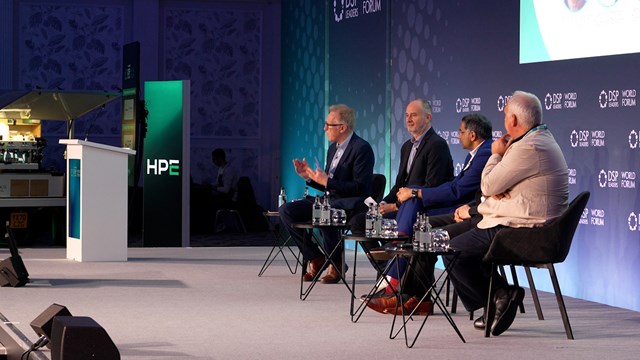
In this DSP Leaders World Forum session, experts from Deutsche Telekom, Vodafone, China Telecom, Intel and InterDigital examine the shift from retrofitting AI into existing networks to designing AI-native systems from inception. They reveal the five key pillars including data readiness, API availability, real-time processing capabilities and lifecycle management, and explore the need for distributed compute infrastructure, and the challenge of planning long-term network strategies when AI capabilities change faster than traditional network cycles.
Broadcast live 20 May 2026
Participants

CO-HOST
Ahmed Hafez
SVP Network Strategy and Data & AI in Networks, Deutsche Telekom

Andy Dunkin
OpenRAN RF & Digital Platform Development Manager, Vodafone

Philippe Sartori
Director, Engineering, InterDigital

Prashant Agarwal
Head of Business Development, Telco EMEA, Intel Corporation

Yue Wang
Chief Technologist Next-Gen ICT, China Telecom