The Future of RAN: Building for the future with an open, virtual and AI-enabled RAN

By Guy Daniels
Jun 10, 2025
To embed our video on your website copy and paste the code below:
<iframe src="https://www.youtube.com/embed/RpMj7pRZep8?modestbranding=1&rel=0" width="970" height="546" frameborder="0" scrolling="auto" allowfullscreen></iframe>
Welcome back and straight into our next session, which is focused on the radio access network, the ran. We're going to be discussing how we build for the future with an open virtual and AI enabled ran. Now we know the RAN is undergoing a major transition as network operators consider a range, a number of different technology options from single vendor full stack to virtual cloud open AI architectures. The list, the list expands all the time, but what we want to ask is what approach makes the most sense for DSPs? That's what we are here to try and find out today. So first of all, let's meet our panelists. I'm going to ask them to introduce themselves starting on my left hand side with Rob.
Rob Joyce, VM02 (01:24):
Okay, thank you. Robert Joyce. I'm the director of mobile access engineering at Virgin Media O2, so I look after the O2 network from top to bottom. Lots of experience with ran vendors. Before this role I was in the Middle East and worked for a redo group so I got to look at all the different vendors from the Chinese through to the Europeans and open ran. So really excited about being here today. Thank you. Thanks Rob. Andy?
Andy Dunkin, Vodafone (01:50):
Good morning. Andy Dunkin. I'm part of Vodafone group, specifically the open ran product team. We're responsible for all of the radio access networks that we deploy across Vodafone and looking after transition of technology today to be future ready for tomorrow.
Darrell Jordan-Smith, Wind River (02:10):
Darrell Jordan-Smith, I'm the chief revenue officer at Wind River, a key partner and vendor in the software areas of ran
Yago Tenorio, Verizon (02:20):
And I am Yago Tenorio, I'm Verizon, CTO and before that I was 30 years in Vodafone.
Guy Daniels, TelecomTV (02:26):
Thank you very much everybody. Thank you very much. Delighted to have you all and we are especially delighted Yago that you were turning as a cohost. You were cohost last year with us so we're delighted that you're going to do it again for us. So Yago is going to give a DSP leaders address for us to start the session off and frame our conversation. So Yago, if you'd like to make your wait. Thank you.
Yago Tenorio, Verizon (02:56):
So thank you very much for having me and I'm really glad to be back in here at DSP forum but also in London where I spent a lot of time before I moved on to the US and to Verizon. So the future of RAN, I think it was nicely put the way you introduced it, but I think I have to say when I speak externally at any event or in any occasion, one of the questions that I still get most often is about open RAN. Is it going to happen or the alternative version, when is it going to happen? I think those questions are outdated, they're the wrong questions. In Verizon, we have a number that's between 20,000 to 30,000 base stations live that are built on an architecture that has an off the shelf computing. On top of that is a Wind River caas layer. On top of that there is a CU Samsung software with a fully compliant open front hall and we have them in operation in some of the busiest areas of the US like Manhattan for instance.
(04:10):
I still have discussions very recently I remember about open RAN ready for urban areas where part of the industry is debating that we serve Manhattan with the best network in the US with this architecture we also deliver the Super Bowl. Something that I'm coming from Europe starting to understand slowly, but now I understand how important it is, how big it is. It was the biggest traffic event at the beginning of February. It's been actually surpassed by Indie 500 very recently, but at its time in February was the biggest traffic, highest traffic we ever recorded. We delivered the Super Bowl with zero congestion and the performance was a number of times better than our competitors depending on which KPI you look at like throughput on 5G or 4G or uplink or downlink. By the way, it was the first event on which uplink was bigger than the downlink and it was delivered on this architecture.
(05:16):
Now this is all to say that as an industry I think we would do ourselves a favor if we move on from those questions and we start embracing and making it happen because it is better than single RAN. That's why we're doing it. And to be clear, if we could, we would've rolled out this architecture to 100% of the US and our ambition is to still do that as soon as we possibly can. Why? Because it's better. How is it better? Is more flexible. It makes us faster. It enables automation far more than any other architecture that's it's better. So if this is not the right question anyway, what is the right question? I've been thinking in the context of the future of RAN and I definitely think in my personal opinion and I want to leave this other topic with the panel to discuss today, maybe we are about to witness a change of paradigm, a new user interface.
(06:21):
I know this may sound like, oh no again, no wait, I really think that we are in front of what could be another smartphone moment. You remember when we were very busy rolling out 3G and then a smartphone happened to us and we weren't ready? Okay, I think there is another one of this coming. New devices, new form factors are about to come. Wearables, glasses, you name it. So silly, acceptable, thin, liked and design. And this is important point to enable new AI use cases. How is that? Well today if you use your AI of choice, the context that the AI has of you is the one that you provide through prompts, conversation, maybe uploading files. It's great, it's terrific. We all enjoy playing with that. But the amount of friction and the loneliness for the AI to understand your situation I think is slowing down the progress of this. Imagine a situation powered by these wearables where spooky as you can be, your AI of choice is seeing what you see and is listening to anything you hear and is learning 1000 times faster about your context, your environment, your situation. That's what's coming Now that will require a fundamental change in many things. So picture this as a continuous aling stream of some high definition video with an app frames per second, whatever you name it. Is the network ready for it? Are the standards ready for it?
(08:14):
Of course the architecture of this system you can think of part of the processing will be actually taken on by the device itself. Maybe there is a peripheral, maybe the device that wearable is tethered to a smartphone or to another device nearby that's taking another kind of significant part of the processing and there will always be an outer loop that goes to the network. Now I'm not talking about AI RAN, AI RAN is the answer to a different question, possibly a question that nobody asked. I'm talking about that. I personally think that the inferencing, the simplest and easier way to do it is on the other side of the core somewhere and the difference of latency between the RAN and that point is not significant. What's significant here is the opportunity that we have to engineer the future RAN so that we maximize that outer loop. We take as much processing as we can on a central inferencing point, but think of the device again, it's thin, it's light, the space is very limited, the battery is very limited.
(09:36):
We need to engineer a different radio link. One that preserves the power, makes it easy for a device that have very low thermal dissipation capabilities and prolongs the battery life at the same time deliver low latency and it can take probably a number of times, more uplink capacity than today. If we do that, this can be the biggest opportunity for this industry to find new revenue. Not the only one but one of the biggest ones. And I think that's where we have to spend time thinking how are we going to maximize that outer loop to make all these wearable devices completely frictionless and enable the new AI use cases. But over to the panel, let's discuss. Thank you.
Guy Daniels, TelecomTV (10:24):
Yeah, thank you very much. Want to have a applause for great. Well as usual, you've given us a lot to think about and we've certainly got to reframe our thought process because you are up there with this foresight and you're looking at building the future ran and the opportunities there. And yeah, we're all interested in say what IO are going to unveil in the next 18 months or so. That's going to be fascinating and how much we can benefit from it. But if we're building to this future that you've been talking about here and the opportunities of this future, we're building there with an open and virtual ran, which is the context of our discussion. We've got to get there quickly. We've got to accelerate this process surely to take the opportunities and take advantage of what you've been talking about. So Rob, maybe I can start with your thoughts here about how can we quickly move to this vRAN, this open ran world?
Rob Joyce, VM02 (11:21):
It's a great question and if we could do it tomorrow we would, but we obviously have lots of legacy stuff in the network and to give you an idea, there's two G kit in the network now that's probably 30 years old nearly to get to site and replace That is a challenge. And so certainly we're not going to flip this overnight. We're also when we look at vendors roadmaps as well, yes, they all want to move there, but I still think some have moved quicker than others. So again, that's a challenge. But certainly if you said to me in the next two years will I be buying only vRAN COT servers? Probably not in the next five years will I be certainly. And I think that's the sort of timeframe that we see that we will be refreshing the network and moving towards this sort of architecture. But fully agree with the Argo, we will go there and that's for sure.
Guy Daniels, TelecomTV (12:17):
Great, great. Thanks Rob. Andy, are we moving on from the if and why's and when's questions now to how we get there in a timely manner at scale?
Andy Dunkin, Vodafone (12:29):
So for many operators we have a refresh cycle in terms of the networks and as Rob's already indicated, it's something that doesn't move quickly, but typically that refresh rate is perhaps anywhere between seven years and 10 years. So for any m and o today that wants to make the transition to be future ready, we can't afford to delay that decision any further because realistically we've got AI coming, we want to put services closer to our customers and as the panel this morning started off with the transition of telcos to something other than a dumb pipe will only be achieved if we move to new future looking architectures. So if you have a choice, why wouldn't you put cloud at the edge? And it's interesting to see the dynamics actually of the business changing at the moment. So 12 months ago I think the AI locomotive appeared started to take all the headlines for the conferences and the focus perhaps a little bit away from transition to open platforms.
(13:37):
But increasingly the questions that I now get in terms of our compute platforms are actually not even questions. They're just assumptions that we will be able to support AI based services, much more customer focused services at the edge in our base stations. And that's not easy with the proprietary platforms and we really need to be thinking about making that transition and doing that now. But my role in Vodafone is not a strategist, so I'm not going to spend too much time on how and when we get there. But just in terms of evidence where we are, and I know I'm only allowed to speak for two minutes, I'll make it quick. Our CapEx expenditure in terms of radios is the most significant expenditure in the base station, both in terms of CapEx for the product and then opex in terms of power efficiency today in the portfolio of radios that we have available and the transition that we made 18 months ago was that we only deliver one set of requirements now to our vendors.
(14:40):
There's no separation between the proprietary platform and an open platform. One set of requirements all covers it. And today what I see in the portfolio is that we have radios that are class leading best in class both in terms of CapEx, both in terms of radio efficiency and some of those radios are open so we don't need to worry about the X versus Y comparison of is the technology ready. I've got class leading radios today which are open, ready, sitting there on the roadmaps can meet our requirements. So in the radio space we're good, good performance, good power efficiency, open interfaces. Now what's important to remember then is that not every radio vendor has best in class products across the whole portfolio. What we're able to do now with our open platforms is replace the less efficient radios and what we see actually quite often is that less efficient radio is also one of the high runners.
(15:38):
So we can introduce a radio from a second vendor into our stack and replace and improve our radio efficiency that way. So the flexibility of the open platform is really critical. And then just lastly the point around compute the rate of change in compute, we work with all the leading silicon vendors that you can name and the compute platform, the capability to enhance performance and capacity on a two year cycle at the moment is something that we've never really experienced before, but we see great change. Critical thing for us today is that as of the beginning of next year, we'll be able to deliver a single box to the edge of the network that will support 95% of all the radio configurations. And before anybody says, oh yes, but what about the other sites? Then that 5% where you need two boxes, well we need two boxes if we put a proprietary platform there as well. So technology is absolutely ready to make that transition today to cloud-based networks. As Rob rightly points out, it'll be a journey. There's a massive complexity around legacy that we have to consider, but it's a journey that we do need to start today and I believe that the platforms are ready to do that.
Guy Daniels, TelecomTV (16:55):
Thanks so much Andy and Darryl, this is the question of we know procurement cycles and periods of hardware refresh, the technology is there, what are you seeing? What more can we do to accelerate this transition?
Darrell Jordan-Smith, Wind River (17:11):
Well I think from our side, certainly that common CAS layer that Yago spoke about is a very important element. That's what we're very focused on. Making that as optional and configurable as possible with zero touch in that environment is very, very key. So we can drive that agility and that speed the ecosystem itself of support of different radio vendors also very, very important. So very much focused on facilitating and enabling that. That's a very other important element of what we're trying to do. And really we've kind of got to where yago is, we've assumed that open ran is there, open interfaces are there. We believe that we have a very strong CAS platform and we're very focused on building agility and speed into that at the CAS layer. And now we've kind of moved on a little bit because the core of our business at Wind River is connecting 2 billion devices that we deployed our software on, whether that be automobiles, aircraft, industrial equipment and so on and so forth. Whether it's a Zephyr based small operating system that might sit in a refrigerator or washing machine through to something that's a little bit thicker and more complex, we really see the combination of that operational technology coming closer to where we can deliver that connectivity to enable those new business cases to drive more revenue. So our customers are really saying, right, okay, we're building this infrastructure, we need that flexibility. How do we go make money in the next 2, 5, 10 years?
Guy Daniels, TelecomTV (18:49):
That's a great point Darrell, because we've been talking at forums, our forum for the past few years, especially about the technology and moving the technology on and seeing the evolution of the technology. But yago, are the commercial models now starting to evolve to support this investment in this technology move
Yago Tenorio, Verizon (19:09):
To the point that you can make a washing machine and next Space station though, or can you
Darrell Jordan-Smith, Wind River (19:15):
Say again
Yago Tenorio, Verizon (19:15):
The washing machine, can it be the next space station?
Darrell Jordan-Smith, Wind River (19:18):
Yes,
Guy Daniels, TelecomTV (19:19):
Absolutely. Yeah, Tumble dryers as well, probably Darrell,
Darrell Jordan-Smith, Wind River (19:23):
But there be a car going around could become a base station, a mobile base station for, well, there we go.
Guy Daniels, TelecomTV (19:27):
We heard yesterday about that. Yeah, yeah, the optimal sector.
Yago Tenorio, Verizon (19:29):
I think one thing that's generally not very well understood, but I think Andy explained it really well is the lifecycle of the contracts in the operators and this becomes a commercial reality when the operators have the opportunity to renegotiate contracts that are coming up for instance, and that's the sweet spot and the right moment to maybe to give way to for instance third party radios. Those cycles are quite long and they're dictated by the life of the equipment and of course the moderation of the capital and on behalf of the capital efficiency that the operator wants to control. So I think the speed at which things like and changes like open RAN or virtual RAN happen, they need to be understood in the context of that. Which by the way, I have a question that I would like to ask, is that okay,
Guy Daniels, TelecomTV (20:32):
Fire away
Yago Tenorio, Verizon (20:33):
On behalf of the audience and when is spring six going to be announced? I still get a question and I dunno what to say
Andy Dunkin, Vodafone (20:46):
And even after a few beers last night, I had to give the same answer very soon.
Yago Tenorio, Verizon (20:52):
Very soon. Okay, happy.
Guy Daniels, TelecomTV (20:56):
I wouldn't dare ask that question. That's why your co-host, can I just continue on this topic for just a second, Rob, just talking generally about the industry, are we at a stage where our deployment choices, our deployment models that we want to put in place start to define procurements on that side?
Rob Joyce, VM02 (21:20):
Yeah, for sure. I mean there's no secret that network sharing is a big topic now and certainly that adds a lot of complexity. I mean you can imagine that your sharing partner, I'm sat next to him I guess, but we have different methodologies of optimizing the network, different parameter sets that can really complicate the way that we share networks. But certainly we are looking at building a shared mock and Moran network in the UK and that'll be probably one of the first of its kind. And certainly with the bands that we're deploying across the two networks, it will be one of the most complex shared networks in the world. So certainly that dictates really what we can do. I mean what I forgot to mention though is I was at the small cell conference yesterday and what really encouraged me was just how many new vendors there are in that small cell space. So I know we're talking about typically the big RAN vendors, but if you look at the small cell space, there's been some great work done in that space and honestly there were about 10 new vendors in the small cell space that I saw yesterday alone. That's
Guy Daniels, TelecomTV (22:28):
Encouraging. That's great. Thanks. Thanks Rob. Let me move the conversation along because again, the past couple of years we've spent a lot of time looking at or asking the question, what are the TCO benefits of making this move? What are we seeing improvements in total cost of ownership? And to be frank, we never get answers. It's a little bit proprietary and everyone's a little bit reluctant to give hard data there, but is this still yago? I'm going to talk to you first. This still given what you've just said to us here, is this still a big focal point or are you shifting your focus into what are the potential future revenues? Is this becoming more important or is TCO still a massive factor for what you're doing with Iran?
Yago Tenorio, Verizon (23:16):
I think they're equally important and they're compatible as well. So I don't think we need to choose one. It's very important that we navigate to open new revenue streams. I mentioned why I think is what we should do in engineering the future RAN slightly differently to open those arguably, and I think my colleagues were mentioned that before, that's probably easier do with an open RAN or a virtual van or a cloud-native RAN than it is with a traditional vertical single van model. So in that way it can be an enabler, but it also has its own merits when it comes to reduced total cost of ownership. So operating a cloud native network in the RAN very similarly to the core enables you to automate it. You can deploy thousands of sites, new software in really record time to your point. That's probably something that the operators for now, we keep our guards very close to our chest on, but believe me when I say if we could in Verizon deploy our architecture of choice that I described before that we call verin to 100% of the market in the us, we certainly would.
(24:45):
And we don't give up on that ambition. We want to do that as soon as possible. And it's not because we like it, it's not because we're fanatics, it's because it's much simpler to operate, it's faster we can react to the customer needs. I mean, I watched our operations during the Super Bowl how we could react to the demand in real time and define new cells and we just had the capacity to do it without any hardware intervention. Well, things like that are either only possible or much easier to implement with a virtualized RAN or with an open RAN. Then that is the other part of the commercial model that comes in when you give way to multiple suppliers for the radio units. So I fully agree with what's been said before, that is the biggest component when it comes to CapEx in a base station, but that's also the biggest consumer of energy. So it's very interesting to see what opening the fronthaul can do for you when you can choose, for instance, the most energy efficient radios for each band and you put together a very competitive portfolio and what that can do for your TCO is very significant.
Guy Daniels, TelecomTV (26:13):
Great to hear. And Andy, I want to pick up on this with you. Do you think we are now industry-wise at a position, a more positive position than we have been and are we now seeing real value evolution in the ran?
Andy Dunkin, Vodafone (26:32):
I think we are. The challenge around the TCO piece and even the evolution is that every m and o and every market's different. And that's why there isn't ever, I think there's no one position that says absolutely X is better than Y. And that's why as I say at the beginning, we need to sort of get away a little bit from that. The most important thing is that we drive this forward and the number one requirement within my team, so driving the hardware platforms year on year, we have a continuous process to drive better power efficiency, be it from the radios or from the compute platform working with cash partners and IMS partners to achieve that. So the overall platform, we put extreme pressure on the vendors to enhance their roadmaps year on year for obvious reasons that OPEX is a massive overhead for an m and o and we have to keep that under control while at the same time evolving the new capabilities and services for our customers.
(27:32):
And that will continue to be a target going forwards. And I think the more flexible that we can make our platforms, the easier it is to adopt that new functionality. And without laboring the point around open platforms, it means that as an operator we take back a lot more control in terms of what that platform looks like and whose components or whose services we run on there to enable us to optimize perhaps areas of uplink performance or just purely in terms of power efficiency. So yeah, absolutely. I think the platforms are increasingly capable of that evolution without us having to regularly make as many perhaps hardware changes or not make the change, but just have to accept that our OPEX bill year on year was not heading in the direction that we wanted it to.
Guy Daniels, TelecomTV (28:20):
Great. Darrell as and was just saying there all operators will put pressure on their vendor partners, you rise to that challenge. How do you help them accelerate this transition by creating value?
Darrell Jordan-Smith, Wind River (28:37):
Well, it's the optionality you build into the platform, being able to introduce competition and that change and having the options to make decisions around different things around energy for example. And as you're right, energy is a complete end-to-end system problem. It's not just a one layer problem. You've got to look at those things and geographies and markets matter when you're deploying a radio access network because that also has cost implications. So a country like Japan is a very long country, very thin country. The US is a very wide and thick country geographically, you've got to deploy infrastructure differently in that environment in addition to that optionality and that flexibility gives our customers and the operators in this space the ability to not be locked into one thing or another. So we have a number of customers now that are migrating from one CAS partner to another on similar radios or the same hardware looking to leapfrog different hardware to go to Granite Rapids for example, to really drive better TCO. And having that optionality and that flexibility to do that at speed is very, very, very important.
Guy Daniels, TelecomTV (29:48):
Thanks. You want to comment on what we've heard so far? You happy
Yago Tenorio, Verizon (29:52):
I started this round? So happy to go.
Guy Daniels, TelecomTV (29:54):
Oh, very good. Okay, well let me move it on because we've been talking about the RAN technology, but what about other aspects, Rob? Might we see brakes being applied to this accelerated rollout due to factors like site power constraints, site decommissioning, bottlenecks in the fronthaul, backhaul fiber, whatever?
Rob Joyce, VM02 (30:19):
Yeah, I mean certainly we have sites that we've not accessed in two years because we have a really tricky relationship with site providers at the moment. I've returned to the UK after being abroad for 12 years and it certainly has changed in those last 12 years. I think what government and the industry tried to do to help us gain access is actually sort of almost locked us out of some sites. So certainly that's a challenge, probably not one for today. But on the power and the backhaul side of things, I mean if you think about these sites that we're going to build now that we'll have probably seven frequencies, massive MIMO in the top end. So we could be looking at tens of gigabits per second per site on the data throughput on the user plane. And that's a challenge anyway. So we then get to the limits of what we can do on a, let's call it a least fiber.
(31:15):
If we wanted to go to dark fiber in terms of the fronthaul and move the sort of CU DDU back to a centralized location, then you're talking 25 gigs of data on that fiber if we're going backhaul the fronthaul for want of a better word. But certainly that will be a challenge in terms of power. Once upon a time when we rolled out 5G, we were talking five kilowatts per site, now we're getting close to 20 kilowatts per site on some of these full stack sites. So it's a real challenge and anything that can help us optimize that through more efficient PAs in the radio, more efficient or being able to switch down using some during the quiet hours, switch down a lot of those radios so that we have a minimal throughput. And you know what, I'm sure there's lots of hype about six G and I get that, but we certainly need a more power efficient radio than 5G and we certainly need a radio that goes deeper indoors as we begin to switch off legacy technologies, we're beginning to realize just what good coverage we had from two G and 3G, and we really need to be able to stretch what 5G can do and whether that's 5G advanced or six g, I don't care.
(32:30):
But certainly there is a need for an evolved radio interface
Guy Daniels, TelecomTV (32:34):
Without resorting to millimeter wave frequencies or the dreaded terahertz hopefully no comment from anyone there. Right,
Rob Joyce, VM02 (32:41):
There's an auction coming, so no comment.
Guy Daniels, TelecomTV (32:43):
Yeah. Yago, is this a case that there's physical aspects of the RAN that may limit ambitions or put the brakes on ambitions
Yago Tenorio, Verizon (32:53):
To react to your comment first? Millimeter waves are great. Yeah, I kind of discovered them when I got into the us. They are game changing. Whenever you have crowds on line of sight, the propagation is very tough. That is true, but they actually have a very important purpose. But nevertheless, I fully subscribe what Rob was saying in terms of we need better energy efficiency, we need all the research from our vendors to go in that direction. They need to be more competitive. We as operators, we need to be favoring the best solutions when it comes to energy. And the reason behind that is as you put more bands on the same sides, the power requirements of the side, particularly with massive MMO and they grow very quickly, that's not only a very important cost item, but it's also a corporate social responsibility item as well. In any case, things like better PAs but especially better and more clever energy saving features, I think they can make a big difference and I think there is a significant room for improvement there.
Guy Daniels, TelecomTV (34:16):
Andy, this is coming, isn't it Work on. This is going on as we speak. It is just a matter of time, isn't it? Before we get to this stage and more efficient radios,
Andy Dunkin, Vodafone (34:26):
I'd argue they'd already arrived. What we're already working on is the next generation of more efficient radios. And what's interesting as we've brought more competition into the ecosystem, so we have now more radio vendors than we did when we only had proprietary platforms. That rate of development, the innovation is happening and we're also finding that there's opportunities for the smaller specialist companies to work with us because the integration of their technology, be it in hardware or software, is now more possible because of the open platforms that we have. And this drive towards greater efficiencies is never going to go away. It is what we need to be doing. But increasingly I think we start to see that we have more reliance and capability delivered through the software platforms than purely in terms of hardware, which was perhaps would've been the older way of looking at it, but we've seen big advances in the last couple of years in terms of the digital front end processing for the fronthaul open fronthaul interfaces.
(35:35):
But just recently in the last 18 actually surprising progress in terms of PA technology, architecture, achieving designs and capabilities that five years were maybe some concepts but nobody was quite sure how they would be able to deliver it. And that's starting to appear in the radios today. So actually I think it's a very positive outlook, but we have to offset this with the reality that at the end of the day, certainly in open round we need to scale. And today certainly in Europe, we don't have the scale that we need to really drive the best possible prices. Also for all of these vendors that we work with, they need to see a return on their r and d. So we have to be buying products, we have to sort of feed the market and then they can invest that money and we'll see a return in better technology and products going forwards. So we're in this circle at the moment. We have to make sure that we start to make that investment and support the vendors.
Guy Daniels, TelecomTV (36:30):
Great. Thanks Sandy. And Yago, how dependent is future or the evolving ran success? How dependent is that on a broader infrastructure ecosystem evolution? You can't just take it isolate. Can we take it in as an isolated unit that ran or must we look at it within the broader context of the whole infrastructure?
Yago Tenorio, Verizon (36:52):
There is certainly a context and an ecosystem. So I think we need to look starting with the silicon and then just going to every layer seeking optionality, which is ultimately one like virtualized RAN or open RAN is unlocking. So looking after that ecosystem and growing it and just finding new choices, better choices to add I think is going to be important. But that will affect all layers. So that's one thing. The other thing is, as I was referring to at the beginning is which direction we want to take like the RAN, how do we want to evolve it? Do we need a different engineering of the RAN, a different architecture to actually better serve the new use cases that are going to be coming up? So uplink, everybody starts realizing that this is going to be the new currency, so how are we going to cover that need and satisfy the demand for a significantly higher capacity. But then as I was saying at the beginning, how are we going to enable devices that may be much smaller, simpler, cheaper, with different kind of power requirements? Can we provide them with a different link budget? Are we ready for that and what sort of changes is that going to attract to the RAN?
Guy Daniels, TelecomTV (38:28):
So both of those aspects, aren't they? They're already feeding into the next generation work and standards work. The form factors of user devices supporting a range there, the option for maybe one ran for all doesn't work. We need a programmable ran or multiple rans depending on the vertical that we're looking at. So there's a lot going on here that we're looking forward to seeing, but we're quite keen to see it quite fast.
Yago Tenorio, Verizon (38:52):
Yeah, I have a view on that. I mean if you notice I didn't say six G at any point and that is because I think the change is going to happen while we are very busy trying to make sense of 5G and then whatever happens, six G will perfect it, which is what happened at every generation before. So I think we would probably should be thinking of being ready now with the staff we have on 5G advance, which can be in some way can be enough to provide those and to make that happen.
Guy Daniels, TelecomTV (39:29):
Okay, great. Thank you very much. Time for one more question. I'd like to bring it down the line if I can maybe start with Rob, but Yago, you were talking about AI earlier on in the session, a lot of talk at the moment about AI for ran on, ran and ran, whatever the linkage really AI and RAN is focusing on the AI and ran. Is this, as you said, is this perhaps a question that nobody really wants to ask or is this still a doubtful proposition? Should we be more focused when we talk about AI ran, we're talking about AI for the RAN and what it can do for the ran. Is that our prime focus at the moment?
Rob Joyce, VM02 (40:10):
It is. I mean just to touch on yoga's point about the services first. I mean the meta glasses, if you wear those now you can ask it to describe and summarize a piece of text. I mean, so that exists today. It's not just science fiction anymore and that's two years old tech. So certainly we expect traffic to be increased by AI when it comes. Let's see. But certainly it will come on the RAN side then we already make 17,000 changes automatically a day on the network through the sun engines that we've got mainly on the 3G and 4G network. But they're going to go onto the 5G network. And what we're seeing there is we will use AI to start looking at predictive maintenance on the network or predictive changes. The other thing that I think AI in the RAN will help us with is back to the 5G advanced and as I say, low codec rates or low forward error correction to get deep indoors. And there's already been some talk about negotiated bearers and negotiated coding using AI in order to increase the range of 5G Tech. So yeah, there's lots happening in this space and yeah, looking forward to seeing that come. So whether that's 5G advanced or six G, as I say, I don't care what it's called as long as it works great.
Guy Daniels, TelecomTV (41:27):
Yeah, absolutely. As long as it works. Andy, obviously there's a lot of work going on with AI for the
Andy Dunkin, Vodafone (41:33):
Absolutely everything that Rob said. A hundred percent. And I'd say at the moment our silicon evolution is around enhancing the capability of the silicon to support that for RAN applications. So to get better performance in whatever areas we're looking at AI on RAN, I think needs more work, more study. I can scale my compute to support it, but somebody needs to tell me what the services are and what the requirements are and how much compute I want to put in. And I think the danger for lots of people within the AI space at the moment is that there's lots of promise. There's not so much confidence and evidence on what we need to be doing. And what we have as an m and O that might help us in the future is do we actually need to put that compute at the edge for ai?
(42:19):
Do we put it into our data centers? Perhaps we can run it more efficiently there. And increasingly data centers are moving also closer to the edge. There's a lot of things that are going to play out over the next two to three years, which I think we just need to work through. But in the first instance, let's get the most efficient compute platforms that we can for our own RAN networks and then we'll look at what we need to do for AI with a bigger picture, AI on the ran. And I'm also really keen to understand more about the services because I think what we'll start to use compute for much more is multi-tenant applications. So less of the wall garden approach and making sure that we're utilizing the compute for the maximum amount of time and therefore getting the best cost and efficiency from it.
Guy Daniels, TelecomTV (43:00):
Great. Darryl, thoughts on AI ran
Darrell Jordan-Smith, Wind River (43:02):
Well for us it's really in three buckets. The first is we use AI to write better software to speed things up. Second area for us is how do we use AI to better deploy the technology and make it more natural to interface with the technology so we can focus on enabling the people that administer the technology and make that easier for them. And then really the third area that we're experimenting, which is in two sub buckets, is what can we enable in the ran itself around ai? What are those use cases? But also what you could put an offload at the edge, power constraints and other such things mean that you might be find it more efficient to put things at a data center at the edge of the network versus on the device or even in the core data center itself. So we're working in all of those areas.
Guy Daniels, TelecomTV (43:50):
Great. And Yaga, how does AI fit with your vision for the future of the ran?
Yago Tenorio, Verizon (43:58):
We love labels, right? Which is great because I'm reviewing my English on the RAN, prepositions on the RAN, in the RAN behind the RAN over the RAN for the RAN. I think operators, Verizon in particular, we've been using matching learning before AI later in to automate and to improve every process that we have in the house from operations to planning to engineering for years. And I mean probably more than a decade. And I know we're not the only ones and I think in general we are well into that journey. When it comes to other uses or prepositions of AI and RAN again, the one that I think is most exciting is to make sure that the network can enable and monetize the use cases that our customers will want with as less friction as possible. And that is probably far more important whether we use GPUs inside the network for a purpose, time will tell, but I think that's a cost performance equation that will have the answer. So when we can have a better performance at a lower cost, then I think it'll only be natural that we will use GPU for whatever purpose. I don't think today is that day. So for now that will be AI and RAN for us.
Guy Daniels, TelecomTV (45:24):
Maybe 12 months time when we reconvene we may have a different view. It's moving so fast, but we shall see. For now though, great place to end. We need to wrap up the session. Thank you all very much indeed. Let's have a round of applause for our guests. Thank you.
Please note that video transcripts are provided for reference only – content may vary from the published video or contain inaccuracies.
Panel Discussion
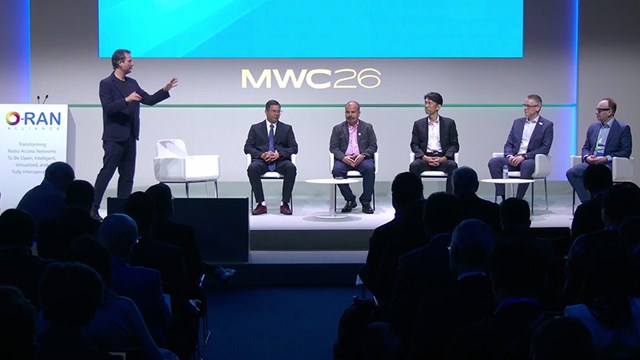
This high-level panel brings together experts from Verizon, Vodafone, Virgin Media O2 and Wind River to explore the future of the radio access network (RAN). From Open RAN and virtualised RAN to the role of AI and next-gen devices, this session dives into the real-world progress and challenges of modernising RAN architecture. Topics include total cost of ownership, power and spectrum efficiency, vendor flexibility and why rethinking RAN design is essential to supporting new AI-driven user experiences.
Broadcast live 4 June 2025
Featuring:

CO-HOST
Yago Tenorio
SVP & CTO, Verizon

Andy Dunkin
OpenRAN RF & Digital Platform Development Manager, Vodafone

Darrell Jordan-Smith
Chief Revenue Officer, Wind River

Rob Joyce
Director of Mobile Access Engineering, Virgin Media O2