Why provincial UK universities are enjoying tech spin-out success

By Martyn Warwick
Sep 16, 2026
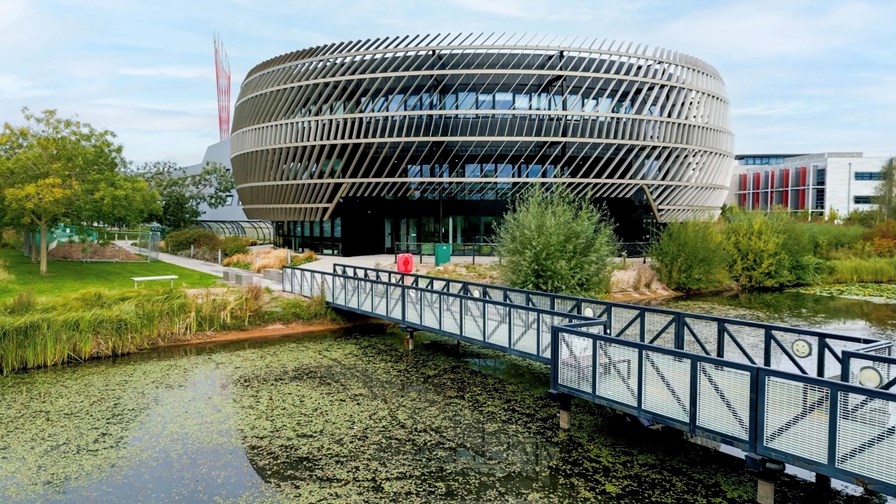
The University of Nottingham Innovation Park.
- Geographical location no longer regarded as a barrier to funding
- A levelled playing field is helping to make Britain a major global player in science and technology innovation
- University of Nottingham launched six new spinouts over the 2025-26 university financial year, its strongest performance yet
- There is an expanding pipeline of innovation and commercial expertise and support
In the UK, the bosky “groves of academe” lie somnolent under an unremittingly hot sun as the dog days of summer grind on. Universities will remain almost empty of students and academic staff until late September or even early October when, as the heat abates, normal academic services will be resumed. The mass media usually portrays academia as an environment of quiet, contemplative scholarship where the church clock forever stands “at ten to three” and there is always “honey still for tea”. However the idea that academia exists in a timeless limbo quite separate from the quotidian concerns of life beyond hallowed ivy-clad walls couldn’t be further from the reality.
Academe, despite its “other worldly” reputation, can be a cut-throat environment often riven by professional jealousies and intense pressures to publish results of research before others can do so, and is a locus of fierce competition between established senior academic staff fighting it out as they climb or strive to say atop the greasy poles of tenure and preferment. Meanwhile, ambitious students strive to prove themselves by achieving their best first degrees and gaining prestigious places on the most desirable post-graduate degree courses that can eventually lead to international recognition as experts in their chosen fields… and, increasingly, to commercial riches.
It has been the same for centuries but, in the recent past, Britain has taken advantage of the growing trend whereby academia is moving quickly to commercialise university research by creating and spinning out independent high-tech, scalable, for-profit, market-ready companies. More recently still, the trend has been given added impetus by the UK government’s decision to provide a £2.5bn cash injection to help commercialise fast-growing AI and quantum technology research and development.
The extra money is designated, in part, to help redress regional disparities between university research labs in different parts of the country, a structural fault line that is highlighted in the government’s Independent Review of University Spin-out Companies. Until 2023, the high-tech spin-out sector was dominated by the wealthy ‘golden triangle’ of the elite universities of Oxford, Cambridge and University College London. They routinely secured for themselves 75% of all the UK’s spin-out investments while other universities were left to fight it out for scraps from the remaining 25% of funding available to the “also rans”.
Times are now changing and government policy is to push hard to make Britain a major global player in science and technology innovation. That goal means ensuring other universities in other parts of the UK are enabled, where technological innovation is concerned, to compete on a more level playing field with their wealthier and more renowned rivals than has hitherto ever been the case.
The University of Nottingham is one notable case in point. It is a public research university in the English Midlands, ranks in the Top 100 list of universities globally, and is recognised for its leading-edge research and international network of partners and collaborators around the world. The number one university worldwide is the Massachusetts Institute of Technology (MIT), located in Cambridge, across the Charles River from the city of Boston in the US. Meanwhile, at number 100 (out of the QS full ranking of the leading 1,054 of the world’s universities) is University College Dublin, Ireland.
The influential QS World University Rankings is published by a British analytics outfit that specialises in analysing higher education around the world. QS stands for Quacquarelli Symonds, and includes the initial of the surname of the company’s founder, Nunzio Quacquarelli, who first began producing the academic statistics and league table back in 2004, as well as that of co-founder Matt Symonds.
From MRI to AI, quantum, and beyond
During the course of the 2025-26 university financial year, the University of Nottingham launched six spin-out companies and is, understandably, celebrating its strongest year yet for the introduction of innovative new companies. Managed by Nottingham Technology Ventures (NTV), since 2017 a wholly owned subsidiary of the university based in the Ingenuity Centre at the University of Nottingham Innovation Park, NTV is also responsible for the multimillion-pound Nottingham Invention Fund, which invests in university spin-out companies and supports their development and growth.
The latest spin-out launches relate to sectors including healthcare diagnostics, advanced electrification, data-driven platforms, quantum technologies and AI. The six new spinouts freshly added to Nottingham University’s portfolio bring its tally of commercially viable and active companies to 44 and are indicative of the breadth and depth of Nottingham’s commercialisation pipeline.
The president and vice-chancellor at the University of Nottingham, Professor Jane Norman, commented: “The creation of six new spin-out companies in a single year is a remarkable achievement and reflects the strength of our research, the ambition of our academics and the support available to transform ideas into real-world impact."
She added, “These companies are addressing some of society’s most pressing challenges, from improving healthcare outcomes and accelerating the transition to net zero, to advancing artificial intelligence and quantum technologies. We are incredibly proud of the researchers and teams behind them.”
One of Nottingham’s best-known and most celebrated successes was in the discovery and development of magnetic resonance imaging (MRI). The technology was developed and refined thanks to contributions made by teams of researchers in various parts of the world and now, more than half a century on from the original lab experiments and 40 years after the first clinical scanners were installed in hospitals, MRI is a globally vital, valued and widespread medical technology. Among the research pioneers of MRI, Paul Lauterbur of Stony Brook University, New York, and Sir Peter Mansfield of the University of Nottingham were awarded the 2003 Nobel Prize in Physiology or Medicine for their “discoveries concerning magnetic resonance imaging”. The university has some highly noteworthy research antecedents and intends to improve its already impressive track record.
Nottingham University’s first spinout, back in 1997, was Scancell, a cancer immunotherapy company, but progress with spinning-out other companies thereafter was intermittent until NTV was launched. Since then, spin-out activity has accelerated and it has been proven that it can scale when required. Of course, history everywhere is littered with the ruins of what once seemed to be promising technology startups that, whilst intellectually stimulating, were found to have minimal application in the commercial arena. Good research does not automatically translate into good business and what may very well be of abstract interest to research scientists may have no commercial application in the real world.
Dr Alice MacGowan, the CEO of NTV, points out that: “The journey from promising research to a company operating at scale is difficult… and one of the greatest obstacles is access to funding”.
To that end, in June this summer, the University of Nottingham inaugurated I Fund, its first Enterprise Investment Scheme (EIS) to provide “early-stage capital for its high-potential spin-out companies.” I Fund is managed by SyndicateRoom, an FCA-regulated fund manager, in partnership with NTV, the university's commercialisation arm. The aim is to raise £1.2m exclusively to target a portfolio of some six to eight university spin-out companies and to connect private investment with the university’s innovation pipeline, which includes life sciences, deep technology, AI and ‘clean-tech’ to help startups to scale and commercialise research.
Dr. MacGowan added, “We have an increasing number of academics who are choosing to spin out, and we also know that the existing portfolio is scaling rapidly and has greater demands for capital – and at the moment those demands are not being met. It can be difficult for those companies to fundraise within the time frames that enable them to execute on their plans. That is why it is important for us to generate a new source of venture capital for those companies to access. We want to give them the opportunity to accelerate their growth and achieve scale.”
The Nottingham University spin-out pipeline
Given the comparatively recent acceptance by the academic community that the physical location of a university should not be a determinant of whether or not leading-edge research can be spun out into a profit commercial enterprise, Nottingham, which successfully launched its first spinout, Scancell, 29 years ago and founded Nottingham Technology Ventures in 2017, has been in the vanguard of the commercialisation of university research. Along the way it has developed an integrated innovation ecosystem provenly capable of supporting academic researchers through from early discoveries that have been identified as having future commercial potential through to launch and long-term business support.
For example, originating from research conducted at Nottingham’s School of Physics and Astronomy, the spinout Contour Advanced Magnetic Design Ltd. has tight ties to quantum technology research and is a specialist in the control of magnetic fields. It serves both the British and international quantum technology supply chain with applications ranging from the agri-technology sector through to clean energy, defence, health care, navigation and space exploration/exploitation.
Meanwhile, Shard Diagnostics, a molecular diagnostics company spun out of the University of Nottingham in 2024 and part of its investment portfolio since 2025, produces accessible next-generation detection technologies for applications including oncology, infectious diseases and point-of-care testing.
Elsewhere, Qurae, a 2025 Nottingham spinout, helps healthcare organisations maximise the utility of their data. Working in partnership with NHS trusts, research organisations and “other custodians of sensitive patient data,” the company helps deliver the practical work of data transformation – establishing what data exists, bringing it up to recognised international standards and putting governance in place that protects patients without blocking ongoing work. As a result, data is trusted, interoperable and ready to support both AI-driven research and day-to-day service improvement.
Phil Quinlan, Professor of digital engineering and health informatics at Nottingham University and Andy Rae, senior software engineer, from the Faculty of Medicine and Health Sciences founded Qurae (see what they did there?) and are internationally recognised and renowned leaders in understanding and managing the complexity between data sovereignty, data standards and the use of data in global analyses.
The Faculty of Engineering has launched two new ventures: HPDrive Technologies and MatAlytics. HPDrive Technologies, created in partnership with GKN Aerospace, commercialises pioneering, megawatt-scale cryogenic electrical machine and drive technologies for sustainable aviation and future hydrogen-powered regional and narrowbody aircraft applications.
And so it goes. In August 2026, the university celebrated MatAlytics, its latest spinout, which is based on a PhD research programme that received backing and significant funding after demonstrating a highly scalable proof of concept (PoC). MatAlytics is an AI platform designed to support the development of steel manufacturing. The physics embedded in the company’s neural network CITRUS software enables steel makers (and the manufacturers of other metals) to predict thermochemical behaviour and the microstructure of steel slabs and components much more quickly and with considerably greater accuracy than current solutions. In use, the MatAlytics solution will enable the steel industry to reduce operating costs, carbon emissions and improve the production, quality and consistency of products.
Nottingham University continues to prove that geographical location need not be a barrier to innovation and that the repeated spinout of new commercial companies exploiting laboratory research across an enormous number of diverse subjects, disciplines and technologies is no longer confined to the few ‘golden triangle’ universities that have dominated the UK tech spin-out scene for so long.
– Martyn Warwick, Editor in Chief, TelecomTV
Email Newsletters
Sign up to receive TelecomTV's top news and videos, plus exclusive subscriber-only content direct to your inbox.