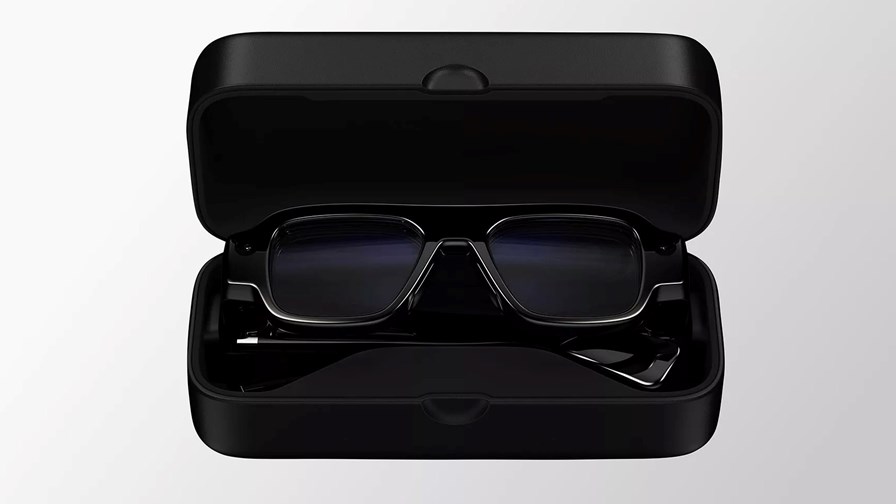
The Charging Case with Cellular for the SPECS AR glasses developed by Snap Inc.
- Snap signs up Verizon, Orange, BT as Specs partners
- Orange and Telesat launch LEO gateway
- FCC chairman eyes $100bn in spectrum auction proceeds
In today’s industry news roundup: Snap teams up with mobile operators to enable 5G as well as Wi-Fi connectivity to its AI-enabled AR glasses, but boy are they expensive…; Orange is supporting Telesat with terrestrial support for the Canadian satellite operator’s soon-to-be-launched LEO constellation; FCC chief Brendan Carr has dollar signs in his eyes as he lines up multiple US spectrum auctions; and much more!
Wearables vendor Snap has signed up Verizon, Orange and BT Group’s consumer division EE as its initial mobile connectivity partners as the company launched Specs, “a new kind of computer built into a pair of augmented reality (AR) glasses.” According to Snap, the Specs technology, including its AI-native operating system, enables users to engage with the world “through natural interactions using your hands and voice” and “bring AI assistance and useful digital information into your field of view, enabling you to communicate, work, shop, watch content, learn and navigate while remaining engaged with the world around you.” Such interactions require dependable connectivity beyond the reach of Wi-Fi, which is where the mobile operators come in. “To help Specs AR glasses stay powered and connected even when you’re away from Wi-Fi, Snap introduced a new Specs Charging Case with Cellular. Sold separately, it provides four additional charges and offers cellular connectivity through participating wireless carriers,” noted Snap. In the US, Snap is partnering with Verizon “to offer custom data plans, flexible financing, digital setup and hands-on experiences at select Verizon stores.” Verizon noted in its own announcement: “For years, the promise of wearable computing was held back by smartphone tethering and low-range Wi-Fi networks. By bringing Verizon’s fast, reliable 5G network directly to the Specs Charging Case, Specs Inc. and Verizon are offering a true heads-up, hands-free experience that keeps users present in the real world while they access real-time digital content.” But it ain’t cheap… “The Specs Connected Case bundle will be available for $2,395. Verizon will offer eligible customers financing options, including a 36-month payment plan. Connected Wearable data plans are available from $10 per month for Verizon customers and from $20 per month for non-Verizon customers.” The bundle will be available “soon”, while prospective customers can try out the Specs from 1 October at Specs First Look at Westfield Century City in Los Angeles. Snap has also teamed up with Orange in France and BT’s EE in the UK, though the details of those launches are yet to be announced.
Orange and Canadian satellite operator Telesat have inaugurated the first Telesat Lightspeed gateway at the French telco’s teleport facility in the Champagne region of France. The gateway, which will connect to Telesat’s Lightspeed low-earth orbit (LEO) satellites once they become operational in early 2028, is located within Orange’s World Teleport Association Tier-4 certified teleport in Bercenay-en-Othe, southeast of Paris. The teleport is connected to Orange’s international backbone, including onward connectivity to the French capital and other interconnects across Europe, and the carrier will provide terrestrial connectivity to Telesat’s point of presence in Paris. Telesat plans to launch an initial 225 satellites as part of its Lightspeed constellation. The Bercenay-en-Othe facility is one of six Orange teleports around the globe and has been in operation since 1978: It includes advanced gateway antennas supplied by Intellian Technologies that support Lightspeed’s high-capacity, low-latency architecture. “We are very pleased to host this new low-earth orbit gateway in our Bercenay-en-Othe teleport,” stated Jean-Louis Le Roux, EVP of Orange international networks, who took part in the inauguration ceremony alongside Telesat chief commercial officer Glenn Katz. “This partnership with Telesat demonstrates our ability to deliver trusted ground infrastructure as well as innovative and resilient connectivity solutions with our integration of next-generation satellite networks,” added Le Roux.
Brendan Carr, chairman of US regulator Federal Communications Commission (FCC), is bullish about the financial opportunities that future spectrum auctions can generate – claiming the US government could make up to $100bn in proceeds over the next few years. According to Reuters, the FCC boss said the administration plans to conduct three additional auctions following the planned C-Band auction that is due to take place in July 2027, saying it has provided formal notification of the plans with a goal of completing them by the end of 2028. “We’re seeing real response in the market in ways that we didn’t see just a couple of years ago,” said Carr. The likes of SpaceX have bid against T-Mobile US, AT&T and Verizon in recent spectrum auctions, such as the $40bn May resale of Echostar’s spectrum. “It’s more competition. It drives prices down for consumers. It raises money for the Treasury,” he added.
NTT Docomo, KDDI, SoftBank Corp. and Rakuten Mobile have joined forces to assess the possibility of sharing millimetre-wave (mmWave) infrastructure in pursuit of broader coverage. The operators each issued a statement explaining that the frequency band is prone to degradation due to physical obstructions. They outlined a plan to study ways to expand the use of compatible base stations and architectures and identify possible options to widen the reach of mmWave 5G. Some form of shared access could be involved in the future: The operators stated they would continue to deploy their own mmWave 5G equipment but look into “how to effectively” use it. “To achieve this expansion through collaboration among mobile network operators, this study will focus on technologies and approaches related to 5G millimeter-wave base stations, repeaters and other related assets. While each operator actively deploys its own 5G millimeter-wave equipment, the companies will pursue concrete studies to effectively utilise deployed facilities,” the Japanese telcos said in a joint statement.
Here’s an interesting blog from Google Cloud, which spoke with Camille Marini, the head of FinOps (financial operations, aka cloud spending management) at Orange, to get an understanding of how the telco managed to get its engineering teams to take responsibility, and be accountable for, the operator’s cloud spending. “We insisted on the concept of shared responsibility across the organisation for our FinOps practices,” Marini told Google Cloud, which helped the telcos set up the FinOps Community of Practice. “It’s very similar to how we approach cloud security. We needed to make teams understand that every single stakeholder in a project is involved in FinOps, each in their own way, if we are going to achieve responsible and impactful AI spending and usage.”
Programmable chip developer Altera, the Intel spinout in which Silver Lake Partners acquired a 51% stake for $4.46bn last year, has filed for an IPO that, according to Reuters, could raise more than $2bn. The company, in which Intel still holds a 49% stake, is set to benefit from the AI infrastructure and physical AI (robots) investment boom.
– The staff, TelecomTV
Email Newsletters
Sign up to receive TelecomTV's top news and videos, plus exclusive subscriber-only content direct to your inbox.