Yossi Chai (Senior Solution Architect - AWS), Yuval Stein (Director of Products, Technologies & AI - Amdocs), Jose Carlos Mendez (Director of Network and OSS Product Marketing - Amdocs)
Operational digital twins give CSPs a continuously updated, system-wide model of how their networks actually behave — connecting structure, services, and operational intent in a single representation. Combined with agentic AI, this foundation enables autonomous network operations that are accurate, explainable, and trustworthy. This paper explains how Amdocs works with AWS to deliver that capability.
As CSP networks have grown more disaggregated, cloud-native, and multi-vendor, the gap between network complexity and operational capability has widened steadily. The operational models most CSPs still rely on were not built for this environment.
The evidence shows up in three recurring patterns. First, issue resolution slows as engineers manually reconstruct cross-domain dependencies. Second, capacity and change decisions become conservative because confidence in the real-time network state is limited. And third, automation stays bounded to local optimizations because broader impact cannot be guaranteed and explainability cannot be assured. As networks grow, these constraints define the ceiling of what automation alone can ever achieve.
Autonomous network operations require a different foundation. They depend on an explicit, continuously updated understanding of how network, services, and operational processes interact in real time, and on the ability to act on that understanding in ways that are both controlled and explainable.
Autonomy requires deeper network understanding
Modern CSP networks span multiple domains, from RAN and transport through core, cloud, and service layers, typically sourced from different vendors and evolved through years of incremental change. The constraint on autonomous operations is structural, rooted in how networks are represented and understood, persisting regardless of how much automation is already in place.
First, cross-domain dependencies are typically implicit rather than explicitly modelled. Second, visibility across physical, virtual, and service layers remains fragmented. And third, automated decisions lack sufficient explainability to be trusted in live operations. Even where individual domains are well instrumented, operational insight stays fragmented across tools and teams.
The consequences are consistent and compounding. Service-affecting issues take longer to diagnose and resolve, thereby increasing risk to customer experience and SLA compliance. Meanwhile, limited confidence in the real-time network state leads CSPs to over-provision capacity or defer optimization, accelerating capital spend. And skilled engineers spend disproportionate effort correlating symptoms and validating assumptions rather than addressing root causes or preventing recurrence.
An operational digital twin addresses these challenges by establishing a shared, system-wide representation of the network that aligns technical behavior with service and business impact. Paired with agentic AI, it enables higher levels of autonomy grounded in network structure and behavior, informed by how the network actually works rather than driven by symptoms alone.
From correlation to comprehension
Most traditional root cause analysis approaches cluster alarms, anomalies, or events to surface the most statistically prominent signal. While this works well for noise reduction, it rarely explains why a problem occurs, how it propagates across domains, or which network function is responsible. As networks become more dynamic and interdependent, symptom-level correlation increasingly obscures underlying causes.
A more effective approach grounds root cause analysis in an explicit understanding of the network itself. Analysis is built on how the network is constructed, how it behaves under normal conditions, and how deviations propagate through dependencies, working from network reality outward as opposed to inferring backward from symptoms after the fact.
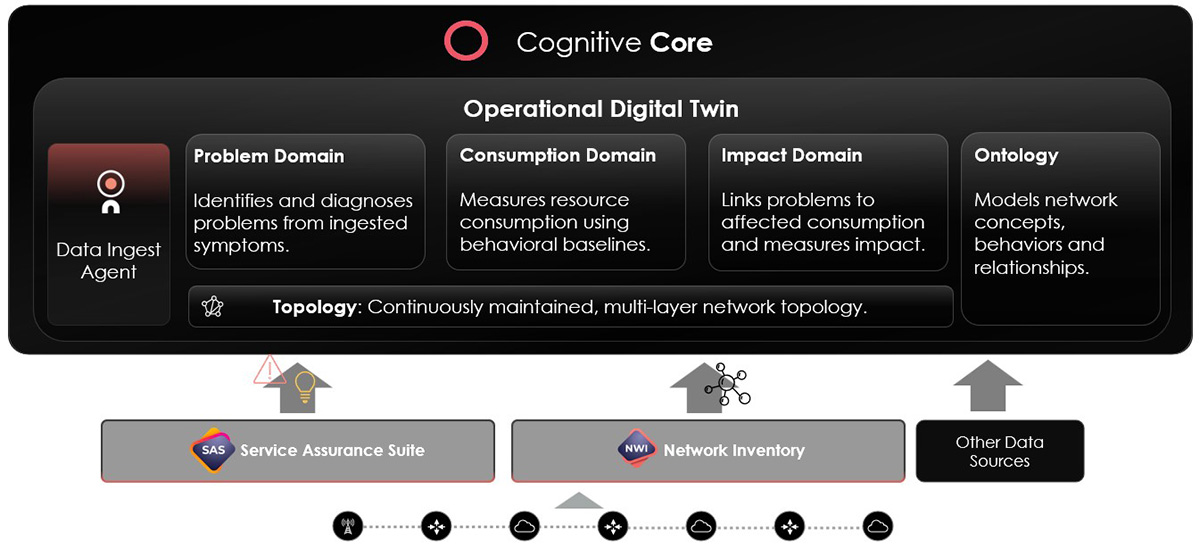
The operational digital twin makes this possible — a continuously updated, multi-layer, multi-domain model that represents how physical, logical, and service components interact, as well as how degradations propagate across network and service boundaries. As a result, root cause analysis identifies affected network functions and dependency paths, providing problem-level insight that is more accurate and more actionable, with fewer repeat incidents and escalation loops as a direct consequence.
Technical challenges in building an operational digital twin
Constructing an operational digital twin suitable for autonomous operations means addressing several technical challenges that are easy to underestimate:
Topology and ontology as complementary models
Network topology captures structure and connectivity, referring to which components are linked and how. Ontology captures meaning and semantics, including what those components represent, which services they support, and their operational and business relationships. Effective reasoning requires both. Treating them as complementary but distinct models allows analysis to traverse from physical failures to service-level consequences without collapsing important abstractions.
Near real‑time, multi‑source data aggregation
Operational data is distributed across numerous systems, each with its own formats, update frequencies, and vendor-specific protocols. Creating a coherent, time-aligned representation requires continuous ingestion, normalization, and synchronization of telemetry, topology, and event data. Without such alignment, any digital representation would quickly diverge from the live network.
Multi‑layer, multi‑protocol topology construction
Network topology spans multiple layers, from Layer 2 connectivity and Layer 3 routing through virtualized and cloud network functions to service-level constructs, with each following different structural rules. A usable digital twin must preserve all these distinctions while still enabling reasoning across layers, as when tracing how a physical link degradation affects a customer-facing service.
Behavioral understanding with limited alarm data
Even large CSPs have limited examples of certain failure modes, particularly rare but high-impact events where purely data-driven machine learning approaches struggle. The challenge lies in building behavioral models that combine limited historical data with synthetic scenarios to enable robust generalization while remaining sensitive to novel conditions and emerging issues.
Digital twin as foundation, Agentic AI as execution
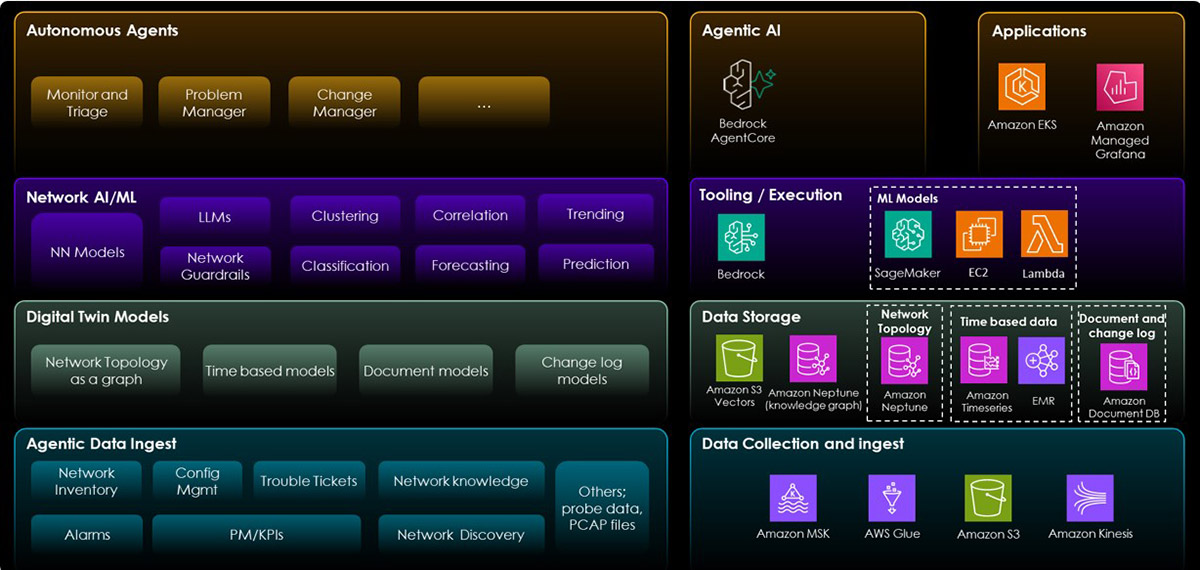
Amdocs addresses these challenges through an integrated architecture that combines an operational digital twin with agentic AI, built on AWS to bring together telco-specific operational intelligence and AWS cloud and AI services.
Agentic‑driven data ingestion
Multiple AI agents, guided by telco-specific technology blueprints, ingest and normalize data from diverse sources and construct multi-graph topology and ontology models. These agents collaborate to identify relationships across domains, with human-in-the-loop validation applied selectively to close gaps and ensure accuracy. The result is accelerated digital twin creation without compromising CSP’s trust in the resulting model.
Behavioral anomaly detection grounded in network understanding
Statistical models learn normal and abnormal behavior patterns from available alarm and telemetry data. To address data scarcity, simulators generate synthetic scenarios that enrich training sets and improve model robustness, enabling earlier and more reliable detection of behavioral anomalies that signal emerging problems before they escalate to late-stage symptoms.
Cloud‑native architecture for scale and viability
Maintaining large, dynamic graph models and processing high-volume telemetry requires elastic compute and storage. A cloud-native architecture supports growth in network complexity while aligning cost to usage, enabling advanced analytics and autonomous operations to scale economically across environments.
Together, these capabilities give agentic AI a live, system-wide representation of the network from which to prioritize issues, assess impact, and recommend actions across the problem-resolution lifecycle.
AWS technology foundation
The Amdocs operational digital twin and agentic architecture leverage AWS cloud technology and managed services to support scale, performance, and operational efficiency.
- Amazon Neptune underpins the multi-graph topology and ontology models, using complex graph traversal queries to trace impact paths from technical issues to affected services.
- Amazon Managed Streaming for Apache Kafka (Amazon MSK) and Amazon Timestream handle ingestion and storage of real-time telemetry and time-series data for near real-time analysis across large numbers of network elements.
- Amazon SageMaker AI and Amazon Bedrock support model training and agentic workflows, with continuous learning and adaptation as network behavior evolves.
Together, these managed services can help reduce operational overhead by an estimated 60–70% compared to self-managed infrastructure [2], support pay-per-use economics, and allow CSPs to concentrate on network intelligence rather than infrastructure management.
Measurable operational impact
When applied to selected use cases, CSPs have reported measurable improvements across the incident lifecycle, based on TM Forum industry indicators from CSPs implementing Autonomous Networks [1].
- Detection and diagnosis: CSPs report an 81% fault prediction/diagnosis accuracy rate, reflecting improved ability to identify service‑impacting conditions and isolate root causes.
- Resolution: TM Forum indicators show up to an 80% reduction in fault handling duration (e.g., mean time to repair) alongside a reported 78% fault handling automation rate, supporting faster and more consistent fault resolution.
- Operational efficiency: CSPs report a 61% improvement in operational timeliness (e.g., time per process) and a 72% reduction in network site visits, consistent with reduced reliance on manual and on‑site interventions as fault handling becomes more automated and predictable.
Business outcomes include fewer service disruptions and faster restoration, contributing to improved customer satisfaction and operational efficiency.
Enabling the path to autonomous networks
Autonomous network operations scale through shared, explainable understanding of how the network behaves as a system. Additional automation alone cannot deliver this. Operational digital twins provide the foundation, connecting network structure, behavior, and operational intent in a form that both humans and machines can work with.
By combining an operational digital twin with agentic AI, the Amdocs solution built on AWS gives CSPs a controlled and credible path toward higher levels of network autonomy. The approach augments human expertise, reducing manual effort where understanding can be automated while allowing engineers to focus on design, optimization, and strategic decision-making. Without it, the gap between automation capability and operational trust continues to widen.
References
[1] TM Forum. Assessing CSPs ’progress towards Level 4 autonomous networks, Benchmark Report, March 2026.
[2] Estimated reduction based on comparison of AWS managed services (Amazon Neptune, Amazon MSK, Amazon Timestream, Amazon SageMaker AI) versus equivalent self-managed infrastructure. See AWS Total Cost of Ownership analysis methodology at https://aws.amazon.com/economics/