Lockheed Martin partners Verizon, Nvidia et al to demo drone detection tech

By James Pearce
Aug 13, 2026
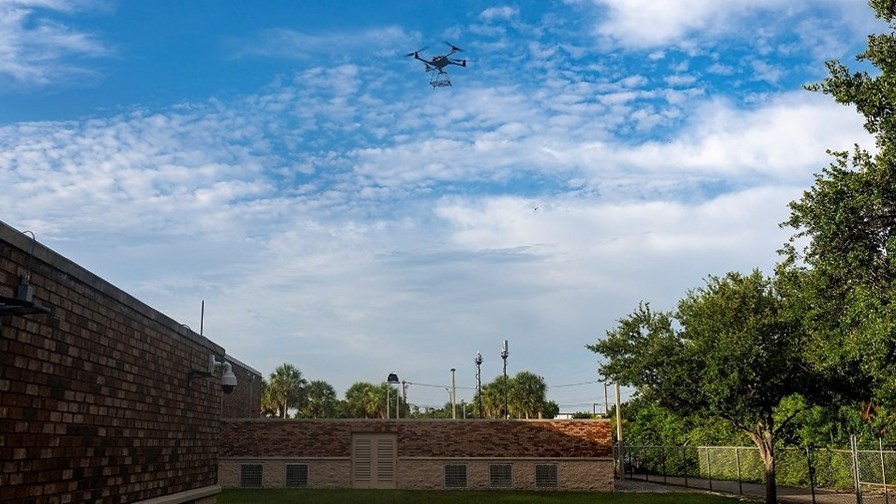
The NetSense system combines AI, 5G and commercial tech to detect UASs during a July demonstration in the Miami area.
- Trial uses 5G and AI to sense unmanned aircraft
- Netsense system aimed at helping enterprises uses RF to track drones
- System relies on 5G infrastructure for connectivity and uses AI to process threats
US aerospace giant Lockheed Martin has partnered with Verizon, Nvidia and others to demonstrate how existing 5G networks can power AI-enabled systems capable of identifying, tracking and monitoring unmanned aerial systems (UASs).
In a July demonstration in Miami, Florida, the defence firm deployed its NetSense Airspace Awareness-as-a-Service system, which leverages commercial off-the-shelf tech to detect UASs such as drones.
Verizon provided the 5G network spectrum for NetSense, which used AI-native radio access network software from ORAN Development Company (ODC) – which specialises in AI sensing and inference – Nvidia’s AI Aerial platform, and an advanced radio frequency simulation platform from test vendor Keysight Technologies to detect and alert the demo team to the presence of drones.
Netsense, which is managed by Lockheed’s Astris AI subsidiary, combines Lockheed Martin’s warning and tracking technology, which works together with AI to read radio frequency (RF) disturbances, which can then predict and track a drone’s flightpath, automatically sending real-time alerts. Nvidia’s AI Aerial feeds its analysis of the signal disturbances into Lockheed Martin’s NetSense algorithms.
The demonstration highlighted how NetSense can detect drones without changing existing radio deployments, ahead of potential advances such as Integrated Sensing and Communication (ISAC), which, in 6G networks in particular, transforms mobile networks from data-delivery systems into spatially aware platforms. They can also work alongside 6G ISAC, and Verizon is working with Lockheed Martin to develop a roadmap for broader deployment across 5G and future 6G networks.
"By applying AI to the RF signal measurement data already traversing our 5G infrastructure, we can effectively turn our network into an intelligent sensing platform," said Anil Guntupali, senior vice president of Technology and Product Development at Verizon.
"By collaborating with Lockheed Martin to apply intelligence to our existing 5G spectrum, we're proving that the most complex security problems often have an answer embedded in the network."
With drones becoming more affordable, capable and widely available, the solution can be used beyond military capabilities, according to Lockheed Martin. It can be deployed for commercial applications across critical infrastructure, large-scale events, utilities, or for public services such as schools, hospitals and airports.
The solution relies on open architecture design, meaning new interceptors can be added without the need for entirely new hardware, and can be scaled from protecting one single critical site to supporting a mobile command unit spanning larger operations.
The aerospace giant said it now plans pilot deployments in the second half of 2026 and early 2027, with NetSense expected to launch commercially next year.
"As drones become more affordable and accessible, airspace awareness technology needs to evolve rapidly to outpace potential threats. That's why we developed the NetSense solution," said Sarah Hiza, senior VP of technology and strategic innovation at Lockheed Martin. "By working within the established 5G network spectrum, we're able to collaborate with the commercial technology industry and deploy a solution that's ready at the time of need."
- James Pearce, Editor, TelecomTV
Email Newsletters
Sign up to receive TelecomTV's top news and videos, plus exclusive subscriber-only content direct to your inbox.