To embed our video on your website copy and paste the code below:
<iframe src="https://www.youtube.com/embed/YowQz3cuFiI?modestbranding=1&rel=0" width="970" height="546" frameborder="0" scrolling="auto" allowfullscreen></iframe>
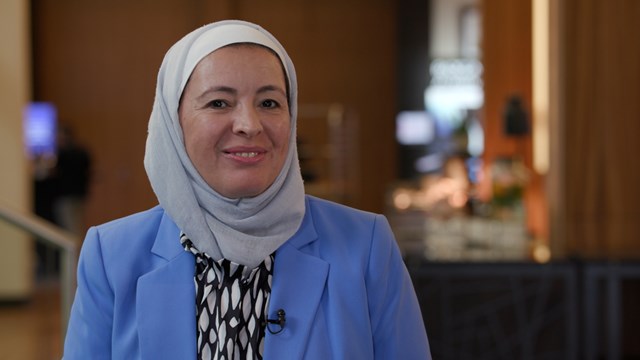
Welcome to TelecomTV. I'm James Pearce and I'm reporting from the AI Native Telco Forum in Düsseldorf, where I'm delighted to be joined today by Basma Driss, who's from Deutsche Telekom. Basma, thank you for joining us. Can you start by telling us about your role and responsibilities at Deutsche Telekom?
Basma Driss, Deutsche Telekom (00:24):
Of course. Hi, James. I'm working in Deutsche Telekom Group in group technology responsible for AI and automation for networks from a vendor management perspective. What does it mean? It means I'm working very closely with my colleagues to connect our AI strategy, our autonomous network ambition with the AI ecosystem and finding the right partners and partnership models for us. I have the luxury that I have a big choice in looking to the AI ecosystem. It includes a lot of players starting from the chipset vendors, to the cloud providers, to the network vendors, to the OSS/BSS vendors and AI native LLM providers and all of that, which is now becoming a very vibrant ecosystem. And my responsibility is really to see who do we work with, who we select in our stack and in our AI use cases so that it help us to accelerate and to scale.
James Pearce, TelecomTV (01:36):
So maybe you can talk us through some of the latest autonomous network developments at DT.
Basma Driss, Deutsche Telekom (01:41):
Maybe I start telling you the autonomous network journey started much earlier, many, many years ago where we started working on using the techniques from machine learning, orchestration, automation, et cetera, to automate the way how we plan, build, operate, and secure our network. AI has helped us like everybody to accelerate in our journey. And recent examples as have been publicly announced and also yesterday explained by Ahmad are RAN Guardian, which help us to manage events and optimise our radio network to host much, much more events than we could. And another one is Minder, our multi-agent system to observe and close loop and react on network failures and make our network more resilient. These are examples, but we have much, much more than that. Fibre rollout, for example, is an area where we have been working heavily using all the techniques again, and especially with the agentic AI to, for example, first to digitalise our processes, but also to facilitate and accelerate fibre rollout.
(03:23):
We have developed digital construction assistance, which help field engineers and construction company to efficiently improve the quality of the rollout as well and decrease the time for that, but also back office having process automation in the back office as well. So these are just examples and there are many of them. In each network domain, of course, there are a lot of examples.
James Pearce, TelecomTV (03:54):
So you mentioned partnerships. How important are those partnerships in becoming an AI-native telco? And also, can you talk us through some of the collaborations that are key to your day-to-day work?
Basma Driss, Deutsche Telekom (04:03):
That's the dimension that is really not always highlighted when we talk about accelerating AI or autonomous network. We need really to move from a normal operator-supplier relationship to partnership to collaboration. And the AI ecosystem is very vibrant and we have a big choice. So our telcos in general needs to move to be an AI ecosystem orchestrator working with the different players from the chipset vendors to the cloud providers to the OSS/BSS vendors, network vendors, the LLM providers, et cetera. We cannot continue using the way how we engage, let's say a typical tender in the area of let's say automation or AI for network. It take us, including some PoCs, et cetera, at least one year to select the right partner for us. So that's not scalable, that's too long. So we are changing the way how we are procuring.
(05:38):
We are working on a new AI sourcing model to address that. And we are looking to a partnership model where it minimises the risk for us obviously and help us to accelerate and integrate.
James Pearce, TelecomTV (06:01):
Brilliant. Clearly a very important part of what you do. In terms of going forward, what would you like to see next from the AI-native telco ecosystem that could advance autonomous network developments?
Basma Driss, Deutsche Telekom (06:15):
We have been learning a lot from, let's say, the way how we engage with the vendors and how we put our requirements toward them through the typical tender processes, RFXs, et cetera. So we are reviewing that and we are changing the way how we do AI sourcing because our typical way how we did it, it takes us at least more than one year to select the right vendor for us and to go through our, let's say complex requirements. So we are changing that and we need also, when you talk to the vendors, I tell them you also need to change. You change from the way how first you develop your AI systems or your AI enabler solutions from day one as AI native. Don't come with a monolithic OSS system where you do some makeup and you put an agentic system on top of it and you tell me I have an AI native system, but still you duplicate the data.
(07:31):
You are not able to integrate with my platform. You bring a built-in MLOps platform or AIOps platform where I need you to integrate with my AIOps platform. So all these challenges around really integration and scale. When I buy a system, I need to be able also to use it to scale, to integrate to the next network domain or to build the next service or to deploy in another NatCo, which could be a large NatCo like Germany or a very small NatCo like Montenegro. So we have these variants between our national units. And the other thing that they really need to work on is on the way how they sell. As I said, we are transforming the way how we buy, but they need also to rethink in the AI native era, their commercial model and how we work together on a model that yes, reduce our risk of course, but reduce risk that AI expose from both sides, have a governance in place and have agreed model on how we handle IPR and liability and work together on having a less risky system that can integrate easily and help us in our journey.
James Pearce, TelecomTV (09:06):
Brilliant. Thank you so much for joining us today on TelecomTV.
Basma Driss, Deutsche Telekom (09:09):
Thank you.
Please note that video transcripts are provided for reference only – content may vary from the published video or contain inaccuracies.
Basma Driss, Domain Lead AI & Automation Technology Vendor Management, Deutsche Telekom
Basma Driss, domain lead for AI & automation technology vendor management at Deutsche Telekom, discusses her role connecting DT’s AI and autonomous network strategy with the wider AI ecosystem, shares recent autonomous network developments including RAN Guardian, Minder and fibre rollout, why explains telcos must become AI ecosystem orchestrators, how DT is changing its AI sourcing and partnership model, what she wants vendors to do differently in the AI-native era.
Recorded September 2026
Email Newsletters
Sign up to receive TelecomTV's top news and videos, plus exclusive subscriber-only content direct to your inbox.