AI in the RAN: A DSP Leaders Report insights discussion

By Guy Daniels
Nov 14, 2025
To embed our video on your website copy and paste the code below:
<iframe src="https://www.youtube.com/embed/p9EmeueToTU?modestbranding=1&rel=0" width="970" height="546" frameborder="0" scrolling="auto" allowfullscreen></iframe>
Hello, you are watching TelecomTV and our extended coverage of the DSP Leaders Report series. I'm Guy Daniels. And today's discussion looks at some of the highlights from our most recent report, AI in the ran. And for the second year running, we asked mobile network operators for their views on how, when, and why they plan to use AI in the ran. If you are a registered viewer of telecom tv, you can download the report now. There's a link in the text below this video. There's no cost and registered viewers will have access to all of our reports, articles, and videos for this year's report. We also asked a set of new questions related to the impact of AI traffic on the RAN and how AI should fit into six G RAN standards considerations. Well, we received responses from 44 qualified respondents who work at MNOs across Asia, Europe, Africa, and the Americas.
(01:20):
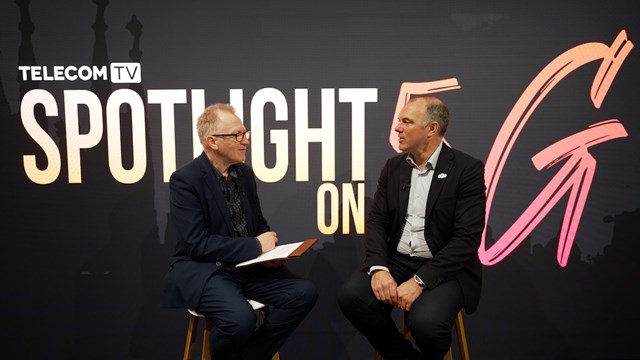
And now that we have published the results, it's the perfect time to discuss our findings with our special guests. So joining me on the program are Beth Cohen, product strategy consultant for Verizon Gilan Peir, VP of Technology Wireless standards at interdigital. And Patrick Kelly, founder, partner and principal analyst of Apple Door Research. Hello everyone. It's good to see you all. Thanks so much for coming on the program to help us make sense of all these findings. And we're going to focus on some specific points that came out of the research and look at these in more detail. So to start with, there's this assumption that all mobile operators are going to reap the benefits of using AI in the ran, but it seems not everyone thinks that way. We asked when do you think AI will positively impact RAN operations for most mobile network operators? And last year, 84% believe that most MNOs would be experiencing an AI upside in their runs before the end of 2026. And only 2% thought never. Well, this year, just 66% said by the end of 2026 and 11% voted for the never option. So basically, is AI in the RAN losing its shine or is this about longer timelines to see the benefits for most operators? And perhaps are we heading for an AI in the RAN digital divide? Patrick, can I come to you first and what are you seeing in the work that you are doing on AI and the ran?
Patrick Kelly, Appledore Research (03:23):
So I think first of all, based on the survey results, I think the timelines are probably about correct. We're probably one to two years away from seeing commercial deployments. There's a lot of activity right now in terms of trials and proof of concepts. Most of that I would say is focused on things like spectral efficiency and energy management. So more on the RAN optimization. I think some of the recent announcements that we've seen, first of all, the NVIDIA investment in Nokia for a billion dollars and then within the last week we've seen an announcement from DT and nvidia. I think what this implies is that you'll see more of a focus on optimization of the RAN and then maybe three, four years out when the business cases surface, we'll see more of the monetization play. I think the monetization side of how you use AI in the RAN for monetization is still up in the air.
Guy Daniels, TelecomTV (04:37):
Yeah, now that is really interesting. Thanks very much Patrick and Beth, can I come across to you as well for your thoughts on this question and the answers we received?
Beth Cohen, Verizon (04:48):
I think there's a little bit of a chicken in an egg going on here, which is of course who's putting the AI in? How's it be handled? I think a lot of it depends upon the vendors and the vendors need to put it in. And then of course once the vendors such as Nokia put it in, then the telecoms themselves need to check it out, do those trials to make sure that it all works. Because you can't really test it without that scale. I mean that's what AI is all about scale. And so I think, and of course telecoms are traditionally pretty conservative about such things. So I think there's a whole lot of moving parts that will take a little longer to settle down, which I think is a good thing.
Guy Daniels, TelecomTV (05:45):
Yeah, absolutely. Thank you very much Perth. And I think it's apparent that we bundled together benefits in our survey there. And as Patrick started to say there are different aspects of this and some are coming at different timelines. Justine, let's come across to you as well. What do you make of these findings?
Ghyslain Pelletier, InterDigital (06:07):
I agree with the previous comments from both Beth and Patrick and from, if I take the standards perspective, I think that what I'm interested in seeing is if the first rollout of six G will have a catalyst effect on increasing the amount of AI and amount of use case that's being deployed in durran. I think in the first phase or the phase that we are now, it's a lot about proprietary implementation. It's a lot about the network vendors that as was said by Beth and I think that as standards look into priorities for six G, which is monetization and reducing total cost of ownership, then more will be enabled and we will be able to roll out more AI and see additional benefits. But the timeline of standards is a little bit longer. So it is a stepwise approach it seems.
Guy Daniels, TelecomTV (07:12):
Yes, absolutely. And standards timelines are a bit longer. There is so much work that goes into them. And speaking of standards and specifications, let's move on to another aspect of the survey. The proposals that have been put forward by the AI Run Alliance, well, they've been widely discussed in the industry, but our experience is that there's still a degree of skepticism about the elements of this three-part proposal. So we asked our readers and viewers, thanks very much, lan. Well, next survey question then, and the proposals put forward by the AI ran alliance are widely discussed in the industry, but our experience is that there's still a degree of skepticism about elements of this three-part proposal. So we asked do the AI ran alliance proposals related to AI for ran AI on RAN and AI and ran, provide a useful and relevant foundation for mobile operator next generation network strategies. And you can see the results on the slide. 34% of respondents say yes, 39% say yes to certain aspects and 25% are unsure. So fairly well spaced out set of views there. So Beth, let me come to you is the AI run aligns onto something because the results suggest anything but major pushback?
Beth Cohen, Verizon (08:56):
Just looking at that chart, I would say the jury's still out on exactly the right approach, which again makes sense. I think the AI alliance and the RAN alliance are still trying to figure it all out and they're kind of, I wouldn't say throwing spaghetti at the wall, not quite, but they're trying different approaches and trying to figure it out. And that applies to the operators as well. So the operators need to figure out in terms of where to put the different elements, what makes the most sense. Do you put the AI at the edge? Do you put it in the core? Do you put it in a mix? I suspect that's what's going to end up happening in the end it's going to be distributed. But I think again, as was earlier alluded to in the previous question, we're still working it out.
Guy Daniels, TelecomTV (09:55):
Thanks Beth. And that's a great final comment there. It's so apparent, isn't it? We're still working out so many aspects of all this GI land let's come across to you. Is the jury still out here? Is there still more thinking to be done?
Ghyslain Pelletier, InterDigital (10:08):
Absolutely. I think what's happening this breakdown into different areas vs for further investigation or work, I think what it does is it provides us at least with a baseline of the challenges and the hurdle that remains what we need to solve, where we need to keep putting some focus to enable more deployments of ai. So I think we have to look at it as the big benefit is that it at least raises the questions that maybe not all, maybe not all equally important, but it at least raises very good questions that we need to address going forward.
Guy Daniels, TelecomTV (10:57):
Yeah, absolutely. You have to raise those questions and then we've got to put in the effort to actually study them and see what the implications are. Thanks very much. And Patrick, what's your take on this?
Patrick Kelly, Appledore Research (11:07):
I would just add, I think what we'll see is very discreet use cases, particularly around AI in the ran. So if you look at for example, newer technology being deployed, many more antennas with MIMO, you've got more traffic on the uplink between the base station and your smartphone or some iot device. So I think using AI and some of the ML algorithms, you'll see early deployments where channel state information, the compression on that AI is being used to optimize that. And that kind of goes back to spectral efficiency, saving battery life, things of that nature. And those are the things that we should look for in the industry is where you have very discreet use cases and you're not trying to boil the ocean.
Guy Daniels, TelecomTV (12:02):
Yeah, interesting. Good ideas. Thanks very much Patrick and Beth, let's come back to you quickly.
Beth Cohen, Verizon (12:08):
So I just wanted to get back to, that's all dependent upon the vendors who need to write the software and have the hardware that can handle these use cases. So I agree with Patrick that I think it's going to be some quite specific use cases. I was actually recently at a conference where I heard some presentations around specific AI use cases at the edge related to particularly around turning systems down and optimizing for power consumption. So I think that's a really, really good use case for that because you don't have to get it a hundred percent right, but I suspect again the vendors have to lead the charge here.
Guy Daniels, TelecomTV (13:01):
Yes, I'm sure we'll be seen that. And again with these questions on this report, it's going to be interesting to pose them again in 12 months time and see how the trends are moving. Well let's move on to our next survey question now, because whilst there is much ongoing debate about developing and using AI for the network, there's also major consideration in the telco community of how the network should be architected for ai. So we asked, do you expect AI driven solutions to significantly impact ran traffic composition within the next five years? And well the response was overwhelming. 70% of operators expect to see a significant impact on ran traffic composition over the next five years with just 16% who are not. I must say I thought this number would be a lot lower. So is this a wake up call for the broader telco community or is it a surprise that only 70% expect a significant impact come across to you? What do you make of that breakdown from our viewers?
Ghyslain Pelletier, InterDigital (14:21):
I think it's a sign that data will be very important. I think it's also a sign that once we know more about how AI models will be deployed, how they will be maintained, it will generate more traffic. It's essentially a different type of traffic. It's not control signaling, it's not end user data, it's operational data. And it might also depend on the level of appetite of different operators in deploying or using AI in their networks or even their views about how to monetize it. But for sure there is interest in creating the ability to have operators generate data sets. So pull data from the terminals. There is an interest into potentially managing models in terms of distributing models in the downlink or updating them. But here there are different choices we can make from technology perspective. We can make choices that will lead to more the operational data being exchanged, but we could also have other choices in the way we design our AI in the end that might tone down this. So in terms of composition, the characteristic will also change. It might be more of the uplink, it might be a strain on uplink resources. What I'm a little bit more interested in understanding better is it's not a change in only a change in the composition. It might be actually a change on a large upside in terms of volume and that I want to know more eventually how we're going to keep a check on that.
Guy Daniels, TelecomTV (16:11):
Yes, indeed. This is certainly want to keep an eye on as we move forward. Thanks Joline. Beth, let's come across to you next and your thoughts.
Beth Cohen, Verizon (16:21):
So I think there's a little bit of ambiguity and the question. So it was not clear to me that it was addressing the end user that would be affected or whether it would be the traffic that's as Glin was talking about related to the operational aspects of it, the end user traffic. Again, that's a conversation, how much traffic is going to be generated just by the agents themselves. So we're now getting to the point where we have applications where there are a genetic AI out there that is feeding onto itself and particularly in the iot space where these ais are acting independently and they're generating traffic streams independently and rag also where the AI goes out and gets additional information from real-time sources. So that potentially has to change the actual traffic that's going over the network significantly. And I think that the operators really need to think about that, how much that traffic is going to be generated by the AI itself.
Guy Daniels, TelecomTV (17:56):
Thanks very much Beth. And you're right in terms of that question, the question didn't differentiate between the two types of traffic. Maybe we will make that clearer next year and ask two separate questions on that one. We've got Patrick next and then we'll go back to Gilan. But Patrick,
Patrick Kelly, Appledore Research (18:12):
Yeah, just a quick follow up on what's already been said guys. So I think we'll definitely see more traffic. It'll be a progressive phase so it's not like we're just going to get hit with a lot of traffic in the next six months. We'll see an increase in probably a user plane traffic. One of the things that I would look for that I think is interesting is again this posturing up with primarily your infrastructure provider. So if you look at Nvidia, they get their cuda platform is do you have more developers actually make their way into the ecosystem and leverage some of the infrastructure from Nokia, from Ericsson, from a lot of the infrastructure providers in Iran where they have expertise directly with their market. So it could be they're writing applications for the enterprise market that are AI based and it's using that infrastructure in the ran. And that's again, it kind of comes back to the monetization question, how do you make money either if you're an operator or if you are a developer or an enterprise customer, how are you going to monetize the capabilities that will exist in the ran? And I think that's today. I don't see any compelling use cases around monetization, but it's not to say that we won't see that in the next year or two.
Guy Daniels, TelecomTV (19:39):
Yeah, thanks very much indeed, Patrick and yeah, Kuda certainly has a stranglehold of the market at the moment, although things always change. It's a fast moving sector. Let's come back to you for some additional comments.
Ghyslain Pelletier, InterDigital (19:52):
Yes, I think Beth had a good point about what is it that we define as AI generated or what is the data that is part of that question? So I think from the end user perspective, we already see applications that generate data in the uplink, let's say capture context with different modalities being video or audio and then sends it in the uplink towards a server or an inference engine in the network so that there's a task being performed. So I think what we see now, and we test it in our labs right over the wireless interface, we see that even the most basic application with low quality, low resolution data already struggles in some situation in having a fair QOE with 5G networks. And the thing is that these are first iteration of those applications, they're basic applications. So what if these applications develop and become much more high resolution, much more complex and they live in the terminal. I think from that perspective as well, we might see a shift from the very heavy downlink streaming type of traffic from 5G towards a little bit more of an uplink, asymmetric type of traffic from those end user or consumer level application that are driven by ai,
Guy Daniels, TelecomTV (21:23):
The balance between the two shifts. That's really interesting. Thanks very much for those comments. Right. Well as we've been talking about putting a strain on 5G networks, it's probably about time to talk about six G networks. One more key finding from the report to look at because everyone's talking about six G whilst at the same time many operators would rather not be talking about the next generation of RAN publicly just at this moment. But like it or not, six G development is underway. So we asked, do you believe industry standards should define how AI related data and operations are handled in the RAN for six G? Well, half of our respondents believe six G standards should define how AI related data and operations are handled. While another 27% believe certain functions should be standardized and only 16% of MNOs believe the potential of AI should not be constrained by industry specifications. And just to reinforce a few points, all respondents to this survey were MNOs, they were all mobile network operators. So do you find these numbers surprising? Do you believe industry standards should define how AI related data and operations are handled? Gilan, I'm going to come to you first because key area of focus for you and let's get your take.
Ghyslain Pelletier, InterDigital (22:56):
Well, I'm not surprised by the responses and I think maybe the responses might change next year if you ask the question again. I think what's happening right now and what I observe at least in three GPP and in standardization forums is that there's a lot of implementation potential. There's a lot of proprietary potential with AI and there's many use cases also that will require some interve interoperability. I think because we're still in the process of figuring out what is the priorities in terms of the use cases to enable what to optimize, what to enable, I think there is still a little bit of clarity how much standardization we should do, what are the key aspects, and then there is also a question, how do we maintain the balance in leaving the vendors enough flexibility and not over specifying everything? One thing that I observe is because of that, it's very difficult to converge in three GPP right now, but what I do see as a consensus is that we will need a framework for managing those models. We will need a framework for managing the data. We will need some form of interoperability. There is certainly some use cases that will be defined for the air interface to reduce the energy, let's say, by reducing the need to put power on pilots constantly over the air interface, things like that. But we're in the process of defining what's the best way standards can enable AI and not overs specify anything.
Guy Daniels, TelecomTV (24:49):
Thanks. As you say, it's always difficult getting the balance right and the answer is probably not as straightforward as some people might think. Beth, let's come across to you for your views.
Beth Cohen, Verizon (25:01):
So I think it's important that the standards bodies do take the lead on this. And part of the reason is the missing thing in your question was data sovereignty, which has become very important right now and an understanding of who owns that data. And now that we have these giant data pools, data privacy obviously, but data sovereignty as well. And I think there's been rumblings like in the EU specifically around monitoring, regulating that data. And so I think that the standards bodies can kind of get ahead of that and be partners with the regulatory bodies to make sure that the data is handled properly and does the industry can absorb it correctly.
Guy Daniels, TelecomTV (26:00):
Yeah, good points. Thanks very much Beth. And watch out for more from us on data and digital sovereignty next month. Okay, well that's four questions from the report handle, but we must leave it there for our discussion. Thank you very much everyone for taking part in today's program. If you haven't already done so, then please download the DSP Leaders report. It's available to all registered viewers of telecom TV. Registration is free, so sign up now and you can get not only our AI report, but you will have access to all of our DSP leaders content. And if you are new to telecom tv, please do take a look at our dedicated AI native telco channel where you'll find the latest news analysis and event coverage. For now though, thank you for watching our discussion on AI in the ran and goodbye.
Please note that video transcripts are provided for reference only – content may vary from the published video or contain inaccuracies.
Panel discussion
“AI in the RAN” is the latest release in our DSP Leaders report series. For the second year running, we asked mobile network operators for their views on how, when and why they plan to use AI in the RAN. Having published the results, we assembled a special panel of industry guests to discuss the key findings. Amongst the highlights discussed are:
- Is AI in the RAN losing its shine? Are we heading for an AI in the RAN digital divide?
- Do the AI-RAN Alliance proposals provide a useful foundation for mobile network operator strategies?
- Will AI-driven solutions impact RAN traffic within the next five years?
- Should industry standards define how AI-related data and operations are handled in the RAN for 6G?
Featuring:
- Beth Cohen, Product Strategy Consultant, Verizon
- Ghyslain Pelletier, VP of Technology, Wireless Standards, InterDigital
- Patrick Kelly, Founder, Partner, and Principal Analyst, Appledore Research
Sponsored by:

The AI in the RAN Report - published November 2025
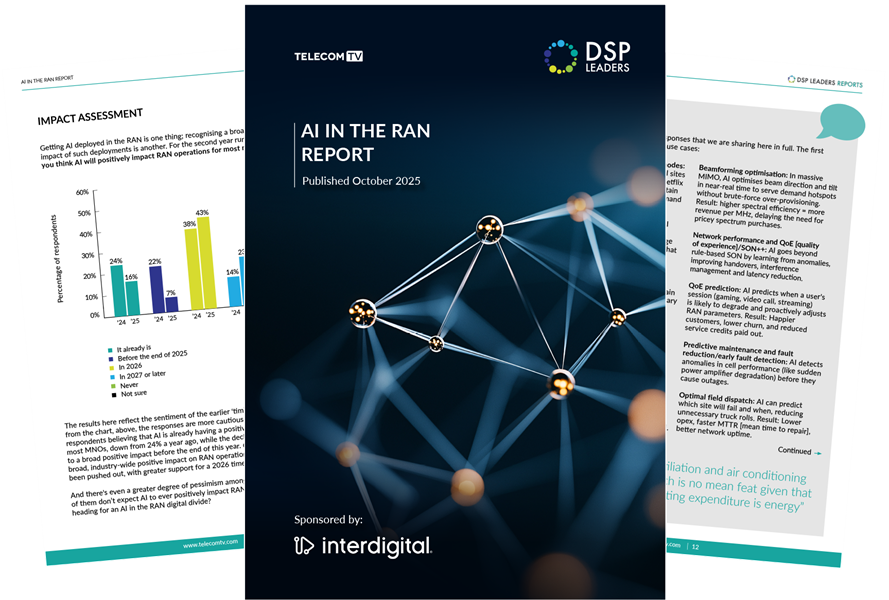
The AI in the RAN Report is a 24-page editorial publication that provides insights for the whole industry into how mobile network operators are thinking about using artificial intelligence (AI) tools in their day-to-day operations and, indeed, how they are already doing so.
The report is based on the results of a survey conducted with mobile network operator (MNO) executives during September and early October 2025. We received responses from 44 qualified respondents who work at MNOs across Asia, Europe, Africa and the Americas. The respondents range from the very top level of decision-makers through to network operations team members, with about a third holding CXO (CEO, CTO, CTIO etc) or director job titles.
For the second year running, we sought their views on how, when and why they plan to use AI in the RAN and asked them to share specific insights into the ways in which MNOs can benefit from AI deployments. We also asked a set of new questions related to the impact of AI traffic on the RAN and how AI should fit into 6G standards considerations.
This free report will tell you:
- How MNOs are approaching the use of AI in the RAN
- When they expect AI to have a positive impact on operations
- What MNOs are thinking about AI skills, procurement and the impact of AI on their networks, and how AI should be addressed by the 6G standards bodies.