- TAFS deploys Ciena in trans-Americas network
- Salt Typhoon spotted in European telco
- Scots develop Open RAN system for remote medical procedures
In today’s industry news roundup: Ciena gear to be deployed in new subsea network that connects Central America and the Caribbean to the US; Darktrace suggests the Salt Typhoon hacking group has breached a European telco; Open RAN tech could soon enable remote dentistry; and more!
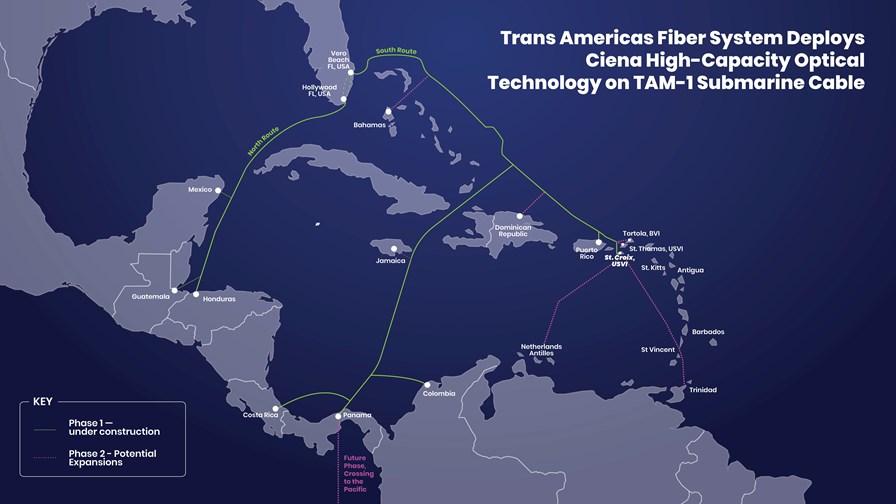
Trans Americas Fiber System (TAFS) has selected a couple of Ciena’s optical transport systems – the GeoMesh Extreme and 6500 Reconfigurable Line System – to light portions of its new “trans-Americas” 7,200km TAM-1 subsea cable system. The submarine network will connect Central America and the Caribbean directly to the US, with landing points in Florida, Puerto Rico, the US Virgin Islands, Colombia, Costa Rica, Guatemala, Honduras, Mexico and Panama (see map above). It has been designed with a total system capacity of more than 650 Tbit/s across 24 fibre pairs southbound and 12 northbound. The TAM-1 system features two diverse subsea routes and, according to this press release from Ciena, features a “programmable and automated design,” making it “purpose-built to support the bandwidth needs of AI, cloud, 5G, edge computing, streaming and enterprise services – representing a massive leap forward compared to legacy systems currently operating in the region.” The northern route of TAM-1 will be ready for service before the end of 2025, followed by the southern route in the first quarter of 2026. Xtera is deploying the network for TAM-1 and AT&T is the anchor tenant for the cable as well as the landing station partner in all US jurisdictions.
Cambridge, UK-based cybersecurity specialist Darktrace has warned in a recently published blog that the dangerous, determined and devious Chinese state-sponsored hacking group, Salt Typhoon, classed globally as an advanced persistent threat after successfully breaching multiple telco networks in North America, is also extremely active in Europe. Indeed, Darktrace says it has evidence that Salt Typhoon has attacked and gained access to data belonging to a major but, as yet, un-named European telco. Darktrace adds that it has “observed activity in a European telecommunications organisation consistent with Salt Typhoon’s known tactics, techniques and procedures, including dynamic-link library (DLL) sideloading and abuse of legitimate software for stealth and execution.” That is not good news. Apparently, the incursion was first effected back in July this year when “bad actors” exploited a vulnerability in a Citrix NetScaler Gateway appliance. Thereafter, problems multiplied via a Citrix Virtual Delivery Agent (VDA) in the client’s Machine Creation Services (MCS) subnet. The methodology used, and “patterns of activity observed”, are typical of a Salt Typhoon attack and the group’s virtual fingerprints are everywhere. Darktrace says Salt Typhoon has “advanced capabilities” where the exploitation of edge devices is concerned and has shown “deep persistence” in “exfiltrating sensitive data across more than 80 countries.” The group has targeted telecom operators, government departments, highly secure communications networks and technology companies the world over. Salt Typhoon’s attacks are carried out with levels of strategic rigour that point to Chinese state involvement and it is believed that in some cases the group steals sensitive intelligence data more or less to the order of the politburo, although the Chinese government denies it has any connections to the group. It is no coincidence that Salt Typhoon is actively building a mythology around itself as a remorseless outfit able to worm its way into almost any organisation it targets, building its geopolitical influence as it does so. Salt Typhoon is a prime example of the creeping reach of the tentacles of nation state-sponsored cyber-criminal groups and that proactive defensive strategies are needed immediately to counter an ever-growing threat. Darktrace claims its technology learns a company’s “particular pattern of life” to identify and automatically neutralise novel and in-progress attacks with minimal disruption. The platform supports the entire security lifecycle, from proactively identifying weak points and preventing attacks to autonomously containing them and helping companies to recover from them.
A team of scientists at the University of Glasgow’s James Watt School of Engineering in Scotland have used cheap, off-the-shelf hardware to build an Open RAN-based 4G network that connects a haptic controller to a robot arm. The system permits users to direct and manipulate movement of the arm in “near-real time” with extremely low latency that enables a very high level of delicate control. It is hoped that, in due course, affordable, open-source mobile networks can be further developed to enable remote medical procedures and operations. A paper detailing the team’s efforts, Development of Open Radio Access Networks (O-RAN) for Real-time Robotic Teleoperation, is published in the latest edition of the academic journal Communications Engineering. The new system was demonstrated as a mock dental examination on a set of false teeth (presumably to ensure there would be no unseemly whimpering from a live volunteer). The team “repurposed” a USB network dongle to provide stable connections between the haptic input device, the robotic arm and a computer configured as an intelligent base station. Tests in the laboratory environment demonstrated communications between the base station, the controller and the robotic arm at a bandwidth of 10Mbit/s, with a latency of less than a second and with minimal signal loss. The repurposed dongle permitted the team to create a network that used considerably less power than comparable connections using software-defined radio (SDRs), which are more commonly used in similar tasks. The network devised by the team from the University of Glasgow drew down power of just 4.5 watts, a 90% reduction on the 45 watts required by traditional SDRs to perform the same activities. The paper’s first author, Dr Saber Hassouna, of the James Watt School of Engineering, noted: “The O-RAN [Open RAN] framework holds a great deal of potential for enabling intelligent, data-driven, programmable and virtualised networks, but a significant amount of work remains to be done to demonstrate that potential being achieved in the real world, beyond theoretical modelling. The testbed we’ve developed here using commercially available hardware shows that O-RAN can be used to enable excellent performance in robotic teleoperation, which is a complex task. For applications like dental procedures, the robotic arm must move very smoothly, which requires high data throughput and low latency, both of which we’ve been able to achieve for the first time with O-RAN.” Professor Qammer Abbasi, head of the University of Glasgow’s Communications, Sensing and Imaging Hub, added: “This is a very encouraging demonstration of the potential of O-RAN to enable fine-grained, close to real-time control of a robotic arm. The paper showcases the performance we’ve been able to deliver in a single room with a direct line of sight between the base station and the arm, and we’re currently working on developing the system further to ensure it can deliver the same level of performance at greater distances. Ultimately, this could be a step towards creating reliable, affordable methods of performing complex tasks remotely, opening up new applications in medicine, automation, industry and beyond.” Meanwhile, Professor Muhammad Imran, head of the James Watt School of Engineering said: “The Internet of Skills [That’s a new one! Ed.] is now one step closer with the advent of low-latency, high-reliability communication links. With Open RAN making these technologies more affordable and accessible, I’m proud that our team is helping to lay the foundation for truly inclusive digital accessibility for all.”
MásOrange and Vodafone Spain, which is now owned by Zegona Communications following last May’s €5bn acquisition, are believed to be the frontrunners to acquire Spanish altnet Excom, according to Bloomberg. Exacom, which provides broadband and mobile services in small towns (fewer than 50,000 inhabitants) that are not well served by the country’s biggest telcos, is valued at about €150m.
A reminder, as if we needed one, that security threats are on the rise comes from UK operator Virgin Media O2. It notes in this press release that “phishing attempts have become one of the UK’s most common cyber scams,” and notes that its security partner, Akamai, recorded 232,365 new phishing threat entries to its threat intelligence feeds during the April-to-June quarter this year, up a staggering 285% from the 60,433 new phishing threat entries recorded during the same period a year earlier.
– The staff, TelecomTV
Email Newsletters
Sign up to receive TelecomTV's top news and videos, plus exclusive subscriber-only content direct to your inbox.