Trends in Telco AI Infrastructure: A DSP Leaders Report insights discussion

By Sean McManus
Jul 31, 2025
To embed our video on your website copy and paste the code below:
<iframe src="https://www.youtube.com/embed/2LtuyppZqSg?modestbranding=1&rel=0" width="970" height="546" frameborder="0" scrolling="auto" allowfullscreen></iframe>
Hello and welcome to TelecomTV. I'm Sean McManus, and today I'm hosting a panel discussion about trends in telco AI infrastructure. Inspired by our latest DSP leaders publication, the report examines the impact that the AI boom is having on network IT financial and strategic decision-making for telecom operators. It uses survey data gleaned from our previous DSP leaders, reports, publications, as well as interviews with industry executives. This comprehensive research is free to you as a registered viewer of Telecom tv. You can find the link below. This video registration for telecom TV is also free, so if you're not yet registered, please do go ahead and join our community. We'd love to welcome you. Joining me today to discuss the reports are Manish Singh, CTO Telecom Systems Business at Dell Technologies. Kanika Atri, Senior Director for Telco marketing at NVIDIA. And Grant Lenahan, partner and principal analyst at Appledore Research.
(01:26):
Thank you all for joining me today to discuss the trends you are seeing in telco AI infrastructure. First of all, there's been a lot of buzz in the telco industry in the last couple of years around AI factories. So let's start by defining them. In our reports, we describe an AI factory as a data center facility optimized for AI workloads, from data ingestion to training fine tuning and AI inference. Does this apply to all telco AI factories and does the Dell AI factory with NVIDIA architecture shown here give us a good overview of such a facility, Manish, as our Dell representative? Let's start with you.
Manish Singh, Dell Technologies (02:10):
First of all, thank you for having me. Truly a pleasure to be here, the Dell AI factory with NVIDIA. To really talk about that, let's first of all start with what a usual factory is. Raw materials in finished goods out in the case of an AI factory, the raw material in is the data. So first of all, within the data, there's a whole body of work that needs to be done to really get the data prepped, curated, build the data, pipelines, most importantly, break the data silos and more then when we think about the AI factory inside the factory floor, and think of it as a three is the infrastructure and what goes on that infrastructure is GPUs, CPUs, you have networking, storage, cooling, power and more. And so really getting that architecture right for the infrastructure that sits inside their factory floor. The next layer up inside the AI factory, think of it as an open ecosystem where we're bringing in the models, the use cases, we're bringing in agents, agent workflows and more.
(03:32):
And then the third layer up is where we bring in a set of services to really help the telcos build these AI factories and operationalize them. So that's what sits inside the factory floor, but most importantly, what comes out and when we think about that, think about tokens, think about intelligence, think about use cases, and most importantly, think about business outcomes. So in a nutshell, an AI factory data in tokens, intelligence use case business outcomes out inside the factory floor. You have the infrastructure, you have an open ecosystem for all the models, the different use cases, and then a set of services that we built on top of these to again, help our customers operationalize and deploy and operationalize their AI factories.
Sean McManus, TelecomTV (04:31):
Thank you. Manish, it's interesting to think of this term AI factory literally in industrial terms in terms of input and output and the genesis of that term. Kanika, what can you add here from NVIDIA's point of view?
Kanika Atri, NVIDIA (04:43):
Yeah, I think first of all, thank you very much for having me on the panel. It's a pleasure. And Manish put it really well. Factories, they manufacture intelligence. A few years ago we used to say data is the new currency and now we say intelligence is the new currency, and AI factories are the entire suite of systems, software services that actually deliver that intelligence. So it's a very full stack operation and I think over the years as we passed by the cloud era, all those principles of how do you actually do multi-tenancy, have multiple workloads running and make it consumable off the shelf? The AI factory also embodies those key ideas. In fact, we think of from the point of setting up to actually selling the outcomes, that time to market is really, really short because we think of this as a full stack implementation that is helping many of the telcos around the world get started with this new kind of business.
Sean McManus, TelecomTV (06:02):
Thank you, Kanika. Interesting to think how far we have come and how quickly that now we think of intelligence as a currency already. Finally, Grant, let's hear your thoughts on AI factories.
Grant Lenahan, Appledore Research (06:14):
Well first of all, thanks for having me on as well. I'm really enjoying being part of this. I think the two other panelists have done a really good job of explaining what an AI factory is, why it's an important thing. What I'd like to focus on is the market for infrastructure providers of various stripes and what that opportunity is for them. I think it's important in the case of telcos to separate whether there's an opportunity for someone versus whether there's an opportunity that they're in a good position to capture. I think the answer to the first part is yes, there is an opportunity. The answer to the second part's, a little sketchier in that telcos have not typically been very fast movers into non-network capabilities in the past. The data center and the cloud opportunities largely pass them by. So I think the question they need to ask is what are the trends that make their assets and their strengths really valuable? And I think the fact that networks are very distributed, they're distributed to the edge throughout geography and that they have that network component are the two things that are really important for them to be able to leverage. So that says, the more decentralized AI factories become and the more edge oriented they become, the better the competitive the position for telcos.
Sean McManus, TelecomTV (07:42):
Thank you. I guess that means that in some cases telcos are in a really, really strong position because they do have that decentralized architecture that a few others can compete with. Now we know what AI factories are. Let's discuss why more and more telcos are investing in them, is the increasing demand for sovereign cloud and AI services the key driver Grant, could you start us off on this question please?
Grant Lenahan, Appledore Research (08:05):
I think the real reason that they're looking at them is their geographic distribution does do several things for the market. First of all, as you noted, sovereignty is very important, often driven by regulation and particularly to the degree that inferencing and training on data that is associated with users in an area is important. Anyone who can keep closely associated data in that area is going to have an advantage. Also, back to my comments earlier, if you think about competitive advantage, typically the hyperscalers and others do really well when you can have a small number of really gigantic facilities. They struggle more as the facilities become more numerous and somewhat smaller and they start looking much more a telco footprint. So I think once again, as we start looking at inferencing, as we look at sovereignty, as we look at regulation, telcos may be very good partners to technology firms in particular, which is I think exactly what Dell NVIDIA are planning on.
Sean McManus, TelecomTV (09:16):
Thank you. Grant. Seems like there's a potential win-win here for the telco companies and the tech giants to start working together on this. Kenika, what trends are you seeing in telcos deploying AI factories? And in addition, let me ask you to what degree you are seeing your partners setting up distributed factories as opposed to centralized ones?
Kanika Atri, NVIDIA (09:36):
Great. I mean, I'm absolutely thrilled with the momentum that I'm seeing in sovereign AI factories. Just recently I published a blog on behalf of NVIDIA capturing 18 telcos around the world, across five continents who built sovereign AI factories. And literally two weeks after I published that, we were at GTC Paris where we announced three more. So the count is literally increasing literally in last 18 months. Almost every month we are hearing a telco announcing a sovereign AI factory serving nation, their particular country serving enterprises there is. So this is more than a one-off trend. We are seeing it everywhere. There's lots more in the pipeline and it's very exciting. A few things I want to call out as I'm watching this front end row, first seat in the house, one, the pace at which the telcos is moving is incredible. Often we've seen that the time between the first dialogue and the actual live deployment is less than a year.
(10:46):
And typically we've known the narratives in our industry that telcos are slow. I mean, I'm not believing that when it comes to sovereign AI factories. Secondly, what I'm seeing as a big trend is many of them are introducing sort of supporting brands. So they are creating subsidiaries that are focused on selling these AI services. So that's very exciting and these are complimentary brands to their connectivity, and that's one way of obviously being more successful in positioning, creating a new position in the market as an AI service provider, not just a connectivity service provider. So that's the second trend I'm noticing. The third trend that I'm seeing is the telcos are going beyond the GPU as a service. That is not their vision, that is the starting point. But pretty much each of these telcos that we've worked with, they are looking to sell AI as a service, right?
(11:50):
Recently in Europe, exciting telco without of course naming some of these, they launched an AI studio service for the enterprises wherein the enterprises could come and bring their data and use an existing model and customize it. And the entire thing was beautifully packaged such that within days the enterprise could realize the outcomes that Manisha talked about. So telcos are positioning themselves really above this GPU as a service model. Their goal is to go higher up in the value chain. And then to your question about distributed, we're hearing this vision or what we are terming as AI grid. And what that means is it's a collection of few centralized mega factories that are really good at running training, massive training workloads, and then complimented by smaller edge AI factories that are distributed through existing locations that telcos enjoy. And collectively it forms an AI grid and there is a way to actually share workloads across these two.
(13:10):
Plenty of technologies exist around there, and that's a huge benefit and something that only telcos can uniquely do versus many other providers of AI solutions. And one last thing I'm going to just make to your initial question about demand, let me say it and ask many words. The demand is unsatiable. The way we are seeing it, it's underserved. We've seen the emergence of neo clouds in addition to the hyperscalers. We are seeing neo clouds, they've been massively successful, and now we are seeing this third category of AI service provider, which are the telcos, and there's enough demand for all of them to uptake. We're seeing the existing telcos who started a year ago already expanding capacities. So as every industry is undergoing a massive AI intelligence revolution, the demand is only growing and this is the right time for telcos and the right full role of telcos to partake in this revolution.
Sean McManus, TelecomTV (14:25):
Thank you, Kanika. It seems like there's such an extra ordinary opportunity here. The telcos are really keen to capitalize on that. And moving really quickly to do so, Manish, tell us a bit about your view on why telcos are investing in AI factories.
Manish Singh, Dell Technologies (14:40):
Right. I'll just start as I did previously with data, and when we think about data, we know data has gravity, data also has security and privacy requirements and more and more and more need for data sovereignty. And this is all creating tailwinds for sovereign AI factories. Now, telcos in many markets are very uniquely to offer these services. Telcos today are the trusted service provider for connectivity and building further on that to start offering AI services on top of it. Second thing I want to touch on is power. We need to power these AI factories and in many markets have the advantage to really tap into the sovereign power infrastructures within those markets. And again, take advantage of that. In terms of offering these services, I do agree with Kanika and this is what we are seeing as well. The telcos are not only just offering GPU as a service, rather they're bringing in their own local language models.
(15:58):
And the word local here is really important because language is culture nuance context and more. And so telcos bringing local language models and offering them. And then last but not the least, let's touch a little bit about edge. We know that more and more of that data is going to get created out and about in the real world, in the physical world, and telcos have this priceless real estate called the Edge. Now we know AI is going to be everywhere. It's going to be on the devices. You'll have AI, pc, AI on the edge, you'll have hyper mega scale AI factories for training for inferencing and more. And the point being, as AI continues to get more and more adopted, we're going to see the need for more distributed infrastructure. And telcos, again, are very uniquely positioned to really take advantage of their edge and bring AI closer to the data sources, to the real world to where more and more of the data is going to be created and do that while delivering data security, data privacy, data sovereignty and more. And B, the trusted provider in markets to serve.
Sean McManus, TelecomTV (17:20):
Thank you Manishh. I think AI is clearly going to be a massive opportunity, but I was also interested to hear you talk about trusted providers there because given how sensitive some of this data is, trusted AI providers are going to be absolutely essential. Now let's talk about the money. Do these investments actually make sense? Can AI factories be a driver for profitable new services for telcos? A telecom TV survey conducted earlier this year suggests there is some optimism about the business of telco AI factories. 54% of respondents said yes, this is a strong business opportunity for telcos. Grant, let me ask you, did these investments make sense?
Grant Lenahan, Appledore Research (18:02):
Well, the first thing I'd like to say is it's rare to get a second chance in life, and if we look back 10, 15 years, the telcos in some ways missed the data center and some of the cloud opportunities. And yet I think there's a real key fact that we can take out of that. If we look at this from sort of competitive advantage 101, telcos are generally regional businesses. Many data center and cloud opportunities have been global businesses. That puts telcos at a disadvantage when there is a single large global market to be addressed. That's where the Googles and others do very, very well. And yet when you start thinking about AI, I think we're going to start looking at as Manish has pointed out things that are more, first of all, regionalized than nationalized and then edified telcos, if you look back, where have they been really successful?
(19:09):
The closer you can get to associating something with their basic asset, which is real estate right of way and transport networking, the more successful they've been, the big success that they have had recently and is growing for telcos is security. If you start thinking about a lot of the discussion about why sovereignty, why trusted providers that both Ian and Kanika were just talking about and think about the telco's success recently in security with SSI and sd-wan. And even if you look at what's going on in the meth, the secure transport services, there could be sort of a triple here with transport, with distributed AI and with security and back to the competitive advantage 1 0 1 where they can bring security that others can can't or bring it more elegantly and where the need is for regional or even localized AI processing in a factory, suddenly the competitive advantage works in their advantage not to their disadvantage. So I think there is an opportunity here, but once again, I think telcos need to be very surgical, look at it carefully and say, where do I get my greatest advantage? And let me focus on maximizing what I deliver in those areas and focusing like a laser on those segments of the market.
Sean McManus, TelecomTV (20:42):
Thank you Grant. Interesting that by being hyper-local they can really take on these global giants in AI. Let's move across to Kanika now. What's your view? Could AI factories be profitable for telcos?
Kanika Atri, NVIDIA (20:54):
I think it's a no-brainer, Sean, of course many telcos have not published numbers yet. It's kind of early to share any quantified business metrics and impact. But of course we've seen through a lot of surveys that they are indicating that this is a big driver of growth to me. The other indicator is are they actually expanding their initial deployments and pretty much all of them who are now in phase two are expanding. The third indicator for me is to see the diversity of use cases. What is it that they're building with it? And I'd like to take a few examples to give some color. There is a exciting telco who built large language models for their nation, not one, but at least tens of them who are doing that. And Manish gave that great example. Another great example I saw was in healthcare, tying up with healthcare and creating services like proactively calling women for health checkups and using AI to build those profiles of who they should be reaching out and so on.
(22:18):
Absolutely exciting to see that we saw applications even in the judicial systems where how the citizen services judiciary services are completely improved with AI and these are use cases that they are building for the nations. So we are seeing different kinds of users for this AI factory that telcos are targeting. They are not just the model builders, but there are also lots of enterprises specific verticals. They are nations. And then the bigger other piece that we are going to see come through to telcos is as these reasoning models become all pervasive, we all know that a reasoning model as compared to a general LLM, could probably take 2050 x more tokens sometimes and accordingly, more compute. And that's where also the overall experience and being very, very close to where that data is and where the user is, where the application is, makes a huge difference.
(23:20):
So we are seeing all of that also come through and hitting the workloads on these AI factories. And all in all, we definitely see that it's a no-brainer and it's something that, like Grant said, it's a second opportunity to be part of the AI value chain and that value chain is going to touch every industry, the customers that telcos already serve today, the enterprises, in fact, even there's a middle segment if you park the super extra large enterprises for a minute and they may be building their own AI factories, but there is a whole middle in between who's waiting for the telcos to help them out. And that demand is there in every industry and telcos are already offering connectivity to these very small medium enterprises and now AI is a plus one for all of them. So in my mind it's a no-brainer. We should definitely watch this space and hopefully there'll be more numbers that'll come through as more and more telcos join this renaissance.
Sean McManus, TelecomTV (24:37):
Thank you. It would definitely be interesting to see what kind of numbers they're able to publish and how soon they can do that. What's your thinking? Should telcos be investing in AI factories?
Manish Singh, Dell Technologies (24:47):
Yeah, there's absolutely no doubt in my mind that telcos have to adopt AI first and foremost for their own businesses to deliver better customer care, to build autonomous networks and get started on that journey. And it's not that they should, they must have to actually are already doing. We are seeing number of telcos who are building these capabilities. They're building their AI factories, first of all for their own use cases, for their own consumption, be it on the autonomous network side from network planning, installed commissioning, field technician support, and more really building and enabling those use cases or for that matter, deliver better customer care, billing care and more. So this is happening now as they do, it's not just about technology. These telcos are also building process people skill. It's a holistic transformation that they have to go through and they are on that journey.
(25:57):
Once you're on that journey, then that creates the opportunity that while you're building all these capabilities for yourself, how do you package that and bring it to customers in your markets? And the other piece probably I would want to touch on is the connectivity piece. They're already telcos today are the connectivity providers in their markets. I would take a point that Grant earlier made around offering connectivity services. Now think about that. Take SD WAN as a case as SDWAN. SE telcos today already are offering these services and delivering them to the enterprises to small medium businesses and more. Now if you think about from the enterprise perspective, small medium business perspective, there's a lot of data that's getting generated within those environments and the enterprise would want to unlock the value of that data not to forget again, that data will come with its own privacy, security, sovereignty and all other requirements.
(27:08):
And so this creates the opportunity for telcos to not only provide connectivity but also enable the enterprises, the small medium businesses to truly unlock the value of that data on the edge many a times in enterprise locations and prepare connectivity and AI services together. So if I sum it up, I mean clearly telcos have to do this. They are doing this, they're doing it for their own use cases, for autonomous networks, for customer care and more really derive the productivity gains and efficiencies that AI is offering, derive that for their own telco business and then package these and offer them also to the customers enterprises and more and in many cases even pair them with the existing connectivity services that they're offering.
Sean McManus, TelecomTV (28:05):
Thank you. And particularly therefore reminding us of the other side of the equation. We often talk about revenue generation but obviously profits also involve lowering costs and that can also be really important for telcos as they seek every efficiency they can find nowadays. Now let's talk about the radio access network. What is the future for AI related compute and storage? In the RAN a survey from earlier this year found that 24% of telcos believe now is the time to invest in AI RAN. While 52% say maybe in a few years time when cloud RAN and virtual RAN are more mature, only 8% said AI RAN was not an optimal architecture for mobile network operators. Manishh, let's start with you for this one. Will the AI RAN alliance model gain traction with many operators over time do you think?
Manish Singh, Dell Technologies (28:59):
Yeah, let me just start with what we've already talked about is the edge and we know edge is the closest we get to the real world, the physical world where most of the data is going to get created and when we think about the radio access network, the cell sites, we know that's a distributed infrastructure citywide nationwide providing these edge locations. So that's the starting point. Now what are you going to do on these edge locations? Mostly I would say you would be doing a lot more inferencing for the data that's getting created out and about in the physical world, but there's also opportunity to do federated learning, especially for data streams have high privacy and security constraints around that where you might not be even able to send that data upstream into the cloud, but you can learn from that data in a distributed environment and do federated learning.
(29:55):
But then when we talk about AI RAN the two parts to this, right, so part A is AI in the radio access network and then AI on the radio access network. I think when we think about AI in the radio access network, it's very clear that it's a very rich environment to apply AI and across the stack whether we are thinking from layer one signal processing and in there, whether it's channel estimation, link adaptation management and more even in layer two, better scheduling opportunities and for that matter with the RAN intelligent controller, the R and the SO architectural pieces that have already fallen in place with open RAN. Then bringing AI agents, be it near real time or non real time and these are all things that are already happening even for that matter RAN operations. So whether it's for RAN optimization and more, as I said, it's a rich environment to apply AI and this is going to happen, then the question is of AI on the RAN and I touched on it in terms of inferencing and maybe even federated learning in certain cases and bringing AI closer to the data.
(31:27):
But I think I would also want to touch on some of the learnings that we all have had as an industry with open RAN and what did we learn. We obviously know that large part of these radio access networks are distributed, they're not centralized and in those cases when we look at the cell site at the bottom of the tower, there are a number of constraints. You have space, power, cooling constraints, those constraints are not going away. And so when we think about bringing AI in those environments, we have to solve for power cooling space to again enable that. And then radio access network in the world of a wireless network is one of the most cost sensitive areas and TCO comes into play. And so how do we balance the cost and what the revenue generation opportunity would be? I think that's the area of opportunity that we have to work together as an industry and go solve for. So yes, we can do inferencing, yes, we can do federated learning, but there are constraints as well in terms of power cooling space and cost and we need to find that right balance as we move forward on AI RAN.
Sean McManus, TelecomTV (32:42):
Thanks Manishh. Very interesting points and in particular the constraints I think are going to be the puzzle that telcos are going to have to solve if they're really going to make a success of this. Let's hear from Grant on this next. What do you think will operators adopt the AI RAN alliance model?
Grant Lenahan, Appledore Research (32:58):
Well, I'd like to actually, rather than look at the AI RAN alliance, I'd like to look at the fundamentals of the market and how that plays into it, right? And I'd like to go back building on what Manish was just talking about to the competitive advantages that telcos do in some areas and don't in other areas have. It is clear that as they get out into the ran and the RAN as it cloudify is going to be segregated with things out at towers, things at aggregation points, things that further aggregation points that can be leveraged, that is where telcos can have a real advantage. The problem is they are being cautious at the moment, they're being cautious because the market for that sort of distributed edge inferencing has not matured yet. Telcos are telcos. They are rewarded for being highly reliable, highly predictable, not necessarily rewarded for taking moonshots.
(33:59):
Manish also brought up some of the practical issues, the tremendous opportunity of synergy between AI infrastructure used for the ran that can also be offered on a service basis and the synergy with IT infrastructure that can be shared between the RAN and AI distributed factories. And yet this is an area where the telcos are trying to make two major changes at once. In the one case they're looking at how do I capitalize on AI and AI as a service? And at the same time they're honestly trying to figure out how to deploy Cloudified ran. So let's put aside open ran, which is a separate issue, but we're really talking about where we get to Cloudified rans where there are Dell servers and NVIDIA chips out there being used for layer one processing as well as internal RAN uses. And while those are performing well and I think there is a desire to move to those architectures, the reality is that today the levels of automation in CICD, et cetera are nowhere near as good in Cloudified Rams as they are in proprietary appliance-based rams and all the major telcos are working on this, all the major suppliers are working on this.
(35:26):
In fact, we just published on it. You can find that on our website using GI UPS and CICD as keywords. But this is a set of moving parts that are being dealt with right now, I believe as volume clarification as the RAN occurs and as we get more clarity about the inferencing loads, how they're geographically distributed, this will be a great opportunity. But I think the chart and the data that you collected really says it all. There is a caution. I think most companies believe there is an opportunity here and they want to be part of it, but they want to be part of it in a successful way with the right timing and the right investment, the right scale, et cetera.
Sean McManus, TelecomTV (36:11):
Let's come next to Kanika who is a member of the AI Ran Alliance. Is there anything you want to add about operators adopting the AI Ran Alliance model?
Kanika Atri, NVIDIA (36:20):
Absolutely. First of all, I'm very thrilled to share that recently we crossed a hundred members of the AI Ran Alliance and that's in little over than one year of being formed. So I mean this is really a movement and if you actually look at the number of other ecosystem partners, even telcos who are in the queue, we are ourselves really, really thrilled by this momentum in the a r alliance community. The amount of progress that has happened in the last one year, be it on the technology maturity, be it on the economics, be it on the sustainability angle, be it on the applications side of the house, even field trials, I mean I'm actually really blown away with that progress. We recently published together with SoftBank, who's also a founding member of the AI RAN Alliance results from a field trial where we talked about monetization.
(37:30):
We estimate that to be in the range of five x the revenue per dollar of CapEx. We publish numbers around utilization. Current networks today are one third utilized. So the remaining two thirds is sort of building to capacity but not using it with AI ran, you are fully utilizing that. So up to three x better utilization, energy efficiency, the per wat numbers, they're now almost comparable, better in some cases even far better than custom ASIC based solutions. And then of course the performance things like orchestration, some of the skeptics really have few questions like, oh, does it work in a distributed ran scenario just in May we showcase solutions for distributed rat where you can have a very lean low power AI ran solution with A GPU and A CPU to do full ransack plus a little bit of edge AI at a cell site, which is outdoor capable, which is small form factor and so on so forth.
(38:52):
So is the D Run problem solved? Absolutely. Then they ask the question, oh, can the two workloads really be shared? Isn't there an inherent risk? Then again, a lot of progress made on orchestration, right? Then people ask the question about, okay, where is the demand on the edge? And again, I keep coming back to that core point. We probably anybody who tries to estimate what will be the amount of AI inferencing traffic is going to be wrong at this point, I don't think anybody knows. And to me it's mind blowing to see how these reasoning models and how much are compute and inferencing and tokens that they need and now we are going to see them embedded into pretty much every application across every industry. So the networks have to be AI native. There is no way for A-C-P-U-X 86 ASIC kind of system to service that AI traffic.
(39:56):
There has to be something different. AI ran as a technology is very promising. The ecosystem and the overall maturity is sort of growing at a fast pace. That said, I do understand that because this changes so fast, there is still a cautious optimism and I would like to approach it from the operational angle. I think there are many questions on the operational side. How would this really get rolled out? How would this be managed? Like Grant said, the entire autonomous operations stack using a Gentech AI that is work in progress. So those pieces have to come together for all of this to become ready for deployment. However, I have no doubt that this is going to be the foundation also for six G, six G will be AI native. A lot of work, particularly even things like AI for ran. We've seen breakthrough demos even at MWC 2025 and through this year, like I said, I have a front row seat to some of these cool, exciting things that are happening. So I have no doubt in my mind that the industry is paying attention is working really fast and it'll be of course a little bit time till it becomes mass. But we do believe this is the right architecture for the future.
Sean McManus, TelecomTV (41:24):
Thank you Kanika. It will be interesting to see how six G and AI develop together and feed off each other to create a joint opportunity. Now we've spoken about telcos using AI within their own infrastructure, but let's now discuss the role that telcos play as enablers of the wider economy. How important are accelerated and new investments in data center connectivity for the success of all companies engaged in the AI ecosystem? Could this be the really big growth opportunity for Telcos? Grant, would you like to start us off?
Grant Lenahan, Appledore Research (41:59):
Simple answer, yes. I like the way that's framed. So telcos, their biggest asset is in fact their transport networks, their ability to give a shared resource that performs well, that reaches everywhere that has high bandwidth, that's highly reliable. And yet AI is doing a couple of things which could be scary if you look at it as a challenge, but I'd rather look at it as a market opportunity. It's increasing fundamentally demand and it is also increasing the demand for quality, which typically means you're going to be more selective in who your suppliers are. So I think that telcos need to really jump on this and say, how do I capture more and more of the transport between AI data centers, more transport into inferencing, whether it's at the edge or at more of the near and far edge areas. And one of the things I want to talk about is we're not just talking about the volume of networking.
(43:01):
I'm not saying let's just make bigger pipes as they exist. If you look at some of the carriers, the leading carriers that are trying to capitalize on fourth industrial revolution AI and lots of the changes that we're seeing in how industry works, they're saying we need to start rethinking the architecture of our network. Certainly we need it to be more intelligent, more controllable, more switchable, more on demand, but it also needs to have fewer constriction points to give lower latency, the ability to go more point to point, the ability to think about data centers as the hubs as opposed to traditional geographically based hubs that were based on where central offices were. I mean we've seen talks from Lumen on this topic. We've seen talks from Verizon on this topic and how they're rethinking where their paths and where their hubs and spokes go. I do think that the bottom line is it's a large market opportunity regardless of what their role in the actual AI factory is. I think when you combine, when the strength of networks with the decentralization of AI, the network suddenly becomes an opportunity for telcos to succeed in the AI factory as well. So it's probably a stepping stone to the broader opportunity.
Sean McManus, TelecomTV (44:35):
Kanika, let's come across to you on this. How important are investments in data center connectivity for the success of all companies engaged in the AI ecosystem?
Kanika Atri, NVIDIA (44:47):
Absolutely. More AI players means they all need more connectivity and this is one of the bread and butter businesses for telcos. They're the ones who got feet on the ground, they're there in every corner of the world laying fiber. This is what they do. To me, this is business as usual and they should sort of lean all in and take it in with both hands. This is again, one of those no-brainer opportunities, something that they're already very good at and I believe that this is going to keep growing as more and more AI service providers, infra providers, set up shop across the globe.
Sean McManus, TelecomTV (45:34):
Thank you very much. Now let's finish by looking into the crystal ball. What developments do you expect to see in telco AI infrastructure during the next year or two? Manishh, let's start with you.
Manish Singh, Dell Technologies (45:47):
Oh, that's a tough question. Crystal balling on AI, a technology that is already moving at such a fast pace, but here's some thoughts, right? I mean if you just go back to that AI factory, start from the infrastructure layer as well. Number of things there, I expect we'll continue to see more scale up and more capabilities building in there within the compute, the networking, the storage and within the infrastructure also more move towards liquid cooling. So we continue to improve the energy efficiency, the PUE, that's going to continue to make progress and we expect to see more and more deployments and adoption of that going up in the layer of models. Clearly advancements in models, think about the AI scaling laws. These are empirical laws, but we haven't seen any slowdown. So the models I expect will continue to improve. Kanika talked about the rise of the reasoning models.
(47:01):
We should expect that that even richer better reasoning capabilities. They will continue to build in here. But then talk about the outcomes from the AI factory, the tokens, the intelligence, the use cases, and in particular there I think for the telcos, I expect them to continue to make big strides both on autonomous networks and customer. We have talked about autonomous networks in this industry forever, but this is here and now it really is in grasp with AI to start the journey towards building the autonomous networks. I'm just coming back from TM forum, DTW Ignite, and it was really amazing to see the amount of catalyst projects that are working both on network automation on their journey towards autonomous networks and on customer care. And rather, I should share that we did a catalyst at TM forum along with Globe Syntel and our partners, where we actually showed the capability of applying predictive AI and generative AI for network fault detection, root cause analysis, and recommending solutions for the human in the loop and accelerate the whole network fault remediation cycle.
(48:34):
The implications, better KPIs, reduce downtime, better customer experience, taking costs out, improving efficiency and more. And it was one of the award-winning catalysts at TM forum. Really, really pleased and proud about that. But just going back to your question, clearly expect to see more progress on that. And then as far as edge, is that priceless real estate? I expect that to come into sharper focus, whether it's with the SD van, SS E, and also expect progress now to be on the AI ran, especially as six G starts to come into focus, how AI as a technology will shape and intersect with the six G. Next.
Sean McManus, TelecomTV (49:27):
Thank you. That was a great answer to an admittedly very difficult question given how fast AI is changing. But Kanika, I'm going to ask you the same thing. What do you expect to see in the next couple of years?
Kanika Atri, NVIDIA (49:37):
I'll talk about three or four things. The first one, telcos already own connectivity and like we know connectivity is going to be the fabric for delivering intelligence at scale. We're going to see telcos owning compute as well. So connectivity plus computing together. And then the third part of it is telco leaning in a lot more in developing the local application ecosystem. We're already seeing sort of a new muscle that they're developing by leveraging a lot more partnerships and creating a much more vibrant go-to market model that is less DIY, more partner. So together the ownership of connectivity, computing and applications, that investment and that new muscle together I believe will create a completely new positioning, new business opportunity for telco. So that's one big area I see is going to change in the next few years. The second one like Manishh talked about is autonomous operations.
(50:54):
I couldn't have said it better. This is the first time I feel this autonomous networks feel like they're within reach, they're really doable and the base is incredible. AgTech AI is transforming customer experience, network operations, even their own enterprise applications, be it it hr, all these workloads are going to sit on a AI native infrastructure and it's going to completely transform how the telco operates. Saving time, saving money, more people doing with less and doing more. So I think that's one big area we're going to see massive progress in a very short time. And part of this is also digital twins. I'm seeing that every year because AI agents need digital twins. Everything that they recommend, they actually simulate it and see the impact before they actually take action or allow the human to decide on a certain action. So we're going to see a lot more of autonomous networks, Gentech, ai, digital twins kind of transform the way telcos operate.
(52:03):
And then the third big area I definitely see is the rise of the AI native edge networks. This is where AI ran will be a foundational architecture, a lot more applications and then different ways in which that architecture can be realized are still meeting the first principles of a homogeneous centralized as well as distributed ran architecture fully. Software defined six G will be an upgrade software upgrade, fully cos infrastructure. So we are going to see that entire re-imagination of the wireless network. So those are my three big beliefs on how the future will shape up Fortas.
Sean McManus, TelecomTV (52:55):
Thank you Kanika, some compelling opportunities there clearly. Finally, Grant, tell us how do you see the future?
Grant Lenahan, Appledore Research (53:02):
Well, I think what I'll do is since I think both of my colleagues here have painted a very nice picture of the future and where we want to go, I'll just comment on some blocking and tackling that can hopefully get us there. The first thing, and I had mentioned it earlier, is that telcos are really looking at how do they operate cloudified rans on servers with specialty chips in them as efficiently with as much automation as they can operate existing networks. Because that isn't there the minute that occurs. They suddenly have what was Kenika was referring to, which is this synergy of the transport along with the AI data center, at least the underlying facility out in the ran and out at the edge. And I do believe that is going to happen in the timeframe you noted the next couple of years. Once that's there, you've got a foundational building block.
(54:02):
I think a second foundational building block is that we're seeing the move toward switched optical networks with a lot less optical to electrical converting. This lowers latency, it speeds throughput, it lowers costs, and it allows a lot of the really data intensive, performance intensive interconnection, both between data centers, between edges and data centers and between edges and users for inferencing. So I think that's another piece of infrastructure that's going to get there and be a building block for the vision. The third, and everyone's talked about network autonomy. As many may know that's the practice I lead within Apple Door and watch it very carefully. I do believe that autonomy is going to be important in that it is going to give telcos a lot of experience with the importance of AI and agents, which is also going to give them experience on how to be a good supplier of a multi-tenant service and of technology to others. And as we covered earlier in this panel discussion, we're not talking about GPUs as a service. We're truly talking about a platform as a service where the data, which may be more important than the models and its structuring is a critical part of it and therefore bringing a lot of experience and packaging and then tying it into the transport and security, I think is the sort of bundle that will allow telcos very likely in partnership with firms like Dell and NVIDIA and others we'll be able to bring to a wide audience.
Sean McManus, TelecomTV (55:51):
Thank you Grant. We'll keep an eye on how things develop over the next couple of years, but unfortunately we must leave it there. Thanks again to our panelists for joining us and sharing their insights on today's show. Remember to download the DSP leaders reports to find out more. It's available to all registered viewers of telecom tv and as I said earlier, registration is free when you have an account, you can access all of our videos and reports. So please do sign up. Thank you for watching and goodbye.
Please note that video transcripts are provided for reference only – content may vary from the published video or contain inaccuracies.
Panel discussion
This TelecomTV panel discussion delves into the current trends and future prospects of AI infrastructure within the telecommunications sector. Featuring insights from executives at Dell Technologies, NVIDIA, and Appledore Research, the conversation covers the concept of AI factories, the strategic importance of datacentre connectivity, and the potential profitability of AI investments for telcos. The discussion also touches upon the role of telcos in enabling the wider economy through AI and the anticipated developments in telco AI infrastructure over the next few years.
Featuring:
- Kanika Atri, Senior Director of Product Marketing for Telecom, NVIDIA
- Manish Singh, CTO, Telecom Systems Business, Dell Technologies
- Grant Lenahan, Partner and Principal Analyst, Appledore Research
Recorded July 2025
Sponsored by:


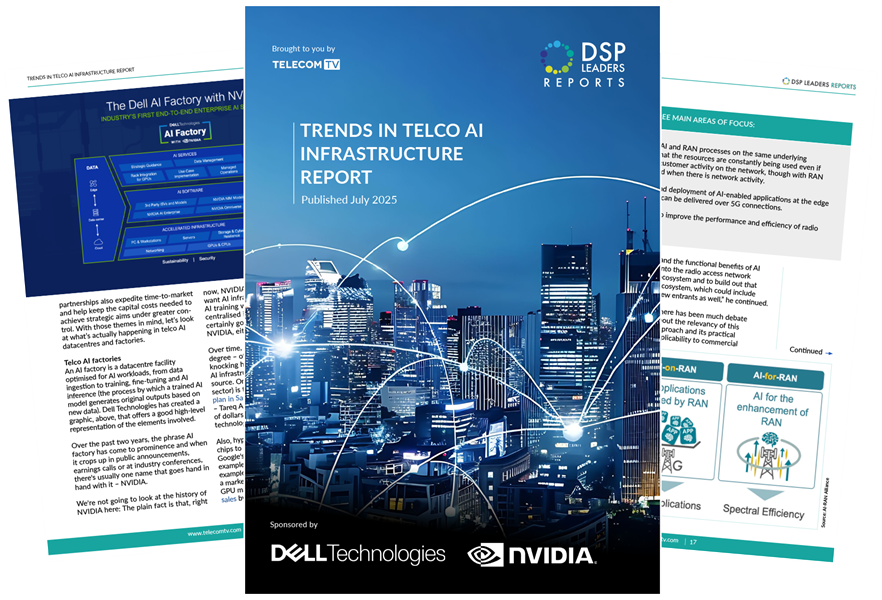
The Trends in Telco AI Infrastructure Report is a 28-page editorial publication that examines the impact that the AI boom is having on telecom operator network, IT, financial and strategic decision-making.
The report makes use of survey data gleaned from previous DSP Leaders Report publications as well as interviews with various industry executives and general industry research.
It examines some of the key trends of the past few years, including the emergence of AI factories, the potential of AI-RAN architectures and other mobile network compute options, and investments in datacentre interconnect fibre networks.
The report’s findings are presented in three main chapters:
- AI infrastructure – datacentres and AI factories
- The role of the radio access network (RAN)
- AI infrastructure – connectivity requirements.