To embed our video on your website copy and paste the code below:
<iframe src="https://www.youtube.com/embed/UiMv8sYr8Hk?modestbranding=1&rel=0" width="970" height="546" frameborder="0" scrolling="auto" allowfullscreen></iframe>
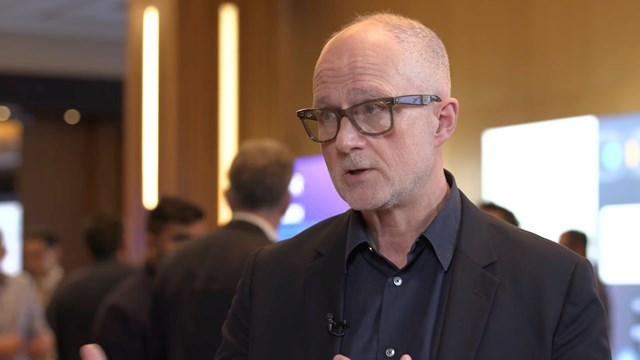
So we're at FYUZ 2025 in Dublin. I'm here with Rob Soni. He is the chairman of tip, but also the VP of RAN technology at AT&T. We're going to focus a little bit on a at and t now. So Rob, can you just give us a very quick update on AT&T's open RAN rollout progress. Everybody is always interested in where you are and what you're doing with that.
Rob Soni, AT&T & TIP (00:30):
Very good. Very good. So first of all, thank you again for having me here to talk about and share our progress. It's been a great journey over the last 18 months or so since we signed our landmark deal with Ericsson to modernize and refresh our network. It's had already a pretty dramatic impact overall on user experience in the network itself. As we also acquired significant spectrum from EchoStar in the last few weeks, which we've actually started to light up in a pretty dramatic fashion. In fact, our goal is to have most of it lit up by Thanksgiving. So already seeing impact on Ookla, results on speed testing, dramatic impacts actually overall in the network, putting us in a position we think to win overall in North America to continue gain new subs. The reason we did the deal fundamentally was to grow out our capabilities to support 5G SA services and to modernize and refresh and build out largely mid-band TDD frequencies and implement essentially very high capacity layer for our users. And we've been able to already see the value of being able to do that, and we've moved quite rapidly to do that and dramatically increased user experiences in the network throughout. It's a watershed kind of thing for us as a company and we continue to look forward to the progress that we expect to see over the next two or three years as we continue to build out the most aggressive build out of any North American operators. And we're not slowing down. I know the other guys talk about what they don't do, but we are not slowing down. The simple thing is there's an aggressive push to continue to modernize and to refresh, but also fundamentally introduce open and open capabilities. We have a lot of really good progress overall to report on that. It's public actually what we've done, this is not for me, I am not a huge fan of PR about lab. It's about when you're in the field and when you're running commercial traffic.
(02:29):
Today, I can tell you confidently we are running commercial traffic on our cloud RAN instance from Ericsson. We're running commercial traffic from our third party radios from Fujitsu interfacing with Ericsson baseband, and we now have a cloud-based open network management platform that allows us to run third party applications already running. One in particular from our partners at HCL running specifically in the network. It was something we had before running. So overall I used that word three times. So I hate to say it again, but I would say we're running. We're very optimistic about our capability to have full scale and full capability to carry all the traffic on open capable interfaces. Our target is to be 70% by the end of next year. We're about halfway. There we're so dramatic progress overall for us as an industry, but also dramatic progress for at and t.
Ray Le Maistre, TelecomTV (03:20):
Okay. So what do you say, you might not hear it here at this TIP event because it's kind of, everybody here is a supporter of open and programmable networks, but out there in the broader world, there's still a lot of skepticism you might say. What do you think when you hear people say at and t's deployment isn't really open RAN or the open RAN has failed or open RAN is dead?
Rob Soni, AT&T & TIP (03:49):
I think there actually with the news of the past week and significant investments now coming from NVIDIA into this world, I think people need to recognize that AI RAN doesn't exist without open RAN. So our fundamental statements out to our customers, to our stakeholders is that open RAN is the enabler for an AI RAN. Now does that mean we don't have AI RAN today? Absolutely not. We are today leveraging and using AI in our network for things like energy savings, for outage compensation, for prediction on performance, for automation specifically in how we roll out and deploy. So for us, AI has been table stakes for a while. It's just accelerating, moving more from offline approaches into inline approaches that take more immediate action. We expect those immediate actions to shift from days, hours to minutes to seconds as the technology progresses. Obviously the vendors will drive more of the second level or sub-second level interaction as they introduce new capabilities in their stacks and their solutions to support AI and embed AI in that.
(05:01):
But my team has also been very deeply involved in creating the framework that allows devices and infrastructure to collaborate tightly on how AI should work. So if you have a model running a device and a model running in the infrastructure and they're collaborating on performance, we need to have a unified life cycle. We need to have ability for them to stay in sync so they don't make conflictory decisions. So that framework has going to become very powerful of us now going forward as we see we move to the next level of AI as we move past. From my perspective, we're probably in the third generation of AI. We're looking forth to the future, the fourth, the fifth, whatever. But it's a continuous disruption model. It's a continuous innovation model, which is different. So I hate to say it, but I mean people who think it's a failure or it's dead.
(05:46):
I mean there are always curmudgeons. There are always people who believe what they believe. I haven't seen, I think there was a belief that you could implement a network four or five disruptors at the same time in the same domain. So four or five different baseband providers, four or five different radio providers, four or five different cloud providers, four or five different network management providers all simultaneously and expect that to succeed. Well, that end temple problem of testing and running and executing, it seems to me like it would be really, really hard to actually complete it. So yeah, the blueprint we have is pick a blueprint solution, a set of operators, then scale outwards, continuously add operators. So yes, we started with Ericsson. Yes, we started with Dell. Yes, we started with Intel. Yes, we started with traditional base band from Ericsson would be bringing third party partners in, some of which are announced, some of which are unannounced.
(06:43):
HCL I mentioned. Aira is also mentioned as a partner. We have a variety of partners out there that are working with us and everybody wants to bring their innovation in through the R app model because they know it's sustainable. They know if they take it, pick it up and take it to another operator, they can use it and reuse it. And that's powerful. We're trying to do the same thing overall with what we do on the radio side. Try not to build two at specific solutions on that same thing, even with the cloud. So yes, we have an infrastructure layer today from Ericsson with CNAs, but at the same time we're O-RAN compliant. If somebody wants to come and look at the interfaces and probe them, they're free to do it. In fact, we're going to do some of that and in the Accord lab in Dallas, that'll be fully visible. The results will be published more on the fronthaul, at least initially, and then eventually hopefully to O1, to O2 and to R1.
Ray Le Maistre, TelecomTV (07:35):
Okay. So from your perspective then, do you think that other operators looking and watching what at t is doing that what you are doing is replicable elsewhere, even for smaller operators in different markets with a different history and a different background?
Rob Soni, AT&T & TIP (07:54):
Yeah, I mean, I think they can talk to the guys up in Canada up north of us. We talk to them regularly. I mean, they're pivoting from it's public. I mean, I don't want to talk about other company plans, other operative plans too much, but it's very public. They made the pivot from Huawei to Samsung and to an O-RAN based solution. You heard IL talk about it this morning on the panel. So it's no secret of what they're doing. They're doing it largely with Samsung and with HPE, I believe, and with Wind River. And they're looking to bring in radio innovation from a variety of partners.
(08:27):
So, they're... To some degree they're not very different from us with a different set of vendors. So we have a lot to talk about lots in common. So there are others that are now starting to follow this path and will start to move in this direction. I don't think it's easy to do the end temple thing, and I think there was a belief that that's how you were just going to flip the switch and we would immediately be in that complete almost five ring circus immediately. It's not easy to do that, especially for a, I like to say brownstone. It's how Brown Field doesn't feel good, but a brownstone operator.
Ray Le Maistre, TelecomTV (09:03):
Okay. And then you talked earlier on about AI and AI RAN and how open RAN is the starting point for you to be able to think about that. The proposition as put forward by the AI RAN Alliance has three pillars and one of them is focused on the compute capability that could sit at the RAN. What's your views on the applicability of GPU technology in the RAN? Is this something that at and t is looking at? Is it something for the future or is it something for now that maybe you are trialing and testing out?
Rob Soni, AT&T & TIP (09:50):
I think admittedly, it's still a future topic. I mean, I have had my own personal involvement in this topic from my previous roles at Nokia and at VMware. It's been a future topic for a while, which you always worry about when something is stuck in the future for too long and then it gets positioned for the next generation. But at the same time, it's great for the industry that NVIDIA decided to make this relatively large investment and effectively open RAN. They didn't say that. They said it was AI RAN, but I think this actually buoys the industry overall, GPU to cell site, power price performance is going to be a common theme that you hear from a lot of operators. Really. Can we get to the capacity we need in the time that we need it with the software? Because the software development cycles typically are long.
(10:40):
I mean, hopefully the benefit of moving to a GPU would be that you would shorten some of those cycles and simplify them. But yeah, there are still lots of challenges ahead. I think GPUs at a cell site, obviously that form factor is going to be really, really important when you move to a centralized location and you start thinking about that and that location. I think it depends on the operator where you are. And we have limited centralization in our network today, and there's a reason for that. Our population distribution is quite different than say Japan. So trying to get to an ability to highly centralized outside of some key areas like New York City or San Francisco or even Chicago within the centralized areas is not something that we have everywhere in the network, but there will be opportunities to centralize. Do they have a play there? I think it remains to be seen. There is a lot of work to be done to actually build solutions that are truly commercial that offer us what we have today in terms of network management, ability to orchestrate and manage and support lifecycle, but also to achieve kind of performance that our customers expect in terms of throughput and drop call behavior and mobility experience. So they're on their journey. Are we part of that journey? I think so. Will we be more active in the journey? Can't tell yet.
Ray Le Maistre, TelecomTV (12:08):
Right. So watching brief, basically. But yeah, there's lots of things that could happen in the future, but in a year's time things are moving so quickly. Right. In a year's time, so many things could be different.
Rob Soni, AT&T & TIP (12:22):
Exactly. It'll be interesting to have this conversation a year from now.
Ray Le Maistre, TelecomTV (12:25):
Absolutely. Well, I look forward to wherever this event is next year. We look forward to it. Rob, thanks so much for joining us. Really appreciate it. Thank you.
Rob Soni, AT&T & TIP (12:33):
Yeah, take care.
Please note that video transcripts are provided for reference only – content may vary from the published video or contain inaccuracies.
Rob Soni, VP, RAN Technology, AT&T and Chairman, TIP
AT&T’s VP of RAN technology, Rob Soni, joins TelecomTV on the show floor of FYUZ25 in Dublin to discuss the US operator’s Open RAN deployment. Soni says Open RAN sites are now carrying commercial traffic from 1Finity (Fujitsu) radio units that are interfacing with Ericsson’s baseband and are all controlled by a cloud-based, open network management system that can run third-party applications. The AT&T executive also discussed the relevance of AT&T’s rollout to other operators and shared his views on AI-RAN architecture options.
Recorded November 2025
Email Newsletters
Sign up to receive TelecomTV's top news and videos, plus exclusive subscriber-only content direct to your inbox.