KDDI, Rakuten target 40% gain in vRAN energy efficiency

By Ray Le Maistre
May 18, 2026
- Next-generation network architectures come with energy-efficiency challenges that are exacerbated by rising power supply costs
- Japanese operators KDDI and Rakuten Mobile have been jointly selected for a project that aims to reduce power consumption in virtualised radio access network (vRAN) deployments by up to 40%
KDDI and Rakuten Mobile have been jointly selected by Japan’s New Energy and Industrial Technology Development Organisation (NEDO) for a project that aims to reduce power consumption in virtualised radio access network (vRAN) deployments by up to 40%.
The aim of the project is to “achieve significant reductions in [RAN and datacentre] power consumption by 2030” of about 40% – an ambitious target and one that would have a major impact on operating expenditure. The telcos aim to do this by identifying a network design that “efficiently processes the immense computational load of AI and virtualised RAN processing while minimising power consumption”.
The two telcos bring key industry experience to the project, dubbed the Development of Simultaneous Optimization Technology for Virtualized Base Stations and Computing Infrastructure. KDDI has “extensive experience in mobile communication R&D and commercial operations, complemented by its global and domestic expertise in large-scale datacentre management”, while Rakuten Mobile “has developed all of its cloud, RAN software and service management and orchestration (SMO) in-house for the virtualised Open RAN network it built and operates in Japan.”
And while the project is run by the state-funded NEDO and is clearly aiming to develop options suited to the Japanese market, the effort will be of interest to operators around the world that are considering how they evolve to automated, virtualised cloud-native networks that make use of AI software and hardware without incurring massive energy costs and ripping up their green network plans.
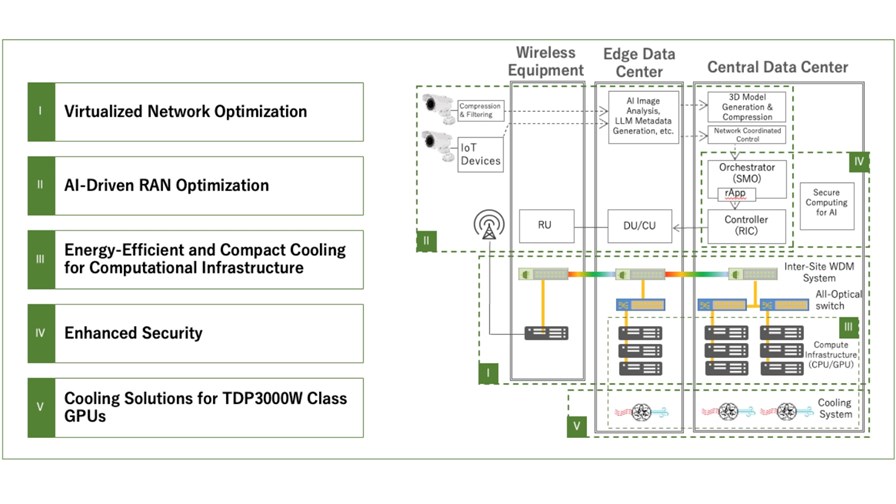
The joint effort is focused on five “key domains”, namely:
Virtualised network optimisation: This will be achieved through the deployment of optical networking technology between graphics processing unit (GPU) clusters inside datacentre facilities and the development of technologies for “cluster generalisation, power-efficient control of transport devices, and resource optimisation according to traffic demand and computational load.”
AI-driven RAN optimisation: Using AI and a telco cloud platform “to optimise RAN radio transmission in real time according to traffic fluctuations” and using edge AI data processing and video compression technologies to reduce the data traffic volumes and power consumption associated with internet of things (IoT) devices.
Energy-efficient and compact cooling for computational infrastructure: Enhancing “the efficiency and miniaturisation of air-cooling systems” by integrating the control systems of cooling equipment and IT devices to “establish technology that optimises cooling based on IT equipment load.”
Cooling solutions for TDP3000W class GPUs: This is where the project gets very specific, as clearly there is the joint view that 3000-watt thermal design power (TDP3000W) GPUs will be at the heart of the high-performance compute clusters that run vRAN deployments in the future. The aim here is to develop “water cooling and immersion cooling technologies capable of supporting GPUs in the TDP3000W class”.
Enhanced security: This is a bit more vague, as the focus here is on the enhancement of Open RAN security while, at the same time, reducing power consumption by “minimising the volume of security-related data”. The diagram above suggests this will be achieved using rApps running on a RAN intelligent controller (RIC) platform.
- Ray Le Maistre, Editorial Director, TelecomTV
Email Newsletters
Sign up to receive TelecomTV's top news and videos, plus exclusive subscriber-only content direct to your inbox.