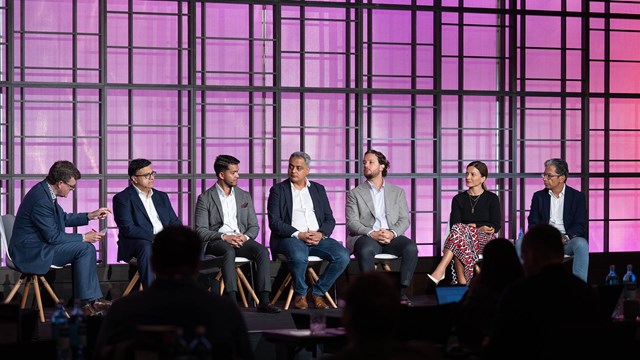
Digital sovereignty for the UK and beyond

By Ray Le Maistre
Dec 5, 2025
To embed our video on your website copy and paste the code below:
<iframe src="https://www.youtube.com/embed/-nwLtR1mSJ8?modestbranding=1&rel=0" width="970" height="546" frameborder="0" scrolling="auto" allowfullscreen></iframe>
Guy Daniels, TelecomTV (00:07):
Welcome to TelecomTV's brand new Digital Sovereignty Forum. Now, last year in this very room, we held the Telcos and AI event. It was kind of like an incubator event, and we're doing that the same again this year. So Telcos and AI obviously went on to bigger and better things this year in Dusseldorf. That was terrific event. Hope to see all that next year as well. To kick things off though, now I'm going to hand you over to Ray. Ray sitting in front here. Ray, as you all know, is TelecomTV's editorial director, and Ray will be hosting the first session. Ray. Great, thank
Ray Le Maistre, TelecomTV (00:44):
You guys. So as guy mentioned, I'm Ray Le Maistre, editorial director at Telecom tv. And as guy mentioned, this is our first digital sovereignty forum, but it follows the same format that we've had in this location around this kind of time of the year for the past couple of years. It's a hot topic, it's kind of semi-formal, built around more interactive workshopy type format rather than a standard conference presentation kind of format based on the past couple of years of AI discussions. It kind of works for all involved in the audience here in the room. And so we look for as much involvement from the audience as possible in the form of questions. But please just mention now no short presentations from the audience floor if we can. We're looking for questions to put to our expert speakers, please. We also have a poll associated with today's forum, and you can find that on the telecom TV website on the event page for this forum.
(01:53):
So please do go and vote in that poll as soon as you can. But before we get into today's sessions, a few quick words. We're running this event because as I think we already know, the topic of sovereignty is red hot right now. It's driving a lot of political investment and corporate strategy decisions, especially in recent months in Europe. Europe is desperate to have its own cloud and AI infrastructure and to be able to contain its data and provide in-region and in-country services to public bodies, enterprises and residents. But let's just take a quick look at how Europe is faring in terms of cloud services, market cloud. So here's a synergy research group chart showing the main cloud service players and their global market shares. Now, I'm not going to go through this, but none of the named companies here are European, as you can see, getting a bit more regional.
(03:02):
Here's another synergy research group chart showing the market share that European cloud service providers command in Europe. And as you can see, it's not particularly good news for the European sovereign Cloud flag waivers just 15%. It's almost a case of it's the only way is up for Europe's cloud services hopefuls. But things might change though quite how much the needle will move remains to be seen. But on a more hopeful note for the unionist here, a charge from Accenture, which surveyed European enterprise to see how many enterprises plan to increase investments in sovereign AI in the next two years, and the average is 60%. What I found most surprising actually was that France was at the bottom of this chart, given some recent announcements and developments, but that might change, but SAVI as they say.
(04:01):
So that's just to give a little flavor and put sort of the European situation into context. But enough from me. We're going to crack on now with the first session, digital sovereignty for the UK and beyond. So if I can ask our speakers please to join me at the front and let's give 'em a round of applause, please. Should I go under my picture? Oh yeah, you can do, absolutely. Yeah. So just before we get into this first session also, I just want to say one of the things we want to try and avoid today is to make this just another day, just another event that's only about ai. That's absolutely not the intention here. We do have AI sessions that's going to crop up a lot, but we want it to be about much more than just ai. And also during the course of the day, we don't want to get too philosophical about what the word or the term sovereignty means.
(05:12):
We do want to look at the definition, obviously we want to discuss the practical considerations, but where for example, intellectual property might've been developed, where patents were submitted, et cetera, what country and whether that software is used in a bit of technology that's deployed in another country that might be a bit too deep in the weeds to get into today, but we will be discussing the supply chain later on. And obviously the considerations of who's behind various services obviously matters a lot, but if we can keep as practical as possible, especially in terms of the questions we have from the audience. Okay, let's get into this first session then. And I'm going to open up by getting the speakers just to introduce themselves so everybody knows the perspective they're coming from before we hear from them each individually. So we'll start from this side. Mike, if you want to introduce yourself please.
Michael John Short, CBE FREng FIET (06:07):
Good morning everybody. It's great to be back here with TelecomTV. Good morning ladies and gentlemen, and Valley the dog I think down in the front row. So I bring 30 years in telecoms, having worked largely in the Telefonica family international experience in mobile. I was chairman of the GSM Association 30 years ago, so I'm more likely to give an international flavor to the subject. But I have also worked for five and a half years as chief scientist in the UK government for the Department of Business and Trade. And today, amongst other things, I chair UK telecoms Innovation labs, which is very much geared towards cybersecurity testing of mobile networks today.
Ray Le Maistre, TelecomTV (06:47):
Okay, thank you
Michael John Short, CBE FREng FIET (06:48):
Sophie.
Sophie Greaves, techUK (06:50):
Hi everyone. Good morning. My name is Sophie Greaves. I'm associate director for digital infrastructure at Tech uk. Tech UK is the UK's technology trade body. So we're a membership organization of just over 1100 member companies who collectively employ 1.1 million people. And we are really here to champion the tech sector, support our members as they operate in the UK and also internationally. And yeah, my ion is, I manage our telecoms program as well as spectrum policy and data centers.
Ray Le Maistre, TelecomTV (07:23):
Thanks. Okay, thanks Sophie. Dominic?
Dominic Laurie, SUSE (07:25):
Yes. Hello, I'm Dominic Laurie, thank you. Director of corporate comms at suse, the open source enterprise software company. I've worked in lots of different careers. I'm not technical, so I'm not going to get into the weeds, I don't even know how, but I've worked as a teacher, as a journalist. I was a presenter at the BBC for 10 to 12 years as a business and economics journalist. And I also worked in another part of the telco area as director of corporate affairs at TalkTalk, the broadband company, and now work Atsa Sosa, enterprise infrastructure software company 33 years now headquartered in Luxembourg. We were founded in Germany, but now global, so fortune 500 customers across the world. So our whole work is around connecting customers at scale. So that's kind of what you're interested in that perspective I'll be giving as well this morning.
Ray Le Maistre, TelecomTV (08:18):
Okay, great. Thanks very much. So we're going to start this session with just short talks from each of our experts here at the front, three minutes each, and we do keep it to three minutes. We want to get to the interactive part of the day as quickly as possible. So we're going to start with Sophie. So Sophie, your three minutes starts now.
Sophie Greaves, techUK (08:41):
Gosh, thank you Ray. And just to say thank you so much for inviting me to participate this morning, it's great to be here and share some thoughts. So this is our view of Tech UK and what some of our members are talking about when it comes to digital sovereignty. I think ideally our members are looking for quite a distinct definition, particularly when it comes to what the UK government is thinking. But really my perspective is we're talking about resilience. So telecoms, it's critical national infrastructure. We need to ensure that it's always on, it's secure, it's always there to be trusted. And so sovereignty comes into questions around control where could be talking about from a jurisdiction perspective where our data is located, where it should be located and where it's accessed. We might also from a telecoms perspective, be talking about supply chain resilience and diversification of course.
(09:42):
And then as different developments or threats occur, potentially we want the operational kind of agility. Two, I would also like to say that for tech UK specifically, we would always seek a pragmatic approach. So we want to balance openness with security. So when I'm talking about openness, I mean it's an open digital economy. It's one that works obviously internationally, and you want to achieve that control whilst supporting and encouraging that open digital economy. For the telcos themselves, many of whom participate in our members of Tech uk, it's a very difficult investment environment at the moment, and I think we'll talk about that in a second and later in the conversation. So there are other kind of levers that we could seek to use when it comes to potentially supporting strategic investment in telecoms, sharing some of the risk. Partnering is obviously a key part of that too.
(10:49):
And yeah, there's more I would like to talk about, but I think I would like to frame this discussion particularly around quite a positive outcome. So if done right sovereignty could mean that for the UK we are an attractive place to invest. We are more resilient ourselves, we're more secure and we are more innovative. So a journey from dependence to control is something that I like to think about. We want to see how the UK is navigating a sort of international corporation, but also balancing that with some strategic domestic investment. So that was my opening gambit.
Ray Le Maistre, TelecomTV (11:29):
Okay, fantastic. With 15 seconds to spare, that's pretty nice. Thanks. You've set the benchmark there. So thank
Dominic Laurie, SUSE (11:37):
You much. Thanks
Ray Le Maistre, TelecomTV (11:37):
Much. Your three minutes starts now.
Dominic Laurie, SUSE (11:41):
You clearly have a great internal clock. This is very impressive. Thanks. So I looked on the materials sent out yesterday and there was a really good question with a survey saying, what do you see as the critical factors in advancing digital sovereignty? And I would just add to that in Europe, that's why we're here. And I think that Sosa has two concepts that are really important choice and scale. Those are the two words I'll talk about in the next three minutes. What does choice mean? It's clear from our customers that our customers are in different places. So the one person, on the one hand, you might have a customer who really loves the hyperscalers, they love their functionality, love the solidity that they give, the ease of access, the robustness, and they might come to us and say, you know what? We're going to stick with hyperscaler, but we just love a little bit more sovereignty.
(12:36):
We just love a little bit more sovereign resilience, a little bit more sense that we're doing even the right thing. Sometimes it's an emotional response we're finding. So they might come to us and say, well, can you just bring us along the scale a little bit from say two to four, but then we might have a customer conversation the next day with somebody in the heat map that's much closer to government or critical industries, much more sensitive to sovereignty. And they might be saying, we're already really far along this journey and actually we want you su to try and help us make the last step almost really create a European sovereign ring-fenced estate. So the point I'm making is I think there's a lot of chat about purity sometimes that sovereignty can only be a hundred percent pure. I think Susa we would say no, it just depends where your customer is, meet your customer where you are because sovereignty means different things to different people depending on where they are in the ecosystem and where they are on their journey.
(13:33):
So choice is absolutely vital and we should respect that choice. The second thing is scale. So again, why would someone go with a hyperscaler? It's often because they have an easy single access point to massive different functionality. And that's great. You can understand why people would do that. A us hyperscaler, it is so easy for them, and I've been to conferences in Europe on the other hand where there's the email guy on the stage and he's beside the data center woman and he's beside the cloud guy and they're all sort of lined up sort of vertically and they're not getting into each other's swim lanes. And it just gives the impression of something that's quite hard to deal with sometimes often. And I thought of that we have different plug sockets across this continent, whereas in the US they have one socket and there's a reason why things are easy to deal with. So I think what we have to do is we have to create standards that function at scale. We have to start to work towards standards across Europe that are easy to use and can customers can plug into at scale. How do we do that? We have to collaborate. We have to do collaborations that perhaps we haven't done before. Reach out to companies we perhaps have reached out to so we can function and create adoption at scale. So choice and scale, the two words that I would frame it in.
Ray Le Maistre, TelecomTV (14:58):
Okay,
Dominic Laurie, SUSE (14:59):
I went over I
Ray Le Maistre, TelecomTV (15:00):
Well you took up some of the 15 seconds. Cheers if you left behind. So that was okay, thank you so much. But you get an extra couple of seconds for bringing props because props are gone. Prop. Okay, Mike, the three minute standard is yours.
Michael John Short, CBE FREng FIET (15:17):
So I'd like to go back to one G mobile and the days which I happen to remember and some in the room may still remember when we had national standards, national supply chains, and we didn't really have the choice that you've just described and we certainly didn't have the scale and benefits of the mobile industry that we've had from two G onwards. And those benefits include international standards, better interoperability, the ability to have a much broader supply chain, but also lower cost for every customer. The cost profile of devices having come down from around three $4,000 to something much, much less today, the ability to use a range of suppliers obviously may have been constrained by a large amount of globalization. However, the reality is that it's given much more choice, but there's a lot more to be done. We've still got another 2.2 billion people roughly who don't have access to the internet today.
(16:12):
We also can see a much wider range of services that are going to be needed going forward. So I worry when we talk about sovereignty that we are going back to the world of nationalism. I worry that we're going back to reducing supply choice. I worry that we are putting in objectives into an industry that isn't ready for sovereignty, that worry can be counted if we break it down into a few areas where I think it is reasonable to address sovereignty. So things like control, control of data, perhaps better resilience, perhaps better international standards to serve new needs, perhaps better security on the supply chain side itself, I chair UK telecoms labs as I said earlier on, and we test for cybersecurity and we need to be concerned about the attack vector getting worse. So we've got good reasons for security to look at sovereignty data I think is a matter of trust and a matter of trust in terms of what do we do with it, how do we share it?
(17:10):
So to me, I can see cases where cloud and AI have to have a data lens of sovereignty and on regulation. I think we need to say, well what regulation do we need? But my overall lens is similar to yours in terms of your points, Dominic, about choice and scale we need to regulate for the market of today and tomorrow, but take some lessons from the past. How do we make sure the choice is maintained? Not defining it in an old way but in a modern way, and how do we make sure scale is maintained? So we have maximum choice in the process, it's got to meet the market needs and I'll give you a few examples later on beyond my three minutes.
Ray Le Maistre, TelecomTV (17:49):
Well you've still got a bit of time Mike, but we can certainly come back to that. Okay, brilliant, thank you. Well, I think that's really set the scene. So before we come to the room and see if we've got any questions, I do want to start off with a question because Sophie, you mentioned investment. Then as we know Ray, turn your mic on as we know the telcos are under or certainly say they're under investment pressures and we've seen CapEx figures going down and there's a real focus now on trying to increase cashflow, et cetera, et cetera. But obviously these kind of scenarios could point towards having to invest in yet more infrastructure and yet more support services. So given this ongoing pressure on CapEx, what kind of commercial models or partnerships could allow telcos to be the enablers of national digital resilience without having to bear all of the costs? So Sophie, we'll start with you as you mentioned it there.
Sophie Greaves, techUK (19:05):
Thanks Ray. It's a really good question. Timely, we had the budget last week, which was notable in very, very low mention or thought gone into our connectivity digital infrastructure sector. Despite it underpinning our digital economy, it's a difficult environment. Costs are going up. Energy prices in the UK are some of the highest in the world, so it makes running a distributed network like mobile, extremely expensive. So any type of tax incentive as relates to running networks I think would be extremely welcome. We've seen that with the discussion about business rates here in the uk, you're building infrastructure that underpins so much and yet you are then taxed for that. Of course it does make the operator money, but equally what does it enable? I think for telecoms companies in the uk, they're always seeking a sort of long-term regulatory stability, which can help their investment decisions make sense and have trust in what is going to happen in the uk public investment and partnerships.
(20:21):
Dominic mentioned collaboration. We've seen some really effective partnerships between the government and companies in terms of things like BDK programs, shared rural network and so on. And that can deliver real impact. Mike's already mentioned the kind of digital inclusion imperative. I think we should all bear in mind when we're talking about anything to do with connectivity. And then just equally some we're here in London, we're probably within steps of some shared infrastructure, some new ways to deploy connectivity and equipment that is a shared cost. So there are a number of options that we can look at, but certainly government can play a role. Okay.
Ray Le Maistre, TelecomTV (21:06):
Mike, are you hearing any conversations about how the telecom community, whether it's within the UK or within Europe, is discussing how they might meet the sovereign services requirements in the most economic way?
Michael John Short, CBE FREng FIET (21:28):
I think you'll find that most major vendors and most major operators have got a sovereign approach. Is it all public domain? No, but the discussions have certainly started. I'd quite like to give some business examples if I may, of sovereignty where I think it's not needed, but also areas where it needs to be discussed. If we look at some of the innovation around private networks, for example, you could say that's not a sovereign issue. I don't believe it is. But if there is more choice being offered to customers, particularly enterprise customers or government customers through private networks, let that innovation flow. I don't think it needs to be regulated in favor of it. It needs to perhaps have some barriers broken down to enable private networks where they make sense. But I think the market should define that by contrast. If I look to see in the satcoms developments areas, I can see a tendency to look at national champions as opposed to the multi-country play that satcoms could be.
(22:28):
So how do we make sure we have the right satcoms infill coverage that compliments mobile without excessive sovereignty regulation in that area? Clearly we may want national champions, we might want better jobs created locally. We might want to have richer services, but I think we need to measure how much sovereignty regulation is in the area so it's not disproportionate. I'm also in favor of open source as an example where we can adopt more open source innovation. And I would hate to feel that sovereignty rules got in the way of open source, but standards are a critical enabler to keep these markets open as well. So I would like to see that continue. My last example I think is made in India. So I was in India last October two months ago at the major India Mobile Congress and it was notable how strong the made in India initiative is, which you could argue is a sovereignty initiative. It is to get more in India manufacturing because they have a huge import bill. A lot of what they use in the biggest mobile market in the world is imported. So I don't blame them for having a made in India initiative, but it is based on a lot more partnerships than you might imagine in the made in India name or mantra.
Ray Le Maistre, TelecomTV (23:47):
Yeah, absolutely. And I think it's worth pointing out in Made in India example that that's something that was instigated 10 years ago and now it's really starting to have an impact on the Indian telecom sector in terms of what technology, local locally produced technologies available, not necessarily by an indigenous company, Ericsson for example, and others are setting up more manufacturing plants there and stuff is being made in the country. But there are also, there's a lot of encouragement as well for Indian vendors to be producing the equipment that the operators use. Of course, I guess it'll be another 10 years before we see how that plays out once that technology is deployed and what kind of advantages or not that might bring. But yeah, Dominic,
Dominic Laurie, SUSE (24:38):
Can I just follow up on the open source point? Absolutely. The answer to the question is how does Europe make use of the resources it has to come back and be a strategic player, embrace open source, open source. Europe is one of the heartlands of open source. We have huge numbers of open source engineers, open source contributors across this continent. And open source I don't think gets in the way of sovereignty. I think totally the opposite. I think open source and sovereignty are perfect partners. Two simple examples, what's in it, and you can take it with you. Two very crude definitions of open source are that it, it's a transparent box as opposed to an opaque box that's brilliant for sovereignty. And I think open source is not understood and embraced enough within the corridors of power across the European continent. I think it should be more, it is a resource that Europe has plentifully and I think it can be used to greater effect. And there are also quite, if you look across the European continent, there are many companies like us, there's lots of really great open source pioneers give those organizations a chance to show what they can do. I think also the telco sector is brilliant. It's a great trailblazer in open source collaboration. You look at the silver project as a good example, it shows what can be done. You just need to collaborate using open source principles across silos. And I think a lot can happen.
Ray Le Maistre, TelecomTV (26:08):
But do you think open source companies in Europe are not being given the chance to shine?
Dominic Laurie, SUSE (26:16):
I wouldn't say it's sort of black or white like that. I think there are things that you could do and there's a debate going on in Brussels about public procurement for example. European governments have sort of soft factors in RFPs for it tenders should open source be more of a mandated factor, should European this be more of a mandated factor, whatever. I mean everyone will have different views. There are ways that you can nudge decisions and I know that discussions like that happening right now and we might see some movements on that early on in the next year in the following year. But I think that you can just give them a bit more of a chance, open source, a bit more of a chance when a new tender comes up for a government ministry's IT estate for example. It's not difficult to do and it doesn't have to be that dramatic.
Ray Le Maistre, TelecomTV (27:04):
Okay. Alright, let's go to the room and see if we have any questions for our speakers. So I can see three. Okay, so I'm going to move this way. So I'm going to start up here. If you can use the microphone in front of you, say who you are, where you're from and what your question is.
Thierry van de Velde, Nokia (27:26):
I'm trying this way. Okay. I'm Thierry van de Velde, from Nokia. I'm based in Brussels by the way. What I didn't hear in this debate was the hardware layer, the server, the storage, et cetera. Yes, this is the year of hardware with big discussions about X 86 export bans about using perhaps GPUs rather than CPUs. So we are at the mercy of large players, in fact two blocks who are controlling this hardware market. How do we deal with that in Europe?
Ray Le Maistre, TelecomTV (28:05):
And then just to point out, we have a lot more discussion around this topic, the other sessions, but absolutely, let's address this now.
Sophie Greaves, techUK (28:13):
I'll jump in if that's okay. Thank you for the question from a UK perspective and from a telecoms perspective specifically, but I appreciate your questions probably a bit wider than that. I would say that one thing I didn't super mention or touch on in my opening gambit and answer was the impact of the telecom security act in the uk. That was an intervention across on removing high-risk vendors from the uk telecoms networks and then bringing in a new security regime, which is currently going through enforcement. IT public networks have to comply and ofcom enforces it. That's all about partly hardware and how you manage and test and assure what vendors are putting into your networks. It's usually burdensome, but again, to the point on CapEx and pressures on the telcos, what we would like to see as more kind of investment in neutral labs, testing facilities that for the sector can really drive through understanding and assuring this kind of supply chain. And I'll maybe pass to Mike because he is on the board of UKTL can expand a bit.
Michael John Short, CBE FREng FIET (29:29):
Can I say I did stress early on the importance of international standards and I think Nokia has done a sterling job amongst others on international standards and I think that is critical for the strengthening of anything that's done on hardware side of the supply chain. Should we do anything between sovereignty and hardware? I'm not sure it's justified. I'm not sure that we can actually say that we should do anything specific. Maybe you've got something in mind, but I think what we want to do is to have market driven approaches where market can determine what choices we have. And if we don't have sufficient choice, then sometimes regulators, governments will step in if there is insufficient choice as we've seen with, for example, high risk vendors, they have stepped in. Now the reality is to be specific on hardware though, you've really got to say what are the market drivers to do something about hardware? If it's lost employment, that's a bit more than your average market driver. If it's lost innovation, that is also a significant concern. But I'm not sure I'm making the strong link between sovereignty and hardware because I'm not sure how to make an impact in that area.
Thierry van de Velde, Nokia (30:38):
Well, my question is triggered by a sharp price increase that we're expecting next year for hardware due to import tariffs due to the world getting a smaller place and we in Europe are going to be at the mercy of those higher tariffs.
Michael John Short, CBE FREng FIET (30:53):
So if it's a tariff question, I will revert back to my previous department of business and trade that deals with export controls, also deals with tariff negotiations and so on. And that is tricky for many countries. The reality is that I don't think Europe is as well coordinated on issues to do with tariff negotiations as it could be. And perhaps that's what's needed rather than a pure sovereignty debate. I think some of the tariff challenges and maybe the weaponizing of tariff discussions is challenging for many countries. As I say, I was in India in October. They're seeing it just as much as we're seeing that in Europe. But I think it's not just a sovereignty debate, it's about how do you negotiate in that area.
Ray Le Maistre, TelecomTV (31:38):
Great, thank you. Okay, we'll come there and then here.
Robert Curran, Appledore Research (31:44):
Hello, I'm Robert Curran from Appledore Research. Dominic, I mean all of you have reference to some degree implied a degree of quantification of digital sovereignty ness if you like. And I was interested to know, are you aware of any initiative to try to standardize, if you like, the measurement of digital sovereignty and what the parameters of that? Obviously it'll be different for different contexts. I mean a telco measuring its own digital sovereignty is different than an enterprise measuring it. But nonetheless, is there any kind of joined up initiative on trying to find a way to quantify the degree of digital sovereignty?
Dominic Laurie, SUSE (32:24):
So two things I've seen that I think will be quite well adopted and quite well accepted. One, we are seeing I think three areas of digital sovereignty, technical data and operations. Most of the analysts are agreeing on those three categories and you can look at it like that. Where is your tech built? Where is your data stored and operations, who runs and manages it? And our customers are coming to us, I think talking to us across those three buckets I would say. And if you look at Gartner and Forrester, their reports, their sort of second gen reports about digital sovereignty, they're coalescing around those three buckets. I would say the second thing, the European Cloud framework, I don't think I've seen something come out of Brussels that has a relatively as widespread acceptance in this area as that I think people think it's quite useful. It's very easy to understand. It's quite visual, it's quite simple and it gives a useful guide for potential customers to use. So I would say that that's that's had quite a lot of acceptance and applauded it, I would say, and is quite useful above. Those two things I would say are quite standard now I would say in discussions that we're having with customers, put it this way, customers are bringing those things up to us as part of look, can you help us using these three types of frameworks, two types.
Ray Le Maistre, TelecomTV (33:58):
Beth,
Beth Cohen, Luth Computer (33:59):
Hi. I'd like to talk a little bit following up on the tariffs that was brought up. Obviously there's a lot of shifting political and economic alliances going on right now. Who knows how long they'll last but whatever. So obviously this is affecting the sovereignty discussion, so I'd like you to kind of talk more about, go into more about how those factors are shading the discussions about digital sovereignty.
Dominic Laurie, SUSE (34:38):
I can answer just to start with, I don't think it was the software. Obviously tariffs is often not necessarily the major factor, but I think it was how it made some of our customers feel given what's gone on in the previous two years. I just think in Europe a lot of our customers have seen a layer upon layer of business uncertainty hit them. So I think it's what tariffs represent to a certain extent with our customers and therefore they're looking at business continuity issues and they see digital sovereignty as a business continuity issue.
Beth Cohen, Luth Computer (35:09):
Yeah, it's not specific to tariffs. A lot of economic uncertainty going on right now. I mean in the US we're getting hit. I mean let's face it, the tariffs hit us because they are taxes on us. And so the economic conditions in the US are actually pretty bad right now despite the fact that there's no reports. So what I'm talking about more is just kind of more general, the uncertainty that's going on politically and shifting alliances from a trade perspective that's
Dominic Laurie, SUSE (35:47):
Going on. Yeah, sorry, I kind of meant that. Which the geopolitical uncertainty they're seeing. If you're looking at various quarters of the world, I think our customers see a geopolitically more uncertain place than say two or three years ago and they're then making a link between that and their business continuity and their resilience. So that's more what I meant, but absolutely way those conversations are coming up and I think often then you get an emotional response. I think one thing that we're seeing from our customers that we haven't necessarily seen in other decisions that they make about what tech to take is there's an emotional factor coming into this thing. Someone told me about a customer, potential customer that said the other day, I feel like I want to do the right thing. And you don't often hear that in an RFP, you must do the right thing, but that is coming up and that's an emotional subjective view.
Ray Le Maistre, TelecomTV (36:43):
Okay, so sweeping across, so Dean and then back over here. So if you could, oh sorry Francis, right, we'll come back to you. We'll go to Dean Francis and then, oh sorry Sophie. No, go
Sophie Greaves, techUK (36:58):
Ahead. No, no, I'll go for the question. Well put Dean go. What he said, yeah, what he said. Yeah.
Dean Bubley, Disruptive Analysis (37:06):
What does sovereignty mean for multinational enterprises? Yeah, I spent yesterday at a conference on private networks and there was a lot of complaints from international companies like BASF and Cargill. They have to deal with different spectrum policies in different parts of the world if they want to build private networks. Surely a lot of the sovereignty elements, whether it's on cloud or AI or anything else, make it a hundred times worse for everything else they do. What happens to a multinational in a sovereign world,
Sophie Greaves, techUK (37:42):
It's a headache. Simply put, we represent a lot of multinational tech companies who obviously operate here in the uk. So they are trying to navigate UK policy and regulation. They are also simultaneously navigating EU policy and regulation American, wherever else they would like to operate. And if it's digital tech, it's everywhere. So it's a headache in terms of regulatory burden, overlapping requirements. We see that even just within the uk. One thing that we're tracking at Tech UK very closely is the impact of the cybersecurity and resilience bill, which has been introduced as an act of parliament and is going through at the moment, but will be enforced by multiple regulators. So yeah, we see that something that we want to try and help coordinate as best as possible. And I think just on the previous question and Dominic's great response, it is the sort of, so what I think for a consumer alongside doing the right thing, it's is this adding to my overall cost of using this service or this network If it's a regulatory burden or it's uncertainty for an operator, that could translate down into cost to run the service which gets passed on to a consumer.
(39:05):
So I think that would be the main impact on that geopolitical uncertainty.
Michael John Short, CBE FREng FIET (39:11):
If I can just add a few things. I first designed some private networks back in the 1980s for multinational customers. Clearly to doing it from an analog tax base was very difficult. GSM really helped because you moved worlds of standards. Today though the work is done by a much wider variety of people, not just operators. So the role of the systems integrator already takes a lot of that load. That may include issues like spectrum clearance, devices, approvals, issues around standards, issues around security for each country, issues around keeping the cost down and the service level up. So in practice there are quite a few people who do some of that work. The heavy lifting that's just been described and in reality it could be made more efficient and I would expect with 5G as it evolves, it will become a lot more efficient. But there are loads of VPNs already out there.
(40:07):
There are loads of tailored services out there and that's just going to increase. Sovereignty can get in the way if you're adding in more complexity in that area. But at the same time, some customers might be quite specific as to what their needs are. They certainly would like more control that doesn't sit in one member state or one nation. They might want more control of the service that they wish to offer. I was talking to some people involved with the private network of Jaguar Land Rover the other day and some of the lessons from private networks in Jaguar Land Rover are being taken into their international plants by way of next steps. That was nothing to do with the recent cybersecurity difficulty. It was to do with the private network deployment. So I think the heavy lifting has to be addressed and sovereignty could make it worse unless we're careful.
Dominic Laurie, SUSE (40:57):
I think we're seeing a really good example this week about what sovereignty means for multinationals because we expect AWS to launch its European sovereign cloud. So I would say where customers are demanding a sovereign solution, I think multinationals of which AWS is one will respond. So I think it kind of depends. If customers demand is significant enough, then I think a global firm will react and provide a sovereign solution for their customers and it will take some heavy lifting.
Dean Bubley, Disruptive Analysis (41:30):
I meant the other way around, I mean it's the multinational customer, it's if your Airbus or your BMW or your BASF or your Toshiba and you are trying to buy stuff and you've got factories or you've got offices in 73 countries, do you have something have to do with 73 different cloud stacks?
Michael John Short, CBE FREng FIET (41:51):
They usually have a unified architecture before the inquiry comes out. They may need some advice on it, but they usually have a unified architecture in the bigger companies. There are some who need help though.
Ray Le Maistre, TelecomTV (42:08):
Joel, we'll come back to that dean though because it's a critical point and it'll be interesting to hear maybe during the day if we have anybody from large international companies who are seeing complications already from these kinds of things. So Francis and then over here, yeah,
Francis Haysom, Appledore Research (42:30):
Francis Haysom, Appledore Research how panel would think of, is the sovereignty word actually a useful one here because it
Ray Le Maistre, TelecomTV (42:38):
Almost, I hope so.
Francis Haysom, Appledore Research (42:40):
No, but in terms of how people think about the problem, because the immediate thing you think of when you're thinking of the sovereignty is Castle wars or the UK border force or everything at the border. And in fact actually digital sovereignty is hundreds if not thousands of different things which vary depending on customers. Is sovereignty, I think it's a useful word, but is it something which conjures the wrong, a sort of sense of what we need to do? And do you therefore end up with what I would term is what you see, for example, that the UK border or any border sort of security theater, everything's solved by the passport rather than thinking of it as an in-depth issue?
Sophie Greaves, techUK (43:28):
Thanks Francis. That's a really good question. I go back to my kind of opening gambit of resilience and control. So
(43:37):
Yes, sovereignty, I think it touches on what Dominic talked about is quite an emotive question, but I think it does have some use. But it ultimately comes back to, for the UK specifically, we're an island nation. The TSA has brought in national resilience requirements where you have to be able to run your network from the uk, you have to have people in the UK to run the network for you and it has to be architected and set up in that way. But that's the hardest bit of the TSA and it's coming. So resilience is part of it. We have to have this connectivity always on and control. So the data control question being able to have the kind of technical operational control. And so I think it is useful, but as I said, it's the definitions, which is probably the struggle. So yeah, that would be my response quickly on that one.
Dominic Laurie, SUSE (44:28):
I was going to say exactly the same thing, exactly the same words, resilience and control. That's the so what for our customers, what does digital sovereignty mean? Well, greater business continuity, greater resilience for my forward planning and control over my operations. Yeah, I think if you were do it to do a word cloud of stuff that comes up in from our customers in these conversations, resilience and control. Be right in the middle.
Ray Le Maistre, TelecomTV (44:53):
Okay, Fran?
Fran Heeran, Red Hat (44:54):
Thanks Ray. Maybe a follow on question,
Ray Le Maistre, TelecomTV (44:57):
Sorry, if you can just tell everybody who you are, I
Fran Heeran, Red Hat (44:59):
Know who you are, Fran here in Red Hat, good to meet you all. Is there a risk of fragmentation in this space if we don't define a basic definition? And so if you mentioned the TSA coming on stream in March in security, we saw the UK going one direction. The French have had ANSI for years in sovereignty. If we don't define at least a basic definition in Europe, will countries go different directions and then place pressure on supply chains to deliver different solutions into different parts of Europe?
Sophie Greaves, techUK (45:27):
It's a huge risk. Fragmentation is a major risk for any tech company and particularly the telcos that we're working with and those who are in scope of, I guess N two in Europe and CSLB in the uk. I think just going back to the TSA, what has fundamentally transpired and what that is, yes, it's prescriptive in certain regards when you read the code of practice that operators are meant to follow, but fundamentally it encourages a holistic and risk-based approach. And I think that comes back to Francis's question as well in terms of what does sovereignty mean? It's talking about resilience and control. But you can do that in many different ways. As long as you take the right risk-based approach, think about the challenge that you're trying to overcome, you can get there. So yeah, I would say that the fragmentation is a challenge. And so if we could support a risk-based holistic approach across many different regions and countries, I think we would get there. And I think the TSA is something that other countries may want to and should follow. Thanks.
Dominic Laurie, SUSE (46:34):
I think you could argue that there's some fragmentation already that we need to come together further across Europe to create standards that are widely adopted. And I think the European Cloud framework sovereign framework would be interesting to see whether that's widely adopted. But yeah, I just think we need more collaboration to guard against that.
Ray Le Maistre, TelecomTV (46:54):
One very quick question up here from Diego and then we have to finish this session. The time goes very quickly.
Diego R Lopez, Telefónica (47:02):
Just a comment on fragmentation because this is something that I keep hearing for. Well, by the way, DiegoLopez, Telefónica. Hi Mike. Long time we have not met. The point is when it comes to fragmentation is something that I believe that has to do as well with something that we have got used at least in this market, that these standards are not standards for interoperability or resilience or whatever, but they become and more design guidelines. And this is something that we have to avoid and this is one of my personal fights in standards world, when they try to work standardizing an architecture. Well, if the air does architecture is about two pieces working together, yes. But if we're talking about how I design things is something that is against anything. I mean it's against an open market is again, resilience is against control or whatever. Let's able to make a call for not being that much a threat of diversity because diversity is good and very often diversity is accused to be fragmentation is not the case.
Ray Le Maistre, TelecomTV (48:14):
Okay, yeah, that's a great point to end on. I'm sure we'll get back to that as well in some of the other sessions here today. I know there was a few more hands up, but a lot of these topics will crop up in later sessions as well. So get your hand up early if you have a question that can hang over to another session. But we have reached the end of this first session incredibly quickly, so we're going to take our first break, but do take a look at the agenda and see where the different points or questions that you might want to make during the course of the day might crop up as well. But in the meantime, we can give a round of applause to our speakers please. Great start to the day. Thank you.
Welcome to TelecomTV's brand new Digital Sovereignty Forum. Now, last year in this very room, we held the Telcos and AI event. It was kind of like an incubator event, and we're doing that the same again this year. So Telcos and AI obviously went on to bigger and better things this year in Dusseldorf. That was terrific event. Hope to see all that next year as well. To kick things off though, now I'm going to hand you over to Ray. Ray sitting in front here. Ray, as you all know, is TelecomTV's editorial director, and Ray will be hosting the first session. Ray. Great, thank
Ray Le Maistre, TelecomTV (00:44):
You guys. So as guy mentioned, I'm Ray Le Maistre, editorial director at Telecom tv. And as guy mentioned, this is our first digital sovereignty forum, but it follows the same format that we've had in this location around this kind of time of the year for the past couple of years. It's a hot topic, it's kind of semi-formal, built around more interactive workshopy type format rather than a standard conference presentation kind of format based on the past couple of years of AI discussions. It kind of works for all involved in the audience here in the room. And so we look for as much involvement from the audience as possible in the form of questions. But please just mention now no short presentations from the audience floor if we can. We're looking for questions to put to our expert speakers, please. We also have a poll associated with today's forum, and you can find that on the telecom TV website on the event page for this forum.
(01:53):
So please do go and vote in that poll as soon as you can. But before we get into today's sessions, a few quick words. We're running this event because as I think we already know, the topic of sovereignty is red hot right now. It's driving a lot of political investment and corporate strategy decisions, especially in recent months in Europe. Europe is desperate to have its own cloud and AI infrastructure and to be able to contain its data and provide in-region and in-country services to public bodies, enterprises and residents. But let's just take a quick look at how Europe is faring in terms of cloud services, market cloud. So here's a synergy research group chart showing the main cloud service players and their global market shares. Now, I'm not going to go through this, but none of the named companies here are European, as you can see, getting a bit more regional.
(03:02):
Here's another synergy research group chart showing the market share that European cloud service providers command in Europe. And as you can see, it's not particularly good news for the European sovereign Cloud flag waivers just 15%. It's almost a case of it's the only way is up for Europe's cloud services hopefuls. But things might change though quite how much the needle will move remains to be seen. But on a more hopeful note for the unionist here, a charge from Accenture, which surveyed European enterprise to see how many enterprises plan to increase investments in sovereign AI in the next two years, and the average is 60%. What I found most surprising actually was that France was at the bottom of this chart, given some recent announcements and developments, but that might change, but SAVI as they say.
(04:01):
So that's just to give a little flavor and put sort of the European situation into context. But enough from me. We're going to crack on now with the first session, digital sovereignty for the UK and beyond. So if I can ask our speakers please to join me at the front and let's give 'em a round of applause, please. Should I go under my picture? Oh yeah, you can do, absolutely. Yeah. So just before we get into this first session also, I just want to say one of the things we want to try and avoid today is to make this just another day, just another event that's only about ai. That's absolutely not the intention here. We do have AI sessions that's going to crop up a lot, but we want it to be about much more than just ai. And also during the course of the day, we don't want to get too philosophical about what the word or the term sovereignty means.
(05:12):
We do want to look at the definition, obviously we want to discuss the practical considerations, but where for example, intellectual property might've been developed, where patents were submitted, et cetera, what country and whether that software is used in a bit of technology that's deployed in another country that might be a bit too deep in the weeds to get into today, but we will be discussing the supply chain later on. And obviously the considerations of who's behind various services obviously matters a lot, but if we can keep as practical as possible, especially in terms of the questions we have from the audience. Okay, let's get into this first session then. And I'm going to open up by getting the speakers just to introduce themselves so everybody knows the perspective they're coming from before we hear from them each individually. So we'll start from this side. Mike, if you want to introduce yourself please.
Michael John Short, CBE FREng FIET (06:07):
Good morning everybody. It's great to be back here with TelecomTV. Good morning ladies and gentlemen, and Valley the dog I think down in the front row. So I bring 30 years in telecoms, having worked largely in the Telefonica family international experience in mobile. I was chairman of the GSM Association 30 years ago, so I'm more likely to give an international flavor to the subject. But I have also worked for five and a half years as chief scientist in the UK government for the Department of Business and Trade. And today, amongst other things, I chair UK telecoms Innovation labs, which is very much geared towards cybersecurity testing of mobile networks today.
Ray Le Maistre, TelecomTV (06:47):
Okay, thank you
Michael John Short, CBE FREng FIET (06:48):
Sophie.
Sophie Greaves, techUK (06:50):
Hi everyone. Good morning. My name is Sophie Greaves. I'm associate director for digital infrastructure at Tech uk. Tech UK is the UK's technology trade body. So we're a membership organization of just over 1100 member companies who collectively employ 1.1 million people. And we are really here to champion the tech sector, support our members as they operate in the UK and also internationally. And yeah, my ion is, I manage our telecoms program as well as spectrum policy and data centers.
Ray Le Maistre, TelecomTV (07:23):
Thanks. Okay, thanks Sophie. Dominic?
Dominic Laurie, SUSE (07:25):
Yes. Hello, I'm Dominic Laurie, thank you. Director of corporate comms at suse, the open source enterprise software company. I've worked in lots of different careers. I'm not technical, so I'm not going to get into the weeds, I don't even know how, but I've worked as a teacher, as a journalist. I was a presenter at the BBC for 10 to 12 years as a business and economics journalist. And I also worked in another part of the telco area as director of corporate affairs at TalkTalk, the broadband company, and now work Atsa Sosa, enterprise infrastructure software company 33 years now headquartered in Luxembourg. We were founded in Germany, but now global, so fortune 500 customers across the world. So our whole work is around connecting customers at scale. So that's kind of what you're interested in that perspective I'll be giving as well this morning.
Ray Le Maistre, TelecomTV (08:18):
Okay, great. Thanks very much. So we're going to start this session with just short talks from each of our experts here at the front, three minutes each, and we do keep it to three minutes. We want to get to the interactive part of the day as quickly as possible. So we're going to start with Sophie. So Sophie, your three minutes starts now.
Sophie Greaves, techUK (08:41):
Gosh, thank you Ray. And just to say thank you so much for inviting me to participate this morning, it's great to be here and share some thoughts. So this is our view of Tech UK and what some of our members are talking about when it comes to digital sovereignty. I think ideally our members are looking for quite a distinct definition, particularly when it comes to what the UK government is thinking. But really my perspective is we're talking about resilience. So telecoms, it's critical national infrastructure. We need to ensure that it's always on, it's secure, it's always there to be trusted. And so sovereignty comes into questions around control where could be talking about from a jurisdiction perspective where our data is located, where it should be located and where it's accessed. We might also from a telecoms perspective, be talking about supply chain resilience and diversification of course.
(09:42):
And then as different developments or threats occur, potentially we want the operational kind of agility. Two, I would also like to say that for tech UK specifically, we would always seek a pragmatic approach. So we want to balance openness with security. So when I'm talking about openness, I mean it's an open digital economy. It's one that works obviously internationally, and you want to achieve that control whilst supporting and encouraging that open digital economy. For the telcos themselves, many of whom participate in our members of Tech uk, it's a very difficult investment environment at the moment, and I think we'll talk about that in a second and later in the conversation. So there are other kind of levers that we could seek to use when it comes to potentially supporting strategic investment in telecoms, sharing some of the risk. Partnering is obviously a key part of that too.
(10:49):
And yeah, there's more I would like to talk about, but I think I would like to frame this discussion particularly around quite a positive outcome. So if done right sovereignty could mean that for the UK we are an attractive place to invest. We are more resilient ourselves, we're more secure and we are more innovative. So a journey from dependence to control is something that I like to think about. We want to see how the UK is navigating a sort of international corporation, but also balancing that with some strategic domestic investment. So that was my opening gambit.
Ray Le Maistre, TelecomTV (11:29):
Okay, fantastic. With 15 seconds to spare, that's pretty nice. Thanks. You've set the benchmark there. So thank
Dominic Laurie, SUSE (11:37):
You much. Thanks
Ray Le Maistre, TelecomTV (11:37):
Much. Your three minutes starts now.
Dominic Laurie, SUSE (11:41):
You clearly have a great internal clock. This is very impressive. Thanks. So I looked on the materials sent out yesterday and there was a really good question with a survey saying, what do you see as the critical factors in advancing digital sovereignty? And I would just add to that in Europe, that's why we're here. And I think that Sosa has two concepts that are really important choice and scale. Those are the two words I'll talk about in the next three minutes. What does choice mean? It's clear from our customers that our customers are in different places. So the one person, on the one hand, you might have a customer who really loves the hyperscalers, they love their functionality, love the solidity that they give, the ease of access, the robustness, and they might come to us and say, you know what? We're going to stick with hyperscaler, but we just love a little bit more sovereignty.
(12:36):
We just love a little bit more sovereign resilience, a little bit more sense that we're doing even the right thing. Sometimes it's an emotional response we're finding. So they might come to us and say, well, can you just bring us along the scale a little bit from say two to four, but then we might have a customer conversation the next day with somebody in the heat map that's much closer to government or critical industries, much more sensitive to sovereignty. And they might be saying, we're already really far along this journey and actually we want you su to try and help us make the last step almost really create a European sovereign ring-fenced estate. So the point I'm making is I think there's a lot of chat about purity sometimes that sovereignty can only be a hundred percent pure. I think Susa we would say no, it just depends where your customer is, meet your customer where you are because sovereignty means different things to different people depending on where they are in the ecosystem and where they are on their journey.
(13:33):
So choice is absolutely vital and we should respect that choice. The second thing is scale. So again, why would someone go with a hyperscaler? It's often because they have an easy single access point to massive different functionality. And that's great. You can understand why people would do that. A us hyperscaler, it is so easy for them, and I've been to conferences in Europe on the other hand where there's the email guy on the stage and he's beside the data center woman and he's beside the cloud guy and they're all sort of lined up sort of vertically and they're not getting into each other's swim lanes. And it just gives the impression of something that's quite hard to deal with sometimes often. And I thought of that we have different plug sockets across this continent, whereas in the US they have one socket and there's a reason why things are easy to deal with. So I think what we have to do is we have to create standards that function at scale. We have to start to work towards standards across Europe that are easy to use and can customers can plug into at scale. How do we do that? We have to collaborate. We have to do collaborations that perhaps we haven't done before. Reach out to companies we perhaps have reached out to so we can function and create adoption at scale. So choice and scale, the two words that I would frame it in.
Ray Le Maistre, TelecomTV (14:58):
Okay,
Dominic Laurie, SUSE (14:59):
I went over I
Ray Le Maistre, TelecomTV (15:00):
Well you took up some of the 15 seconds. Cheers if you left behind. So that was okay, thank you so much. But you get an extra couple of seconds for bringing props because props are gone. Prop. Okay, Mike, the three minute standard is yours.
Michael John Short, CBE FREng FIET (15:17):
So I'd like to go back to one G mobile and the days which I happen to remember and some in the room may still remember when we had national standards, national supply chains, and we didn't really have the choice that you've just described and we certainly didn't have the scale and benefits of the mobile industry that we've had from two G onwards. And those benefits include international standards, better interoperability, the ability to have a much broader supply chain, but also lower cost for every customer. The cost profile of devices having come down from around three $4,000 to something much, much less today, the ability to use a range of suppliers obviously may have been constrained by a large amount of globalization. However, the reality is that it's given much more choice, but there's a lot more to be done. We've still got another 2.2 billion people roughly who don't have access to the internet today.
(16:12):
We also can see a much wider range of services that are going to be needed going forward. So I worry when we talk about sovereignty that we are going back to the world of nationalism. I worry that we're going back to reducing supply choice. I worry that we are putting in objectives into an industry that isn't ready for sovereignty, that worry can be counted if we break it down into a few areas where I think it is reasonable to address sovereignty. So things like control, control of data, perhaps better resilience, perhaps better international standards to serve new needs, perhaps better security on the supply chain side itself, I chair UK telecoms labs as I said earlier on, and we test for cybersecurity and we need to be concerned about the attack vector getting worse. So we've got good reasons for security to look at sovereignty data I think is a matter of trust and a matter of trust in terms of what do we do with it, how do we share it?
(17:10):
So to me, I can see cases where cloud and AI have to have a data lens of sovereignty and on regulation. I think we need to say, well what regulation do we need? But my overall lens is similar to yours in terms of your points, Dominic, about choice and scale we need to regulate for the market of today and tomorrow, but take some lessons from the past. How do we make sure the choice is maintained? Not defining it in an old way but in a modern way, and how do we make sure scale is maintained? So we have maximum choice in the process, it's got to meet the market needs and I'll give you a few examples later on beyond my three minutes.
Ray Le Maistre, TelecomTV (17:49):
Well you've still got a bit of time Mike, but we can certainly come back to that. Okay, brilliant, thank you. Well, I think that's really set the scene. So before we come to the room and see if we've got any questions, I do want to start off with a question because Sophie, you mentioned investment. Then as we know Ray, turn your mic on as we know the telcos are under or certainly say they're under investment pressures and we've seen CapEx figures going down and there's a real focus now on trying to increase cashflow, et cetera, et cetera. But obviously these kind of scenarios could point towards having to invest in yet more infrastructure and yet more support services. So given this ongoing pressure on CapEx, what kind of commercial models or partnerships could allow telcos to be the enablers of national digital resilience without having to bear all of the costs? So Sophie, we'll start with you as you mentioned it there.
Sophie Greaves, techUK (19:05):
Thanks Ray. It's a really good question. Timely, we had the budget last week, which was notable in very, very low mention or thought gone into our connectivity digital infrastructure sector. Despite it underpinning our digital economy, it's a difficult environment. Costs are going up. Energy prices in the UK are some of the highest in the world, so it makes running a distributed network like mobile, extremely expensive. So any type of tax incentive as relates to running networks I think would be extremely welcome. We've seen that with the discussion about business rates here in the uk, you're building infrastructure that underpins so much and yet you are then taxed for that. Of course it does make the operator money, but equally what does it enable? I think for telecoms companies in the uk, they're always seeking a sort of long-term regulatory stability, which can help their investment decisions make sense and have trust in what is going to happen in the uk public investment and partnerships.
(20:21):
Dominic mentioned collaboration. We've seen some really effective partnerships between the government and companies in terms of things like BDK programs, shared rural network and so on. And that can deliver real impact. Mike's already mentioned the kind of digital inclusion imperative. I think we should all bear in mind when we're talking about anything to do with connectivity. And then just equally some we're here in London, we're probably within steps of some shared infrastructure, some new ways to deploy connectivity and equipment that is a shared cost. So there are a number of options that we can look at, but certainly government can play a role. Okay.
Ray Le Maistre, TelecomTV (21:06):
Mike, are you hearing any conversations about how the telecom community, whether it's within the UK or within Europe, is discussing how they might meet the sovereign services requirements in the most economic way?
Michael John Short, CBE FREng FIET (21:28):
I think you'll find that most major vendors and most major operators have got a sovereign approach. Is it all public domain? No, but the discussions have certainly started. I'd quite like to give some business examples if I may, of sovereignty where I think it's not needed, but also areas where it needs to be discussed. If we look at some of the innovation around private networks, for example, you could say that's not a sovereign issue. I don't believe it is. But if there is more choice being offered to customers, particularly enterprise customers or government customers through private networks, let that innovation flow. I don't think it needs to be regulated in favor of it. It needs to perhaps have some barriers broken down to enable private networks where they make sense. But I think the market should define that by contrast. If I look to see in the satcoms developments areas, I can see a tendency to look at national champions as opposed to the multi-country play that satcoms could be.
(22:28):
So how do we make sure we have the right satcoms infill coverage that compliments mobile without excessive sovereignty regulation in that area? Clearly we may want national champions, we might want better jobs created locally. We might want to have richer services, but I think we need to measure how much sovereignty regulation is in the area so it's not disproportionate. I'm also in favor of open source as an example where we can adopt more open source innovation. And I would hate to feel that sovereignty rules got in the way of open source, but standards are a critical enabler to keep these markets open as well. So I would like to see that continue. My last example I think is made in India. So I was in India last October two months ago at the major India Mobile Congress and it was notable how strong the made in India initiative is, which you could argue is a sovereignty initiative. It is to get more in India manufacturing because they have a huge import bill. A lot of what they use in the biggest mobile market in the world is imported. So I don't blame them for having a made in India initiative, but it is based on a lot more partnerships than you might imagine in the made in India name or mantra.
Ray Le Maistre, TelecomTV (23:47):
Yeah, absolutely. And I think it's worth pointing out in Made in India example that that's something that was instigated 10 years ago and now it's really starting to have an impact on the Indian telecom sector in terms of what technology, local locally produced technologies available, not necessarily by an indigenous company, Ericsson for example, and others are setting up more manufacturing plants there and stuff is being made in the country. But there are also, there's a lot of encouragement as well for Indian vendors to be producing the equipment that the operators use. Of course, I guess it'll be another 10 years before we see how that plays out once that technology is deployed and what kind of advantages or not that might bring. But yeah, Dominic,
Dominic Laurie, SUSE (24:38):
Can I just follow up on the open source point? Absolutely. The answer to the question is how does Europe make use of the resources it has to come back and be a strategic player, embrace open source, open source. Europe is one of the heartlands of open source. We have huge numbers of open source engineers, open source contributors across this continent. And open source I don't think gets in the way of sovereignty. I think totally the opposite. I think open source and sovereignty are perfect partners. Two simple examples, what's in it, and you can take it with you. Two very crude definitions of open source are that it, it's a transparent box as opposed to an opaque box that's brilliant for sovereignty. And I think open source is not understood and embraced enough within the corridors of power across the European continent. I think it should be more, it is a resource that Europe has plentifully and I think it can be used to greater effect. And there are also quite, if you look across the European continent, there are many companies like us, there's lots of really great open source pioneers give those organizations a chance to show what they can do. I think also the telco sector is brilliant. It's a great trailblazer in open source collaboration. You look at the silver project as a good example, it shows what can be done. You just need to collaborate using open source principles across silos. And I think a lot can happen.
Ray Le Maistre, TelecomTV (26:08):
But do you think open source companies in Europe are not being given the chance to shine?
Dominic Laurie, SUSE (26:16):
I wouldn't say it's sort of black or white like that. I think there are things that you could do and there's a debate going on in Brussels about public procurement for example. European governments have sort of soft factors in RFPs for it tenders should open source be more of a mandated factor, should European this be more of a mandated factor, whatever. I mean everyone will have different views. There are ways that you can nudge decisions and I know that discussions like that happening right now and we might see some movements on that early on in the next year in the following year. But I think that you can just give them a bit more of a chance, open source, a bit more of a chance when a new tender comes up for a government ministry's IT estate for example. It's not difficult to do and it doesn't have to be that dramatic.
Ray Le Maistre, TelecomTV (27:04):
Okay. Alright, let's go to the room and see if we have any questions for our speakers. So I can see three. Okay, so I'm going to move this way. So I'm going to start up here. If you can use the microphone in front of you, say who you are, where you're from and what your question is.
Thierry van de Velde, Nokia (27:26):
I'm trying this way. Okay. I'm Thierry van de Velde, from Nokia. I'm based in Brussels by the way. What I didn't hear in this debate was the hardware layer, the server, the storage, et cetera. Yes, this is the year of hardware with big discussions about X 86 export bans about using perhaps GPUs rather than CPUs. So we are at the mercy of large players, in fact two blocks who are controlling this hardware market. How do we deal with that in Europe?
Ray Le Maistre, TelecomTV (28:05):
And then just to point out, we have a lot more discussion around this topic, the other sessions, but absolutely, let's address this now.
Sophie Greaves, techUK (28:13):
I'll jump in if that's okay. Thank you for the question from a UK perspective and from a telecoms perspective specifically, but I appreciate your questions probably a bit wider than that. I would say that one thing I didn't super mention or touch on in my opening gambit and answer was the impact of the telecom security act in the uk. That was an intervention across on removing high-risk vendors from the uk telecoms networks and then bringing in a new security regime, which is currently going through enforcement. IT public networks have to comply and ofcom enforces it. That's all about partly hardware and how you manage and test and assure what vendors are putting into your networks. It's usually burdensome, but again, to the point on CapEx and pressures on the telcos, what we would like to see as more kind of investment in neutral labs, testing facilities that for the sector can really drive through understanding and assuring this kind of supply chain. And I'll maybe pass to Mike because he is on the board of UKTL can expand a bit.
Michael John Short, CBE FREng FIET (29:29):
Can I say I did stress early on the importance of international standards and I think Nokia has done a sterling job amongst others on international standards and I think that is critical for the strengthening of anything that's done on hardware side of the supply chain. Should we do anything between sovereignty and hardware? I'm not sure it's justified. I'm not sure that we can actually say that we should do anything specific. Maybe you've got something in mind, but I think what we want to do is to have market driven approaches where market can determine what choices we have. And if we don't have sufficient choice, then sometimes regulators, governments will step in if there is insufficient choice as we've seen with, for example, high risk vendors, they have stepped in. Now the reality is to be specific on hardware though, you've really got to say what are the market drivers to do something about hardware? If it's lost employment, that's a bit more than your average market driver. If it's lost innovation, that is also a significant concern. But I'm not sure I'm making the strong link between sovereignty and hardware because I'm not sure how to make an impact in that area.
Thierry van de Velde, Nokia (30:38):
Well, my question is triggered by a sharp price increase that we're expecting next year for hardware due to import tariffs due to the world getting a smaller place and we in Europe are going to be at the mercy of those higher tariffs.
Michael John Short, CBE FREng FIET (30:53):
So if it's a tariff question, I will revert back to my previous department of business and trade that deals with export controls, also deals with tariff negotiations and so on. And that is tricky for many countries. The reality is that I don't think Europe is as well coordinated on issues to do with tariff negotiations as it could be. And perhaps that's what's needed rather than a pure sovereignty debate. I think some of the tariff challenges and maybe the weaponizing of tariff discussions is challenging for many countries. As I say, I was in India in October. They're seeing it just as much as we're seeing that in Europe. But I think it's not just a sovereignty debate, it's about how do you negotiate in that area.
Ray Le Maistre, TelecomTV (31:38):
Great, thank you. Okay, we'll come there and then here.
Robert Curran, Appledore Research (31:44):
Hello, I'm Robert Curran from Appledore Research. Dominic, I mean all of you have reference to some degree implied a degree of quantification of digital sovereignty ness if you like. And I was interested to know, are you aware of any initiative to try to standardize, if you like, the measurement of digital sovereignty and what the parameters of that? Obviously it'll be different for different contexts. I mean a telco measuring its own digital sovereignty is different than an enterprise measuring it. But nonetheless, is there any kind of joined up initiative on trying to find a way to quantify the degree of digital sovereignty?
Dominic Laurie, SUSE (32:24):
So two things I've seen that I think will be quite well adopted and quite well accepted. One, we are seeing I think three areas of digital sovereignty, technical data and operations. Most of the analysts are agreeing on those three categories and you can look at it like that. Where is your tech built? Where is your data stored and operations, who runs and manages it? And our customers are coming to us, I think talking to us across those three buckets I would say. And if you look at Gartner and Forrester, their reports, their sort of second gen reports about digital sovereignty, they're coalescing around those three buckets. I would say the second thing, the European Cloud framework, I don't think I've seen something come out of Brussels that has a relatively as widespread acceptance in this area as that I think people think it's quite useful. It's very easy to understand. It's quite visual, it's quite simple and it gives a useful guide for potential customers to use. So I would say that that's that's had quite a lot of acceptance and applauded it, I would say, and is quite useful above. Those two things I would say are quite standard now I would say in discussions that we're having with customers, put it this way, customers are bringing those things up to us as part of look, can you help us using these three types of frameworks, two types.
Ray Le Maistre, TelecomTV (33:58):
Beth,
Beth Cohen, Luth Computer (33:59):
Hi. I'd like to talk a little bit following up on the tariffs that was brought up. Obviously there's a lot of shifting political and economic alliances going on right now. Who knows how long they'll last but whatever. So obviously this is affecting the sovereignty discussion, so I'd like you to kind of talk more about, go into more about how those factors are shading the discussions about digital sovereignty.
Dominic Laurie, SUSE (34:38):
I can answer just to start with, I don't think it was the software. Obviously tariffs is often not necessarily the major factor, but I think it was how it made some of our customers feel given what's gone on in the previous two years. I just think in Europe a lot of our customers have seen a layer upon layer of business uncertainty hit them. So I think it's what tariffs represent to a certain extent with our customers and therefore they're looking at business continuity issues and they see digital sovereignty as a business continuity issue.
Beth Cohen, Luth Computer (35:09):
Yeah, it's not specific to tariffs. A lot of economic uncertainty going on right now. I mean in the US we're getting hit. I mean let's face it, the tariffs hit us because they are taxes on us. And so the economic conditions in the US are actually pretty bad right now despite the fact that there's no reports. So what I'm talking about more is just kind of more general, the uncertainty that's going on politically and shifting alliances from a trade perspective that's
Dominic Laurie, SUSE (35:47):
Going on. Yeah, sorry, I kind of meant that. Which the geopolitical uncertainty they're seeing. If you're looking at various quarters of the world, I think our customers see a geopolitically more uncertain place than say two or three years ago and they're then making a link between that and their business continuity and their resilience. So that's more what I meant, but absolutely way those conversations are coming up and I think often then you get an emotional response. I think one thing that we're seeing from our customers that we haven't necessarily seen in other decisions that they make about what tech to take is there's an emotional factor coming into this thing. Someone told me about a customer, potential customer that said the other day, I feel like I want to do the right thing. And you don't often hear that in an RFP, you must do the right thing, but that is coming up and that's an emotional subjective view.
Ray Le Maistre, TelecomTV (36:43):
Okay, so sweeping across, so Dean and then back over here. So if you could, oh sorry Francis, right, we'll come back to you. We'll go to Dean Francis and then, oh sorry Sophie. No, go
Sophie Greaves, techUK (36:58):
Ahead. No, no, I'll go for the question. Well put Dean go. What he said, yeah, what he said. Yeah.
Dean Bubley, Disruptive Analysis (37:06):
What does sovereignty mean for multinational enterprises? Yeah, I spent yesterday at a conference on private networks and there was a lot of complaints from international companies like BASF and Cargill. They have to deal with different spectrum policies in different parts of the world if they want to build private networks. Surely a lot of the sovereignty elements, whether it's on cloud or AI or anything else, make it a hundred times worse for everything else they do. What happens to a multinational in a sovereign world,
Sophie Greaves, techUK (37:42):
It's a headache. Simply put, we represent a lot of multinational tech companies who obviously operate here in the uk. So they are trying to navigate UK policy and regulation. They are also simultaneously navigating EU policy and regulation American, wherever else they would like to operate. And if it's digital tech, it's everywhere. So it's a headache in terms of regulatory burden, overlapping requirements. We see that even just within the uk. One thing that we're tracking at Tech UK very closely is the impact of the cybersecurity and resilience bill, which has been introduced as an act of parliament and is going through at the moment, but will be enforced by multiple regulators. So yeah, we see that something that we want to try and help coordinate as best as possible. And I think just on the previous question and Dominic's great response, it is the sort of, so what I think for a consumer alongside doing the right thing, it's is this adding to my overall cost of using this service or this network If it's a regulatory burden or it's uncertainty for an operator, that could translate down into cost to run the service which gets passed on to a consumer.
(39:05):
So I think that would be the main impact on that geopolitical uncertainty.
Michael John Short, CBE FREng FIET (39:11):
If I can just add a few things. I first designed some private networks back in the 1980s for multinational customers. Clearly to doing it from an analog tax base was very difficult. GSM really helped because you moved worlds of standards. Today though the work is done by a much wider variety of people, not just operators. So the role of the systems integrator already takes a lot of that load. That may include issues like spectrum clearance, devices, approvals, issues around standards, issues around security for each country, issues around keeping the cost down and the service level up. So in practice there are quite a few people who do some of that work. The heavy lifting that's just been described and in reality it could be made more efficient and I would expect with 5G as it evolves, it will become a lot more efficient. But there are loads of VPNs already out there.
(40:07):
There are loads of tailored services out there and that's just going to increase. Sovereignty can get in the way if you're adding in more complexity in that area. But at the same time, some customers might be quite specific as to what their needs are. They certainly would like more control that doesn't sit in one member state or one nation. They might want more control of the service that they wish to offer. I was talking to some people involved with the private network of Jaguar Land Rover the other day and some of the lessons from private networks in Jaguar Land Rover are being taken into their international plants by way of next steps. That was nothing to do with the recent cybersecurity difficulty. It was to do with the private network deployment. So I think the heavy lifting has to be addressed and sovereignty could make it worse unless we're careful.
Dominic Laurie, SUSE (40:57):
I think we're seeing a really good example this week about what sovereignty means for multinationals because we expect AWS to launch its European sovereign cloud. So I would say where customers are demanding a sovereign solution, I think multinationals of which AWS is one will respond. So I think it kind of depends. If customers demand is significant enough, then I think a global firm will react and provide a sovereign solution for their customers and it will take some heavy lifting.
Dean Bubley, Disruptive Analysis (41:30):
I meant the other way around, I mean it's the multinational customer, it's if your Airbus or your BMW or your BASF or your Toshiba and you are trying to buy stuff and you've got factories or you've got offices in 73 countries, do you have something have to do with 73 different cloud stacks?
Michael John Short, CBE FREng FIET (41:51):
They usually have a unified architecture before the inquiry comes out. They may need some advice on it, but they usually have a unified architecture in the bigger companies. There are some who need help though.
Ray Le Maistre, TelecomTV (42:08):
Joel, we'll come back to that dean though because it's a critical point and it'll be interesting to hear maybe during the day if we have anybody from large international companies who are seeing complications already from these kinds of things. So Francis and then over here, yeah,
Francis Haysom, Appledore Research (42:30):
Francis Haysom, Appledore Research how panel would think of, is the sovereignty word actually a useful one here because it
Ray Le Maistre, TelecomTV (42:38):
Almost, I hope so.
Francis Haysom, Appledore Research (42:40):
No, but in terms of how people think about the problem, because the immediate thing you think of when you're thinking of the sovereignty is Castle wars or the UK border force or everything at the border. And in fact actually digital sovereignty is hundreds if not thousands of different things which vary depending on customers. Is sovereignty, I think it's a useful word, but is it something which conjures the wrong, a sort of sense of what we need to do? And do you therefore end up with what I would term is what you see, for example, that the UK border or any border sort of security theater, everything's solved by the passport rather than thinking of it as an in-depth issue?
Sophie Greaves, techUK (43:28):
Thanks Francis. That's a really good question. I go back to my kind of opening gambit of resilience and control. So
(43:37):
Yes, sovereignty, I think it touches on what Dominic talked about is quite an emotive question, but I think it does have some use. But it ultimately comes back to, for the UK specifically, we're an island nation. The TSA has brought in national resilience requirements where you have to be able to run your network from the uk, you have to have people in the UK to run the network for you and it has to be architected and set up in that way. But that's the hardest bit of the TSA and it's coming. So resilience is part of it. We have to have this connectivity always on and control. So the data control question being able to have the kind of technical operational control. And so I think it is useful, but as I said, it's the definitions, which is probably the struggle. So yeah, that would be my response quickly on that one.
Dominic Laurie, SUSE (44:28):
I was going to say exactly the same thing, exactly the same words, resilience and control. That's the so what for our customers, what does digital sovereignty mean? Well, greater business continuity, greater resilience for my forward planning and control over my operations. Yeah, I think if you were do it to do a word cloud of stuff that comes up in from our customers in these conversations, resilience and control. Be right in the middle.
Ray Le Maistre, TelecomTV (44:53):
Okay, Fran?
Fran Heeran, Red Hat (44:54):
Thanks Ray. Maybe a follow on question,
Ray Le Maistre, TelecomTV (44:57):
Sorry, if you can just tell everybody who you are, I
Fran Heeran, Red Hat (44:59):
Know who you are, Fran here in Red Hat, good to meet you all. Is there a risk of fragmentation in this space if we don't define a basic definition? And so if you mentioned the TSA coming on stream in March in security, we saw the UK going one direction. The French have had ANSI for years in sovereignty. If we don't define at least a basic definition in Europe, will countries go different directions and then place pressure on supply chains to deliver different solutions into different parts of Europe?
Sophie Greaves, techUK (45:27):
It's a huge risk. Fragmentation is a major risk for any tech company and particularly the telcos that we're working with and those who are in scope of, I guess N two in Europe and CSLB in the uk. I think just going back to the TSA, what has fundamentally transpired and what that is, yes, it's prescriptive in certain regards when you read the code of practice that operators are meant to follow, but fundamentally it encourages a holistic and risk-based approach. And I think that comes back to Francis's question as well in terms of what does sovereignty mean? It's talking about resilience and control. But you can do that in many different ways. As long as you take the right risk-based approach, think about the challenge that you're trying to overcome, you can get there. So yeah, I would say that the fragmentation is a challenge. And so if we could support a risk-based holistic approach across many different regions and countries, I think we would get there. And I think the TSA is something that other countries may want to and should follow. Thanks.
Dominic Laurie, SUSE (46:34):
I think you could argue that there's some fragmentation already that we need to come together further across Europe to create standards that are widely adopted. And I think the European Cloud framework sovereign framework would be interesting to see whether that's widely adopted. But yeah, I just think we need more collaboration to guard against that.
Ray Le Maistre, TelecomTV (46:54):
One very quick question up here from Diego and then we have to finish this session. The time goes very quickly.
Diego R Lopez, Telefónica (47:02):
Just a comment on fragmentation because this is something that I keep hearing for. Well, by the way, DiegoLopez, Telefónica. Hi Mike. Long time we have not met. The point is when it comes to fragmentation is something that I believe that has to do as well with something that we have got used at least in this market, that these standards are not standards for interoperability or resilience or whatever, but they become and more design guidelines. And this is something that we have to avoid and this is one of my personal fights in standards world, when they try to work standardizing an architecture. Well, if the air does architecture is about two pieces working together, yes. But if we're talking about how I design things is something that is against anything. I mean it's against an open market is again, resilience is against control or whatever. Let's able to make a call for not being that much a threat of diversity because diversity is good and very often diversity is accused to be fragmentation is not the case.
Ray Le Maistre, TelecomTV (48:14):
Okay, yeah, that's a great point to end on. I'm sure we'll get back to that as well in some of the other sessions here today. I know there was a few more hands up, but a lot of these topics will crop up in later sessions as well. So get your hand up early if you have a question that can hang over to another session. But we have reached the end of this first session incredibly quickly, so we're going to take our first break, but do take a look at the agenda and see where the different points or questions that you might want to make during the course of the day might crop up as well. But in the meantime, we can give a round of applause to our speakers please. Great start to the day. Thank you.
Please note that video transcripts are provided for reference only – content may vary from the published video or contain inaccuracies.
Panel Discussion
This session examines the UK government’s policy direction, strategic priorities and regulatory approaches, and explores where telecom networks and operators fit into the national vision. It then compares this to other nations to identify commonalities. Panellists also discuss how telcos can support resilience, security and innovation while navigating an evolving policy landscape.
Recorded December 2025
Participants

Dominic Laurie
Senior Director Corporate Communications, SUSE

Michael John Short CBE FREng FIET

Sophie Greaves
Associate Director, Digital Infrastructure, techUK