To embed our video on your website copy and paste the code below:
<iframe src="https://www.youtube.com/embed/KPzimOvUdnw?modestbranding=1&rel=0" width="970" height="546" frameborder="0" scrolling="auto" allowfullscreen></iframe>
Brian Baird, MetTel (00:08):
All right. Thanks for having me. So I'm from Victoria, Canada, but I work in Manhattan. We'll have a discussion outside of, and what's interesting how that happened. It's a little bit odd. The other thing about MetTel, we're a full stack communication solution provider, so we're not technically a telecom, although I do have roots in that space. I also have founded start-ups, come from IBM, Sun Microsystems, et cetera. So possibly a little bit different perspective from maybe what we've heard so far today.
(00:46):
So the thing that really stuck with me when preparing for this is we hear about business outcomes, we hear about MNOs, we hear about the value stack. But how can you possibly hold an AI model or the use of an AI model accountable if you don't actually control the inputs? Because let's be honest, the much desired business outcomes are simply a trailing metric from what the input metrics are. And you can hope at the board level, you can pound your fist at the board level, but you really don't control the outcome. You control the inputs.
(01:36):
So what we've seen over the last number of years is a slow, steady pace where we can update our run books or operational books. We can take, if I could go so far back as to say mainframes to distributed, distributed to cloud, cloud back to edge. So it kind of went full circle. And the same thing with networks is went from copper to fibre to the MPLS and circuits to SD-WAN, and it was all fairly methodic. Same thing happened with the Gs, right? 1xEV-DO, 2G, 3G, 4G, 5G, and I think we heard Daniel this morning talk about 6G. Again, very methodic, predictable, steady heartbeat of five to 10-year cycles perhaps. That's over, right?
(02:36):
What my team is being faced with right now as a full stack communication solution provider is everything happening all at once, right? On one hand, we're trying to figure out this AI thing and what does it mean and how can it benefit our customers. On the other hand, we're dealing with space towers, right? With Starlink and LEO, formerly known as Kuiper and AST, and how does that all fit into the stack? And then, of course, the very rapid evolution and demands of enterprise.
(03:14):
I should note that MetTel exclusively serves medium to large enterprise with that full stack that I suggested. So everything from the fibre and the circuits into even the POTS replacement, which is a very big thing in the Americas right now. Probably coming soon to Europe and other areas, all the way up to cellular connectivity and of course, as I mentioned, space towers. So we're a huge Starlink distributor. We're in discussions with LEO, as is probably most folks. What does that all mean? How can you make sense of it? And if I could share some advice based on the telemetry data that we've learned from, is sometimes slow is smooth, but smooth is fast, right?
(04:07):
It's an old saying, but it's very true. Don't fall for fake AI. I don't know if DR's still here, but she kind of coined this term fake cloud. We're already starting to see the elixir of instant gratification from, if I may say, fake AI. Don't fall for it. Do the hard work. Investigate your own metrics. Improve your own people with the upscaling we've heard this morning, your processes and your procedures and supporting technology. If you don't, all you might do is expedite your own demise. Nobody wants that.
(04:46):
So why should the business even care? We've heard a few times today about this feedback loop thing, right? So the input metrics, of course, you can control them. Output metrics, they're a lagging indicator. You don't really control them, even if the C-suite takes credit for it. It's this very complicated orchestrated dance with AI in the dead centre of all of it. So I think some of these metrics on the left-hand side we've heard about this morning, largely operational. The metrics on the right-hand side are more business orientated that the last panel discussed. But what does it really mean?
(05:27):
Let's take a silly use case of something very modest. Let's take, I don't know, 100,000 subscribers, which for most of us in the room is nothing, right? And just apply the model of maybe reducing churn, which we heard about this morning, from 5% down to 2%. What does that really mean, right? So what if you could save nine million bucks per 100,000 subs over a period of time, say three to five years? Okay, maybe not compelling, but attention grabbing and interesting. Now, what if your long-term value ratio is increased from a more modest level to maybe something like 18 to one? Well, the outcome, as we saw recently with Peter and some of the others that are going through this very active market consolidation M&A cycle, you boost your market valuation from a very who cares commodity two to three X multiplier to something much more substantial, maybe like an eight X multiplier. So the gap in real terms could be around $200 million. Now, that should get anybody's fiduciary responsibility attention, right? It's real money.
(06:52):
So the thing that I deal with every day, having come from the background of SaskTel in Canada and then a start-up founder, and now working with the CSP serving enterprise accounts, is consumer drivers and enterprise drivers couldn't be more different. So if we look at what drives consumer behaviour, traditionally it's features and price. I don't know if you guys would agree, but that's what I've seen. It's who gives me the newest iPhone or the newest Google Pixel 11 at a discounted rate. Now, the problem with that is the consumer market doesn't much care. It's probably a CGNAT, meaning just a generic connection out to the Internet, some kind of APN, and then there's not a whole lot of intrinsic value. So you're competing on price. That pyramid is very tippy, right? The whole thing could fall over and crumble because the customer has no real loyalty to the operator or the service.
(08:05):
Now, if you look at enterprise, it's almost the complete opposite, right? In a lot of cases, there's a fiduciary responsibility and regulatory controls where the data can't under any circumstances touch the public Internet, right? And you're talking about static IPs and private routes and multinational deployments versus individual opcos or national providers. And then eventually, of course, you put a price on it. But the enterprise workload, which is very often overlooked in the MNO, it feels like sometimes the wholesale folks and the for-business folks are maybe put to the back of the bus compared to net adds and vanity metrics that impress Wall Street. The reality of it, it's great business. It's incredibly sticky. My daughter told me one time, nobody cares about the cheese in a Happy Meal, but they sure like the Happy Meal, even if it's just for the toy, right? So if you're the MNO and you think the world is the be-all, end-all of is cheese, you're totally missing the point, right? Terrible analogy, but it seems to work.
(09:25):
So in the case of MetTel, if we look just a little bit deeper from a consumer TaaS point of view, so the telecom as a service, and then the enterprise hybrid platform, I think the colleague from Dell just mentioned the aggregation of neutral host, private cell, and macro connectivity. The enterprise says, "Yes, please, all of it on a global scale." Even if you happen to be UK, EU, or US, or APAC anchored, you still have global operations and you desire operational sameness. So if we look at a typical use case that MetTel would deal with, suppose you have trucks that go in and out of depots, you have proof of completion on tablets. All of these things have to be organised by classification and categorisation of the device, the user, and the data. So it's a very complicated thing, but when you get it right, as I mentioned, it's incredibly sticky and incredibly profitable.
(10:35):
So if I can leave you with three main points, the enterprise has to go FAST, and FAST is an acronym for flexibility, agility, security, and most of all, transparency. For the MNOs in the room, this notion of cannibalisation of revenue, get over it. The audacity to think the next dollar in an Elon Musk world is yours is a little bit optimistic. I would encourage you to think beyond per gig and per line and think about enterprise value, and that's rooted a lot in opening up and sharing that very rich data set that most of us have and turning that into enterprise value. Because number two, telemetry data is in fact the AI rocket fuel that is needed for not only the operators to create value, but the operators' enterprise accounts to create value. And then, of course, last but not least, you only influence the business outcomes. You don't really control them. So build your new business AI-driven, but on a very rock-solid foundation driven by value, not price. Thank you.
Guy Daniels, TelecomTV (11:53):
Brian, thank you very much.
All right. Thanks for having me. So I'm from Victoria, Canada, but I work in Manhattan. We'll have a discussion outside of, and what's interesting how that happened. It's a little bit odd. The other thing about MetTel, we're a full stack communication solution provider, so we're not technically a telecom, although I do have roots in that space. I also have founded start-ups, come from IBM, Sun Microsystems, et cetera. So possibly a little bit different perspective from maybe what we've heard so far today.
(00:46):
So the thing that really stuck with me when preparing for this is we hear about business outcomes, we hear about MNOs, we hear about the value stack. But how can you possibly hold an AI model or the use of an AI model accountable if you don't actually control the inputs? Because let's be honest, the much desired business outcomes are simply a trailing metric from what the input metrics are. And you can hope at the board level, you can pound your fist at the board level, but you really don't control the outcome. You control the inputs.
(01:36):
So what we've seen over the last number of years is a slow, steady pace where we can update our run books or operational books. We can take, if I could go so far back as to say mainframes to distributed, distributed to cloud, cloud back to edge. So it kind of went full circle. And the same thing with networks is went from copper to fibre to the MPLS and circuits to SD-WAN, and it was all fairly methodic. Same thing happened with the Gs, right? 1xEV-DO, 2G, 3G, 4G, 5G, and I think we heard Daniel this morning talk about 6G. Again, very methodic, predictable, steady heartbeat of five to 10-year cycles perhaps. That's over, right?
(02:36):
What my team is being faced with right now as a full stack communication solution provider is everything happening all at once, right? On one hand, we're trying to figure out this AI thing and what does it mean and how can it benefit our customers. On the other hand, we're dealing with space towers, right? With Starlink and LEO, formerly known as Kuiper and AST, and how does that all fit into the stack? And then, of course, the very rapid evolution and demands of enterprise.
(03:14):
I should note that MetTel exclusively serves medium to large enterprise with that full stack that I suggested. So everything from the fibre and the circuits into even the POTS replacement, which is a very big thing in the Americas right now. Probably coming soon to Europe and other areas, all the way up to cellular connectivity and of course, as I mentioned, space towers. So we're a huge Starlink distributor. We're in discussions with LEO, as is probably most folks. What does that all mean? How can you make sense of it? And if I could share some advice based on the telemetry data that we've learned from, is sometimes slow is smooth, but smooth is fast, right?
(04:07):
It's an old saying, but it's very true. Don't fall for fake AI. I don't know if DR's still here, but she kind of coined this term fake cloud. We're already starting to see the elixir of instant gratification from, if I may say, fake AI. Don't fall for it. Do the hard work. Investigate your own metrics. Improve your own people with the upscaling we've heard this morning, your processes and your procedures and supporting technology. If you don't, all you might do is expedite your own demise. Nobody wants that.
(04:46):
So why should the business even care? We've heard a few times today about this feedback loop thing, right? So the input metrics, of course, you can control them. Output metrics, they're a lagging indicator. You don't really control them, even if the C-suite takes credit for it. It's this very complicated orchestrated dance with AI in the dead centre of all of it. So I think some of these metrics on the left-hand side we've heard about this morning, largely operational. The metrics on the right-hand side are more business orientated that the last panel discussed. But what does it really mean?
(05:27):
Let's take a silly use case of something very modest. Let's take, I don't know, 100,000 subscribers, which for most of us in the room is nothing, right? And just apply the model of maybe reducing churn, which we heard about this morning, from 5% down to 2%. What does that really mean, right? So what if you could save nine million bucks per 100,000 subs over a period of time, say three to five years? Okay, maybe not compelling, but attention grabbing and interesting. Now, what if your long-term value ratio is increased from a more modest level to maybe something like 18 to one? Well, the outcome, as we saw recently with Peter and some of the others that are going through this very active market consolidation M&A cycle, you boost your market valuation from a very who cares commodity two to three X multiplier to something much more substantial, maybe like an eight X multiplier. So the gap in real terms could be around $200 million. Now, that should get anybody's fiduciary responsibility attention, right? It's real money.
(06:52):
So the thing that I deal with every day, having come from the background of SaskTel in Canada and then a start-up founder, and now working with the CSP serving enterprise accounts, is consumer drivers and enterprise drivers couldn't be more different. So if we look at what drives consumer behaviour, traditionally it's features and price. I don't know if you guys would agree, but that's what I've seen. It's who gives me the newest iPhone or the newest Google Pixel 11 at a discounted rate. Now, the problem with that is the consumer market doesn't much care. It's probably a CGNAT, meaning just a generic connection out to the Internet, some kind of APN, and then there's not a whole lot of intrinsic value. So you're competing on price. That pyramid is very tippy, right? The whole thing could fall over and crumble because the customer has no real loyalty to the operator or the service.
(08:05):
Now, if you look at enterprise, it's almost the complete opposite, right? In a lot of cases, there's a fiduciary responsibility and regulatory controls where the data can't under any circumstances touch the public Internet, right? And you're talking about static IPs and private routes and multinational deployments versus individual opcos or national providers. And then eventually, of course, you put a price on it. But the enterprise workload, which is very often overlooked in the MNO, it feels like sometimes the wholesale folks and the for-business folks are maybe put to the back of the bus compared to net adds and vanity metrics that impress Wall Street. The reality of it, it's great business. It's incredibly sticky. My daughter told me one time, nobody cares about the cheese in a Happy Meal, but they sure like the Happy Meal, even if it's just for the toy, right? So if you're the MNO and you think the world is the be-all, end-all of is cheese, you're totally missing the point, right? Terrible analogy, but it seems to work.
(09:25):
So in the case of MetTel, if we look just a little bit deeper from a consumer TaaS point of view, so the telecom as a service, and then the enterprise hybrid platform, I think the colleague from Dell just mentioned the aggregation of neutral host, private cell, and macro connectivity. The enterprise says, "Yes, please, all of it on a global scale." Even if you happen to be UK, EU, or US, or APAC anchored, you still have global operations and you desire operational sameness. So if we look at a typical use case that MetTel would deal with, suppose you have trucks that go in and out of depots, you have proof of completion on tablets. All of these things have to be organised by classification and categorisation of the device, the user, and the data. So it's a very complicated thing, but when you get it right, as I mentioned, it's incredibly sticky and incredibly profitable.
(10:35):
So if I can leave you with three main points, the enterprise has to go FAST, and FAST is an acronym for flexibility, agility, security, and most of all, transparency. For the MNOs in the room, this notion of cannibalisation of revenue, get over it. The audacity to think the next dollar in an Elon Musk world is yours is a little bit optimistic. I would encourage you to think beyond per gig and per line and think about enterprise value, and that's rooted a lot in opening up and sharing that very rich data set that most of us have and turning that into enterprise value. Because number two, telemetry data is in fact the AI rocket fuel that is needed for not only the operators to create value, but the operators' enterprise accounts to create value. And then, of course, last but not least, you only influence the business outcomes. You don't really control them. So build your new business AI-driven, but on a very rock-solid foundation driven by value, not price. Thank you.
Guy Daniels, TelecomTV (11:53):
Brian, thank you very much.
Please note that video transcripts are provided for reference only – content may vary from the published video or contain inaccuracies.
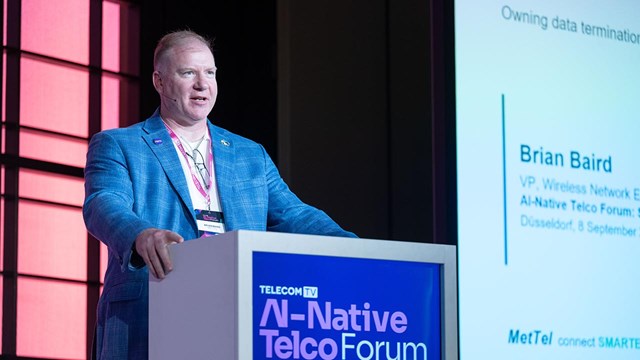
Brian Baird, VP, Wireless Network Engineering, MetTel
At the AI-Native Telco Forum 2026, Brian Baird, VP of wireless network engineering at MetTel, discussed why operators can only hold AI accountable by controlling the inputs rather than the trailing business outcomes, why the steady cycle of network change is over, how churn reduction translates into market valuation, the very different drivers of consumer and enterprise customers, and why telemetry data is the fuel for enterprise value.
Broadcast live Sept 2026