HPE on what it takes to deliver AI services with a public cloud-like experience
To embed our video on your website copy and paste the code below:
<iframe src="https://www.youtube.com/embed/aDhGhpa0a_s?modestbranding=1&rel=0" width="970" height="546" frameborder="0" scrolling="auto" allowfullscreen></iframe>
Guy Davies, HPE (00:09):
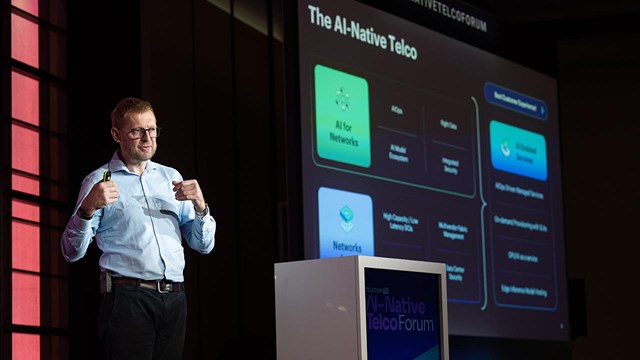
Good morning, everyone. First of all, I'd like to start with a little level set, if you like, as to what I think of when I talk about AI-native telco. Basically, we're talking about constructing networks that help you deliver AI, the high-capacity platforms, the fabrics, and so on. Also, using AI to assist you to operate those networks in the most efficient way. But ultimately, the goal, as I think was expressed earlier, was your goal is to deliver a set of services that delight your customers. Ultimately, building networks and consuming AI has no value unless you can deliver a high-value set of services.
(01:15):
So who are the consumers of the AI? So I see two main classes of consumers. The first are the machines, the networks, the compute, the WAN, the data consumers, in order to consume the AI for networking. But primarily, we want to be able to deliver services for people, for enterprises particularly, who are willing to pay for those services. And those fall across multiple domains, and many of you are familiar with all of those.
(02:05):
So when you deliver services, what are the customers looking for? Well, particularly the machines, they want deterministic-- I'd rather say deterministic behaviour, not just latency, but there are many other characteristics that the machines want to be particularly deterministic. The next is high availability, and we saw last week what a almost catastrophic behaviour when three of the foundation AI platforms all failed almost simultaneously. You had Anthropic, OpenAI, and Grok all went down same morning, and the US had this, "Ah! The sky is falling." So high availability of the service needs to be taken into account. You've got to be able to scale, you've got to be able to seek the best cost for each of your tokens, and you've got to be able to deliver services across multiple modes. You've got to be able to develop different vision AI. We've got vision AI there. I think that's a kind of specific.
(03:41):
When it comes to your end consumers, I think service personalisation is a big deal, and both from the perspective of the telco, because that enables you as a telco to enhance your ARPU that was mentioned earlier, the ability for you to sell, the ability for other service providers to add value to your customers, but also it enables your customers to consume AI in a way that delivers value most effectively to them. So when I talk to telcos, which I do on a relatively frequent basis, what comes to us from a requirements perspective from the telcos is they want to be able to deliver these kind of AI services with a public cloud-like experience, a self-service, minimal intervention from their own staff. They need to be able to consume or deliver these AI capabilities both in public and private cloud environments, and I'll come to why you might want to do that in a minute. When we talk to telcos, they also see themselves as a consumer of these services as an enterprise. Many of the telcos we talk to are tens of thousands of individuals as an enterprise. They're substantial enterprises in addition to delivering services to other enterprises. So all of this has to be end-to-end automated in order to be able, in effect, to deliver the public cloud-like experience.
(05:51):
So what are the risks to telcos looking to deliver AI services? Well, the first is an obvious one. The capital investments involved in certainly building private cloud AI are enormous. They're an order of magnitude higher than your typical telco cloud compute. In addition, the energy consumption of these platforms and the availability of adequate energy in individual locations is a big challenge. When we talk to telcos, they're also concerned about, "Okay, I can order this stuff. How quickly can I get it? How quickly, once I've got it, can I start developing services? Will my staff be ready? Will they be capable of delivering a set of services that this equipment enables?" So the time to market is a big deal. You're making this investment, you want your money back, certainly your CFO does, as quickly as possible. And so if we're looking at delivering this, we've got problems with energy in single locations. Maybe we need to deploy this in a distributed fashion, and we certainly, as Ahmed pointed out, this is a multi-domain problem. This is not a single domain orchestration platform. So how do we deliver or manage this as a coherent environment when we're trying to manage across multiple domains and multiple environments?
(07:49):
So from our perspective, the ways we propose to deliver this are primarily to construct modular, scalable platforms. Construct platforms that can be delivered initially on public cloud, that can be migrated to private cloud when the scale becomes larger, because public cloud, the economics tend to stop working very well when things get big. Use vendor financial services. I work for a vendor, I would say that. But vendor financial services enables you to mitigate the cost as a single capital purchase, make it into an operational expense. With respect to the energy, the primary focus is consume modern, more energy-efficient equipment. Each individual item, it will consume more, but it will deliver orders of magnitude more capability. That's the only way, and that's how you guys have been delivering with 5G compared to 4G. You know the maths.
(09:20):
The time to market is an interesting one. We recommend using pre-validated designs. Talk to the vendors who are delivering the product. They are making designs that enable you, once you've got the product, to build reliable, repeatable, and scalable solutions that enable your teams to start work. They also deliver frameworks within which you can consume the necessary tools to be able to deliver services, which is ultimately your goal. Now, for the biggest challenge, which has been mentioned already today, is the multi-domain orchestration. The only way I believe it can be broken down today is in a hierarchical model, where each of the domains that you work in retains its own AI models, its own AI capabilities, and you have an overarching orchestration, management environment, AI environment, that makes calls into each of those areas in order to request capabilities, in order to be able to deliver services, and to be able to function.
(11:05):
And I see I'm running out of time. So this is just a demonstration of how that is presented end-to-end multi-data centre with cloud, with compute storage. All the capabilities are handled. If anyone wants to see this in more detail, you're more than welcome to come and catch me at our desk. And the message really is that the network is fundamental to the ability to be able to deliver services that delight your customer. So then building those capabilities is the first stage, but operationalising them is really the key to making this work for you and for your customers.
Guy Daniels, TelecomTV (12:02):
Thank you very much indeed. Round of applause.
Good morning, everyone. First of all, I'd like to start with a little level set, if you like, as to what I think of when I talk about AI-native telco. Basically, we're talking about constructing networks that help you deliver AI, the high-capacity platforms, the fabrics, and so on. Also, using AI to assist you to operate those networks in the most efficient way. But ultimately, the goal, as I think was expressed earlier, was your goal is to deliver a set of services that delight your customers. Ultimately, building networks and consuming AI has no value unless you can deliver a high-value set of services.
(01:15):
So who are the consumers of the AI? So I see two main classes of consumers. The first are the machines, the networks, the compute, the WAN, the data consumers, in order to consume the AI for networking. But primarily, we want to be able to deliver services for people, for enterprises particularly, who are willing to pay for those services. And those fall across multiple domains, and many of you are familiar with all of those.
(02:05):
So when you deliver services, what are the customers looking for? Well, particularly the machines, they want deterministic-- I'd rather say deterministic behaviour, not just latency, but there are many other characteristics that the machines want to be particularly deterministic. The next is high availability, and we saw last week what a almost catastrophic behaviour when three of the foundation AI platforms all failed almost simultaneously. You had Anthropic, OpenAI, and Grok all went down same morning, and the US had this, "Ah! The sky is falling." So high availability of the service needs to be taken into account. You've got to be able to scale, you've got to be able to seek the best cost for each of your tokens, and you've got to be able to deliver services across multiple modes. You've got to be able to develop different vision AI. We've got vision AI there. I think that's a kind of specific.
(03:41):
When it comes to your end consumers, I think service personalisation is a big deal, and both from the perspective of the telco, because that enables you as a telco to enhance your ARPU that was mentioned earlier, the ability for you to sell, the ability for other service providers to add value to your customers, but also it enables your customers to consume AI in a way that delivers value most effectively to them. So when I talk to telcos, which I do on a relatively frequent basis, what comes to us from a requirements perspective from the telcos is they want to be able to deliver these kind of AI services with a public cloud-like experience, a self-service, minimal intervention from their own staff. They need to be able to consume or deliver these AI capabilities both in public and private cloud environments, and I'll come to why you might want to do that in a minute. When we talk to telcos, they also see themselves as a consumer of these services as an enterprise. Many of the telcos we talk to are tens of thousands of individuals as an enterprise. They're substantial enterprises in addition to delivering services to other enterprises. So all of this has to be end-to-end automated in order to be able, in effect, to deliver the public cloud-like experience.
(05:51):
So what are the risks to telcos looking to deliver AI services? Well, the first is an obvious one. The capital investments involved in certainly building private cloud AI are enormous. They're an order of magnitude higher than your typical telco cloud compute. In addition, the energy consumption of these platforms and the availability of adequate energy in individual locations is a big challenge. When we talk to telcos, they're also concerned about, "Okay, I can order this stuff. How quickly can I get it? How quickly, once I've got it, can I start developing services? Will my staff be ready? Will they be capable of delivering a set of services that this equipment enables?" So the time to market is a big deal. You're making this investment, you want your money back, certainly your CFO does, as quickly as possible. And so if we're looking at delivering this, we've got problems with energy in single locations. Maybe we need to deploy this in a distributed fashion, and we certainly, as Ahmed pointed out, this is a multi-domain problem. This is not a single domain orchestration platform. So how do we deliver or manage this as a coherent environment when we're trying to manage across multiple domains and multiple environments?
(07:49):
So from our perspective, the ways we propose to deliver this are primarily to construct modular, scalable platforms. Construct platforms that can be delivered initially on public cloud, that can be migrated to private cloud when the scale becomes larger, because public cloud, the economics tend to stop working very well when things get big. Use vendor financial services. I work for a vendor, I would say that. But vendor financial services enables you to mitigate the cost as a single capital purchase, make it into an operational expense. With respect to the energy, the primary focus is consume modern, more energy-efficient equipment. Each individual item, it will consume more, but it will deliver orders of magnitude more capability. That's the only way, and that's how you guys have been delivering with 5G compared to 4G. You know the maths.
(09:20):
The time to market is an interesting one. We recommend using pre-validated designs. Talk to the vendors who are delivering the product. They are making designs that enable you, once you've got the product, to build reliable, repeatable, and scalable solutions that enable your teams to start work. They also deliver frameworks within which you can consume the necessary tools to be able to deliver services, which is ultimately your goal. Now, for the biggest challenge, which has been mentioned already today, is the multi-domain orchestration. The only way I believe it can be broken down today is in a hierarchical model, where each of the domains that you work in retains its own AI models, its own AI capabilities, and you have an overarching orchestration, management environment, AI environment, that makes calls into each of those areas in order to request capabilities, in order to be able to deliver services, and to be able to function.
(11:05):
And I see I'm running out of time. So this is just a demonstration of how that is presented end-to-end multi-data centre with cloud, with compute storage. All the capabilities are handled. If anyone wants to see this in more detail, you're more than welcome to come and catch me at our desk. And the message really is that the network is fundamental to the ability to be able to deliver services that delight your customer. So then building those capabilities is the first stage, but operationalising them is really the key to making this work for you and for your customers.
Guy Daniels, TelecomTV (12:02):
Thank you very much indeed. Round of applause.
Please note that video transcripts are provided for reference only – content may vary from the published video or contain inaccuracies.
Guy Davies, Telco Cloud Architect, HPE
At the AI-Native Telco Forum 2026, Guy Davies, telco cloud architect at HPE, discussed what it means to build networks that deliver AI, who the consumers of AI are, what machines and end customers require in terms of determinism, availability, scale and personalisation, the risks around capital cost, energy and time-to-market, and how a hierarchical model can address multi-domain orchestration.
Broadcast live Sept 2026