To embed our video on your website copy and paste the code below:
<iframe src="https://www.youtube.com/embed/4OW35tJRlJg?modestbranding=1&rel=0" width="970" height="546" frameborder="0" scrolling="auto" allowfullscreen></iframe>
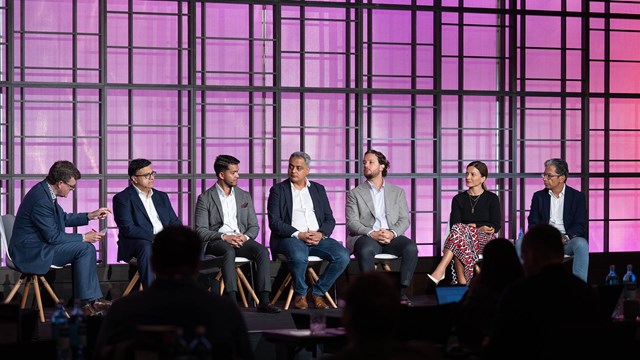
Okay, thanks very much. So we are looking at future challenges, which is the topic of our final panel to wrap up this year's AI native Telco forum. Four guests with me on the stage and I'm first of all going to get them to introduce themselves very briefly and probably don't need many introductions, but Dean, first of all,
Dean Bubley, Disruptive Analysis (00:35):
Hi Dean Bubley from Disruptive Analysis. I'm an industry analyst and advisor on telecoms and aspects of cloud and AI and policy and other stuff.
Guy Daniels, TelecomTV (00:46):
Thanks for joining us Dean.
Konstantinos Chalkiotis, Deutsche Telekom (00:47):
I'm Kostas Chalkiotis, vice president, Deutsche Telekom responsible for access networks and the 6G and also board member of Next Generation mobile networks as an industry forum.
Guy Daniels, TelecomTV (01:00):
Thanks Kostas and Ben, we just met, Ben?
Benjamin Hickey, IBM (01:02):
Hi, I'm Ben Hickey. I'm at IBM and I look after our software networking portfolio.
Guy Daniels, TelecomTV (01:07):
Great. And Itsuma?
Itsuma Tanaka, Docomo Labs Europe (01:09):
Hi, I'm Itsuma from NTT Docomo Euro Labs here in Germany and mainly working on the designs of the future infrastructure. So thank you.
Guy Daniels, TelecomTV (01:19):
Great, thank you. Good. Thanks very much for joining us. We are going to get straight on to some of the important questions that define future challenges and something that we've been talking about offline is there's a lot that we know that we don't know, which sounds a bit odd but there is a lot that we don't know. Dean, maybe I could start with coming to you first to set the scene for us on this one. What are the biggest unknowns that still surround this AI native telco model or vision if you like, that we've been discussing this past day and a half that could still cause us some serious challenges?
Dean Bubley, Disruptive Analysis (01:55):
I think I'm going to highlight one or two boundaries between different parts of the telecom industry and how AI will work either for learning or for inference across those. So if you think increasingly the telecom industry is divided into wholesale and retail layers, whether that's open access, fiber and retail, ISPs, MNOs and MVNOs and tower companies and you might have roaming between different operators. You essentially have, the telecoms industry isn't made up of just of vertically integrated companies. It's increasingly delea and segmented. So how do you run AI across those boundaries? If you say want to correlate retail customer perception and network performance where the network might be physically in building, we are in a hotel, they have both a wifi and an in-building cellular system to pipe wireless around the building which is provided by anyone's guess and how would you do resolution of a fault or anything else between all of those participants, most of whom you don't even know. I think that's a big problem for when you try and stick AI over the top of it.
Guy Daniels, TelecomTV (03:13):
Absolutely. Thanks very much Dean. Itsuma, have you got some thoughts on this as well?
Itsuma Tanaka, Docomo Labs Europe (03:17):
My biggest unknown is how deeply the AI goes into our architecture. Well architecture doesn't mean not only the technical architecture but including our business models and everything. How we run our telecom business today, and this is really a big question because it has a lot of impacts on what kind of governance we need to have around the rules, how we manage AI and what kind of interoperability we need to have. Exactly your point as well as well, we need to have this kind of ecosystem level discussion so that everybody can survive.
Guy Daniels, TelecomTV (04:06):
Absolutely. Thanks very much. Kostas. Any thoughts from you.
Konstantinos Chalkiotis, Deutsche Telekom (04:11):
To be honest, if we look back the last five to six years, we have seen a big revolution in the telco networks and I'm speaking about the cloudification in both fixed and mobile and also the operating of these aggregated networks and all these automated view and flavor and so on. Let's be honest, we cannot handle this with the traditional ways of operating networks. We need something that is radically different and saying something that is radically different. We need to think out of the box and bring, let's say real time embedded things in the network that can help us not only to interwork and make the networks operating more efficient. And I heard from the previous speakers that our target is to reduce opex. No. Our target is to find out a way how we can make the different segments that are now on the table to work perfectly like an orchestra and provide to the end users the best customer experience and in a most cost efficient way.
Guy Daniels, TelecomTV (05:22):
Yeah, and a big challenge. Thanks very much for pointing that one out. It's good. Ben, let's come to you as well because let's round out our opening about these biggest unknowns.
Benjamin Hickey, IBM (05:31):
Yeah, thanks Guy. I think there's a slightly different attack, there's sort of two big unknowns that are related. I think one that the pace of innovation is just so fast right now in AI and I think learning, we're seeing just the LLMs, you know what I mean? The large language models, what are they going to evolve to? We see a lot of specialist models coming out and I mentioned in the last talk we see from a non LLM model but a time series foundation model. So I think that's a big unknown is just to see what that innovation brings in terms of new foundation models and that feeds into the second one, which is really everyone that's really innovating in the space right now from a user, from an operator perspective is pretty much taking a DIY approach. How do I take a model? How do I write to an API from an open AI or corridor or how do I bring an open source model in what we've seen in other areas we were to look at one of the very rapid changing spaces is in the coding space and how AI is helping developers and you see companies that have emerged like Cursor and Windsurf and have broken new records fastest time to a hundred million ARR in revenue.
(06:46):
And so what's happening here is that's not a DIY approach, that's the AI is being used to build a product that can be used by an end user that's not a data scientist. And so we haven't seen that come into the telecom space just yet. So it's really what are the applications and products that come that are going to be for our users as opposed to data scientists and teams trying to build everything.
Guy Daniels, TelecomTV (07:13):
Yeah, that's going to be interesting to see if and when and rather how that manifests itself as we move forward. Dean, do you want to to pop in with some comments there or you were just listening technically to what Ben was saying?
Dean Bubley, Disruptive Analysis (07:24):
No, no. I'm going to carry on.
Guy Daniels, TelecomTV (07:26):
In that case. I want to just pick up with Kostas, because you were saying there about we need a new way of operating and part of this involves interconnection. We'll have you, Ben was talking about DOI approach. I'm curious if we do need this new way of working. Is this left to the individual telcos, the individual operators to decide that is is it a collective effort? Is it ecosystem effort? How do you force that?
Konstantinos Chalkiotis, Deutsche Telekom (07:51):
That's an excellent point to be honest, it's no way out. There is no other option for all the telco operators globally to operate, let's say to go into a full autonomous networks. We have seen that telco operator forums like NGMN IETF and also in three gpp we are trying let's say to identify how we can move to the full autonomous networks. We are not there yet. The problem that I see is that we have different voices and the speed that the AI is changing and it's transforming is tremendous. I have to tell you that in the last, let's say one year we have seen so many developments that we have not seen the last 20 years in the telco industry. And one of the things that I want share with you is that everything that we see now is post-processing. It's not real time. So the critical point for us is how we can have let's say the real time interaction by using all these AI agents embedded AI, you name it. Because there are all fancy names that are coming around in order to help us to maximize the benefits and reduce not only the cost of operating the network but also the resources that we're using for the network. Let's be honest, today all the mobile and fixed networks are standing there waiting for the users to come. Is this the right way forward?
Dean Bubley, Disruptive Analysis (09:23):
I think it's going to be very domain specific because I think that too much of the discussion is focused on the access network whereas actually most of the AI action is happening in the transport data center interconnect and in the middle of the network. And so I think the people who are operationalizing this first, oh yeah, people doing subsidy cables for example, not an area we would normally talk about, but they have very intense requirements on things like sensing. I saw yesterday and it was very tangible that the European commissioner on, well telecoms and cybersecurity spent twice as much time talking about integrity of subsea cables at the event I was at than she spoke about fixed mobile access. And that's a very specific domain you'll see also maybe in satellite it could be asset management for towers or whatever it is. And I think we'll all move at different paces that are domain specific and there will be some operators that have unique challenges and also suitable infrastructure and there's others that will take longer. So I don't think we are going to be able to have the telecoms industry, which to my mind anyway is pretty meaningless when you've got networks owned by oil companies and satellite companies that are owned by individual. I think telecoms industry is itself amorphous,
Guy Daniels, TelecomTV (10:46):
Interesting perspective. I do like that. Ben, did you want to come in?
Benjamin Hickey, IBM (10:49):
Yeah, I just wanted to sort of wholeheartedly agree about the domain aspect and I think that's been one of the things that holds back operations today is that things are siloed by domain. I mean this is when you have some of these tricky or these intractable issues come up, teams have to consult with one another transport team is consulting with the mobile core team, et cetera. So I think that's really been the limitation that the technology we've been living with up until now and AI will start to unlock that for us as we can start to look across the domain. So I think that is a big area to focus on.
Guy Daniels, TelecomTV (11:24):
Great. Any more points on what you've just heard there or views on opinions?
Itsuma Tanaka, Docomo Labs Europe (11:30):
The reason why many telecom operators, I'm addressing your point are focusing more on the radio access is that that's the biggest part of the mobile network today for sure. I mean amount of investment to build all the towers and everything. So if we want to get the best effect productivity out of ai, that is usually typically the first area to look at. But I think you are absolutely right, we need to also look at all the different perspectives. I mean telco is not just radio, right? So network virtualization, improving resiliency, all those things, bringing different access, it's onto the big picture. That's what we need to do.
Guy Daniels, TelecomTV (12:14):
And we talked at several points yesterday about the need for quick wins still and to balance the quick wins with the future development work, which I found absolutely fascinating. Lemme just move on a little bit. One aspect or trend I really haven't heard here in these two days is that there have been several operators mentioning the separation of AI for the network and basically the network for ai. You can phrase that in many different ways. There's different variations, sometimes it's two, sometimes it's three, whatever it might be. But there is this separation and I could understand this clear distinction is a distinction like that for this sort of more internal focused use of AI and then the supporting the external cases. Is this still an important distinction for us all to have and bear in mind as we move forward? Anybody want to
Dean Bubley, Disruptive Analysis (13:08):
I'll go for that. Actually it's interesting, we have someone from Docomo here,
(13:12):
But we don't have someone from the other part of NTT, which is one of the world's largest data center operators. I'm fairly sure the requirements they have for networking between their data centers and peering and everything else are very different to the ones we'll talk about for the ran. So I think that there, you've definitely got different networks for AI and also AI for networks and that will be an interesting example of a telco. I also think that there's certain parts with the overlap. So one of the things that where I think you you'll find those converging on the venn diagram is around some of the new stuff like sensing. So I think there's quite a lot of interesting stuff around combining communications networks and sensing where you need AI to make sense of the sensing data, but you might also be using the sensing data to protect the integrity of the network and certainly needs to go towards 6G. I think that's the main aim.
Guy Daniels, TelecomTV (14:05):
Yeah, we're going to hear a lot more about ISAC in the coming decade. Absolutely. Itsuma, do you want to pick up on this point as well?
Itsuma Tanaka, Docomo Labs Europe (14:12):
Yeah, so this distinction, it's for a clear purpose for us. The one AI for network, it's about improving our productivity, I mean our operational excellence. So there's a clear purpose why we want to use AI to do that. And for us network for AI as a more difficult question because it's talking about creating new revenue streams for us, creating new opportunities business for example with different stakeholders, other infrastructure relying on our infrastructure and things like this. So it's more complex, lots of unknowns and that requires more experiments, business experiments.
Guy Daniels, TelecomTV (15:01):
It reminded me because the last presentation we had a slide and it was some research from a firm that showed AI traffic on the network and this great curve coming up with this now for a long time I was associating AI traffic with chat-based traffic and then it occurred to me actually it's image-based, it's video traffic and if video is a big, the huge driver of network traffic now then we come onto the AI generation of video, which if you've been playing with some of these, I call them toys. Toys out there makes it so simple and easy. And that's the other phrase we haven't heard in two days is AI slop. We haven't talked about the slop, but surely this is going to be a big strain on our networks. Then you're jumping up been down about the traffic side of this.
Dean Bubley, Disruptive Analysis (15:48):
Frankly, if you're scrolling TikTok or Sora for an hour, it's a gigabyte of traffic, whether it was done with a human with a camera or on the backend, it's a robot there programming the bits. It's still an hour of video and it's still a gigabyte.
Guy Daniels, TelecomTV (16:06):
It cost us, this is a big traffic, big traffic for networks
Konstantinos Chalkiotis, Deutsche Telekom (16:11):
To be honest. All the big traffic needs an access network to be connected to the end users. And I'm challenging all these big boys and girls that says, yeah, we know the cloud, the hyperscalers and all the, if I switch off the mobile and fixed access tomorrow, how can you reach all these services that you are claiming? I don't see anyone. So the bottom line is that operators will be there and you see that all the big players, Amazon, Google, you name it, I will not name any other names, they try to enter the access domain, but as soon as they see that 80% of the spending is there, they push back and they say, I'm using your networks for free. Sorry guys, this is not for free. There are investments there and investments that needs to utilize these huge traffic and cope with this used traffic and networks that needs to be operated in the optimum way, utilizing spectrum, utilizing fibers, utilizing cables and other things that somebody has to invest in order to have all these things.
Dean Bubley, Disruptive Analysis (17:16):
And then we end up with the ridiculous policy discussions that we have in Europe and which frankly paralyze the industry for the last 15 or 20 years. There's been the same story of we're dumb pipes, please tax the cat clever people for us. And we're seeing it again with discussions around the DNA and all this nonsense about fair share regulating IP interconnect, which is the worst if you want to have networks for ai, you need more IP interconnect. And the worst thing the European commission could possibly do is do IP interconnect regulation when everyone including Barrack says it works perfectly, whereas certain company close to me on the panel would like to have a gatekeeping role in IP interconnect and I think that would be harmful for European AI.
Guy Daniels, TelecomTV (18:02):
Right. Well let's chuck the hot potato along. Ben, you're jumping up and down there in the middle I can see you. I see you're desperate to enter this. There's not at all controversial topic in one little bit. Did you want to say anything about this or we like to swiftly move on?
Benjamin Hickey, IBM (18:15):
I'll just make one comment because I do think the distinction of AI for networks and networks is an interesting one because it does bring a level of focus to what we're trying to solve for. And we spoke in the last session about the AI for networks and I think the key point I wanted to make on what Costas was saying is that it really is about the entire life cycle. So it's looking for AI benefits not just in operations but in terms of how we build networks. And to be honest, I think we're actually going to turn ourselves on our head in terms of how we design networks and I think there's a huge opportunity here just in terms of with these systems we can actually get to much higher levels of efficiency and open up new forms of services that we just didn't think is possible because let's acknowledge as network people, we're generally risk adverse people and when we're designing networks, we throw money, we throw CapEx, resilience and redundancy and things like that just to cater for these scenarios that are corner cases that might catch us out.
(19:20):
So when we start to bring AI into that, it will demystify it and it will allow us to actually build these networks in new ways and new efficiency. So that's one I agree with what the other panelists have said about the network for ai and in many cases you might say, we've been here before, we saw Netflix came out, we saw the huge move to streaming and we adjusted and we coped with it and we built the networks and they scaled. I think the thing that might be interesting to come with AI is what happens with these sorts of agents? We know we're going to have a lot of them, but where are they? Do we end up starting to deliver services not just to people via sim cards or modems, but do we end up starting to deliver services to agents and are they somewhere else? So as you move up the stack that starts to open up some new questions.
Guy Daniels, TelecomTV (20:10):
Great, thanks Ben. Yeah, it's important to really get to the number of some of these issues. They are so important. And there's another issue I'd like to introduce and I know there's differences of opinion about this one, but you see, you read, there's an awful lot of development coming out from the big players in the AI world. It it's not every month, every week it's every day I dare not open my laptop to see what the latest news is or they've changed something developed, something added, something you can barely keep up. And with that comes a huge amount of investment. This isn't an investment conference. We know there's a massive investment. We know that this bubble is inflating like crazy and at some point it will pop and we like to see what's left at the end and what we can use at the end.
(20:53):
But the decisions or the narrative has really been driven by a handful of big players. The money's going to this handful of big players. You look at any of these state, state-of-the eye reports and there are several of 'em out there and they're all massive documents. You'll rarely find telecoms mentioned in these documents. So is it a concern that telcos do not appear to have a seat at the big table, the big table where the big decisions are made and is shaping ai? It does not appear that there's a space with a little name tag that says Telco here. Itsuma. Is this a fair comment or do you disagree?
Itsuma Tanaka, Docomo Labs Europe (21:35):
I agree with your observation first of all and it's a big concern for us for sure. I mean to run whatever applications using ai, they need an infrastructure to do that. So we are definitely, well, we believe we are still a part of this big picture. But yeah, so emotionally it's sad, but yeah.
Guy Daniels, TelecomTV (22:00):
Thanks Itsuma. Kostas I think you probably said we are at the table. Do you think we are at the table here? Do you think we are influential here still?
Konstantinos Chalkiotis, Deutsche Telekom (22:10):
First of all, I would invite the participants to visit the NGMN homepage and there are two documents there. One operate in lops with the fully autonomous networks. It's there, it's a publication since February, 2025. So you will see how the operates are thinking about let's say the fully autonomous tion, how AI will play a role. And also one year ago we have published the operating disaggregated networks that they have also this flavor. So I would say that we're not let's say creating a big noise around this, but we're working on this as operator community. So on the other side, let's do not forget that we have huge, let's say developments within the last month, not year, on how to introduce AI into our operations, into our terminals everywhere in order let's say to help and improve the efficiency of the network. So I don't see that we're outside but we're not creating big noise, we're acting efficiently.
Guy Daniels, TelecomTV (23:21):
I just have come in before Dean does here, but I had like to just point out that during this day and a half we've had some great open discussion from Deutsche Telekom on what they're doing and orange and we had today a couple of operators here, we want to hear more in the next 12 months. We want more voices and we want them to share. So that's a call out for all your operators out there. It's an open invite come.
Dean Bubley, Disruptive Analysis (23:46):
We are currently sitting at an event called the AI Native Telco Forum. As far as I know, there is no equivalent event called a telco native AI forum. And I think there's a reason for that is that the AI industry doesn't think that telcos are that critical. I think the entry stake in the big world of ai, leaving aside the sort of AI for networks, you either need to be a semiconductor manufacturer or you need to be someone with essentially gigawatts of power for infrastructure. And I think those are the two entries points. And at the moment as far as I know, there's no telcos that roll their own chips or even design them or haven't. Maybe Docomo and SKT have Arm infrastructure licenses, I don't know. And in terms of power, I comment I made earlier on, I've yet to see a telco announcer, the nuclear energy strategy unlike every AI company and data center company on the planet pretty much. And so those are to me the table stakes and at the moment we are fine talking about AI for telcos, but telcos for AI, we're along down way down the list behind the IT companies. I would also say the defense industry at this point in time and a bunch of others as well.
Guy Daniels, TelecomTV (25:05):
We've got a lot of work to do and there's some great examples of work that it's been doing and you mentioned one resource there NGMN and stuff, but we've still got a lot of work ahead of us. Absolutely. Any more comments on whether or not we're at a table or can I move on? Because another area I'd like to get to before we run out of time is an area that hasn't really been touched too much during this day and a half and that's security. We hear regularly about prompt injection attacks and things like that. On the one hand we hear about new developments like MCP that could revolutionize how we deploy agents and communicate between applications. But then on the other hand, wow, they're just opening up the threat surface and there's ways in, it seems really, it's a bit wild west to me at the moment, but it's assume you must be looking at this as well. You must be looking at and considering where the implications are, what's your take?
Itsuma Tanaka, Docomo Labs Europe (25:57):
There are essentially three categories for security. First all security of the AI and security for the AI and security by the ai. So we need to basically protect AI itself or something internal like data injection and then how we protect the system that's security for the ai. And then the other one, security by the AI is like, well how we use AI to protect against those attacks or how we protect against attacks generated by the AIs. So quite a lot of topics around there.
Guy Daniels, TelecomTV (26:32):
I do and it is not something we can simply cover in about two minutes. You're right, there's different elements. It's almost Lincoln-esque how you approach this AI of and for and by. Ben, we've just had a talk with you about looking at trends and looking at the network trends. Security has got to be there
Benjamin Hickey, IBM (26:52):
And if I zero in on one thing you mentioned Guy, because we're taking this perspective of how can we build products for people to use that don't have to be data scientists. So when you see the excitement that came around with MCP being launched and how that could really extend a lot of this was in that kind of playpen if you like, people just trying to get something working, their goal was to just show how they could have one agent in one system talk to something else and get something working. What's missing from that and what's missing from MCP right now I'd argue is actually something the telecoms operators know quite well. And if you boil it down to something quite simple, and I'm an old broadband guy, right? It is just the old aaa. So if we think about agents communicating with one another via MCP, we don't have that yet.
(27:42):
We don't have the ability to authenticate and to authorize and to account. That's again, we've got one extra issue we need to tackle with these agents is this issue of goal alignment. Now if you think it's complicated to get goal alignment from a single agent and a single LLM, just imagine trying to get goal alignment from different agents that have been built by different people. So should this agent, I'm going to publish a set of tools that they could call. Should I allow this agent to call this based on whether I believe his goal is a goal that I'm aligned with? Now that's pretty complicated. So I think when we want to build in telecoms things like critical systems, we need to solve for that. But I think there's a lot of things we've done in the past that we can bring to bear here.
Guy Daniels, TelecomTV (28:28):
Great, thanks. Kostas, telecoms has always had to do with potential adversarial attacks and challenges to its integrity. Is this threat increasing the more we go AI native and the more use of AI.
Konstantinos Chalkiotis, Deutsche Telekom (28:43):
Of AI or not AI? I would say that whenever you're opening a system and you're opening APIs and so on, the risk is bigger. You're not working on a silo mode. So it's unavoidable that you will have this risk. How to protect your customer data, your let's say critical data and so on is a different story and we're working on a daily basis on this because otherwise you will see a lot of attacks and a lot of systems being down. And I would like to ask one question to the audience. How many of you are you using chat GPT? Yeah. You know that all your questions are published publicly in the entire community. No further comments.
Guy Daniels, TelecomTV (29:36):
Anyone? No? Let's be clear who's using chat GPT first of all, which I anticipate at least three quarters of the room will raise their hands.
Konstantinos Chalkiotis, Deutsche Telekom (29:47):
All the questions that you are asking chat GPT are communicated to the entire community of chat CPT. Nothing is kept for yourself.
Dean Bubley, Disruptive Analysis (29:59):
The projects were.
Guy Daniels, TelecomTV (30:01):
But there's different elements isn't there? If you're using the basic chat GPT as an individual, it's fair game.
Konstantinos Chalkiotis, Deutsche Telekom (30:11):
The key point is the following, if there is an open community, the information is flowing everywhere. So if you want to protect this, there is no simple way. That was my point.
Guy Daniels, TelecomTV (30:24):
Right, I understand. Got you. Dean, can I come to you about the changing threat landscape of AI and security, all this?
Dean Bubley, Disruptive Analysis (30:34):
Yeah, a couple of things. First off, physical security, whether that's subsea cables between data centers, whether it's your edge AI node being pulled off a lamppost by someone with a chain and a truck. There's that side of things to think about. The next thing is outside of AI, there may well be layers of security that relate to things like interconnection and IP, IP layer. There's been some interesting risks highlighted recently around BGP and DNS, which obviously has wider impacts but also affected AI. And then also I would say, given what we're talking about here about multiple different systems inside an operator and the authentication between them, at some point we're going to have to start having serious overlap on the venn diagram between post quantum cryptography and quantum key distribution and AI infrastructure. But again, that's more broad than just AI.
Guy Daniels, TelecomTV (31:44):
It's coming though, isn't it? Thanks so much, Dean. Before we get to our final question, I just want to open up to the audience because we've identified a few challenges here, future challenges for the ai, native telco, we might be overlooking some, so anybody thinks we're overlooking one or two challenges or got some notes or would like our panelists to talk a little bit further about some of those areas? We've lost Tony, but we've got Alex and he's got another microphone.
Francis Haysom, Appledore Research (32:14):
Hi there. Really interesting conversation. One thing that intrigues me, whether it's about AI or it's about edge in the network, is quite often as telcos we come from a telco perspective, we see it from a telco perspective and we see our natural place in being part of the solution, but often we don't look at what are the alternatives. So quite often when we go into this, we see a natural role for networking, AI networking in edge, but we don't see the alternatives, which is I unbundle it and I buy that component from somebody else and I assemble it. We saw that with telcos going into data centers in the early two thousands. To some extent we've seen that in the failure of far edge and MEC in terms of really taking off in that area, how much danger is there a danger that we are just seeing a natural bundling of our connectivity and in the end we get unbundled in that connectivity and that's all our role becomes? Or is there any natural way in which we can actually build real stickiness between AI and our networks?
Guy Daniels, TelecomTV (33:24):
Thanks Francis. Who wants to take that one first? Building the stickiness there. Anybody want to have a crack at this one?
Dean Bubley, Disruptive Analysis (33:31):
Alright, I, I'll give one example where I think that would make sense for telcos to be integrated and that's the stuff I've been doing with voice AI and where you can potentially put in-call AI functions into the voice path. And I think that that will probably require licensing and things like lawful intercept and there's a bunch of regulatory surface there so that if you, for example, wanted to do scam detection of you have a voice whispering in your ear, do not give this person your bank details for example. I think that would probably work better for a licensed operator rather than trying to run it through the cloud, both for regulatory reasons and latency.
Guy Daniels, TelecomTV (34:16):
Thanks Dean. Anybody else want to, are we okay? No more comments.
Itsuma Tanaka, Docomo Labs Europe (34:21):
Sorry. Maybe I haven't fully understood your question, with stickiness again, this network for AI and AI phone network, they have the two different contexts and really close thickness for let's say AI four network. Like look at open RAN, SMO, RIC, edge must be fully integrated, the compute resource must be there. So it's a really close integration. Whereas for the other services it really depends on the business model and what the customer enterprise customer wants really depends on the solution. So hope that answers your question, but.
Guy Daniels, TelecomTV (34:59):
Thank you. Thank you Itsuma.
Benjamin Hickey, IBM (35:01):
I think my observation I'd make is going back to a comment earlier, I think the observation really is as this debate is going on and guide this is I think what you were getting to, there's been people thinking about and I think what it comes down to is what are the frictions that are going to hold back the development of ai? And some of those frictions got quickly identified, energy being one, and I think Dean, you mentioned this point about everybody in the AI space starting to very quickly develop an energy strategy and looking at nuclear and things like that. I think the observation in the absence is people haven't identified a friction with the network, the telecoms network. So the assumption is it's just all going to be okay. And so that's kind of not there. So I think that's an open question too is I think what it's going to evolve and if you go back to the founder of Anthropic, Dario Modi, he wrote a really nice paper early on talking about the potential of AI going forward and one of the concepts in there which could be relevant and we're seeing it play out with these sovereign data centers and sovereign AI is this idea that countries have effectively a data center running agents 24/7 that represent an entire country's worth of geniuses.
(36:17):
So if we think about how the countries come together, how do they compete and add value in the global stage, you can start to see, well this national ability might come in and I think that's a sweet spot for the telecoms operators. So what do they do in that space? How can they become part of the conversation and deliver that kind of infrastructure that now there is a friction because not every country has these assets and what can they do to start to provide those in the future?
Guy Daniels, TelecomTV (36:47):
Thank you Ben. Okay,
Dean Bubley, Disruptive Analysis (36:49):
I was just going to say, I boil it down. The areas where AI will not facilitate unbundling if you like, are those where either regulation or physics gets in the way.
Guy Daniels, TelecomTV (37:05):
Speaking as a physicist, physics always gets in the way. Thanks Dean. Who would like to ask the last question of the AI native telco forum? We have time for just one more question and it looks like it's going to be in the front row. It's Andrew.
Andrew Collinson, Connective Insight (37:21):
Will telcos ever be AI native?
Guy Daniels, TelecomTV (37:27):
Say what you mean Andrew, I don't quite follow the question.
Andrew Collinson, Connective Insight (37:29):
Well, I mean we've had a lot of discussion about what's ahead and all that, but I mean talkers aren't AI native today, are they?
Guy Daniels, TelecomTV (37:36):
Will it happen?
Andrew Collinson, Connective Insight (37:37):
When will telcos become AI native?
Guy Daniels, TelecomTV (37:40):
This is a great question because the answers are going to be really short starting with
Andrew Collinson, Connective Insight (37:45):
No, when go with when Guy rather than if because "never" is an answer
Guy Daniels, TelecomTV (37:49):
You didn't say when is part of the question. It was just if I'm choosing "if".
Andrew Collinson, Connective Insight (37:51):
No, I refined the question.
Guy Daniels, TelecomTV (37:52):
You refined it, have you? Yeah. Okay. V two question. When.
Itsuma Tanaka, Docomo Labs Europe (37:59):
6G is one opportunity for the network to be really AI native like support from day one. That's my take.
Andrew Collinson, Connective Insight (38:07):
So when's that?
Itsuma Tanaka, Docomo Labs Europe (38:08):
When? 2030 ish.
Guy Daniels, TelecomTV (38:12):
Okay, that's good. That's good. That's about, that's really narrow.
Itsuma Tanaka, Docomo Labs Europe (38:17):
Thank you. Brave 6G timeline.
Benjamin Hickey, IBM (38:20):
Well I think if you go to the essence of AI in native and you think about how old technologies tend to live for a long time in telco environments, I think you're going to have to take a pretty long view here. So you're going to be looking at the 10, 15 years kind of mark. I would say
Guy Daniels, TelecomTV (38:37):
35/40. 2035/2040? Okay. Pessimistic, Ben. Kostas, we're not holding you to this and if the industry doesn't go AI native, we're not coming looking for you. So when do you approximately think we might be AI native tacos?
Konstantinos Chalkiotis, Deutsche Telekom (38:49):
Well first of all, apologies, I have not brought my crystal ball with me in order to see when this will happen, but I can tell you that the AI nativeness has started already. Maybe it's not a hundred percent end to end in the telco industry, but it's happening. It's happening. And the speed that AI is transforming the telco industry, it's tremendous. If I look back six months, you will see things that you cannot not even imagine. And there are operators and players that are taking brave decisions, discontinues legacy systems that are not, let's say, capable to be moved in the future. Moving into simplification, I heard that six G will be AI native. I believe that this will come earlier than six G and we should not stick to the regular 3G PP standardization around four or five years. The speed that of the deployment of all this embedded native AI will process.
Guy Daniels, TelecomTV (39:51):
Thank you very much. Kostas. Dean, have you got a flexi answer or you're going to pin your colors?
Dean Bubley, Disruptive Analysis (39:57):
I don't think it's related to 6G. I think 6G will end up being AI optional. I think that we will have the same thing we have with SA and NSA will have AI and N AI on wireless. I would probably look more to telcos in niche domains, whether that is satellite, whether it is new entrant in fiber access or fixed wireless and a few others. I don't think that we're going to have big integrated telcos with lots of legacy becoming AI native because they're legacy native.
Guy Daniels, TelecomTV (40:33):
Okay, fascinating. Well I think we're just at the very beginning of that study phase for the AI aspect of the run. Aren't we in three gpp? So maybe in December might get a few more statements about that one. So we watch that with interest. Right. Thanks for that question. I do want, I have one more question for our guests. It's a little lightning round question, call to action. Basically, if you had one call to action for the industry on AI, answering Andrew's point getting towards full AI native over the next 12 months. So between now and our next event, if you could say to the industry as a whole, you must do this, what would it be? I know it's putting you on the spot here, but Dean, what would that one thing might be?
Dean Bubley, Disruptive Analysis (41:16):
Understand semiconductor landscape a lot better than just talking about NVIDIA. I haven't heard, or maybe it was yesterday, I haven't heard a mention of, say for example Qualcomm or Broadcom.
Guy Daniels, TelecomTV (41:26):
Okay, that's good. Thank you very much, Dean. Kostas, is there one thing you might say to your peers?
Konstantinos Chalkiotis, Deutsche Telekom (41:32):
Yeah guys, make AI energy friendly and real time.
Guy Daniels, TelecomTV (41:37):
Great. Thank you very much, Ben.
Benjamin Hickey, IBM (41:39):
I would say continue on your very innovative approaches with DIY AI, bringing it in house, but keep at least one eye open for AI that's productized in new offerings that you'll be able to adopt much quicker.
Guy Daniels, TelecomTV (41:56):
Fantastic. Thank you very much, Ben. Itsuma.
Itsuma Tanaka, Docomo Labs Europe (41:58):
Let's make bigger noise so that we stay in the game. Thank you.
Guy Daniels, TelecomTV (42:04):
Great. Thanks for those four points. Round of applause for those four points. Yes. And generally for our guests, thank you very much. I'm going to ask them to stay right where they are though because just before we end this panel, I have been promising like crazy for a day and a half that we will look at the audience poll that we've been running. And because we've got our guests here, we might be able to have a quick comment on it. I've teased it plenty of times and we have received a record number of votes for this online poll. So thank you very much to all our online audience for voting. And if I click the clicker, this was the question we were asking, how can telco's best leverage AI innovation to improve operational efficiency and develop profitable new services? We gave seven answers you can vote from.
(42:47):
You could vote for more than one and hopefully if the live demo works, never do a live demo. If a live demo works, we should see the results. Look at that. I was doubtful, but it worked. So quick analysis of this, 55% work with vendors to develop new AI capabilities closely followed by fast track ag agentic AI capabilities. There we go. As a clear endorsement there, fast track your agentic work. So Philippe from Orange will be delighted to hear that. So he's got more work to do when he gets back to Paris and become, oh, 41% become AI native to prepare for six G and future networks. Yes, this is on the assumption that 6G will be AI native baked into the specs and not an option, but it may be an option. Right. Well thank you very much everyone for voting on that one, but any quick comments from our panelists on what they've seen there? Any surprises? Obviously it's an extensive and highly representative industry poll.
Dean Bubley, Disruptive Analysis (43:48):
Vendors want operators to work for the operators to work with the vendors. Makes sense. And actually I agree.
Guy Daniels, TelecomTV (43:57):
Whoa, there's a first. Dean agrees. So I think that's a really good point. Any other comments? We're pretty much happy with what we've seen there. No surprises. Great. Well there you go. We're in tune. That's it. So I'm going to just say again, please thank our guests for this panel. A round of applause. Thank you very much indeed. Thank you.
Please note that video transcripts are provided for reference only – content may vary from the published video or contain inaccuracies.
Panel Discussion
In the final panel of this year’s AI Native Telco Forum, experts from Disruptive Analysis, Deutsche Telekom, IBM, and NTT Docomo Euro Labs discuss the evolving landscape of AI in telecommunications. They delve into the challenges of implementing AI across different segments of the industry, the importance of network autonomy and the potential impact of AI on network operations and customer experiences. This discussion highlights the critical steps the telecom industry must take to harness AI’s full potential and prepare for future networks.
First Broadcast Live October 2025
Participants

Benjamin Hickey
Director, Product Portfolio Management, AI Networking, IBM

Dean Bubley
Founder and Director, Disruptive Analysis

Itsuma Tanaka
President & CEO, Docomo Communications Laboratories Europe GmbH

Konstantinos Chalkiotis
VP Access Technologies & Spectrum, Deutsche Telekom