Source: Beeline Kazakhstan
- Beeline and ZTE launch the ‘Magic Pole’
- The Linux Foundation doubles down on RAN
- Nokia shunts GSM-R into the cloud-native era
In today’s industry news roundup: Veon subsidiary Beeline Kazakhstan teams up with ZTE to launch eco-friendly infrastructure using AI in a bid to enhance urban connectivity; the Linux Foundation partners with the AI-RAN Alliance to accelerate AI-native RAN innovation and with ATIS to boost open-source, Open RAN and next-gen network innovation; Nokia to deploy a cloud-native core to boost the network performance of the Netherland’s national railway, ProRail; and much more!
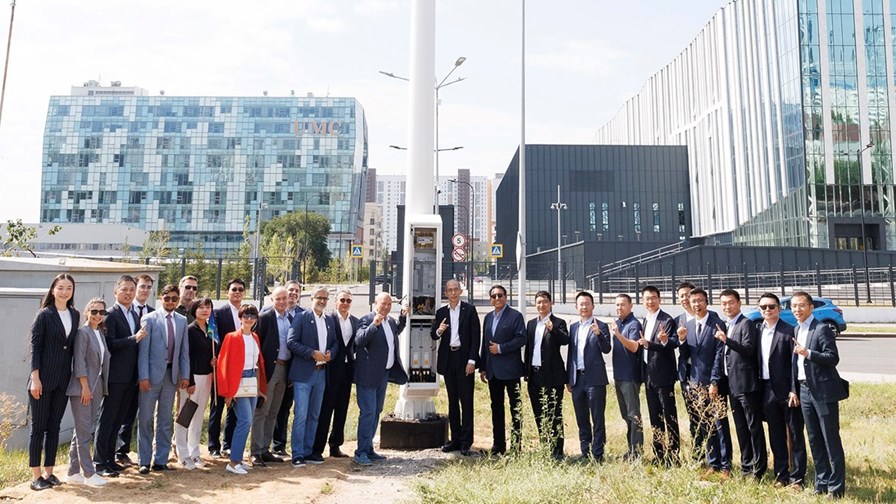
Beeline Kazakhstan and its vendor partner ZTE have launched the Giga City 2.0 initiative to support Kazakhstan’s ongoing digital transformation. Building on the success of the 2024 Giga City initiative, the new phase introduces a suite of AI-driven and environmentally conscious solutions designed to enhance connectivity and support sustainable urban development. Key highlights include the deployment of the first Magic Pole (yes, really) smart infrastructure solution in Astana, which integrates a mobile base station with street lighting. Along the Astana-Borovoe national highway, autonomous hybrid-powered telecom towers, which rely solely on solar and wind energy, have been installed to provide off-grid signal coverage in remote areas, reducing environmental impact and increasing resilience to extreme weather. The launch event for the initiative also showcased the Qcell solution at the Mega Silkway shopping mall, designed to provide improved indoor coverage. “The technologies that we unveil today respond to the soaring demand in Kazakhstan for high-quality connectivity everywhere, powering services that reach every corner of this vast country,” said Kaan Terzioglu, CEO of Veon Group, which operates the Beeline subsidiary. “We are delighted to serve our customers… with solutions that are the backbone of connected society.” In 2024, Beeline and ZTE completed a large-scale modernisation of the 4G network in the Akmola and Turkestan regions, including the implementation of frequency division duplex (FDD) massive MIMO. “For us, it’s essential to leverage cutting-edge technologies to create the best customer experience,” added Evgeniy Nastradin, CEO of Beeline Kazakhstan, “no matter the industry challenges”.
The Linux Foundation (LF) and the AI-RAN Alliance have announced a new collaboration aimed at accelerating innovation in AI-native radio access networks (RAN) and advancing the evolution toward 6G. Formalised through a memorandum of understanding (MoU), the partnership brings together LF Networking’s open-source development model with the AI-RAN Alliance’s mission to optimise AI integration in RAN, to offer improved network performance and flexibility through open innovation. AI is rapidly transforming the way radio networks are built and managed,” said Arpit Joshipura, general manager of networking, edge and IoT at the Linux Foundation. “This collaboration with the AI-RAN Alliance enables us to bring open-source principles and cloud-native innovation into the AI-native RAN space, ensuring transparency, interoperability and industry-wide impact as we evolve toward 6G.” Under the terms of the MoU, LF Networking and the AI-RAN Alliance will work together to support shared goals and promote progress in AI-RAN. “This agreement reinforces our commitment to building an open, inclusive platform for innovation in AI for RAN, AI and RAN and AI on RAN,” added Alex Jinsung Choi, chair of the AI-RAN Alliance and principal fellow at SoftBank’s Research Institute of Advanced Technology. “By aligning with LF Networking, we’re making it easier for developers, vendors, and operators to collaborate across boundaries and deliver AI-powered networks at scale.” For more on AI-RAN, including an explanation of the three AI models referred to by Alex, then make sure you download TelecomTV’s recent DSP Leaders report, Trends in Telco AI Infrastructure.
Whilst the jury is still out on the merits of all three AI-RAN models, the Alliance has already signed up more than 100 members, adding Vodafone in June, and there is some healthy discussion surrounding the commercial motivations for this approach to AI-RAN. But there is currently more appetite for Open RAN, so well done to the Linux Foundation for also signing an MoU with the Alliance for Telecommunications Industry Solutions (ATIS) to strengthen cooperation and accelerate the advancement of open-source and Open RAN technologies across US telecom operators. Both parties say this strategic agreement aims to drive progress toward open, intelligent and sustainable next-generation network architectures, including 5G and 6G. The partnership leverages LF Networking (LFN)’s open-source ecosystem to harmonise industry efforts, identify gaps and align on key priorities for the telecom sector. Key areas of collaboration will include joint education and training, the sharing of technical specifications and best practices, co-hosted workshops and technical sessions, and joint marketing initiatives to engage a wider operator and vendor audience. “By aligning with LFN, we are combining the strengths of open standards and open source to accelerate deployment of secure, sustainable and intelligent next-generation networks,” said Susan Miller, president and CEO of ATIS.
Nokia has been selected by ProRail, the operator of the Netherlands’ national railway infrastructure, to modernise its communications by deploying a cloud-native GSM-R core network, which it says is the first of its kind in the rail industry. The four-year project aims to reduce downtime, cut long-term costs and improve service reliability, while preparing the network for the transition to the 3GPP’s 5G-enabled Future Railway Mobile Communication System (FRMCS). By migrating to a cloud-native GSM-R core, ProRail will extend the life of its existing 2G infrastructure (yes, 2G, the 1990s’ vintage standard!). The upgrade is expected to enhance passenger safety and service reliability for millions, enable real-time data exchange and provide operational efficiencies, such as seamless integration of emerging technologies and lower total cost of ownership. “It is good to see that our partner Nokia is still investing substantially in the development of GSM-R,” said Geert Laureijssen, manager of mobile communications at ProRail. “With the migration towards a cloud-native core network, we lay the basis for the next 10 years of GSM-R operation and [it] prepares us for FRMCS.” Nokia will supply, install and maintain its Nokia Cloud Platform, which includes the Nokia Assurance Center, Packet Core, Registers, intelligent network and datacentre fabric. Additional upgrades will cover network management and automation tools, further increasing agility and efficiency. “By beginning the transition to a cloud-native architecture, ProRail is ensuring its communication systems remain secure, reliable and open to future innovation,” added Emanuele Di Liberto, head of global rail business at Nokia.
SK Telecom has announced that its AI-focused SKT Consortium has been chosen as a core team for South Korea’s Proprietary AI Foundation Model project, led by the Ministry of Science and ICT. The initiative aims to develop a full-stack AI platform covering semiconductors, models, data and services, with a commitment to offer much of the technology on an open-source basis to support domestic companies and accelerate the nation’s AI innovation ecosystem. A key focus will be the development of next-generation, large-scale AI models, featuring “omni-modal” technology capable of processing text, images, speech and video. SK Telecom has already released multiple versions of its proprietary large language model, A.X, which is trained on its Titan supercomputer, with performance reportedly comparable to GPT-4o. “With our proven technological capabilities and operational expertise, we will deliver the highest-quality Korean-style proprietary AI foundation model to empower AI for daily life in Korea,” said Kim Jiwon, head of the AI Model Lab at SK Telecom. The SKT Consortium comprises leading companies and academic institutions in Korea, including the Korea Advanced Institute of Science and Technology (KAIST) and Seoul National University, as well as companies focused on AI agents, inference chip manufacturing, games companies, and data and mobility specialists. It has already published more than 800 research papers and registered 736 patents.
– The staff, TelecomTV
Email Newsletters
Sign up to receive TelecomTV's top news and videos, plus exclusive subscriber-only content direct to your inbox.