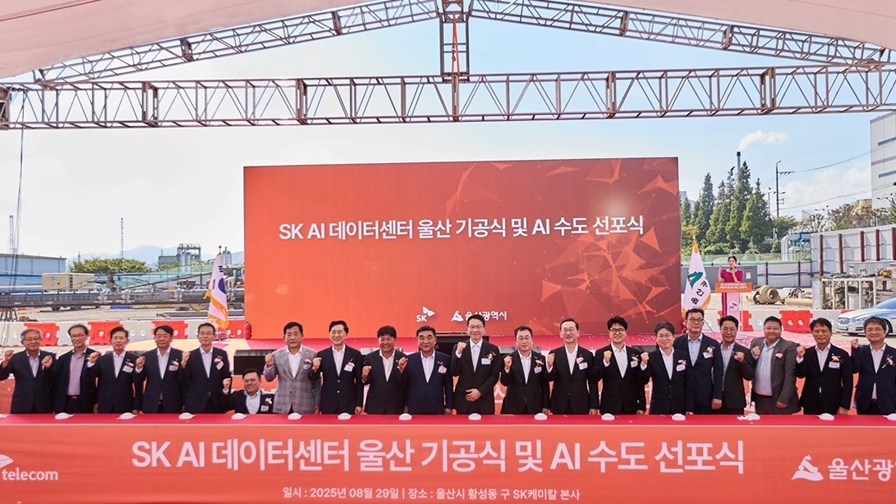
Executives attending the Ulsan AI datacentre groundbreaking ceremony pose for a group photo.
- SK Telecom’s parent company struck an AI datacentre deal with Amazon Web Services (AWS) earlier this year
- Construction has begun on the SK AI Data Center Ulsan
- SK Telecom has shared some interesting insights into the facility’s power consumption and the role of SKT’s corporate siblings in the SK Group
Earlier this year, SK Group, the parent of telecom and AI service provider SK Telecom (SKT), struck a 15-year partnership with hyperscaler Amazon Web Services (AWS) to develop and build a new AI datacentre in Ulsan, South Korea, and the construction work on that facility has just begun. To mark the occasion, SKT, SK Ecoplant (which specialises in datacentre sector-focused IT recycling and infrastructure design), AWS and Ulsan Metropolitan City held a “groundbreaking ceremony” for the SK AI Data Center Ulsan facility, which will be the foundational cloud infrastructure facility of an AWS ‘AI zone’ as well as a key part of SK Telecom’s AI infrastructure superhighway plans.
In a press release (in Korean) about the ceremony, SKT provided details of the facility’s infrastructure and power consumption, and outlined how a variety of companies in the broader SK Group will play important roles in the development and management of the facility.
The telco and self-styled AI company – which late last year revamped its operations, portfolio and structure to reflect its planned future as a provider of communications and AI services – noted that the Ulsan datacentre has been designed “to meet the world’s highest standards in AI computing-specific structures and systems, ultra-high rack density, air-cooled and water-cooled hybrid cooling systems, and stable network construction, boasting higher performance and efficiency than existing datacentres.”
It will feature high-density GPUs (graphics processing units) that consume between 20 kilowatts (kW) and 40kW per server rack: A datacentre not using GPU-based servers consumes an average of 5kW to 10kW of power per server rack, noted SKT.
In addition, “because they operate high-performance servers with massive power consumption, they also require cooling capacity of 40kw to 100kW per server rack, four to 10 times that of a typical datacentre.”
Ulsan is considered “the optimal location for the construction of this AI datacentre, thanks to SK Group's stable gas supply network, energy solutions, optimal land, favourable location for submarine cables, and an industry-friendly environment,” stated SKT.
The datacentre is expected to “drive industrial innovation and a manufacturing renaissance in Ulsan,” which is a “manufacturing-centered city”, noted SKT. The facility “is expected to serve as an opportunity for Ulsan to grow anew by improving the industrial constitution of the Ulsan region through AI innovation in existing manufacturing, such as AI-based digital twins and smart factories, as well as attracting related companies and creating new jobs through investment in AI infrastructure,” added the telco. It also noted that a large number of technology, environmental and energy firms are playing a role in the development, “including major affiliates of SK Group, such as SK Telecom, SK Broadband, SK Ecoplant, SK Gas, SK Chemicals, SK Multi-Utility, SK Hynix, and SK AX.”
This shows how SK Telecom is quite uniquely placed in the telecom sector, as it is able to call on the collaboration of other members of its parent company’s portfolio to help it branch into new areas, such as datacentre construction and management.
SKT emphasised this in the press release. “This project is expected to generate significant synergy between SK Group member companies, including SK Gas and SK Multi-Utility, which are located adjacent to the AI datacentre. SK Multi-Utility’s power plant, fuelled by LNG [liquefied natural gas] from SK Gas, will provide a stable power supply at a lower price than KEPCO [state-owned Korea Electric Power Corporation]. LNG cogeneration will also reduce greenhouse gas emissions while ensuring efficient datacentre operation,” stated SKT.
SK Ecoplant, meanwhile, is responsible for “building the infrastructure for the SK AI Data Center Ulsan”. It “conducted a systematic pre-construction review, including proposing optimal construction methods, establishing a core facility construction strategy, pre-constructing the infrastructure, ensuring power, air conditioning and communications stability, and improving cooling system efficiency… To foster the AI ecosystem in ICT, semiconductors and energy, [SK Ecoplant] will also accelerate the internalisation of AI DC [AI datacentre] solutions through collaboration with SK Group affiliates. In particular, SK Ecoplant can provide stable power infrastructure even in areas where large-scale power grids are difficult to secure through a fuel cell-based power supply system, and also possesses its own cooling system technology (WHRC – Waste Heat Reuse Chiller) that utilises the heat generated from fuel cells.”
The 100 megawatts (MW) datacentre is expected to start operations in 2027: About 78,000 direct and indirect jobs are expected to be created as a result of the development. According to South Korea’s ICT Ministry, SK Group is allocating 7tn won ($5.1bn) to the development and construction of the facility, of which about $4bn will come from AWS. That investment is in addition to AWS’s long-term $5.88bn planned investment in South Korea by 2027, noted SK Group.
At the ceremony, SKT signed a memorandum of understanding with Ulsan Metropolitan City to “collaborate on revitalising the local economy and creating jobs by building an AI datacentre and attracting customers, as well as expanding the hyperscale AI datacentre into a GW-level AI datacentre cluster in the future,” noted the telco.
SK Telecom CEO Ryu Young-sang stated in his speech at the groundbreaking ceremony: “The construction of SK AI Data Center Ulsan will serve as a focal point for driving innovation in the local industry and, from a national perspective, it is an opportunity to leap forward as an AI datacentre hub in the Asia-Pacific region. Building on the strategic foundation of cooperation between Ulsan City and SK Group, we expect the AI DC Cluster Construction to become the starting point for creating a new industrial ecosystem.”
- Ray Le Maistre, Editorial Director, TelecomTV
Email Newsletters
Sign up to receive TelecomTV's top news and videos, plus exclusive subscriber-only content direct to your inbox.