- SK Telecom has just launched its latest GPU-as-a-service (GPUaaS) platform
- As you might expect, Nvidia chips are at the heart of the deployment
- But a number of other tech partners are needed to enable the telco to quickly and efficiently provision such a service
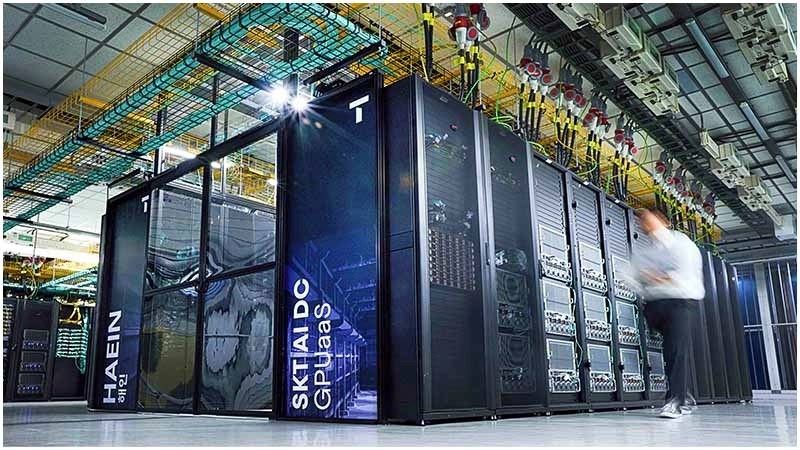
SK Telecom, undoubtedly one of the leading AI pioneers in the telecom operator sector, has just launched its latest GPU-as-a-service (GPUaaS) platform, dubbed Haein, and as you might expect it has Nvidia graphics processing units (GPUs) at its heart. But cutting-edge processors alone are not enough to provision a GPUaaS offering, so what else makes it tick?
Haein is the second GPUaaS platform deployed by SK Telecom (SKT), which is so committed to putting AI services and infrastructure at the centre of its operations that it unveiled a new corporate structure last year to help it capitalise on the growth opportunities in AI as well as communications services. Its first GPUaaS platform, launched late last year, was based on NVIDIA H100 Tensor Core GPUs: The new platform is based on a cluster of more than 1,000 Nvidia Blackwell GPUs, the vendor’s latest commercially available processor designed for AI workloads.
SKT has high hopes for this deployment, stating that it is “expected to contribute significantly to nationwide AI infrastructure expansion and the growth of the Korean AI industry,” as it will be used in the development of national AI foundation models.
Kim Myoung Gook, head of the GPUaaS Business Office at SKT, stated: “Haein Cluster’s GPUaaS will serve as a catalyst for enhancing both customer and national AI competitiveness. As an AI infrastructure provider, we are committed to building the nation’s AI superhighway.”
But, of course, there’s much more to the tech stack than some Nvidia GPUs.
As the telco noted in its recent announcement, the GPUs are housed in servers from Supermicro, which has just expanded its Nvidia Blackwell-based server portfolio, while Penguin Solutions provided the “integrated AI datacentre solutions”. Penguin Solutions, which designs, builds and manages high-performance computing systems that are used for AI workloads, used to be the brand name used by Smart Global Solutions, a company in which SKT invested $200m in July 2024: Smart Global Solutions has since adopted Penguin Solutions as its official company name.
That infrastructure needs state-of-the-art management and orchestration software, of course, and for this SKT is using what it describes as its “in-house virtualisation solution”, dubbed Petasus AI Cloud. This enables SKT to “instantly partition and reconfigure the GPU cluster according to customer needs, maximising its utilisation”.
SKT has also developed an AIOps (AI for IT operations) platform dubbed AI Cloud Manager “that efficiently manages the entire AI service lifecycle – from development and training to deployment. This platform, backed by extensive expertise in large-scale model development, enhances user work efficiency and development convenience,” according to the telco.
Integrated into the Petasus AI Cloud is an AI operating system (AI OS) – the disaggregated, shared-everything (DASE) platform – developed by New York-based Vast Data. According to the AI OS developer, “traditional AI infrastructure built on bare-metal environments often requires days or even weeks to provision new workloads, [creating] a major bottleneck for developers and enterprises”. But with the DASE AI OS, SKT “can spin up GPU environments in as little as 10 minutes, all while preserving near bare-metal performance” and “enabling a high-throughput, secure and multi-tenant environment that supports both AI training and inference at scale.”
According to Vast Data, “this deployment demonstrates how telecom providers are building sovereign AI infrastructure for nations that balance speed, compliance, control and cost, with Vast’s AI OS at the heart of this transformation.”
DK Lee, head of the AI DC Lab at SK Telecom, stated: “Vast Data’s unified architecture has been instrumental in helping us move from legacy bare-metal deployments to a fully virtualised, production-grade AI cloud. The Vast AI OS powers the performance, simplicity and flexibility needed to support the next generation of sovereign AI workloads, and gives us the confidence to scale fast and securely. With Vast, we’re enabling a GPUaaS platform that meets the exacting needs of government, research and enterprise AI customers in South Korea.”
Sunil Chavan, VP for APAC at Vast Data, added: “From our earliest conversations, it was clear that SKT needed cutting-edge infrastructure to match the speed and complexity of enterprise-grade uptime and nation-state inference and training. By eliminating traditional bottlenecks around data movement, provisioning and security, Vast is enabling SKT to launch a sovereign and secure AI infrastructure that offers speed and flexibility at scale for Korea.”
Such GPUaaS deployments enabled by best-of-breed multivendor systems are set to become more common in the telco community as operators look for ways to develop new revenue streams while meeting the fast-emerging AI needs of enterprise and government customers.
The potential of telcos to develop GPUaaS offerings was explored in TelecomTV’s recent free-to-download DSP Leaders report, Trends in Telco AI Infrastructure.
And according to professional services and consulting firm McKinsey, the potential for telcos to generate incremental revenues from GPUaaS is very real: It believes the value of the global GPUaaS market addressable by telcos could range from $35bn to $70bn annually by 2030, up from between $14bn and $25bn this year.
- Ray Le Maistre, Editorial Director, TelecomTV
Email Newsletters
Sign up to receive TelecomTV's top news and videos, plus exclusive subscriber-only content direct to your inbox.