- Telcos expect AI traffic volumes to increase significantly in their metro and long-haul data transport networks during the next three years, finds a white paper from Heavy Reading that was commissioned by Ciena
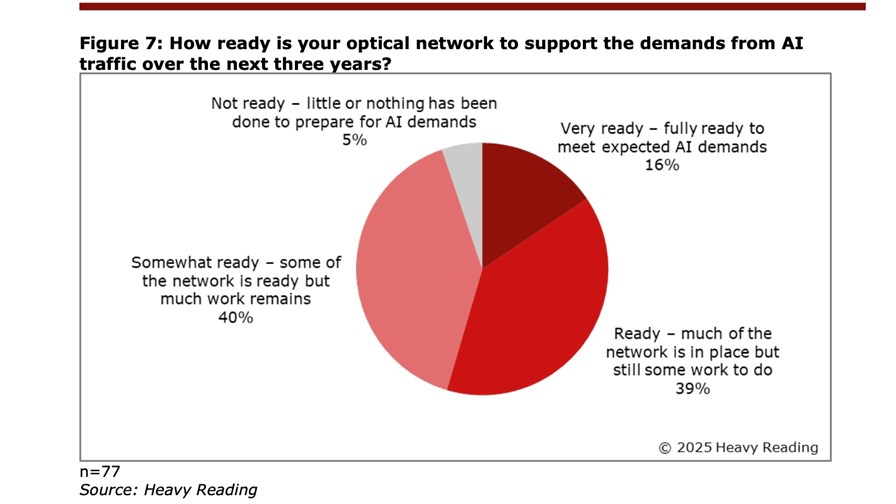
- But only 16% of operators believe their networks are ‘very ready’ to meet the demands of the AI traffic deluge
- There are multiple hurdles in the way of telcos taking full advantage of the opportunities that AI traffic growth will deliver, finds the report
Telcos expect AI traffic volumes to increase significantly in their metro and long-haul data transport networks during the next three years but only a small minority of operators believe their networks are ready for the anticipated AI traffic deluge, according to the results of a survey commissioned by Ciena and undertaken by research firm Heavy Reading.
The survey results, based on responses from 77 qualified network operator executives, are available in a free-to-access white paper, Optical Transport Networks for AI: 2025 Heavy Reading Survey Analysis – you can find a link to the report in this Ciena press release. The survey was conducted, and the white paper written, by Sterling Perrin, senior principal analyst at Heavy Reading, who has been covering the optical networking sector for decades.
The key takeaways from the white paper are:
- In long-haul networks, 29% of the survey respondents believe AI will contribute more than half of their total traffic during the next three years.
- In metro networks, 18% of the survey respondents believe AI will contribute more than half of their total traffic during the next three years.
- Only 19% of respondents believe AI traffic will contribute less than 10% of their total traffic in metro and long-haul networks during the next three years.
- Network operators expect high-bandwidth wavelength services (100 Gbit/s or greater) will be the dominant transport service for providing AI connectivity, followed by dark fibre.
- Low latency and high-bandwidth connectivity are the top two customer priorities for wavelength services currently, with 55% of network operator respondents reporting that low latency is the highest priority and 52% selecting high-bandwidth connectivity.
- The challenges facing network operators seeking to capitalise on the business opportunities associated with AI traffic growth are numerous (we will come to this in a moment)
- Only 16% of operators believe their networks are ‘very ready’ (fully ready to meet expected AI demands), while a further 39% believe their networks are ‘ready’ (much of the network is in place but still some work to do)
There is a lot more detail and analysis in the white paper, which is very readable, just 11 pages long, and comes with the seasoned analysis you’d expect from Perrin. Many of the survey results are broken out to show the different results that come from respondents in North America, home (currently) to most of the world’s hyperscale datacentres and a hotbed of AI action, and the respondents from the rest of the world (RoW).
Perhaps the most interesting regional contrast is related to the readiness of telco transport networks for the AI era. As the graphic above shows, the majority of operators are confident about the current state of their network infrastructure in terms of it being able to handle the expected rise in AI data traffic (albeit with ‘some work to do’ for 39%).
But as Perrin points out in the white paper: “North American respondents – which expect higher traffic demands from AI and are more concerned about network capacity compared to their RoW counterparts – are far less optimistic about their optical networks’ readiness versus RoW. Although 68% of RoW CSPs believe their optical networks are ‘ready’ or ‘very ready’ for the demands of AI, just 44% of North American CSPs believe the same. Whether RoW CSPs are truly prepared for AI, or simply are not yet seeing the traffic impacts, will become apparent in the next one to two years.”
Perrin concludes: “Although CSPs are currently relatively optimistic about their optical networks’ readiness for AI, it is very early days. For most network operators, the impacts of AI traffic have yet to be felt. Now is the time for CSPs to build business cases internally and prepare their networks for the coming AI traffic boom.”
It certainly seems that acting sooner rather than later would benefit those telcos looking to take advantage of the associated business opportunities that AI offers – after all, network operators are always seeking incremental revenue opportunities, and for those that have metro and long-haul data transport networks, this seems like an obvious opportunity to generate new revenues.
But the survey respondents have highlighted a number of challenges that could constrain them. While none of the hurdles was highlighted by more than a third of respondents (who were allowed to pick their two main challenges), there was a broad range “standing in the way of [telcos] taking advantage of the AI traffic boom”, noted Perrin in the white paper.
Capital expenditure (capex) constraints was the one cited by most (32% of respondents), followed by organisational hurdles, such as lack of management buy-in (30%), network security (30%), issues related to software/network management (27%), go-to-market/business strategies (26%), network capacity (23%) and power (22%).
Again, there was a difference in the results between North America (less concerned about capex and more about network security and organisational challenges) and RoW (with capex, go-to-market and network management regarded as the main challenges).
The report is well worth a read and, of course, the overarching takeaway that telcos have a new revenue stream staring them in the face but they need to invest in more optical network capacity and management systems in order to capitalise on the opportunities will be music to the ears of the team at Ciena, one of the leading providers of such technologies to the telco community.
The expectation is that network operators will indeed invest more in their optical network infrastructure in the coming few years: Just last month, research firm Dell’Oro Group noted that the optical transport networking technology sector, which shrank in value by 9% last year, is set to grow at an average rate of 5% for the next five years and be worth about $19bn in 2029. “We are anticipating that the time has come to interconnect all those new AI datacentres being built,” stated Dell’Oro VP and analyst Jimmy Yu.
The data network service opportunities afforded by the AI era is also a topic covered in the recent DSP Leaders free-to-download Trends in Telco AI Infrastructure Report.
- Ray Le Maistre, Editorial Director, TelecomTV
Email Newsletters
Sign up to receive TelecomTV's top news and videos, plus exclusive subscriber-only content direct to your inbox.