To embed our video on your website copy and paste the code below:
<iframe src="https://www.youtube.com/embed/_eFrcUpTy9s?modestbranding=1&rel=0" width="970" height="546" frameborder="0" scrolling="auto" allowfullscreen></iframe>
Charlotte Kan, TelecomTV (00:08):
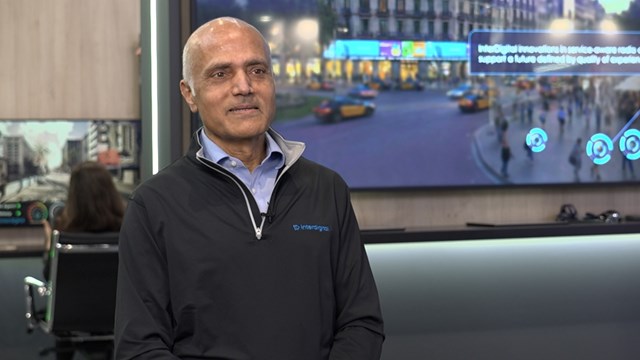
Hello everyone, and thank you for joining us here in Barcelona for MWC 2026, where we are joined by Milind Kulkarni, who is Head of Wireless Lab at InterDigital. Milind, thank you for joining us.
Milind Kulkarni, InterDigital (00:22):
Hello, Charlotte. Glad to be here.
Charlotte Kan, TelecomTV (00:25):
So everyone here is talking about AI, of course, but what does mobile AI actually mean? And is this really an inflection point for wireless or just another hype cycle?
Milind Kulkarni, InterDigital (00:37):
Simply put, mobile AI is a personal experience of intelligence that you can take with you. It is absolutely an inflection point. When you think about how people really are interested in taking their mobile AI everywhere they go with their smartphones or smartwatches or smart glasses, it is now possible. And it is made possible by the advancements we have in using small language models as well as some of the advancements in the chipsets that are on your devices.
Charlotte Kan, TelecomTV (01:14):
So an inflection point indeed, we are also hearing a lot around agentic AI in addition to generative AI. So does that not complicate things?
Milind Kulkarni, InterDigital (01:24):
Think of generative AI as the name suggests. It generates the answers for you based on its learnings. Agentic AI, on the other hand, goes a step further and it can make decisions for you. It can take actions for you and they are complementary to each other. They can work with each other to solve some of the most difficult use cases for you. We have demonstrations here where we are bringing together generative AI as well as agentic AI to solve a remotely operated autonomous vehicle operation when it gets stuck in a crowded situation. When you have a situation of the network getting degraded and a remotely operated vehicle getting stuck in traffic, the operator has to be able to manoeuvre safely and reliably out of that situation. So by using our agentic AI and generative AI together, we are able to demonstrate how to do that.
(02:31):
And we are now trying to bring those types of solutions into the principles of 6G network or the design architecture of the 6G network.
Charlotte Kan, TelecomTV (02:41):
So they are complementary solutions really. Also lots of discussions here around on-device AI. Why is it so central to the distributed model?
Milind Kulkarni, InterDigital (02:53):
Great question. Let us break it down a little bit. People know, most people know about the large language models, and these large language models, as the name suggests, are large in nature. They reside in cloud because they require large data sets. They require a lot of training. As you design the network, you have to be able to see if that is the most ideal situation for the language models to reside. When you start using mobile AI, it starts to stress the network because it has to transmit a lot of information in the uplink direction. Also, there is time involved from the time you send the information from the devices to the cloud and get the response back. So the latency becomes very important, as well as security in terms of the sovereignty of the data that is generated by the devices, comes into play. So we are working with our partners in 3GPP and we are using our leadership influence within 3GPP to come up with very creative solutions in how to address these types of problems.
(04:09):
And one example I can give you is how the distributed computing and communications come into play. As you design the architecture, you can determine where the computing and the model should reside, whether they are in the cloud, they are at the edge, or they are on the devices. And we have some demonstrations in our booth that depict exactly how to do that and take advantage of the distributed models.
Charlotte Kan, TelecomTV (04:38):
Milind, if traffic patterns and workload distributions are changing this dramatically, what does that mean for 5G Advanced and 6G overall?
Milind Kulkarni, InterDigital (04:51):
Let us start by saying that 5G Advanced has a very solid foundation today that supports mobile AI on your smartphones or on your smart glasses even today. However, most of these data transfers are textual in nature. As the demand grows for mobile AI and the video transfers will start to occur, that will start to stress the network. And we have to take that into account as we design the networks today. For example, as you start to transfer a lot more video images from your glasses through the network to the cloud, if you have the ability to do AI models on the devices, it reduces the stress on the network. As a matter of fact, we have some innovations that we have been researching along with some of our colleagues and partners in 3GPP that demonstrate how you can reduce the network stress and how the consumers will benefit through these innovations once they come into play and the AI models can be distributed in the 6G network.
Charlotte Kan, TelecomTV (06:04):
If you were to think of one word to describe the impact of AI on wireless, what would it be?
Milind Kulkarni, InterDigital (06:12):
Powerful. AI can bring a lot of benefit to the wireless network. When you think about the most complex problems and that have a lot of data associated with it, that is where AI becomes very powerful. When you start to go up the network stacks and when you think about network monitoring, autonomy, energy efficiency, spectral efficiency, all these areas can be enhanced and improved using AI. So
Charlotte Kan, TelecomTV (06:45):
To conclude this conversation, tell us about the role that you at InterDigital are playing in this AI ecosystem.
Milind Kulkarni, InterDigital (06:52):
InterDigital is a unique company that has been innovating in wireless and video for over 50 years. Today, we are bringing our expertise in wireless, video, and AI together to solve these technological problems, especially for the networks. As we look at the future, as we look at 6G and how it is being shaped, we have a very active participation in the standards bodies through our leadership. We have a very active research programme where we bring the innovations together. We work very collaboratively with our partners to standardise all these solutions. So in the end, the mobile network operators and the consumers as a whole will benefit from these technological advances.
Charlotte Kan, TelecomTV (07:50):
Thank you so much, Milind Kulkarni, Head of Wireless Lab at InterDigital.
Milind Kulkarni, InterDigital (07:57):
Thank you, Charlotte. It has been my pleasure. Thank you again.
Hello everyone, and thank you for joining us here in Barcelona for MWC 2026, where we are joined by Milind Kulkarni, who is Head of Wireless Lab at InterDigital. Milind, thank you for joining us.
Milind Kulkarni, InterDigital (00:22):
Hello, Charlotte. Glad to be here.
Charlotte Kan, TelecomTV (00:25):
So everyone here is talking about AI, of course, but what does mobile AI actually mean? And is this really an inflection point for wireless or just another hype cycle?
Milind Kulkarni, InterDigital (00:37):
Simply put, mobile AI is a personal experience of intelligence that you can take with you. It is absolutely an inflection point. When you think about how people really are interested in taking their mobile AI everywhere they go with their smartphones or smartwatches or smart glasses, it is now possible. And it is made possible by the advancements we have in using small language models as well as some of the advancements in the chipsets that are on your devices.
Charlotte Kan, TelecomTV (01:14):
So an inflection point indeed, we are also hearing a lot around agentic AI in addition to generative AI. So does that not complicate things?
Milind Kulkarni, InterDigital (01:24):
Think of generative AI as the name suggests. It generates the answers for you based on its learnings. Agentic AI, on the other hand, goes a step further and it can make decisions for you. It can take actions for you and they are complementary to each other. They can work with each other to solve some of the most difficult use cases for you. We have demonstrations here where we are bringing together generative AI as well as agentic AI to solve a remotely operated autonomous vehicle operation when it gets stuck in a crowded situation. When you have a situation of the network getting degraded and a remotely operated vehicle getting stuck in traffic, the operator has to be able to manoeuvre safely and reliably out of that situation. So by using our agentic AI and generative AI together, we are able to demonstrate how to do that.
(02:31):
And we are now trying to bring those types of solutions into the principles of 6G network or the design architecture of the 6G network.
Charlotte Kan, TelecomTV (02:41):
So they are complementary solutions really. Also lots of discussions here around on-device AI. Why is it so central to the distributed model?
Milind Kulkarni, InterDigital (02:53):
Great question. Let us break it down a little bit. People know, most people know about the large language models, and these large language models, as the name suggests, are large in nature. They reside in cloud because they require large data sets. They require a lot of training. As you design the network, you have to be able to see if that is the most ideal situation for the language models to reside. When you start using mobile AI, it starts to stress the network because it has to transmit a lot of information in the uplink direction. Also, there is time involved from the time you send the information from the devices to the cloud and get the response back. So the latency becomes very important, as well as security in terms of the sovereignty of the data that is generated by the devices, comes into play. So we are working with our partners in 3GPP and we are using our leadership influence within 3GPP to come up with very creative solutions in how to address these types of problems.
(04:09):
And one example I can give you is how the distributed computing and communications come into play. As you design the architecture, you can determine where the computing and the model should reside, whether they are in the cloud, they are at the edge, or they are on the devices. And we have some demonstrations in our booth that depict exactly how to do that and take advantage of the distributed models.
Charlotte Kan, TelecomTV (04:38):
Milind, if traffic patterns and workload distributions are changing this dramatically, what does that mean for 5G Advanced and 6G overall?
Milind Kulkarni, InterDigital (04:51):
Let us start by saying that 5G Advanced has a very solid foundation today that supports mobile AI on your smartphones or on your smart glasses even today. However, most of these data transfers are textual in nature. As the demand grows for mobile AI and the video transfers will start to occur, that will start to stress the network. And we have to take that into account as we design the networks today. For example, as you start to transfer a lot more video images from your glasses through the network to the cloud, if you have the ability to do AI models on the devices, it reduces the stress on the network. As a matter of fact, we have some innovations that we have been researching along with some of our colleagues and partners in 3GPP that demonstrate how you can reduce the network stress and how the consumers will benefit through these innovations once they come into play and the AI models can be distributed in the 6G network.
Charlotte Kan, TelecomTV (06:04):
If you were to think of one word to describe the impact of AI on wireless, what would it be?
Milind Kulkarni, InterDigital (06:12):
Powerful. AI can bring a lot of benefit to the wireless network. When you think about the most complex problems and that have a lot of data associated with it, that is where AI becomes very powerful. When you start to go up the network stacks and when you think about network monitoring, autonomy, energy efficiency, spectral efficiency, all these areas can be enhanced and improved using AI. So
Charlotte Kan, TelecomTV (06:45):
To conclude this conversation, tell us about the role that you at InterDigital are playing in this AI ecosystem.
Milind Kulkarni, InterDigital (06:52):
InterDigital is a unique company that has been innovating in wireless and video for over 50 years. Today, we are bringing our expertise in wireless, video, and AI together to solve these technological problems, especially for the networks. As we look at the future, as we look at 6G and how it is being shaped, we have a very active participation in the standards bodies through our leadership. We have a very active research programme where we bring the innovations together. We work very collaboratively with our partners to standardise all these solutions. So in the end, the mobile network operators and the consumers as a whole will benefit from these technological advances.
Charlotte Kan, TelecomTV (07:50):
Thank you so much, Milind Kulkarni, Head of Wireless Lab at InterDigital.
Milind Kulkarni, InterDigital (07:57):
Thank you, Charlotte. It has been my pleasure. Thank you again.
Please note that video transcripts are provided for reference only – content may vary from the published video or contain inaccuracies.
Milind Kulkarni, Vice President and Head of Wireless, InterDigital, Inc.
At MWC26, Milind Kulkarni, head of wireless lab at InterDigital, explores the importance of on-device AI in distributed network models, the impact on network traffic patterns, the ongoing innovations within 3GPP and more.
Recorded March 2026
Email Newsletters
Sign up to receive TelecomTV's top news and videos, plus exclusive subscriber-only content direct to your inbox.