From automation to autonomy: Building self-driving networks

By Clarence Reynolds
Mar 5, 2026
To embed our video on your website copy and paste the code below:
<iframe src="https://www.youtube.com/embed/hYWWLm8xsps?modestbranding=1&rel=0" width="970" height="546" frameborder="0" scrolling="auto" allowfullscreen></iframe>
Clarence Reynolds, TelecomTV (00:01):
I'm Clarence Reynolds at MWC26. AI at Network Scale is moving networks from reactive troubleshooting to proactive self-optimization. As operators manage millions of devices and sites, the line between automation and true autonomy is blurring rapidly. Sujai Hajela, EVP and GM, Campus and Branch networking at HPE joins us to explain how AI is transforming operations. Sujai, thanks for being with us today. Thank you. We talk a lot about measuring networks from uptime, but really people are shifting to understanding that it's not just uptime, it's a lot more about customer experience. Why do you think that change is happening?
Sujai Hajela, HPE (00:41):
It's a very important point you make. I mean, at Mist, when I started the company in 2014, the driving philosophy was up is not the same as good, which means the network being up does not necessarily mean the user connected to the network is getting a good experience. And why this was important is the fact that we were deploying networks. Every vendor was deploying networks out there, but was that network really delivering on the promise of a user having a good experience? That became our philosophy, that became our driving principle, and hence we say up is not the same as good.
Clarence Reynolds, TelecomTV (01:20):
Now, you have been saying that the future is going to be defined by self-driving networks. What does that mean?
Sujai Hajela, HPE (01:28):
A self-driving network is exactly that. A self-driving network, very similar to a self-driving car. But if you think about our philosophy, up is not the same as good. To deliver on that philosophy, the vision was the self-driving network. And in a self-driving network, it learns, it understands, it focuses on enriching the end user experience while reducing the cost of ownership of running that network. Can you give us some examples of self-driving networks? Absolutely. Let's really make it real. So I'll give you some real true scenarios that happened. There was a customer who had deployed video cameras at their front desk so that they could monitor who was coming in and who was going out. They had a party one day, and after the party, they realized that they had had a security incident. There was a theft that had occurred. IT and security said, "Not a problem.
(02:29):
We have the video recordings. We can take a look at what happened." When they actually tried to look at the recording, there was nothing. There was nothing. And everybody was like, "What just happened?" Because the camera was showing it had a green light. That means it was getting power. The problem was that that camera was connected over a wired network to a switch, which was connected back to the recording system, and that switch port was stuck. In a self-driving network, the network was automatically figured out the port is stuck, will unblock the port, and you would not have the issue which this customer experienced.
Clarence Reynolds, TelecomTV (03:10):
Excellent. Overall, what are the biggest benefits customers would see if they deploy a self-driving network?
Sujai Hajela, HPE (03:18):
The self-driving network I can articulate is down to three really critical benefits. Number one, the fastest deployment. We've had customers who have deployed over 3000 network elements in one night. That could take months. So in a self-driving network, you reduce deployment times from years to months, months to weeks, weeks to days, and sometime days to hours. That's the first benefit. The second benefit is a maniacal reduction in user generated trouble tickets. We have customers such as ServiceNow and the Gap who will fundamentally say the number of user generated trouble tickets reduced by over 90%. And third is a self-driving network delivers the best business outcomes. It actually makes an enterprise come digitally alive. Imagine you are in a hospital, unfortunate situation. Everything is checked out well. Now you're checking out of the hospital, you're on a wheelchair, maybe after a surgery, and you and your escort is waiting to figure out where the wheelchair is, when the wheelchair's supposed to be coming.
(04:35):
You can come out, take an app out, which will clearly visualize and give you the Uber experience. You will know where the wheelchair is, how much time it's going to take to get to you, and so on and so forth. So digitally bringing an enterprise alive is a third benefit of a self-driving experience.
Clarence Reynolds, TelecomTV (04:54):
Sujai, thank you so much for these insights.
Sujai Hajela, HPE (04:57):
You're most welcome.
I'm Clarence Reynolds at MWC26. AI at Network Scale is moving networks from reactive troubleshooting to proactive self-optimization. As operators manage millions of devices and sites, the line between automation and true autonomy is blurring rapidly. Sujai Hajela, EVP and GM, Campus and Branch networking at HPE joins us to explain how AI is transforming operations. Sujai, thanks for being with us today. Thank you. We talk a lot about measuring networks from uptime, but really people are shifting to understanding that it's not just uptime, it's a lot more about customer experience. Why do you think that change is happening?
Sujai Hajela, HPE (00:41):
It's a very important point you make. I mean, at Mist, when I started the company in 2014, the driving philosophy was up is not the same as good, which means the network being up does not necessarily mean the user connected to the network is getting a good experience. And why this was important is the fact that we were deploying networks. Every vendor was deploying networks out there, but was that network really delivering on the promise of a user having a good experience? That became our philosophy, that became our driving principle, and hence we say up is not the same as good.
Clarence Reynolds, TelecomTV (01:20):
Now, you have been saying that the future is going to be defined by self-driving networks. What does that mean?
Sujai Hajela, HPE (01:28):
A self-driving network is exactly that. A self-driving network, very similar to a self-driving car. But if you think about our philosophy, up is not the same as good. To deliver on that philosophy, the vision was the self-driving network. And in a self-driving network, it learns, it understands, it focuses on enriching the end user experience while reducing the cost of ownership of running that network. Can you give us some examples of self-driving networks? Absolutely. Let's really make it real. So I'll give you some real true scenarios that happened. There was a customer who had deployed video cameras at their front desk so that they could monitor who was coming in and who was going out. They had a party one day, and after the party, they realized that they had had a security incident. There was a theft that had occurred. IT and security said, "Not a problem.
(02:29):
We have the video recordings. We can take a look at what happened." When they actually tried to look at the recording, there was nothing. There was nothing. And everybody was like, "What just happened?" Because the camera was showing it had a green light. That means it was getting power. The problem was that that camera was connected over a wired network to a switch, which was connected back to the recording system, and that switch port was stuck. In a self-driving network, the network was automatically figured out the port is stuck, will unblock the port, and you would not have the issue which this customer experienced.
Clarence Reynolds, TelecomTV (03:10):
Excellent. Overall, what are the biggest benefits customers would see if they deploy a self-driving network?
Sujai Hajela, HPE (03:18):
The self-driving network I can articulate is down to three really critical benefits. Number one, the fastest deployment. We've had customers who have deployed over 3000 network elements in one night. That could take months. So in a self-driving network, you reduce deployment times from years to months, months to weeks, weeks to days, and sometime days to hours. That's the first benefit. The second benefit is a maniacal reduction in user generated trouble tickets. We have customers such as ServiceNow and the Gap who will fundamentally say the number of user generated trouble tickets reduced by over 90%. And third is a self-driving network delivers the best business outcomes. It actually makes an enterprise come digitally alive. Imagine you are in a hospital, unfortunate situation. Everything is checked out well. Now you're checking out of the hospital, you're on a wheelchair, maybe after a surgery, and you and your escort is waiting to figure out where the wheelchair is, when the wheelchair's supposed to be coming.
(04:35):
You can come out, take an app out, which will clearly visualize and give you the Uber experience. You will know where the wheelchair is, how much time it's going to take to get to you, and so on and so forth. So digitally bringing an enterprise alive is a third benefit of a self-driving experience.
Clarence Reynolds, TelecomTV (04:54):
Sujai, thank you so much for these insights.
Sujai Hajela, HPE (04:57):
You're most welcome.
Please note that video transcripts are provided for reference only – content may vary from the published video or contain inaccuracies.
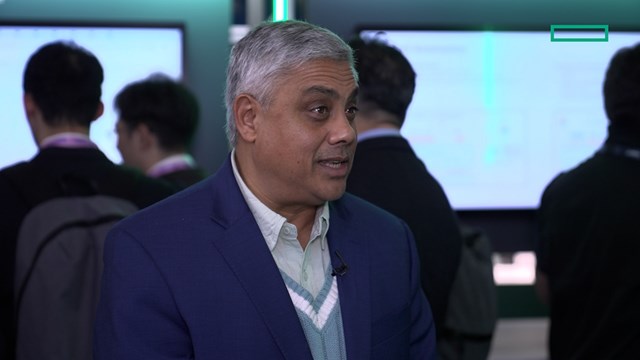
Sujai Hajela, EVP & GM, Campus & Branch, Networking, HPE
Sujai Hajela explains how AI-native automation is transforming network operations at scale. From predictive remediation to coordinated, cross-domain intelligence, he shares how HPE is building self-driving networks that deliver consistent, secure experiences across distributed environments.
Recorded March 2026
Email Newsletters
Sign up to receive TelecomTV's top news and videos, plus exclusive subscriber-only content direct to your inbox.