Source: SNS Telecom & IT
- The private 4G/5G wireless networks sector is thriving
- It’s set for a 22% CAGR over next three years, according to a new report from research house SNS Telecom & IT
- But the market is very fragmented – is anyone making any money?
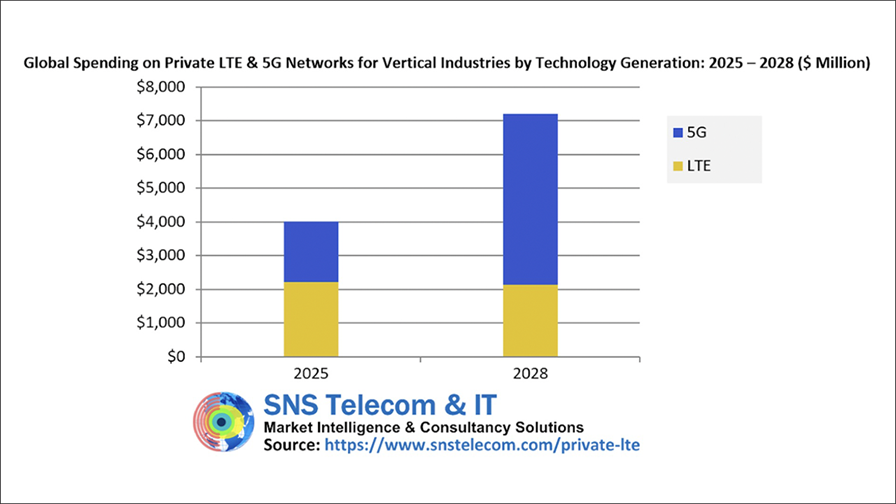
Global investments in private 4G/LTE and 5G networks for enterprise users is expected to grow at a compound annual growth rate (CAGR) of 22% over the next three years, up from about $4bn in 2025 to $7.2bn in 2028, according to a new forecast from research firm SNS Telecom & IT.
In a lengthy new report (2,872 pages), Private LTE & 5G Network Ecosystem: 2025 - 2030 – Opportunities, Challenges, Strategies, Industry Verticals & Forecasts, the SNS team identifies and analyses a number of interesting and important trends that highlight why and how the market is growing and will continue to do so in the coming years.
Private cellular networks, (or non-public networks), once a niche area of the overarching wireless networking industry, have become popular in recent years thanks to their attributes of privacy, security and reliability: Spectrum liberalisation also helped accelerate the provision of private LTE and 5G networks.
That said, many of the companies working within the sector, such as equipment vendors, system integrators and mobile operators, hold differing perceptions of what exactly constitutes a private cellular network. While it is generally agreed that “private LTE and 5G” comprises of “purpose-built cellular communications systems intended for the exclusive use of vertical industries and enterprises”, the report points out that they all differ in some respects, “including isolated end-to-end NPNs [non-public networks] in industrial and enterprise settings, local RAN equipment for targeted cellular coverage, dedicated on-premise core network functions, virtual sliced private networks, secure MVNO (mobile virtual network operator) platforms for critical communications, and wide area networks for application scenarios such as PPDR (public protection & disaster relief) broadband, smart utility grids, railway communications, and A2G (air-to-ground) connectivity.”
These days, private cellular networks are being deployed across a range of vertical industries, providing dedicated connectivity in factories, warehouses, mines, power plants, substations, offshore wind farms, oil and gas facilities, construction sites, maritime ports, airports, hospitals, stadiums, office buildings and university campuses. In addition, regional and nationwide sub-1 GHz private wireless broadband networks have been built for utilities, FRMCS (Future Railway Mobile Communication System)-ready networks for train-to-ground communications, and hybrid government-commercial public safety broadband networks. Custom-built cellular networks have also been implemented in locations as remote as Antarctica, and there have even been attempts to deploy them on the moon and in outer space.
While the report looks at both 4G and 5G deployments, it is clear the latter is starting to dominate deployments. By 2028, more than 70% of private cellular network investments are expected to be for 5G standalone (5G SA) infrastructure, which is well on its way to becoming the predominant option for Industry 4.0 apps in manufacturing and process industries, as well as critical comms over mission-critical broadband networks for sectors such as public safety, defence, utilities and transportation.
By the end of the decade, it is likely that the sector’s growth spurt will have transformed the private RAN, core and transport tech segments into something akin to a parallel equipment ecosystem existing alongside the public wireless network infrastructure sector. Furthermore, by 2030, private networks could account for as much as 25% of all mobile network infrastructure spending.
However, what’s also clear from the report is that the market is very fragmented, which suggests that consolidation is likely – it’s a moot point as to which vendors, if any, are generating profitable returns from their private cellular network technology sales.
Indeed, some companies are reconsidering their roles in the sector: Nokia, one of the market leaders, is the obvious recent example (more on this later).
The reality is that many companies provide only a small part of a private network deployment and are at the mercy of the main contractor (a large vendor or a systems integrator), making it even tougher to get a decent return: There are just too many of them pecking away at the cake, as the long vendor listing included in the report shows.
Increased spectrum availability also helping to power private 5G deployment
What’s clear, though, is that there’s a great deal of activity and investment in the sector currently.
In the past 12 months, the SNS team has added nearly 1,300 new projects to its database of private cellular network engagements, up from 900 in 2024.
The traditional wireless infrastructure players, such as the European companies Ericsson and Nokia, Huawei and ZTE of China, Samsung of South Korea and Japan’s NEC, still dominate the private cellular market in infrastructure sales, while some mobile operators and system integrators have developed their own infrastructure solutions for private networks.
While the larger European and Asian telecom equipment giants each reported between 50 and 170 deployments, smaller vendors accounted for 10 to 30 deployments each.
And 2025 has been a bumper year for private 5G, with the deployment of private wireless networks based on that set of standards overtaking 4G/LTE across many vertical industries.
The sector has benefitted from increased spectrum availability and liberalised regulation: For example, shared and local spectrum licensing frameworks for mid-band frequencies are accelerating the adoption of private networks. Regulators in multiple national markets, including Argentina, Australia, Bahrain, Belgium, Brazil, Canada, France, Finland, Germany, Hong Kong, Ireland, Japan, Lithuania, Moldova, the Netherlands, Norway, Poland, Slovenia, South Korea, Spain, Sweden, Switzerland, Taiwan, Thailand, the UK and the US, have either already released or are in the process of granting access to shared and local area licensed spectrum. Additionally, many national regulators are also making available other spectrum options suitable for specific verticals.
Meanwhile, mobile operators are exploiting their licensed spectrum portfolios, standalone 5G infrastructure assets and cellular networking expertise, as national mobile operators try to bolster their market presence and visibility by moving to deliver both physically isolated SNPNs (standalone non-public networks) and hybrid public-private networks. For example, US operators have introduced integrated neutral host-private 5G systems, sliced virtual/shared private 5G networks, and local breakout solutions with on-premise UPF (user plane function) nodes. The latter two of these examples are also being widely used by Chinese operators.
More opportunities for traditional vendors as hyperscalers pivot to AI
Interestingly, Europe’s major 5G equipment manufacturers, Ericsson and Nokia, are taking different paths in their approach to the sector. Ericsson is pushing its enterprise wireless capabilities hard, with the introduction of an end-to-end portfolio providing compact and scalable private 5G solutions, claiming it has won “several two-digit million-dollar deals” for multisite campus networks and adding that 83% of its new deployments are based on 5G.
On the other hand, just as it was approaching the impressive figure of 1,000 private network deployments, Nokia announced it plans to divest its ECE (Enterprise Campus Edge) integration and software business, having identified the unit as one that hasn’t been delivering decent profitable returns.
However, the Finnish company insists it isn’t quitting the private 5G sector altogether. A company spokesperson stated: “Nokia’s leadership position and commitment to the private 5G market remains unchanged”. Well, up to a point. It looks as if it is set to become an equipment provider rather than supplying the end-to-end private 5G solutions it spent so much time and money developing. Nokia does insist it will continue to provide small cell radios together with its own and third-party mobile core solutions through channel partners – see Nokia – ‘We’re not quitting the private 5G sector’.
According to the SNS team, channel sales already account for 70% of Nokia’s private wireless networks business.
Private 5G is also being boosted by a variety of solutions that enable device management, network visibility, traffic segregation, access control and threat prevention. At the same time, the hyperscalers have scaled back their ambitions for private 5G and are concentrating on AI and other opportunities that are a better fit with their extant cloud infrastructure and service ecosystems. Amazon has already discontinued its AWS (Amazon Web Services) Private 5G managed service, while Microsoft has dumped its Azure Private 5G Core service.
Finally, where the practical and quantifiable benefits of private LTE and 5G network are concerned, the SNS team’s report suggests end user organisations credit private cellular network installations with productivity and efficiency gains for specific manufacturing, quality control and intralogistics processes in the range of 20% to 90%, cost savings as high as 60% and an uplift of up to 80% in worker safety and accident reduction.
All the time in the background, the threat of sector consolidation is growing and it should be borne in mind that the service provider segment is not immune to it: 2026 looks set to be another interesting year for private 5G.
– Martyn Warwick, Editor in Chief, TelecomTV
Email Newsletters
Sign up to receive TelecomTV's top news and videos, plus exclusive subscriber-only content direct to your inbox.