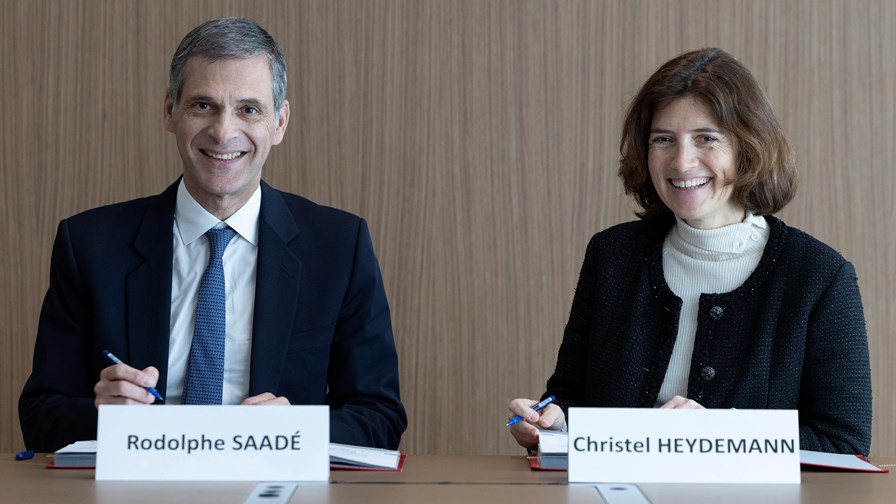
Rodolphe Saadé, chairman and CEO of the CMA CGM Group, of which Zebox is part, and Orange Group CEO Christel Heydemann put pen to paper to seal their partnership.
- Orange targets major enterprises with Zebox partnership
- Ofcom approves VodafoneThree’s D2D satellite licence
- Microsoft steps in as OpenAI scraps Norway datacentre plans
In today’s industry news roundup: Orange is tapping into an innovation hub to help develop new solutions for major enterprises; UK regulator approves change in VodafoneThree’s licence to allow it to offer direct-to-device services; OpenAI goes cold on Norway datacentre plan; and much more!
Orange has teamed up with Marseille-based Zebox, an “innovation accelerator” that is part of the giant shipping and logistics company CMA CGM Group, to “co-develop and deploy innovative technology solutions at scale, supporting the transformation of large organisations,” the companies announced in this press release. As part of the collaboration, Orange becomes a partner of Zebox, a move that the giant telco believes will help it to benefit from the “innovation capabilities of the startups supported by Zebox”. The partners will focus on working together to “identify, test and industrialise high-potential technologies across several shared priorities, namely: Digital infrastructures; AI and data; employee, customer and operational experience; digital trust and cybersecurity; and “responsible digital”. The partnership was sealed by Orange Group CEO Christel Heydemann and Rodolphe Saadé, chairman and CEO of the CMA CGM Group.
UK telecom regulator Ofcom has given the thumbs up to VodafoneThree to vary its licence to include direct-to-device (D2D) satellite services using its licensed spectrum in the 900MHz band. It is the second time the regulator has approved a licence in the UK, with Virgin Media O2 (VMO2) having gained approval earlier this year. VMO2 has already launched its D2D offering, O2 Satellite, which is enabled by SpaceX’s Starlink constellation of more than 650 D2D satellites. Vodafone Group, meanwhile, has its own space venture that will support VodafoneThree’s D2D ambitions as the telco giant has formed a joint venture with AST SpaceMobile (in which Vodafone is an investor) called Satellite Connect Europe, which will provide wholesale D2D services to operators, including multiple Vodafone Group operations, across Europe.
Sticking with Ofcom, the regulator has launched a technical consultation over its recent decision to split 6GHz spectrum between Wi-Fi services and mobile, and plans to expand the spectrum band further. In January, the UK regulator announced that low-powered Wi-Fi devices would be able to access 6GHz spectrum by the end of the year, giving it priority to the bottom 160MHz, while mobile services would have priority over the upper end. This latest consultation is over proposals to set high-density areas for 6GHz spectrum through a sub-national licensing approach, based on mmWave areas that already exist across the UK, to avoid potential interference. The consultation will remain open until 6 July, with plans to make a final statement by the end of the year: Details can be found here.
Last week we reported that OpenAI had shelved plans to invest in the UK through its Stargate datacentre project, impacting UK AI cloud company Nscale, but it seems this isn’t the only rowback from the ChatGPT owner, after news emerged that it has also ditched plans to rent Nscale compute capacity in Norway. OpenAI was due to take space at a planned 230MW Stargate Norway facility in Narvik, but a report from CNBC claims Microsoft will now take on the extra compute capacity instead, with the possibility of OpenAI renting it from Microsoft at a later date. A further report from Bloomberg (subscription required) says OpenAI was lined up to rent about half of the facility’s capacity, but Nscale and OpenAI failed to reach an agreement after the AI company stepped back, with Microsoft set to step in instead. “We are moving ahead with our plans in Norway,” an OpenAI spokesperson told CNBC. “Microsoft is an important partner in our network and we will work with them to access compute in Norway just as we already do in other parts of the world.”
Vodafone UK (which appears to be persevering with the use of a confusing standalone brand despite the merger of Vodafone UK and Three last year to form VodafoneThree) has launched an AI-powered detection tool for scam calls as part of its consumer security offering, Secure Net Mobile. Scam Call Protection flags fraudulent, spam, scam and nuisance calls for Vodafone mobile customers before they pick up. The tool offers round-the-clock monitoring to identify known scam numbers and detect unusual activity, then sends customers an on-screen alert flagging the potential nature of the calls, giving them the option to answer or decline. It has been integrated into Secure Net Mobile, which is an add-on feature that also provides Vodafone UK/VodafoneThree customers with other security tools, including advanced parental controls, round-the-clock ID monitoring, and real-time anti-virus and malware protection for £2 per month, after an initial free three-month period.
Having evolved from a startup with a $25,000 loan in 2006 to a communications platform operator and agentic AI developer with a valuation of more than $1bn, Vodnjan, Croatia-based cloud company Infobip believes it is entering the “most significant chapter in its history” as it strives to help companies adapt to the AI era. It notes in this announcement that, according to the results of research conducted by MIT (the Massachusetts Institute of Technology), just 5% of generative AI (GenAI) pilots “currently deliver measurable business value, with fragmented data and disconnected systems the leading barriers”, which is why Infobip is focused on the further development of its AgentOS platform, as it “addresses this directly, unifying customer data across marketing, sales, and support into a single AI-native orchestration layer, enabling enterprises to deploy agentic AI at scale with human oversight built in.” The company predicts that agentic AI will “define the next decade of customer communication with personal AI agents autonomously managing complex customer interactions, from booking travel to resolving billing issues, communicating directly with a brand’s own AI systems by 2030,” all of which, of course, requires secure communications and APIs.
The Digital Future Institute at the Abu Dhabi, UAE-based Khalifa University of Science and Technology has developed RF-GPT, which it describes as “a first-of-its-kind radio-frequency AI language model capable of interpreting wireless signals, overcoming a major limitation in telecom AI where language models typically operate only on text and structured network data.” RF-GPT, which was trained using approximately 625,000 computer-generated radio signal examples, “showed consistent performance improvements in radio frequency spectrogram tasks, outperforming existing baseline models by up to 75.4%, demonstrating strong radio frequency understanding,” according to this announcement from the university. The model “performed strongly across tasks, such as identifying signal types, detecting overlapping transmissions, recognising wireless standards, estimating device usage in Wi-Fi networks, and extracting data from 5G signals,” the university added.
– The staff, TelecomTV
Email Newsletters
Sign up to receive TelecomTV's top news and videos, plus exclusive subscriber-only content direct to your inbox.