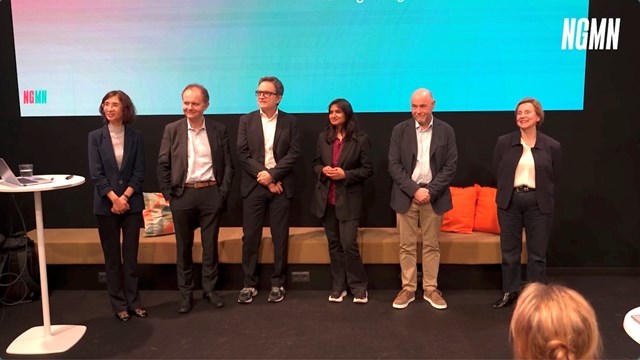
To embed our video on your website copy and paste the code below:
<iframe src="https://www.youtube.com/embed/_0Ow8eTLKfI?modestbranding=1&rel=0" width="970" height="546" frameborder="0" scrolling="auto" allowfullscreen></iframe>
Hello, you are watching the Cloud Native Telco Summit part of our year-Round DSP Leaders coverage. And it's time now for our live Q and A show. I'm Guy Daniels and this is the third and final Q and a program for this year's event. If you are one of our many new viewers who are joining us for the first time, then let me quickly tell you about the format. This is your chance to ask questions on cloud native and how it impacts telcos. The question form is right there on the webpage and your questions come straight through to me here in the studio. Now, as part of today's summit, we featured a panel discussion that looked at the growth of Cloud native and its impact on telcos. The panel has been available to watch on demand all day, but if you have not yet seen it, don't worry because we will be broadcasting it immediately after this live show ends.
(01:26):
So don't go away. Keep your browser tabs open. Meanwhile, do send us your questions. We have already received a number of questions, but we have plenty of time for more, just use the q and a form on the website as I said, and don't wait too long. Send them in, please as soon as you can. Well, I'm delighted to say that joining me live on the program today are Amajit Gupta, who is group CEO and MD of Light Storm, Mehran Hadipour, who is Vice President Business Development and Technology Alliances at Rakuten Symphony. Mark Longwell, Director Telco and Edge Alliances Hybrid Platforms Business Unit at Red Hat, Balaji Subramaniam, director of Product line Management at Blue Planet, a division of Sena, and Juan Carlos Garcia, Senior Technology and Innovations Advisor. Hello everyone. Really good to see you all again. Thanks so much for returning for this live show and Mehran, welcome to the summit. Well, let's get straight to our first audience question, and let me read this one out to you. Where have we seen the big successes in cloud native Telco? Can the panel give some examples? Well, Mehran, perhaps we could come to you first and get your views on some examples of successful cloudnative and give us your insights if you can please.
Mehran Hadipour, Rakuten Symphony (03:04):
Thanks. Actually, this is a great question. It's a question that everybody asking about how real this is. Is it really deployed and at scale can cloud native deliver and its promise for efficiency and agility for operators and so on? I think having been in the midst of deployment and production deployment of a large scale end-to-end network that is entirely cloud native including rancor O-S-S-P-S-S and the entire stack running on Kubernetes and having millions of subscribers running on it in both RMI and one-on-one is a key indication that first of all, this is achievable. It is real in the sense that operators could take on that challenge. And at the same time, the benefits that the operator received, both in case of Raku and Noble and one-on-one has been significant. It goes beyond just the ability to onboard network services faster. We see the savings on efficiency.
(04:24):
Kubernetes by nature is far more efficient than standard. We are deploying services as well as operational savings. 70% of the cost of telecom services recently has been proven to be operations. We showed that we can bring down operation costs significantly with the level of automation you can build in, into how network conscience are delivered on cloud native environment. So I guess those two examples and the fact that we are proven that in the field could be a great guide in terms of not only is this real operators should really think fearlessly about going that direction.
Guy Daniels, TelecomTV (05:15):
Great, thanks very much Mehran. A couple of good examples there based on your personal experience there and we've got some more views from the panel. So Balaji, let me come to you next and then we'll go to some others. But Balaji, what are you seeing? Can you give us some examples?
Balaji Subramaniam, Blue Planet (05:30):
Absolutely, guy, especially from the OSS perspective, we are seeing that within Blue Planet out of a hundred percent deployments, new deployments, 80% of them are completely cloud-based. We have seen success cases with Dish, for example, the O is completely cloud native and it's running on a public cloud. We also see the same thing played over in Europe as well. We have a couple of really large customers using either a public cloud or an on-prem version of how they want to do a cloud native principle and deploy Blue Planet software on that, if you will. And it's called also quite interesting, the wide variety of use cases you see across these different providers. One of them is completely 5G focused, 5G core, all the RAN aspects. And then the other one is around service, service order management and things of that nature. So absolutely there is a moment towards this direction if you'll
Guy Daniels, TelecomTV (06:37):
Great, thanks Balaji. As you say, a wide cross section of examples out there and Mark, what are you seeing as well? Can you point to any big successes for Cloudnative?
Mark Longwell, Red Hat (06:47):
Yeah, thanks guy. Yeah, so from the Red Hat perspective, we're working with customers like Verizon and Spark New Zealand and what we've seen is specifically with Verizon, we've helped 'em on a virtual network function journey over to CNF journey or cloud native journey through a variety of partners, whether it's Ericsson, Nokia, Samsung and others who are supporting Eric, excuse me, Verizon's move to cloud native. So we work with them in conjunction, we see more and more of the Verizon footprint being cloud native, moving from the virtual network function domain over to the CNF domain. And we're seeing that also with other customers such as Spark, New Zealand, Vodafone, Seago and others that we've written about over the last couple of years. So we're seeing the momentum. I think I'm just reiterating what my two previous panelists just mentioned. It's real, it's happening. Is it moving as fast as everyone wanted it? Probably not, but it definitely has momentum at the current stage.
Guy Daniels, TelecomTV (07:47):
Great, thanks Mark. Yeah, real and happening and as you say, I guess we all wanted to move faster and see more things happening quicker, but we've seen some terrific advancements so far. Juan Carlos, let me come across to you because I know you closely monitor this and you've been working within a telco and now you're working outside. So what's your perspective?
Juan Carlos Garcia, Independent (08:08):
Yeah, well today attending the Silva Summit in Vienna as part of the little fund nation open source summit, and I could see there are quite a lot of evolution in the telco clouds of big operators like Orange de Telecon, telephonic entity, common we are, I can see that they are not only speaking the cloud language but also following strict cloud principles in the architecture and design of their cloud infrastructure and also of the tools they're going to manage this infrastructure and the deployments on top of it. Most of them, I think they have completed the 5G, the brand of 5G standalone core. A good part is still over big machines, but they are preparing the introduction of container management for the deployment of cloud of the core. So I see operators really forward on these topics and I see also them attending the news foundation meetings and projects like an Silva.
(09:05):
And there you can see the mindset is changing and this is really something that we have always mentioned that telecom operators still were not there in terms of skills and mindset. This is changing. They're also becoming very practical in the telco cloud implementation. They're not trying to take all the specific features for only our functions. So they are trying just to use what is needed for each of them. And this is also a cloud mindset that they're applying. And finally they're not just designing and architecting the cloud infrastructure following based on open source mature cloud mechanisms, but they're also implementing labs to check the cloud native readiness of network functions. So they're also working on seeing how the applications, and so really I see that the telco industry getting and giving the steps to be more mature on cloud.
Guy Daniels, TelecomTV (10:02):
Well that's positive and that's good to hear Juan Carlos, thank you very much for those observations. Mehran, let's come across quickly back to you for a summation comment from you.
Mehran Hadipour, Rakuten Symphony (10:13):
I think a couple of things that I heard from my colleagues is that this whole idea of cloud native network functions and the challenge with not every network function you're using are going to use our cloud native has been an impediment to some extent, but we discovered that you can actually build a cloud native orchestration platform that can support running v NFS and CNFs concurrently in a common cloud native platform and build the infrastructure which is entirely cloud native and get the benefits of it in the operative point of view and not have to wait for everything to be containerized. And this has actually been a major, I think, advancement that pushes this whole cloud native ball forward. I mean all the network function providers are going to our cloud native, but it's going to take time. On the other hand, operators want to get benefits of cloud native or can be waiting for those to all become cloud native. So this idea of being able to run both winners and CNFs and the common cloud opens the door for acceleration of services being cloud native end to end.
Guy Daniels, TelecomTV (11:34):
Thanks so much for those comments and timely comments as well because on today's summit we also have a deep dive program for you on CNF workloads and containerized applications. So please do watch that if you can. It's on demand on the website as part of the cloud native Telco summit. Okay, thanks very much everyone. Let's move on to our next viewer question then. And the question asks, are there any cloud native trends that we should be looking out for? Is there another major advance coming with the impact that Kubernetes had? Interesting question because Kubernetes did have and is having a significant impact and influence. Juan Carlos, you just revealed you are at one of the Linux events now in Vienna. So what are you seeing? What's the latest from you?
Juan Carlos Garcia, Independent (12:25):
Well, something that the can see is gaining a lot of attention and also resources dedicated to it in CMCF and LE Foundation in general is web assembly was in cloud. This, this is not a new concept. No, it's already here for already more than five, maybe 10 years. No, but this getting to a point that is becoming mature and the amount of projects and developers that are dedicated to it is constantly increasing. It'll not be something that will replace coordinators or everything that is being done on the cloud will be something our to this and I think will be probably the next paradigm that will help to increase interoperability and portability that is often missing in the cloud. And I think if there is something to watch at this moment is the evolution of web assembly and everything that is coming with it in terms of tools and applications. In fact, you can see the first examples of how to deploy web assembly over Kubernetes. You can see also applications of web assembly in the telecom space and we'll see more of these probably in the next months and years.
Guy Daniels, TelecomTV (13:40):
Great. Thanks very much for those insights Juan Carlos, that's maybe something we ought to be looking at in next year's cloud native Telco summit. We might do a deep dive on that. Probably a good timing. Mehran, let's come across to you any major trends you are seeing?
Mehran Hadipour, Rakuten Symphony (13:56):
We do actually. I think something that has been a problem in end-to-end cloud native deployment of telco workload has been the challenges of orchestrational automation for deploying edge and run use cases on cloud native. I mean it's something to create a cloud native cloud and host O-S-S-P-S-S core networks on a large data center. But when you're deploying radio net access networks, you'll have thousands of nodes and clusters deployed in a remote geographic area with very limited IT support and with usually outdoors in some cases. So technology improvement on orchestration and automation is a key enabler of solving this problem. For example, we've been able to zero touch provision a gen B to run the U workload at the for H without intervention externally and then orchestrate the ongoing network functions on top of it and connect it to the core network and do all of that at scale with thousands of nodes being deployed concurrently at the same time, this kind of orchestration function. And I see a lot of vendors building these kind of capabilities in the market are going to accelerate the cloud native journey for the operators in a significant way because it pushes the cloud deving to the edge, which is where the problem actually lies, right? Because the problem of expense and cost and opex really lies at the edge and not as much at the core. So I see this evolving to even more capability in recent future.
Guy Daniels, TelecomTV (15:49):
Thank you very much Mehran for those observations. I've got a couple more comments on this question. Balaji, let me come to you then I'll go to Mark. But Balaji, what are your thoughts?
Balaji Subramaniam, Blue Planet (15:58):
So not so much as a new thing that is coming guy, but what I see is a lot more questions being asked about GitOps basically, right? So we all know that with a cloud native approach, GitOps sort of goes hand in hand like how you set it up, how you use infrastructure as a code, how you use configuration management for doing that sort of thing. So that I'm seeing that it's getting more and more revived in a way more and more customers asking about, Hey, how do we think about GitOps in this particular scenario? That sort of a thing. And along with that, I also see this quest for doing end-to-end testing and then making sure that those kinds of things are automated. I would say those are kind of complimentary and sort of going hand in hand with the cloud chat.
Guy Daniels, TelecomTV (16:48):
That's interesting. Yeah, we've been covering GitOps for some time and we do get a lot of questions from the audience specifically about that, about how to implement. Thanks for that. And Mark, let's come across to you for your comments on this question about trends and what we are seeing in the industry.
Mark Longwell, Red Hat (17:04):
Yeah, thanks guy. Yeah, I definitely agree with my colleagues here. Automation, gi, ups, everything like that. We are seeing that also the one thing that we're seeing a lot of is AI and ML integration, right? The integration of AI machine learning at the cloud native applications is on the rise. So Red Hat is working to streamline the deployment of ML models alongside traditional applications enabling more intelligent services for the service providers to roll out to the customers. I think we're all at the forefront of AI and ML and where it fits into telco. The journey has just started. Obviously it's picked up steam in the last 12 months. It's on everyone's mind and Red Hat and our partners are working hard to understand what's the best way to deploy AI and ML models in a telco perspective.
Guy Daniels, TelecomTV (17:51):
Great. Thanks so much Mark. And we will be picking up those themes next month in our AI native Telco summit and that's coming up next month. Great. Thanks everyone. Well let's move on to our next question and the question asks, will all telcos eventually have comprehensive cloud-native expertise or will many still have to use their integrator and supplier partners? Or maybe this isn't actually a problem at all. I'd just like to note that our viewer poll, which we will update in a few minutes, shows that hiring new talent isn't seen as a major problem, but retraining staff is a bigger problem. But getting back to the question, any thoughts on securing in-house expertise? Mark, can I come across to you first for this one?
Mark Longwell, Red Hat (18:40):
Yeah, absolutely Guy. Yeah. Securing in-house, I don't think we've seen a limit on new talent per se. Retraining obviously from old technologies onto newer technologies, that does take some time. What we think we're seeing is that it's going to depend on the service provider and in regards to how much talent they have, how far are they along in their journey to cloud native? Will they need a system integrator? Will they not need a system integrator? I think it depends on the individual service provider and the rollout that they're putting out there. If you're Verizon, you may have enough in-house talent to do it on your own If you're a smaller but potentially tier two or tier three provider, it may be best to hire a service integrator or a system integrator or a services partner to deploy, manage and run that network for you. But it's going to come down to an individual service provider's scenario, whatever geo they happen to be in.
Guy Daniels, TelecomTV (19:40):
Yeah, thank you very much Mark, for those observations. And Mehran, let's come across to you what your thoughts are on the issue of securing in-house expertise.
Mehran Hadipour, Rakuten Symphony (19:53):
It is a quite interesting, used to be a very problematic issue, this whole issue of expertise. There wasn't a lot of people you could hire that understood Kubernetes and can write home charts and do cucu commands on day in, day out, and a scale of operators require a significant amount of resources. But I think that's all changing and there's a technology answer to that. I think a lot of things we now do in terms of provisioning of network functions and workload is intent based automation. We basically don't write home charts for network functions. We have almost like an app store that is pre-provisioned with the appropriate configuration and the end users could be deploying on demand and it's all orchestrated centrally. And so the shift is moving from understanding Kubernetes and finding resources for that to really standard operational tasks and automations of those tasks. And we remove the complexity that existed by default because of Kubernetes. Nature is really away from the game. So I see that's going to remove or relieve a bit of that resource pressure as these software based from network functions are automated and deployment is automated and you really don't need to know Kubernetes to run network services on the cloud 90 pound.
Guy Daniels, TelecomTV (21:33):
That's interesting. A technology solution to an issue there or partial solution. That's fascinating. Who else wants to come in on this question? Juan Carlos, let's go to you next.
Juan Carlos Garcia, Independent (21:44):
Well, just to add that I think that cloud native Kubernetes in general is a paradigm change. That is another one in the telco industry. It's not the first time that the telco industry is in front of such a change, transformative national change. You may remember maybe 20, 30 years ago on the change from switch to package switch the introduction of the IP technology, the evolution to all IP networks at that time, operators were not ready for that. They had to do a strong effort to understand what was an IP packet, to understand how to build an IP network and how to operate and manage it. And the same thing is happening today with cloud native. And also in the same way as in the past there will be few operators within enough resources to cover all the needs that this transformation requires and likely will have to rely on a first instance on partners with cloud expertise.
(22:40):
I'm working for one of them in T data that is on this situation of supporting operators in this transformation and they may start the transformation with this partner while they retrain and prepare their staff and while the market is generating the resources they need to cover their demand. So I think there is again, another transformational change. It's not the first one and will not be the last one. And as always, I think they will have to rely on partners, many of them to go with this transition. But I think it's something normal. It is just a challenge. It's something that happens with the technology evolution.
Guy Daniels, TelecomTV (23:18):
Great, thanks. Juan Carlos and Amajit let want to come across to you. What's your experience with securing in-house talent? Do you have any firsthand experience with your telco? Anything you can share with us?
Amajit Gupta, Lightstorm (23:32):
Yeah, sure. Look, we have a recent experience of building a telco, which is not a wireless one, but which basically builds the backend and the wholesale one. But we are completely cloud native. Day one, day zero, we started cloud native. And from our recent experience having dealt with the plethora of software suppliers and system integrators, I can tell you it is not an easy experience. There is a tendency or one size fits all and is also the ability to be able to string together as a plethora of partners to fit in exactly to the business process that you need to implement it. So turns out that most of the OSS and even the BSS processes, which you normally assume are very simplistic to native port and cloud is not so easy at all. There starts a very basic problem. And beyond that of course the ability to port your business processes and drive the transformation that you really need to do, which basically is the underlying reason why you need to be cloud native if at all.
(24:44):
I think that really is where there's a lot of struggle to be able to map the business processes to companies who can really understand telco needs to transform at the end of the day, I mean cloud native is not an objective by itself. Business transformation of telcos turning into revenue machines, which they used to be is really the end objective. And the mapping of those business objectives to what these cloud native technologies can do is still a very difficult task accomplish. Whether it's a new telco such as ours or it is the old legacy types. That aside, I think there's a clash of cultures. Traditionally most software design backend design in telcos have been monotech. I call it built to last versus built to change. Cloud native is all about built to change because that provides you the flexibility and the scalability to be able to drive services at pace and that is the end objective which most telcos sometimes lose sight of in the quest to become cloud native.
(25:52):
And that's where I think the challenge lies of mapping together a plethora of partners. In our recent experience, we was confronted with a bunch of one size fits all solutions from a bunch of very renowned technology vendors. Also a bunch of one size of transformation fits all from a bunch of very renowned system integrators. And then of course we have to combine these two communities with a bunch of small startups, DevOp organizations who can understand needs quickly develop on the fly and be able to integrate all the things together. And in our experience, we ran from everywhere from Australia to Estonia to Stanford University eventually to build an orchestrator, which is of course Red Hat based, which completely transforms network operations by being able to talk the OSS APIs, the cloud APIs and network APIs, which is what the objective of transformation for a cloud native telco is.
(26:54):
I can tell you from firsthand experience about 36 months old, that's a much different, much difficult objective to achieve to even sift through the quality of technology suppliers and be able to integrate that to create the business transformation that you need to do. Of course you can rip up out something which is not cloud native and put them all in the cloud and claim cloud naivity, but it actually might not mean anything. So I put a lot of hope in the startup ecosystem, the smaller nimble startups who have plenty of stuff to put into use fast and also work at pace. And I feel dent about the pace of change which is yet left to be desired in very large system integrators, very large technology providers who seem to think that it's one size fits all, it's controversial. But I do want to table that without cracking this controversy. Telco industry can't change as fast as it wants to
Guy Daniels, TelecomTV (28:00):
And thank you very much for your honest views there and firsthand experience from a young telco startup and it is not easy. So thank you very much for sharing that. Right. Before we continue with our view of questions, it is time to check in on our audience poll for the cloud native Telco summit. As always, we ask our viewers a related question and give a selection of multiple choice answer options. And the question we have been asking you all this week is cloud native can deliver substantial benefits to telcos, but what are the main challenges to its adoption? And there you go, you can see the real time results appearing to my right there. As I say, we've been looking at this all week and it hasn't changed that much actually the number of votes has gone up significantly, but the overall trend has remained the same. Maturity of cloudnative software from vendors is ranking extremely highly and as we've just discussed, the difficulties of hiring talent that's very low. It's the lowest one at the moment. Now if you have yet to vote then please do so now. We are going to close the poll at the end of the week and then my colleague Ray Matri and I will analyze the results in next week's brand new extra shot program and more on that later.
(29:31):
We still have time for more questions and here's our next one and this one's related to the poll as well. So the question asks the panel today disputed, this is the earlier panel, the one that you can see on demand. The panel today disputed that lack of maturity of cloudnative software was a problem, but your poll suggests that it most certainly is seen as a problem. Yeah, so thanks for that question. Indeed, lack of maturity as we've just seen is currently the main challenge. So what is going on? Amajit, can I come across to you and pick up on what you've just been telling us really? We've talked about the talent side, but what about the maturity of software and the cloud native maturity of software in particular?
Amajit Gupta, Lightstorm (30:21):
Yeah, I mean truth being told, a lot of the telecom software, particularly the operation support systems has stood its test in time over many, many years and it's not an easy job for those software to be ported even to make it cloud native on a simple billing system. For example, in our experience we've found a lack of matching skills on the software vendors on that side of the table as opposed to the cloud side of table. For example, we in light storm have put all our oass, all our Salesforce oracle up into an Amazon cloud instance with not a single in-premise server and we serve about 70 terabytes and 90 large customers day in and day out with nothing in pre. We do that not because the cloud by itself gives us an advantage, but we do that because it helps us provide transformative services through orchestration and handing over the intact service discovery process to the customer, which really provides acceleration to the business.
(31:31):
So back to your question, I think the ability to put together all the part pieces and then marry the service transformation is where the biggest challenge lies and is compounded by the fact that many of the telco systems are still dated with codes which have been written many, many years back, which have to be almost retrofitted to be fit to the cloud. And that's the really strong truth about how the backend is. But as I said, the opportunity to transform on the back of creating new services with these cloud implementation is just tremendous. We have found a lot of adoption with our customers by doing so, and we have got very good feedback from our users after they having implemented that. So it's a tough journey, it's a slow journey, but indeed it's a journey worthwhile taking.
Guy Daniels, TelecomTV (32:30):
Great, thank you very much Amajit. We've got a couple more comments on this one, Balaji, let me come across to you first with your thoughts on the lack of maturity of cloud native.
Balaji Subramaniam, Blue Planet (32:39):
Yeah, absolutely guy. I think there is a bit of a nuance here when we talk about telco software and when you talk about maturity and so on. I think if you really look at it, the entire stack starts all the way from BSS and goes still the network and then you have an interplay of different vendors, different things sort of happening. You have business processes, you have technical processes and then you have the configuration and then what goes into the devices themselves, et cetera. So I think if you try to map all of them together, different pieces are at different maturity levels is what I feel. And the way they get integrated may not really be a cloud native problem, but we kind of need to look at it as a modernization problem and how does that play along with this? That is part of the perception. I would say on one hand we can say that it needs to be cloud native. On the other hand, how are we going to stitch all of those together? Do all of them have a level playing field? Something like can you use network as a service like principles? That sort of goes a little bit beyond cloud native, but I think thinking holistically probably will help us solve this problem in a better way.
Guy Daniels, TelecomTV (33:59):
Good points. Thank you very much Balaji for that. And Mehran, let's come across to you for your thoughts on this question that challenges the issue of maturity of cloud native software
Mehran Hadipour, Rakuten Symphony (34:14):
Cloud. I think there's a bit of nuance as I was mentioned in this whole question of maturity of cloud native software. I mean when you look at Kubernetes and maturity of Kubernetes to be able to run network functions, we have come a long way. Initially Kubernetes was designed to be stateless. For example, we have built software defined storage stack that can support stateful workload because obviously many of the telco applications are stateful. Our ability to run radio access network software with low latency requirement with the R-O-V-D-P-D-K and multi IPV four i PV six support, all those things are now available on leading Kubernetes providers. So you can run a radio network functions on Kubernetes. So I don't think the platform maturity is a problem. What might be the problem, especially for Brownfield customers is that there have variety of legacy software, much of which they don't want to use.
(35:19):
So they're tied into this whole path to modernization with justifying or selecting alternative platform for voice SBSS ran core or open ran direction versus onboarding existing functions which are probably might not be containerized on their Kubernetes infrastructure. So obviously we solved the first problem if they want to just move, lift and shift the existing applications, they could do that. But the main problem of application justification and picking the modern replacement of legacy applications, that gives them better time to market, improve functionality for the customers. That is a piece that's probably not as mature as it should be, but as Kubernetes become mostly standard and all operators want to run software based telco functions, all the providers would probably move on to that path and you will have more and more leading choices for cloud native functions that are a Kubernetes space. But until we get there and the Brownfield operators will always have this challenge, where would I start my modernization? Am I going to use the applications that I have as of now or will I be shifting to an open run use case for example, or change out my oss bss stack and so on.
(37:00):
The trade off here is that the change is expensive. Customers have to change their processes and business models, sometimes it's not just changing of the software, but on the other hand the benefits are also very clear. So I would say this whole maturity question is really a two side coin and depends on where you sit and whether you're greenfield or brownfield, you'll have more of a challenge in one way or the other.
Guy Daniels, TelecomTV (37:27):
Yeah, absolutely. Thank you very much Mehran. And I think from what you said earlier that we ought to do a poll of our telco viewers. How much of your legacy software do you really want to use? I'd love to find out what they really think. We've done an anonymous poll, we'll do that later in the year. Right. Thanks everyone for those comments. We have another question here we've just received, and let me read this question out to you. Can telcos really influence the direction of cloud native, especially within the open source communities? Do they the telcos have anything to add that will be useful to developers who are focused on other vertical industries? Interesting question. Balaji, perhaps we could come across to you and get your views on this.
Balaji Subramaniam, Blue Planet (38:16):
Sure. I think the answer is yes, telcos have a lot to offer in this area. We should shy away from doing that if you'll right said that. I would say just having a new technology or some new thing to contribute for the sake of technology is not of much use. I would say maybe we should follow the money a little bit here and then look at the principles as to why telcos tend to over-engineer networks and then why they try and how they tend to preserve CapEx and then spend those things and so on. So if you look at that, the telco workloads are very, very different from traditional enterprise workloads, right? There are demands on the data plane, there are a wide variety of demands on how you design these networks, et cetera. And then also there is this optimization problem that is very acute in telcos, right?
(39:09):
The edge resources are going to be expensive. So how do you make a decision where to do the placement, right? Are you going to do it in a centralized location versus an edge? And that is driven a lot by the application and how do you sort of think about it? How do you do that? How do you optimize that? These are certain areas that I'm pretty sure telcos can contribute back. And in principle how telcos approach these sort of things from a very, very OPEX focused lens and how they use different tools to do this is probably a learning that other industries can also take on and apply.
Guy Daniels, TelecomTV (39:49):
Okay, that's good to know. Thank you. Balaji, we've got a few more responses to this question. So Mark, let me come across to you next.
Mark Longwell, Red Hat (39:57):
Yeah, I think there's three or four places where the service providers can provide influence. One is working alongside the standards bodies in developing industry standards, whether it's Etsy, whether it's O Ran, et cetera. Participation here can help drive interoperability, which benefits really quite everyone in the cloud native ecosystem. And besides the standards bodies, as I mentioned Etsy or O ran, there's the open source projects. So take onap for network automation as an example with the service providers providing input there, contributing to the open source projects. Once again, we're creating as a community valuable tools and frameworks that can be leveraged by the whole partner ecosystem and by other service providers. We're on this consistent journey or constant journey to make integration easier to get services out quicker. And we're seeing telcos that are in service providers that are more engaged in the standards and the open source projects. And I think biology mentioned one thing also around collaboration with other industries, right? Have the service providers get engaged with the finance industry or the healthcare industry to help drive standards there that they can leverage into services for their customers. So from a Red Hat perspective, being a hundred percent open source company, we see service providers once again more engaged in the standards in the open source projects and engaged with other verticals out there, other industries such as financial and healthcare and so on and so forth.
Guy Daniels, TelecomTV (41:26):
Great. Thanks very much Mark. Good to see. Yes, get involved. We'll come to Juan Carlos next.
Juan Carlos Garcia, Independent (41:34):
Okay. Well first of all, just to say that I agree with Mark's observation on the role of operators, not just in the standards but also in open source communities. And this is something that we can see progressively increasing as I mentioned before. And what I see is that telcos are not just participating actively in communities now they're even leaving some of them and it's the case of Silva that they already mentioned or camera that is another one very popular in Linux Foundation in Silva. A good part of the developers and contributions are coming from telecom operators that there are somehow also setting the path through contributions of what needs to be in place to manage a telco cloud now. And I think we'll see this trend increasing as telcos are growing in cloud skills, very likely they will not provide all the code because I mean this is something that technology providers will have to accomplish, but they are somehow setting the path by adding contributions.
(42:36):
I also would like to say with respect to what valid observed, that not all telco workloads or network workloads are special and different and require special features from the cloud. So we must be very careful with this. And I think this is something telecom operators also are becoming aware of that telecom, some of them are very special and need to be treated, but not only with regards to what they can contribute to other industries, but I think that the complexity of telecom services, I think that a telecom network may be supported in hundreds of thousands of B CPUs may be distributed in the future in hundreds of nodes and with messes of tens of applications. So really will be complex setup of applications in the network. They will demand specific features and performance requirements for sure. And also high levels of automation because of this complexity. And all this I think may benefit of other industry that may have also this kind of challenging demands. No very highly distributed applications.
(43:49):
Something I see very good in the telecom operators is that now they have software engineers that are just looking at designing a cloud for the workloads it requires. And in many cases, again, these workloads are not treated specially in some cases. These are areas don't understand about the functionality of the specific network functions, but are more focused and interested in the requirements and they configure the telco cloud based on them on the requirements. And I think this is also very positive. They are applying cloud principles to telco workloads as they do, as they have done with os s, vss and the rest of it.
Guy Daniels, TelecomTV (44:36):
Great. Thanks very much for those observations, Juan Carlos. Let's also come across to Amajit for your thoughts about this question which asks about can telcos really influence the direction of cloud native and will it have anything useful to add to those other developers in other industries?
Amajit Gupta, Lightstorm (44:54):
Yeah, sure. That's a very interesting question. To me, it's an existential question for the telco industry. It's time the telco network was opened up to be programmable. That's how the cloud built this stature that it is. And today, if you look at any telecom network, I think wireless is gradually getting it thanks to people like Rakuten, but most of the wireline network, I mean we run ourselves is so hard to program with the inherent network gear and the APIs that they provide. But eventually I think the question that you ask, can they contribute? Yes, of course because the network provides location thousands and thousands of customers and loyalty to which services can be provisioned. But if only we could open up this network completely programmable first to our customers in light storm, we are doing it. We let our customers program the network, almost self service themselves from discovery of the service to provisioning deprovisioning capacity up or down.
(45:57):
We provide what is called NA services and common partners, but then is it possible to be able to open up those APIs and this platform for open source developers to be able to sell it back to the thousands of customers that we have. I think eventually open source developers and the ability to marry and match services for which telcos own this brilliant smart pipes is where the secret lies. I know I'm generalizing and probably elevating it into a very high level, but eventually that's the destination that we need to aim and everything else that comes in the ways tool, I see telcos really, really move towards that. And most advanced progressive telcos that I talk to seem to be thinking on those directions. The path is not easy. The tools and tackles are different for different telcos and that's where the struggle lies and it's work in progress.
Guy Daniels, TelecomTV (46:55):
Great. Thank you very much Amajit. Mehran, did you want to come in on this question as well? It looks like this may well be our final question of this program because the time is progressing really is advancing very, very fast. So Moran, did you want to come in on this question about how telcos can contribute and influence the direction of cloud native?
Mehran Hadipour, Rakuten Symphony (47:15):
If I may, I think the point I was going to make relevant to this, coupled with some of the really insightful comments from our colleague is that Telco has a lot to offer. I mean Kubernetes being a very large open source community and they're all, I would say mostly started in the price space looking at Telco as something foreign. But there are a few places that Telco have unique requirement that would grow Kubernetes to areas that hasn't been before. Give you for example, for example, in telco use case around edge deployment, we are not talking about Kubernetes clusters that on a single node or running on a server or even all the way to the IOT devices. So we scaling out cloud native all the way to the far edge and ability to be able to do that is important for Kubernetes. Second is around security operators have very unique challenge with security, right?
(48:23):
Everything that they deploy is distributed. The network security is essential. This is critical technology protecting how people talk to each other. So the enhancements in security can be really driven by some of the telco requirement. And the last piece, I think this whole idea of idealization of operators with the goal of getting into self-manage networks and there's a lot of room for AI companies to contribute. We will have a huge initiative on organization across track and for example, and I see a lot of benefits around taking the use cases in telco and applying AI to it. For example, power is a big challenge for operators and we work with Intel as an example to build a AI based model to take a look at the performance and change the power requirement on the for inch nodes to save 30% plus power, which is a significant expense for operators. So the door is just opening on what AI can do for telco and there's the use cases that's coming. That direction could help Kubernetes direction as well, I think in a big way.
Guy Daniels, TelecomTV (49:38):
Great. Mehran, thank you very much indeed. Well, unfortunately we are out of time now. So thank you all very much indeed for joining us for this live program. And that is almost all we have for you this year. Don't forget the poll. There is still time for you to have your say. And the more votes we receive, the more reflective the results will be of current industry thinking. You can watch all of the programs from this year's summit on demand from our website featuring this incredible lineup of industry experts. What a stellar group that is. Thank you to all of our speakers and sponsors and viewers for supporting the DSP Leaders Summit series. We will be back next week for our new look Extra Shot program, when I will be joined by telecom TV's Ray Le Maistre, and we will take one final look at the highlights from the summit, the main talking points, the key takeaways, and of course the final poll analysis. And for those viewers watching us live, we are going to broadcast today's panel discussion immediately after this program. So do stay with us. The next topic for our summit series is the AI native telco and you can take part in that next month. For now though, thank you so much for watching and goodbye.
Please note that video transcripts are provided for reference only – content may vary from the published video or contain inaccuracies.
Live Q&A discussion
This live Q&A show was broadcast at the end of day three of The Cloud-Native Telco Summit. TelecomTV’s Guy Daniels was joined by industry guest panellists for this question and answer session. Among the questions raised by our audience were:
- Where have we seen the big successes in cloud-native telco?
- Are there any cloud-native trends we should be looking out for?
- Will all telcos eventually have comprehensive, in-house, cloud-native expertise?
- Is ‘lack of maturity’ of cloud-native software really a problem?
- Can telcos really influence the direction of cloud native, especially within the open-source communities?
Speakers

Amajit Gupta
Group CEO & MD, Lightstorm

Balaji Subramaniam
Director of Product Line Management, Blue Planet, a division of Ciena

Juan Carlos Garcia
Senior Technology and Innovation Advisor

Mark Longwell
Director, Telco and Edge Alliances, Hybrid Platforms Business Unit, Red Hat

Mehran Hadipour
Vice President, Business Development & Technology Alliances, Rakuten Symphony