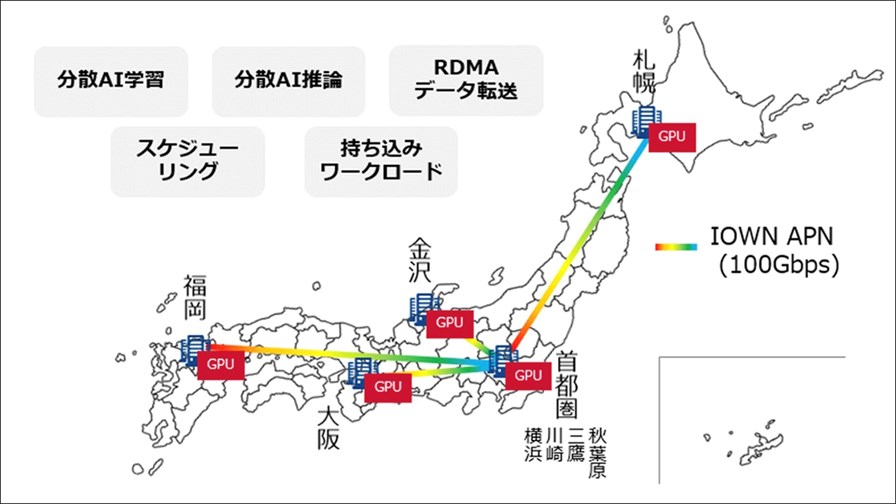
NTT Docomo’s nationwide ’GPU over APN’ testbed.
- NTT Docomo unveils ‘GPU over APN’ testbed
- Fibercop and Nokia collaborate on advanced network sensing
- VodafoneThree advances its anti-fraud efforts
In today’s industry news roundup: NTT Docomo develops a distributed GPU testbed that is connected using an all-photonics network; Italy’s Fibercop and Nokia are exploring the use of fibre infrastructure as an advanced sensing platform; VodafoneThree is helping to block millions of fraud attempts; and much more!
Japan’s NTT Docomo has developed a nationwide “GPU [graphics processing unit] over APN [all-photonics network]” testbed to show how distributed GPU-based AI infrastructure deployments can be used “as a single platform”, the operator announced (in Japanese). The APN is a very high-speed optical network infrastructure developed using the innovative optical and wireless network (IOWN) approach to next-generation networking developed by Docomo’s parent, NTT Group, in recent years: NTT recently announced that, along with the support of other innovative Asian telcos, it has established an investment fund to help fuel IOWN developments around the world. In the meantime, NTT Group companies such as Docomo are exploring use cases for IOWN-based APN networks, such as this testbed, which allows users to run AI workloads using GPU resources based in eight different locations across five cities around Japan as if they were co-located. According to Docomo, the testbed is “the realisation of the AI-Centric ICT Platform concept, which is one of the core concepts of AIOWN”, the NTT Group’s AI-native IOWN infrastructure. For more on the various ways in which telcos are getting involved in AI infrastructure developments, check out TelecomTV’s latest free-to-download 33-page report, Trends In Telco AI Infrastructure.
Italian fixed-line network FiberCop has agreed to collaborate with Nokia to develop technologies that can transform its fibre access network into an advanced sensing platform. The agreement will see the Finnish vendor and KKR-owned FiberCop, which was spun off from Telecom Italia (TIM) in 2024, explore how they can use fibre sensing for both network protection and environment-monitoring purposes, for use cases such as the detection and classification of problems caused by landslides or acts of vandalism, for example. The network can also be used to detect phenomena such as wind or temperature changes, seismic activity and flooding, according to the two firms. The collaboration will see the duo partake in joint research and testing activities that will enable FiberCop’s 28 million kilometre fibre network to not only transmit data but use AI to detect events and changes along the infrastructure in real-time.
VodafoneThree says it has blocked more than 2 million fraud attempts in a banking trial carried out in partnership with Barclays, the Mobile Ecosystem Forum, and the Cyber Defence Alliance. The trial saw the UK mobile operator work with banking firm Barclays and other fraud specialists to block fraudulent SMS messages intended for customers, and resulted in a 25% increase in the number of blocked scam messages on its network. UK banks lose around £1.17bn a year due to fraud, according to figures from UK Finance. The trial, which started in August 2025 and has now been expanded to include The Co-Operative Bank and TSB, has prevented more than 2 million messages from reaching participating banks’ customers. Vodafone, together with its partners, built bespoke rules into its existing scam prevention tools – which blocked more than 139 million fraudulent SMS in 2025 – to differentiate between dangerous messages and legitimate communications.
Paris-based satellite communications firm Univity has signed a memorandum of understanding (MoU) with Indonesia’s national satellite operator Telkomsat – a subsidiary of Telkom Indonesia Group – to explore opportunities to develop new satellite services in the Indonesian market, according to an announcement emailed to the media. Under the terms of the MoU, the two firms will explore potential use cases for satellite connectivity, including future direct-to-device opportunities, and very low-earth orbit (VLEO) architecture. The partnership will use each company’s space-based networks to develop a range of possible applications, including enterprise connectivity, mobility and the provision of connectivity in unserved and underserved areas. The two companies also said they will work together to investigate hybrid multi-orbit architectures, combining state-owned Telkmosat’s geostationary satellite network with Univity’s VLEO systems, to potentially develop a sovereign satellite connectivity platform in Indonesia. Univity recently announced it had raised €27m in funding to complete the build of its very-low-earth orbit (VLEO) 5G demonstration programme.
Lightstorm has partnered with Singtel, Tata Communications and Microsoft to instruct NEC to supply and build a new submarine cable system linking India, Malaysia and Singapore. The new 3,600km India-Southeast Asia (I-2SEA) cable will connect Singapore and Kuala Lumpur directly to the cities of Hyderabad and Chennai on the east Indian coast, with landing stations operated by Lightstorm, which is leading the operator consortium. NEC has been named as system supplier while ASEAN Cableship PTE has been appointed as the marine installation partner. It will boost Lightstorm’s Indian connectivity from 19 AI and cloud zones to 29 across the country, with the cable set to be ready-for-service by the end of 2029.
SK Hynix, the world’s second-largest producer of memory chips (with a 29% global market share) and part of South Korea’s SK Group empire, is preparing to capitalise on the AI infrastructure boom with plans to raise up to $28bn from the sale of new shares via American depositary receipts (ADRs) to US investors, reports Reuters. SK Hynix, along with its sibling SK Telecom, is at the heart of SK Group’s AI infrastructure investments, as we reported last week.
Jon Freier, chief operating officer at T-Mobile US, marked the 250th anniversary of an independent US by publishing a blog that put the current state of critical national infrastructure into historical perspective. “Railroads connected a growing nation. Electrification rewired how goods were made. The interstate highway system accelerated commerce, and the internet transformed nearly every aspect of modern life. Connectivity is the infrastructure of this era. It is the foundation for how we work, learn, build businesses, access health care and respond in emergencies. As AI becomes part of daily life, the demand on networks will only grow. Our country’s ability to lead in an AI-powered world will depend on whether these networks can keep up. That’s why I believe connectivity must be a national priority. Government and the private sector both have a role to play in encouraging investment, protecting competition and making sure access reaches every American community. The future shouldn’t depend on living in the right ZIP code,” noted the COO.
– The staff, TelecomTV
Email Newsletters
Sign up to receive TelecomTV's top news and videos, plus exclusive subscriber-only content direct to your inbox.